
Nvidia's Succession Gap Compared: Three Control Scenarios After Jensen Huang's Admission
Short answer first: nobody has been named to take over, and on day one nobody needed to be. On November 8 local time, Nvidia founder and CEO Jensen Huang acknowledged an extramarital affair in an apology note to employees, and the board opened an independent investigation; the company's spokesperson confirmed that he continues as CEO with no break in his duties. The harder question is structural. Control of the world's largest AI chip company rests on a 3.58% economic stake held mostly inside family trusts, in a company with no dual-class shares and no published succession plan.
What changed on November 8 — and what did not?
The change is procedural, not positional. The board announced a committee made up of independent directors, assisted by outside independent legal counsel, and Huang backed the review in full while apologising to his family and staff. He has served as CEO for more than 30 years and is 63 years old, so the governance calendar moved quickly precisely because his role is so central.
The continuity is real, but it is not the same as low risk. Before this episode, Bloomberg reported on January 27, 2026 that investors were already worried about the "key man risk" created by Huang's unusual management style and the absence of a clear successor. After it, Stacy Rasgon, an analyst at Bernstein, wrote that the revelations "highlight the considerable key man risk that Nvidia faces", adding that it is "not immediately clear who would (or could)" step in. Read together, those two data points frame the issue: near-term headline risk, medium-term structural risk.
How does a 3.58% stake function like control?
Because Nvidia has no AB-share structure, control does not come from vote leverage — it comes from ownership that is bundled, coordinated and long-standing.
In May this year, Nvidia filed formal documents with the U.S. Securities and Exchange Commission (SEC), the United States' market regulator. As of March 23, 2026, Huang held 870.6 million common shares, or 3.58% of the company. Those shares sit across several vehicles that he and his wife, Lori Huang, share:
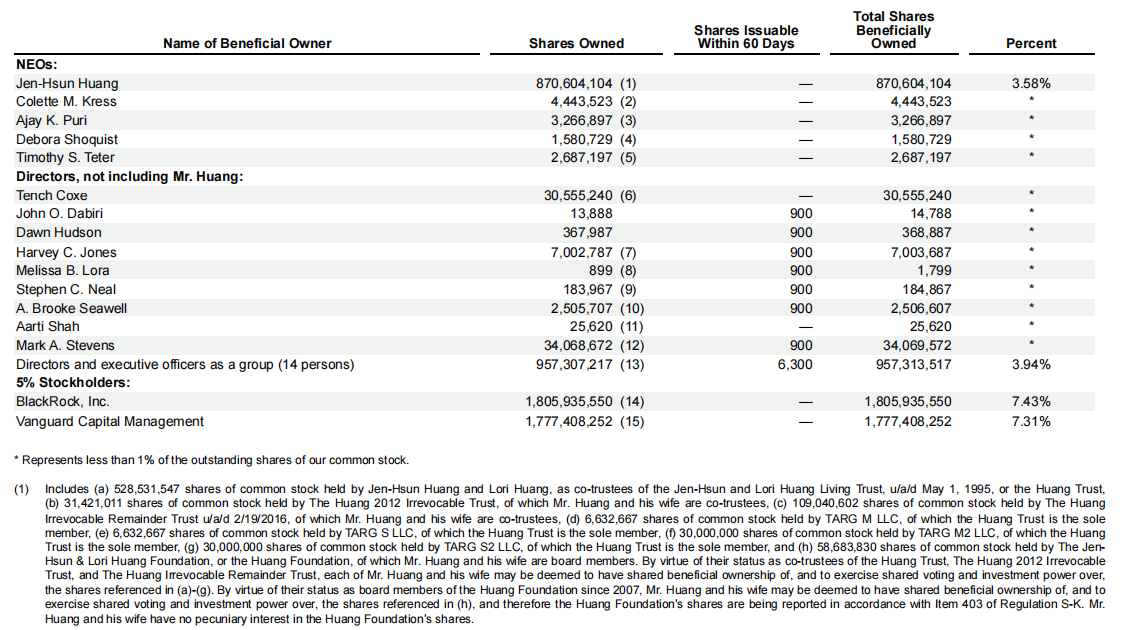
- The Jensen Huang and Lori Huang lifetime trust (the "Huang family trust") holds 528.5 million common shares — 60.7% of the shares under his control, with Huang and his wife acting as co-trustees.
- The Huang irrevocable remainder trust, the Huang 2012 irrevocable trust, TARG M LLC, TARG S LLC, TARG M2 LLC and TARG S2 LLC hold 213.7 million common shares between them; each is either managed by the couple as co-trustees or has the Huang family trust as its sole member.
- The Jensen Huang and Lori Huang Foundation holds 58.6838 million shares, with Huang and his wife serving on its board.
- Through these arrangements, the couple hold joint beneficial ownership and joint voting and investment power over 801 million shares — roughly 92% of everything Huang controls.
- The gap between 870.6 million and 801 million is 69.66 million shares, which is the ceiling on his directly held personal stake at the time of disclosure.
Huang and Lori Huang married before Nvidia was founded in 1993. If the marriage ends, how those shares are partitioned becomes the main variable for control. There is currently no public evidence that Lori Huang has ever individually influenced Nvidia's director elections or split with Huang on major shareholder decisions; how co-trustees settle votes and investment calls depends on the specific trust agreements. There is likewise no public evidence that this episode has altered the couple's marriage, their family trusts or their voting arrangements.
Which control model would have blunted this? A comparison
Conclusion: every large-founder company picks one of three control architectures, and each one trades something away. Nvidia's is the most accountable to outsiders and the least protected against a personal shock.
| Control model | How the founder keeps the wheel | Main advantage | Main exposure under stress | Real-world reference |
|---|---|---|---|---|
| Dual-class shares (high-vote / low-vote) | Super-voting stock concentrated in the founder | Personal scandals and market pressure rarely move control | Shareholders cannot correct a founder error at the ballot box | Meta: proxy filings show roughly 60% of total voting power with a low-teens economic stake |
| Family trust plus coordinated voting | Shares bundled in lifetime and irrevocable trusts, foundations and LLCs | Control survives generations, and often divorces, if the documents say so | Terms are private; outsiders cannot see the trigger points | Amazon: the April 4, 2019 Form 8-K reported a divorce transfer of roughly 4% of the shares while voting stayed with the founder |
| Dispersed single-class ownership | Reputation, board design, a flat organisation, one share one vote | Clean for index funds, easy to hold managers accountable | A key-person event has no buffer and no announced heir | Nvidia today |
Two research points explain why the trade-off matters. A Holladay Securities briefing on dual-class structures (May 2023), citing Anderson, Ottolenghi and Reeb (2017), found that founding families control 89% of dual-class companies versus 28% of single-class ones — concentrated structures are family structures by design. The Harvard Law School Forum on Corporate Governance argued on February 11, 2025 that dual-class shares limit shareholders' ability to weigh in on pay and other votes. Nvidia rejected that protection in advance, which is why a personal matter now raises a control question at all.
Who else sits on the register, and can outsiders act?
Conclusion: two index giants are the only holders above 5%, and neither is a natural kingmaker — which is exactly why the board, not a shareholder, is the pivot.
Insider ownership is thin. The only shareholders above 5% are institutional holders BlackRock, Inc. and Vanguard Capital Management, at 7.43% and 7.31% respectively. Among the 5 named executive officers, the other 4 each hold less than 1% of outstanding common stock. Nvidia has no chief operating officer; the company employs more than 40,000 people in a deliberately flat structure where dozens of direct business heads report to Huang himself.
The board is built around him by design. Nvidia has no chairman; apart from Huang, every director is independent, and the independent directors designate one independent lead director. Huang is the only operating manager on the board. There are now 11 directors, against 10 at the time of the May disclosure, and all were re-elected at the June shareholder meeting. The 9 directors other than Huang each hold under 1% of shares; the largest holding among them belongs to independent director Mark A.Stevens, with 34.0696 million shares.
The disclosure machinery is public, and that sets the practical perimeter. The SEC requires anyone crossing 5% of a voting class to report on Schedule 13D or 13G, and outside counsel such as Skadden has noted that the initial 13D window has been shortened from 10 calendar days since the October 2023 amendments. So a would-be challenger shows up on the register before acting — the same visibility that let an activist try once already.
Nvidia has met the "barbarians at the gate" before. In 2013, when the company was spread across several markets, the activist hedge fund Starboard Value sent the board a letter questioning whether Huang was steering the company toward ruin. He took the advice of Starboard's chief investment officer and exited the modem market, yet still lobbied multiple institutional investors to back spending on CUDA. In the end, outside investors did not set the company's business direction. Nvidia is the world's largest AI chip company and the standard-bearer for AI infrastructure build-out, and within the United States tech ecosystem no competitor has matched it to date — which is why the open question stings. Whether the same shield holds if Huang's stake and title both shift, with the successor question still unresolved, is the scenario markets are now pricing.
Three scenarios, compared by likelihood signal and cost
Conclusion: the disclosed facts support a narrow range for the next quarter and a wide range for the next decade. The following is our reading of the published structure — an analytical framework, not a forecast or inside information.
| Scenario | What it looks like | Early signals to watch | Cost if it happens |
|---|---|---|---|
| A. Review closes, nothing moves | Investigation ends with governance findings; Huang stays CEO; holdings unchanged | No amended trust filings; no change in director nominations | Reputational discount only; AI infrastructure roadmap uninterrupted |
| B. Equity splits, votes stay bundled | Marriage ends but co-trustees keep joint voting and investment power over 801 million shares | Form 3/4/5 activity, amendments naming new trustees, sale windows | Control intact, but a large block could surface for sale — the Amazon playbook |
| C. Leadership change with no named heir | Board must promote from a flat bench of dozens of business heads | Creation of a COO-type role; expanded remit for the independent lead director | Highest risk: strategy is set by one person, and no successor plan is disclosed |
On succession, Huang has been explicit — and explicitly against planning. In a podcast interview in March this year he said he had publicly stated that he does not trust succession plans; rather than worry about it, he prefers to break problems down and stay in the present. If people care about the company's future, he argued, the answer is to pass on knowledge, information, insight, skills and experience as frequently and continuously as possible. His stated goal is to work in the job until the last day of his life.
Common misconceptions in this story
- "A CEO can be removed by the biggest shareholder." BlackRock, Inc. at 7.43% and Vanguard Capital Management at 7.31% are index managers, not controlling shareholders. Directors are elected by all shareholders; the board, not one fund, appoints the CEO.
- "3.58% means he barely controls anything." The votes that matter are the 801 million shares held jointly in family vehicles — the economic stake is small, the coordinated bloc is not.
- "A divorce automatically changes who runs Nvidia." Ownership and voting are separable, as the Amazon precedent shows. Nothing public indicates a change in the Huang family trust terms.
- "An investigation means the board suspects misconduct in the business." The company has said there is no reason to doubt his leadership; the review is being run by independent directors with external counsel.
- "A flat organisation is a bench." Dozens of direct reports is a span of control, not a pipeline of tested successors.
What general readers should watch next: a five-point checklist
- Filing, not headline. Watch Nvidia's next SEC disclosure for changes in trust entities, joint voting arrangements or board composition; those are the only reliable control signals.
- Structure, not statements. A single new operating role above the dozens of business heads, or the creation of a COO seat, would say more about succession than any press release.
- The bench that is visible. Nvidia's product and marketing leadership has its own public tests — our report on Madison Huang's last-minute Korea pull-out before Nvidia's Seoul AI Day shows how one absence becomes a succession talking point.
- Price context. Governance worry lands on shares that were already weak; our comparison of the buyback argument versus policy risk after the nearly $1.4 trillion slide sets the market backdrop.
- Scenario mapping. If the outcome matches Scenario A, treat it as noise. Scenario B is an ownership question. Scenario C is a strategy question — and the one retail investors cannot hedge at home.
Frequently asked questions
Does Jensen Huang still run Nvidia?
Yes. On November 8 local time the company confirmed he continues as CEO without interruption, while a committee of independent directors and outside independent legal counsel examine the matter.
How much of Nvidia does he actually own?
Per the filing made with the U.S. Securities and Exchange Commission in May this year, he held 870.6 million common shares, 3.58% of the company, as of March 23, 2026 — at most 69.66 million of which were held directly rather than in family vehicles.
Could BlackRock or Vanguard install a new CEO?
Not directly. Both are holders above 5%, at 7.43% and 7.31%, but CEO appointment is a board decision, and Nvidia's board has no chairman, with all members except Huang being independent.
What would a divorce change?
It would put share partition into play for the first time in the company's modern history. Whether control changes depends on the trust documents — jointly held 801 million shares and about 92% of what Huang controls — not simply on who ends up with the stock.
Has Nvidia faced outside pressure before?
Yes. In 2013 the activist fund Starboard Value wrote to the board challenging the company's direction. Huang exited the modem market but kept institutional backing for CUDA, and outside investors did not take the strategy wheel.
Sources
- Bloomberg, "Nvidia Lacks Clear Successor for Superstar CEO Who Built Company" (January 27, 2026)
- MarketWatch, coverage of the Nvidia board investigation and Bernstein analyst Stacy Rasgon's note (November 9, 2026)
- SEC, "Officers, Directors and 10% Shareholders" — Schedule 13D/13G reporting at the 5% threshold
- Meta Platforms proxy materials filed with the SEC (April 2026) on dual-class voting power
- Amazon.com Form 8-K filed April 4, 2019 on the divorce-related share transfer
- Holladay Securities, "Dual-Class Stock Structures" (May 2023) and the Harvard Law School Forum on Corporate Governance essay of February 11, 2025
This comparison is based on Nvidia's public disclosures and reporting available as of November 9, 2026. It is analysis of a governance structure, not investment advice.