
Sogou Wenwen Shuts Down Today: ItInsightsWorld Compares Points, Data and What to Use Next
Short answer: today the Q&A community Sogou Wenwen and its companion store, Wenwen Mall, stop running at 23:59 on November 7, 2026. Pages go dark, user accounts are cancelled automatically, the points exchange closes with them, and anything you never copied is deleted or anonymised under applicable rules. The useful verdict is not sentimental. It is a three-part one: what you can still save, what is already unrecoverable, and which type of answer source fits the question you will ask next.
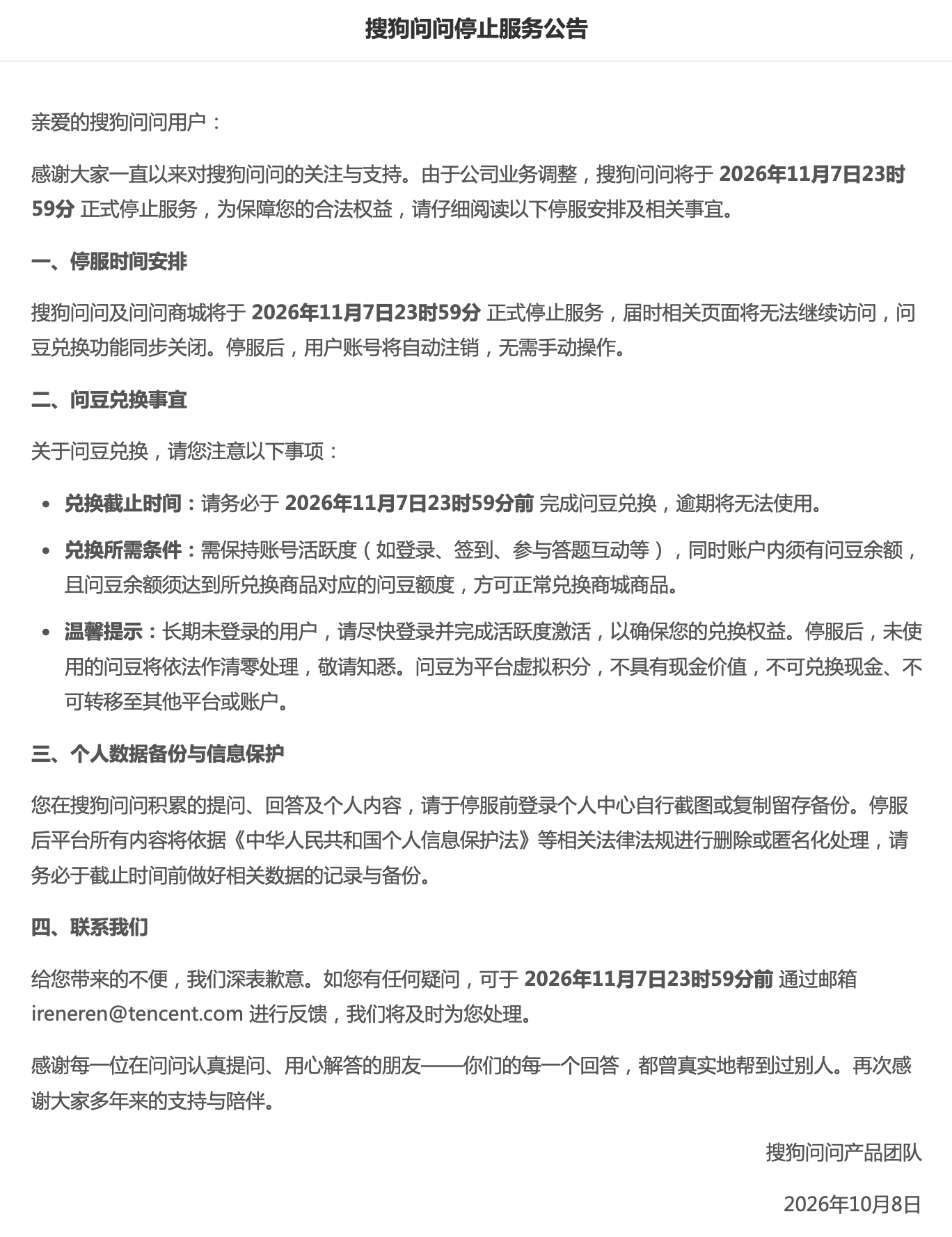
What exactly stops, and what happens to each thing you had there?
The Sogou Wenwen product team published a service discontinuation notice attributing the closure to a company business adjustment: Sogou Wenwen and Wenwen Mall formally stop at 23:59 on November 7, 2026. Read as an asset inventory rather than a news item, that single sentence covers four different outcomes, and each one has a different recoverability.
| Asset you held | Status after the cut-off | Recoverable later? | Action that mattered before the deadline |
|---|---|---|---|
| Wenwen points balance | The points exchange feature closes together with the platform | No. Unused balances are cleared in accordance with law after the deadline | Keep the account active and redeem any balance before 23:59 on November 7, 2026 |
| User account | Cancelled automatically, with no manual step required | No reactivation path was published in the notice | Nothing to do — but note that "automatic" also means "no confirmation email" |
| Your questions, answers and profile content | Related pages become inaccessible | Not from the platform: content is deleted or anonymised under applicable regulations, which coverage of the notice tied to the Personal Information Protection Law | Screenshot or copy from the personal centre and store it outside the platform |
| Wenwen Mall listings and redemption history | The mall shuts at the same minute as the community | No | Export receipts or order screens if you ever need proof of participation |
Two distinctions are worth memorising, because they generalise to every account-based service. First, the notice states plainly that Wenwen points are virtual platform credits: they could not be exchanged for cash or transferred, so closing the exchange is not a refund event and there is no claim to file. Second, an automatic account cancellation is a privacy convenience for you and a data-loss event for your archive at the same time — nobody will ping you when it completes.
Why did a community with more than 700 million users stop answering?
The timeline is the least disputed part of the story, and it explains the shrinkage better than any internal post-mortem.
- 2007 — the product launches as Tencent SOSO Wenwen, a human-answered question board attached to a search box.
- 2014 — during the Sogou integration it is renamed Sogou Wenwen.
- Growth engine — the community rides the QQ account system, which converts login friction into network effects.
- 2021 — Sogou is folded back into Tencent, with the going-private merger completing on September 24, 2021.
- 2025 — the platform reports more than 700 million users and more than 260 million questions solved.
Between that 2025 scale and an October 12, 2026 shutdown notice sits a change in the answer market, not in the user count. The 57th statistical report on internet development released on February 5, 2026 by the China Internet Network Information Center counted 602 million generative AI users by December 2025, up 141.7% from the end of 2024, at 42.8% penetration, inside a total population of 1.125 billion internet users. Our reading of the comparison is structural: a human answer arrives in hours and decays in public view, while a model answer arrives in seconds and never waits for a stranger. Q&A platforms did not lose the argument; they lost the queue.
One caution on the headline number. Figures such as "more than 700 million users" in legacy community announcements typically describe cumulative reach rather than monthly actives, and no concurrent-active series was published alongside this one. Treat the 700 million as an install-base memory, not as a live audience — this is our interpretation of the disclosure, not a claim made by the platform.
The same consolidation logic shows up in enterprise software: our review of the year martech stopped growing tracks how a catalogue of 15,505 products can expand almost not at all while individual tools still vanish, which is the pattern ordinary users experience as "my site disappeared".
How does this sunset compare with the other 2026 shutdown notices?
Placing Sogou Wenwen beside a second, almost simultaneous retirement inside the same company makes the decision rules clearer than any single announcement can.
| Case | Notice published | Service stops | Window for users | What had to be moved |
|---|---|---|---|---|
| Sogou Wenwen and Wenwen Mall | October 12, 2026 | November 7, 2026 | About 26 days | Personal text and images, copied by hand |
| Tencent's Yuanqi no-code agent platform | October 8, 2026 | November 9, 2026 | About 32 days | Working agents and their configurations, rebuilt elsewhere |
| Regulatory reference point | China's telecom business licensing measures require an operator that will not continue a licensed business to report to the original issuing authority at least 90 days in advance and handle user aftermath — a filing duty owed to the regulator, not a user-facing grace period | |||
Three lessons fall out of the comparison. Notice length is set by business convenience, not by the volume of what you stored. Content-type losses (posts, points) are unrecoverable by design, while work-product losses (agents, configurations, documents) can be rebuilt if you exported the recipe early. And the platform's own exit rarely tells you where the surviving copy lives. A writer covering the agent-platform closures put it in one quotable line: building on a vendor's platform is "a tenancy, not ownership" — the same sentence applies to a decade of accepted answers.
Where should your question go next: community, AI engine or your own archive?
There is no universally best successor, only a best fit per question type. This is the trade-off grid we would hand to a non-specialist.
| Dimension | Legacy Q&A community | Generative AI answer engine | Your own archive |
|---|---|---|---|
| Time to first answer | Hours to days, and today: none | Seconds | Instant, if you indexed it |
| Provenance | Named humans, dated replies | Requires manual source checking | Full provenance, including your own context |
| Lifespan of the record | Until the operator adjusts its business | Chats may be purged or model-changed | As long as you maintain it |
| Control over personal data | Platform decides deletion rules | Provider policy decides | You decide |
| Best suited to | Niche lived experience, edge cases, local knowledge | Definitions, comparisons, first drafts, troubleshooting checklists | Repeated decisions, credentials-adjacent notes, family or work history |
| Weakness | Slow, shrinking supply of answerers | Confident tone is not evidence | Invisible unless searched |
Decision advice, condensed into three rules. Use an AI engine when the question has a correct answer that already exists somewhere in text. Keep hunting human communities when the question is "what did it feel like" or "what breaks in year three", which is exactly the content type that made the old boards worth keeping. And never let either be the only copy of something you would hate to lose.
Account-level risk is the same lesson in a different wrapper. Our explainer of Apple's iOS 27.3 iCloud link checks walks through how a public sharing setting can turn into content deletion or account restriction — a reminder that the storage layer you assume is neutral is also governed by someone else's rules.
Five misconceptions that make shutdown news harder than it needs to be
- "My points are money, so they can be redeemed later." The notice defines Wenwen points as virtual platform credits that cannot be converted to cash or transferred; after the deadline they are cleared.
- "Automatic cancellation means somebody deleted my data safely for me." Deletion or anonymisation is performed under applicable regulations on the platform's schedule; what you personally wanted to keep was always your job to copy.
- "Screenshots are enough for everything." They preserve visible text but not links, thread structure, dates of acceptance or anything behind a page you never opened.
- "A 700-million-user product is too big to die." Cumulative reach measures history, not current dependence; the closure is justified by a business adjustment, not by a user vote.
- "This is the end of asking strangers online." What is ending is waiting for them. Human answers increasingly live inside niche forums, chat groups and review sections rather than general-purpose boards.
Action checklist: what to do in each window
If you still have access before 23:59 on November 7
- Redeem any Wenwen points balance while the exchange is open; assume no post-deadline exception.
- Copy, do not just view: accepted answers you wrote, questions you solved, and any thread you cite in work or study.
- Save receipts or order screens from Wenwen Mall if you ever need proof of participation.
- Write the export down: one folder, one dated filename, one line of context per item, so the archive stays searchable after the original page is gone.
If the window has already passed
- Check the paper trails you control: email notifications, forum reposts, bookmarks with cached descriptions, and any document that quoted your own answers.
- Rebuild the shortlist of questions you actually needed answered, then route each one to the column above that fits it.
- Set a personal exit review for every free account you hold: one sentence on what you would lose and how you would carry it out, ninety seconds per service.
- Treat future points, streaks and badges as marketing, not as assets — the test is whether they survive a business adjustment.
FAQ: what readers ask after a discontinuation notice
When did the service actually stop?
At 23:59 on November 7, 2026, according to the notice from the Sogou Wenwen product team, with Wenwen Mall closing at the same minute.
Can I still turn my Wenwen points into cash?
No. Points are virtual platform credits, were never cashable or transferable, and the exchange closes with the service; unused balances are cleared after the deadline under applicable rules.
Will my old answers still appear in search results?
Expect the official pages to become inaccessible and the stored content to be deleted or anonymised. Search snippets and third-party reposts are outside the platform's control, so they may linger — which makes them an unreliable substitute for your own backup.
Does automatic account cancellation need any action from me?
No manual step is required, and that is precisely the trap: nobody is prompted to confirm, so the last moment to export is the moment before 23:59 on November 7, 2026.
Is this proof that human Q&A is dead?
It is proof that one distribution model is dead. With 602 million generative AI users counted by December 2025, the waiting-for-a-stranger model is the losing side of the queue, while lived-experience questions still get answered where communities are small enough to matter.
Bottom line: the reusable framework
Read a shutdown notice in four moves, and you rarely need the news cycle to explain it to you. One: list the assets — balance, account, content, records. Two: sort them into refundable, transferable and disposable, noting that virtual credits almost always fall in the last bucket. Three: measure the notice window in days and decide what you can realistically export inside it. Four: ask which layer you actually controlled — interface, storage or policy — because only the layer you own survives a business adjustment. Today that framework costs a generation of saved links; next time it can cost you ninety seconds.
Sources
- Service discontinuation coverage and notice details, Sina Finance, November 7, 2026: finance.sina.cn
- China Internet Network Information Center, 57th statistical report on internet development, released February 5, 2026 (user and generative AI figures), as summarised by Cailian Press: cls.cn
- Completion of the Sogou going-private merger with Tencent, September 24, 2021: techinasia.com
- Telecom business licensing measures on advance reporting when a licensed operation is not continued: moj.gov.cn
- Tencent Yuanqi agent platform discontinuation notice and analysis: pulse.adyog.com