
After the $11.4 Million NVIDIA Freight Loss: A Practical Checklist for Shipping AI Hardware | ItInsightsWorld
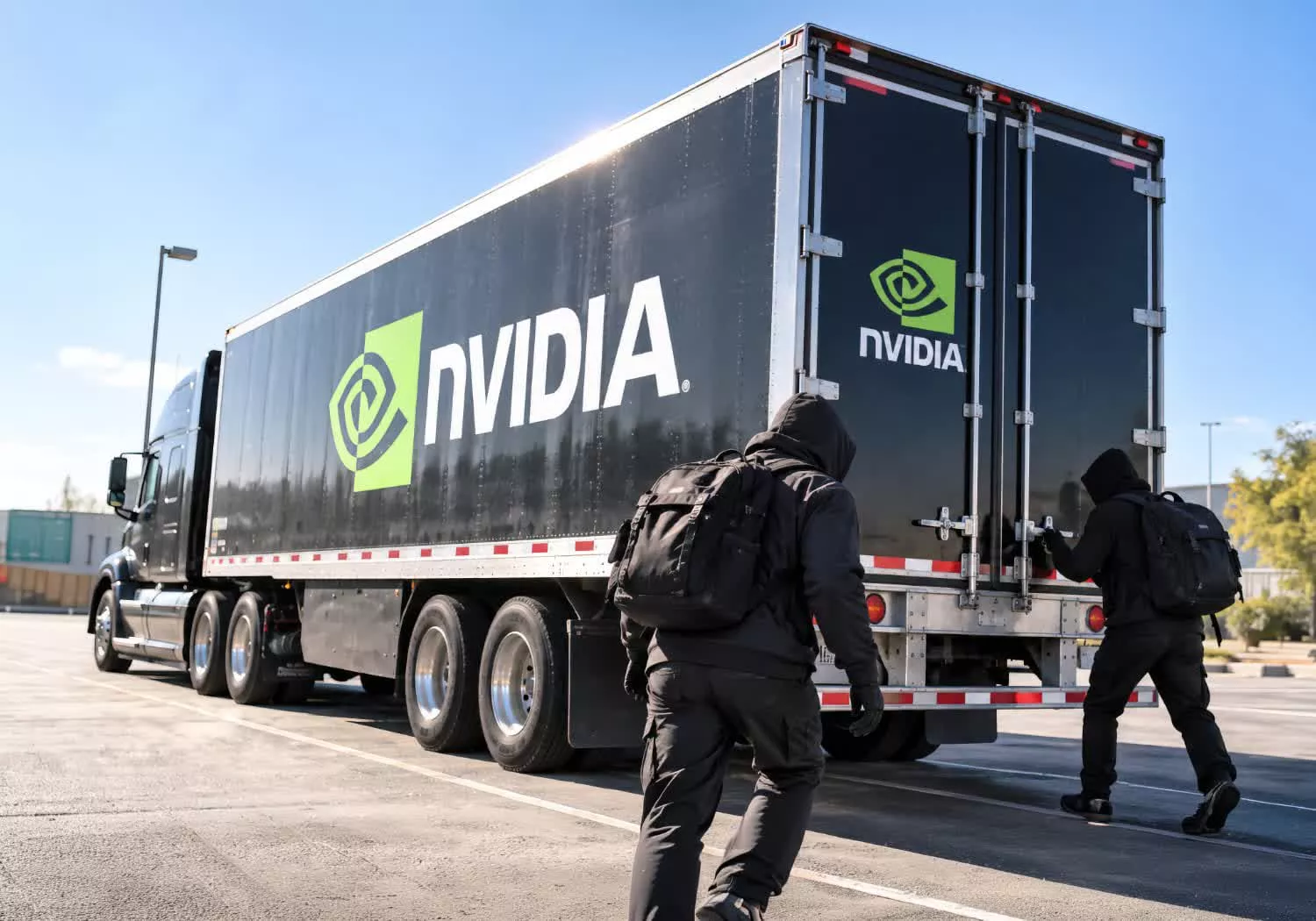
A load of NVIDIA AI hardware worth approximately $11.4 million vanished in the United States after a truck collected six pallets in Oakland on 2026-08-29 for a run to Fort Worth, Texas; the vehicle, the driver and the cargo were never located, and police in California have made no arrests. The practical lesson for anyone moving valuable compute is blunt: paperwork that looks correct is not proof of a legitimate carrier, and the hours between "the truck is quiet" and "we file a report" decide whether anything comes back.
What exactly disappeared on the Oakland-to-Fort Worth lane?
Short answer: a shipment handed over through the normal, scheduled process. California police are investigating a case in which freight declared for a run from Oakland to Fort Worth, Texas never arrived. The facts released so far are narrow, and they belong in one place, because the gaps matter as much as the confirmations.
| Element | Position in the record |
|---|---|
| Cargo | Six pallets of NVIDIA AI hardware, declared value approximately $11.4 million |
| Pickup | 2026-08-29, collected in Oakland exactly as scheduled |
| Vehicle | Truck carrying the livery of a food-haulage company; visually no different from ordinary commercial freight equipment |
| Destination | Fort Worth, Texas |
| First sign of trouble | Early September, when the buyer confirmed the equipment had never arrived |
| Last tracked position | Near San Bernardino County, California, after multiple long roadside stops |
| Formal theft report | Oakland police received the grand-theft report on September 13 |
| Open questions | Exact models, whether the load was GPUs, AI servers or other data-centre hardware, and whether it was broken up for resale |
The absence of a model list is not a small detail: it means the resale value, the export-control exposure and the recovery strategy are all still unknown, even though a declared value of about $11.4 million already signals an unusually large single-vehicle load.
Why does a "paperwork-perfect" pickup keep working?
Because the theft happens in the identity layer, not at the loading dock. Investigators have not published whether this pickup involved a hijacked or forged carrier identity, but the pattern — a compliant appointment, an ordinary-looking truck, then a vehicle that drops off the dispatch grid — is the signature of what U.S. authorities now call strategic cargo theft.
The numbers behind the shift are public. Verisk CargoNet's annual analysis put estimated 2025 cargo-theft losses in the United States and Canada at nearly $725 million, a 60% rise on 2024, with confirmed thefts up 18% to 2,646 and the average stolen load valued at $273,990, up 36% from $202,364. A smaller set of criminals is simply taking far more expensive freight. The FBI's Internet Crime Complaint Center reinforced the point in a public advisory issued 2026-04-30, "Cyber-Enabled Strategic Cargo Theft Surging", which describes fraud and deception used to trick shippers, brokers and carriers into handing cargo over.
Regulators have responded at the registration end: the Federal Motor Carrier Safety Administration now routes new USDOT registrants through identity proofing and verification, precisely because imposters had been able to obtain or copy operating authority and appear legitimate in official records. That change helps, but it does not protect a dock that only checks the name on a pickup email.
Why is AI hardware the preferred prize right now?
Demand plus restricted supply creates a resale spread that organised crews can monetise quickly. NVIDIA's advanced AI accelerators are wanted far beyond what legal channels in some markets can supply, and U.S. export controls on certain high-performance chips and servers mean the same equipment can command a much higher price outside the United States.
Olaf Groth, a professor at the Haas School of Business at the University of California, Berkeley, put the gap in concrete terms: some high-end chips sell for about $550,000 in the U.S. market but can fetch $1 million or more overseas. For a criminal group, that is a margin that justifies planning, inside access and multi-state transport. U.S. law-enforcement findings cited in the reporting suggest some stolen equipment leaves the country through grey-market channels; there is no evidence that this $11.4 million load was moved to China or to any other specific country.
The same squeeze that drives resale prices is visible in ordinary procurement too — the supply-and-regulation distortion is why the RTX PRO 5500 now lists above the RTX PRO 6000. Scarcity, not model tier, is what thieves are pricing.
What criminal tactics are already standard?
- Convoy disruption. WIRED magazine has reported crews attacking the escort vehicles hired to protect high-value freight. In two California cases, thieves allegedly forced private security vehicles off the road through deliberate rear-endings or ramming, after which the load truck left the monitoring grid and disappeared.
- Identity fraud. Groups pose as legitimate transport companies to win haulage contracts for valuable freight, then vanish with the appointment they were legally given.
- Position spoofing. Investigators have documented GPS deception used to jam or falsify telemetry, so neither the broker nor the police can trust the last known location.
- Brand-driven targeting. In September this year, thieves stole two trailers marked with the NVIDIA and autonomous-trucking company PlusAI logos expecting expensive GPUs; the trailers carried sand used to simulate freight weight, roughly 20,000 pounds each and about 40,000 pounds in total — a reminder that branding alone now attracts risk even when hardware worth hundreds of thousands of dollars is nowhere aboard.
- Repeat pressure on the same lanes. In 2025, police in Fremont and Union City, California investigated multiple theft cases involving NVIDIA goods with losses exceeding $7.5 million; investigators suspect crews first acquire vehicles in Southern California before striking in the Bay Area.
- Inside help. A theft of roughly $470,000 in RTX 5090 cards at Brazil's Guarulhos airport led police to identify three employees who allegedly assisted the take, and one stolen card was later traced online through its serial number.
How do you actually protect a load: a 12-step checklist
Use this as a pre-shipment gate for any consignment where one truck can represent millions or even tens of millions of dollars.
- Match the appointment to the carrier of record: confirm the operating number, the vehicle and the named driver against the dispatch file, not against an emailed confirmation.
- Call back using the telephone number on file with the federal registry, never the number printed on the pickup request.
- Photograph driver identity, plate and seal at the dock, and store the images with the shipment record.
- Read the seal number aloud, log it, and refuse release on any mismatch.
- Split consignments across vehicles when delivery windows allow, so no single truck holds the entire declared value.
- Run two independent location sources: carrier telematics plus a hidden, battery-powered tracker inside the pallet stack that keeps reporting when the truck's system goes dark.
- Set geofence and dwell-time alerts with a named human on-call, and treat route deviation as an escalation trigger rather than a curiosity.
- Pre-approve every parking and rest stop; treat any unplanned long stop as a security event.
- Ship blind: remove cargo-identifying branding from trailers and paperwork wherever commercial terms permit.
- Record serial numbers at pallet level before departure, so recovered or resold units can be matched later.
- Align the lane with a recognised standard such as TAPA's Trucking Security Requirements instead of ad hoc rules, so the controls are auditable and transferable between logistics partners.
- Confirm in writing who reports what, and to whom, when a load goes silent — escalation to the owner's security contact, not only the broker's dispatcher.
Which security model fits your shipment?
This comparison is our own reading of how the three common setups behave against the Oakland pattern; it is analysis, not a vendor claim.
| Dimension | Standard brokered freight | Standards-aligned transport (TSR-style) | Guarded convoy |
|---|---|---|---|
| Carrier verification | Documents and email confirmation | Registry callback, driver ID logging, audited records | All of that plus pre-vetted crews |
| Tracking in transit | Carrier GPS only | Dual devices, geofence and dwell alerts | Escort vehicles with radio comms |
| Stopping discipline | Driver discretion | Pre-approved stops only | Controlled stops, no solo parking |
| Where it fails | Fictitious pickup with valid paperwork | Inside information leaks about the appointment | Forced disruption of the escort |
| Best fit | Low-value, high-volume freight | Multi-million-dollar AI hardware moves | Prototype, single-source or export-controlled items |
Five misconceptions that cost money
- "The appointment was on the schedule, so the truck was vetted." A compliant pickup is exactly what a fictitious driver needs.
- "We have GPS, so we have visibility." Position spoofing and unplugged devices are documented tactics.
- "Only the biggest shippers are targeted." Crews scale the same script to smaller loads; average theft value is climbing, not falling.
- "Recovered goods always come back intact." Serial logs and marketplace alerts are what turn a recovery claim into something provable.
- "A police report filed after the delivery deadline is fine." Oakland's report landed on September 13 for an August 29 pickup; that gap is the difference between a live trail and an archive search.
What to do in the first 24 hours when a load goes quiet
- Contact the carrier through its registry-listed number and the driver directly; do not reply into the email thread that booked the load.
- Ask the origin dock to confirm who actually took the freight and against which seal number.
- File a police report the same day the suspicion crystallises, and record the report number in the shipment file.
- Push the loss into industry theft-bulletin channels so resale and re-export attempts surface faster.
- Notify insurers and brokers in parallel, and ask specifically how the policy treats a fraudulent pickup rather than a physical break-in.
- Freeze documentation: transport management logs, appointment records, telematics raw data, dock photographs.
- Issue the serial-number list to major resale channels and authorised partners.
- Review the next two or three scheduled loads on that lane — crews rarely run a single event.
FAQ
Was the NVIDIA truck hacked or simply impersonated?
Unproven. Authorities have not published the method, whether the food-haulage branded vehicle was running a stolen identity or was itself stolen, or whether the load was split up. Treat any version of the story as unconfirmed.
Do stolen AI chips always leave the country?
Not always. Grey-market export is profitable because overseas prices can be far higher, but the same hardware is also dismantled and resold domestically. No evidence ties this particular cargo to any destination.
Should an enterprise stop moving high-value compute by road?
No — it should move it differently. The controls that work are procedural and cheap relative to the load value: callback verification, dual tracking, blind shipping and a same-day reporting rule.
What should a buyer of discounted GPUs watch for?
Serial numbers. In the Brazil airport case, a single resold card was identified by its serial. If a seller will not show an intact serial, or the price sits far below market with no invoice trail, assume the provenance is unverifiable.
Who bears the loss when a pickup turns out to be fake?
It depends on the transport contract, the broker's authority to subcontract, and which policy responds. Confirm this in writing before the first load, not after the truck is missing.
Action plan for this week
- Pick your three most valuable outbound lanes and apply the checklist's first four steps immediately: verification, callback, dock photo, seal log.
- Buy and place independent trackers inside the pallet stack; do not rely on carrier telematics alone.
- Write a one-page "silent load" escalation card with names, phone numbers and a reporting deadline measured in hours.
- Strip cargo branding from any trailer that repeatedly runs AI-infrastructure routes.
Sources
- Verisk CargoNet, 2025 annual cargo-theft analysis — cargonet.com
- FBI Internet Crime Complaint Center, "Cyber-Enabled Strategic Cargo Theft Surging" public advisory, 2026-04-30 — ic3.gov
- Federal Motor Carrier Safety Administration, registration identity-proofing notices — fmcsa.dot.gov
- TAPA, Trucking Security Requirements 2026 standard — tapaemea.org
- Tom's Hardware reporting on the Guarulhos airport RTX 5090 theft and serial-number trace, October 2026 — tomshardware.com
- Case facts: Oakland police statements and U.S. media reporting carried in the parent report
Prepared by the IT Insights editorial desk for ItInsightsWorld. Questions, or a lane you want reviewed: contact@itinsights.com.