
Why Nvidia's RTX PRO 5500 Outprices the RTX PRO 6000: An ItInsightsWorld Explainer
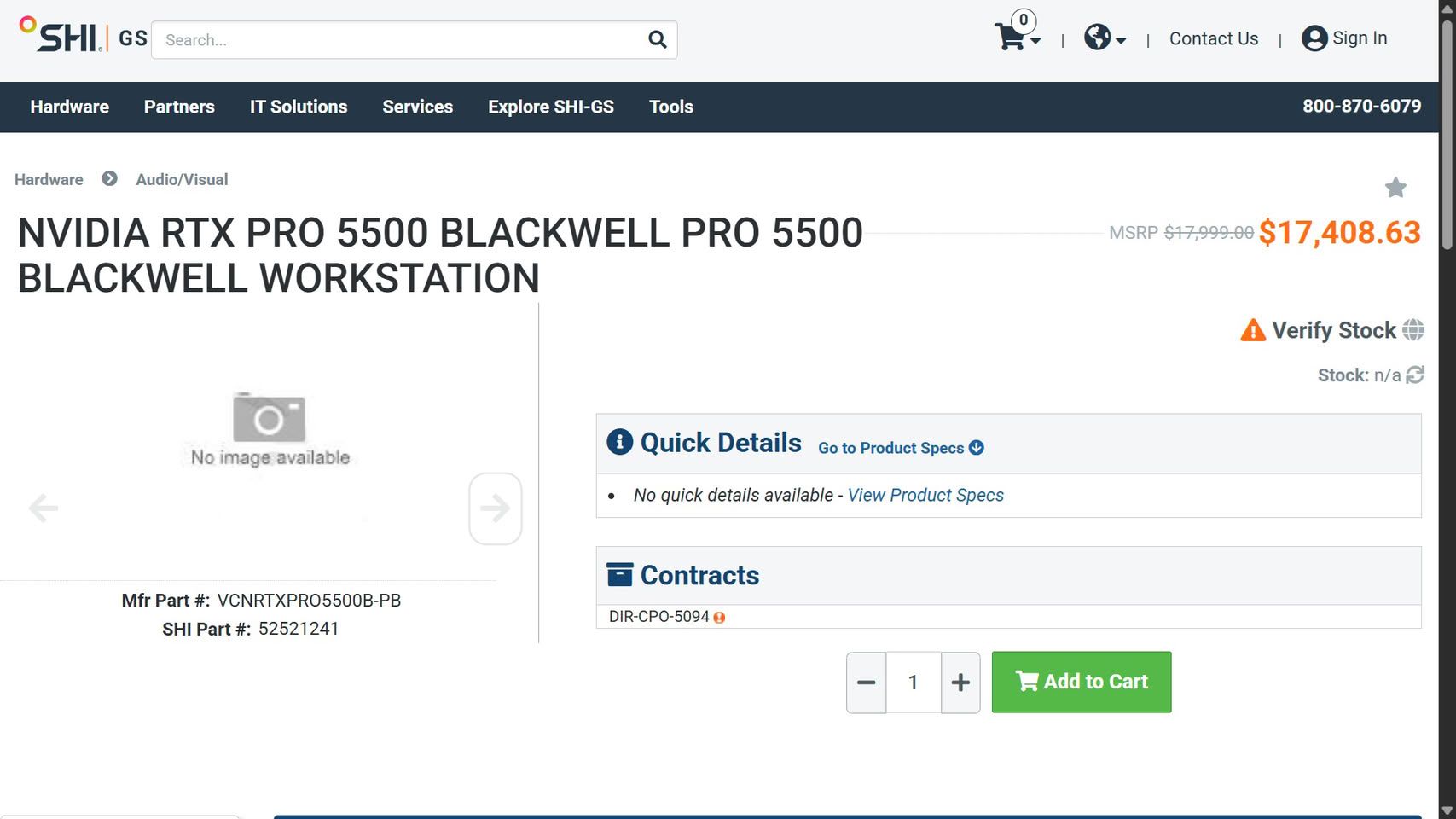
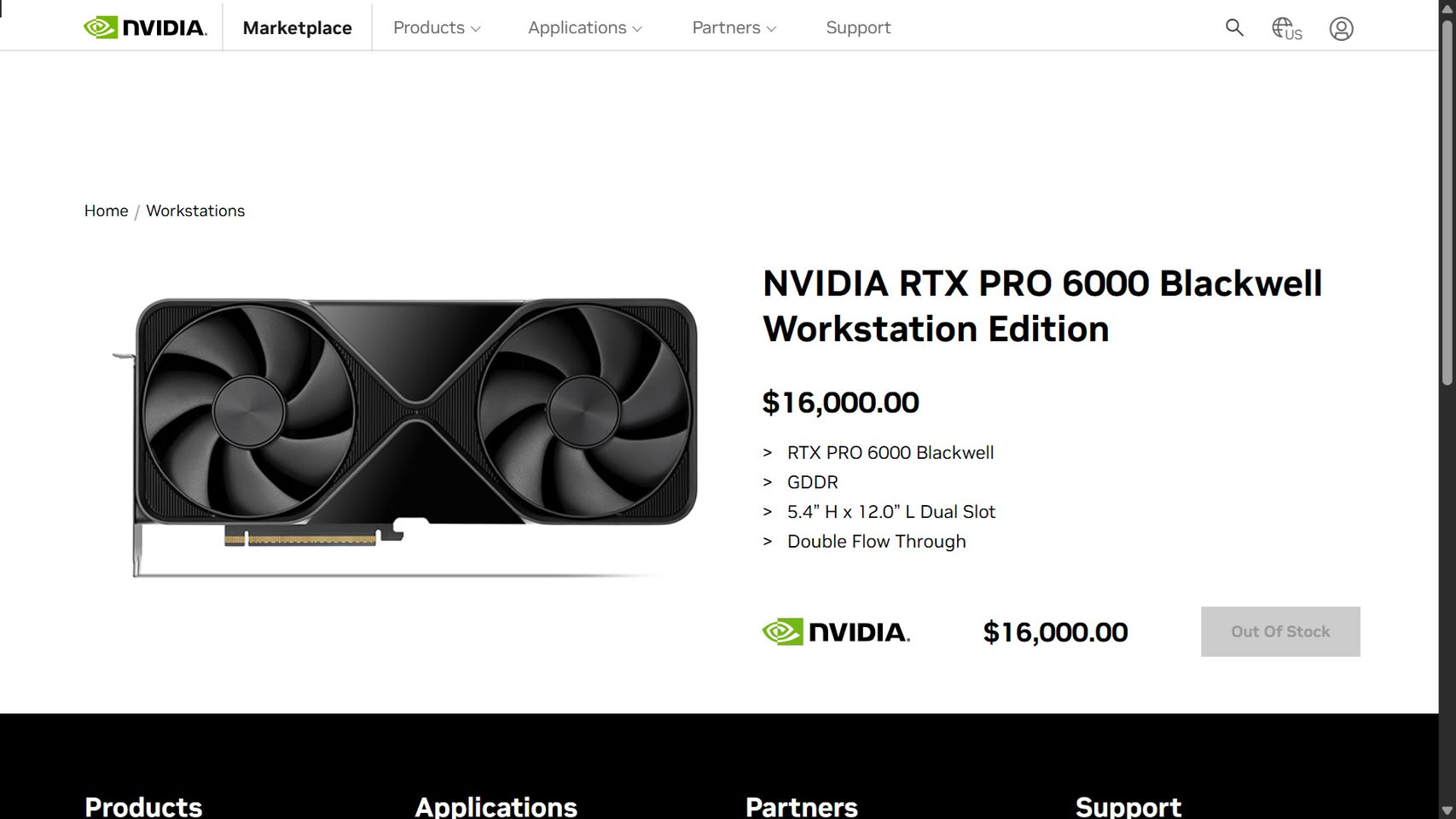
Short answer first: buyers are not paying for more silicon, they are paying for a shipping slot. A PNY-built RTX PRO 5500 Blackwell Workstation Edition is listed at 17999 USD by US reseller SHI, and a roughly 3.3% discount brings the transacted figure to 17408.63 USD — about 1409 USD above the 16000 USD that Nvidia's US online store puts on its flagship RTX PRO 6000 Blackwell Workstation Edition. Fewer CUDA cores, less memory, higher price. The inversion is a supply signal, not a performance story.
Below is a plain-language breakdown aimed at readers who do not follow GPU roadmaps for a living: what is actually being quoted, how the two cards compare, why export rules and China demand flipped the price ladder, and what judgement you can take from it.
Five things to know in 30 seconds
- The 17999 USD number is a reseller listing for part number VCNRTXPRO5500B-PB, not a published Nvidia price.
- On paper the higher card wins: RTX PRO 6000 has 24064 CUDA cores and 96GB GDDR7 ECC against 21760 cores and 84GB with 416bit memory.
- China demand is the swing factor. Reuters reported that ByteDance, Alibaba and Tencent alone ordered more than 3 million units at about 11400 USD per card.
- Reported Chinese orders may run past 6 million units while planned output is around 3 million units in 2027.
- For anyone budgeting AI hardware, availability is quietly becoming a priced feature, alongside specs and brand.
What exactly is being sold for 17999 USD?
Conclusion: the quote is genuine, but it is market evidence rather than manufacturer intent.
The listing shows the PNY version of the RTX PRO 5500 Blackwell Workstation Edition. SHI displays a suggested retail price of 17999 USD, with roughly 3.3% off, landing at 17408.63 USD. For comparison, Nvidia's US online store currently prices the flagship RTX PRO 6000 Blackwell Workstation Edition at 16000 USD. Even after the discount, the lesser-spec card still costs about 1409 USD more.
One caveat that gets lost in headlines: Nvidia has the model in its product catalogue, but its official product page has continued to treat it as forthcoming. So the reseller figure cannot be read as a unified Nvidia-set market price. It is the price one channel is willing to name, which is exactly why it is interesting.
How do the two cards actually compare?
Conclusion: by every conventional yardstick, the cheaper-looking chip should also be the cheaper-looking price.
| Specification | RTX PRO 5500 Blackwell Workstation Edition | RTX PRO 6000 Blackwell Workstation Edition |
|---|---|---|
| Architecture | Blackwell | Blackwell |
| CUDA cores | 21760 | 24064 |
| Memory | 84GB GDDR7 ECC | 96GB GDDR7 ECC |
| Memory interface | 416bit | Not disclosed in this comparison |
| Memory bandwidth | 1398GB/s | 1792GB/s |
| Maximum power draw | 600W | Not disclosed in this comparison |
| GDDR7 modules per card | 28 chips | Not disclosed in this comparison |
| Multi-instance partitioning | Supported: one 84GB instance or two isolated 42GB instances | Higher-tier professional line |
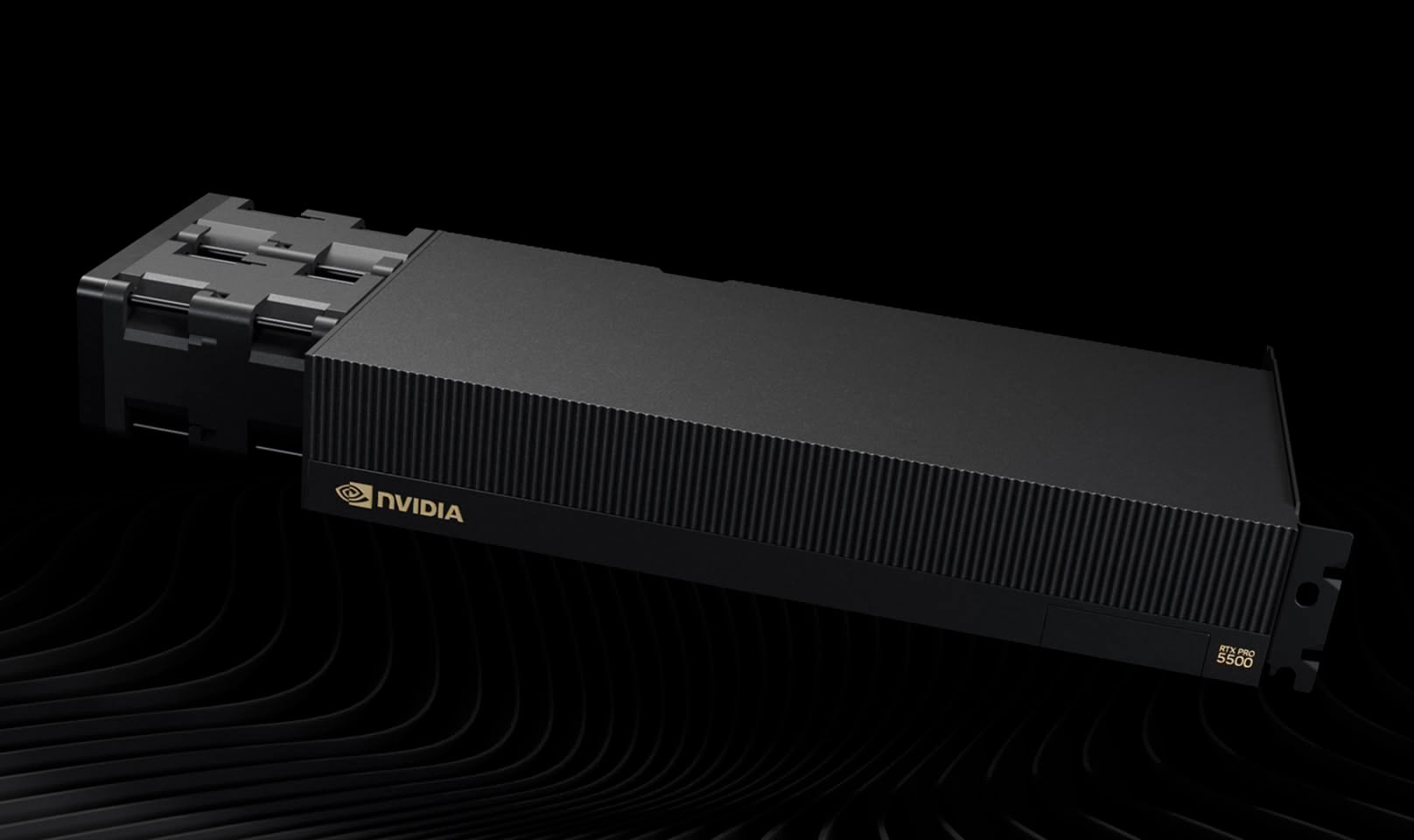
That last row is the detail most summaries miss. Nvidia's own product page frames the card as a rack-mount workstation GPU that can be split into two fully isolated 42GB partitions, each with its own memory allocation and quality of service. For a team serving mid-sized language models, 84GB on a single card means less compromise on quantisation, and partitioning means two workloads where there used to be one.
So the honest reading is: this is not a worse card at a worse price. It is a differently shaped card — smaller compute, unusually large memory — aimed squarely at inference workloads rather than at raw training throughput.
Why would fewer cores command a higher price?
Conclusion: scarcity, not superiority. The card is expensive because relatively few routes lead to it.
The regulatory backdrop explains most of the gap. Washington's controls on advanced computing hardware were set out in the Bureau of Industry and Security rule published in October 2022 and tightened in October 2023, when a total-processing-performance metric was introduced and the scope was extended to chips designed or marketed for data-centre use. Nvidia's B300-class products fall inside those restrictions for China, and H200 shipments are subject to case-by-case review.
A workstation GPU aimed at rack-mounted professional desks sits in a different category, so the RTX PRO 5500 is one of the few high-performance Nvidia products Chinese buyers can still obtain at scale. Reuters has reported Nvidia Chief Executive Jensen Huang saying that US restrictions cut the company's share of China's AI chip market from near monopoly to almost nothing — which tells you how narrow the remaining menu has become. When the menu is short, the remaining items get expensive.
Buyer behaviour reinforced this. Reporting around the same order wave described an earlier, deliberately downgraded China model that buyers first rejected as poor value and which has since been discontinued; the shift is from waiting for a better chip to securing any chip that clears the rules.
How large is the demand behind the premium?
Conclusion: big enough to outrun the factory plan, which is the actual driver of the price inversion.
According to Reuters, ByteDance, Alibaba and Tencent placed orders for more than 3 million RTX PRO 5500 units, at a per-card price of about 11400 USD — a collective value reported at more than 35 billion USD. Later coverage suggested that orders tied to the China market could exceed 6 million units in total, while Nvidia's own production expectation for 2027 has been described as around 3 million units. If both figures hold, the shortfall is structural, not a queue that clears in a quarter.
Crucially, the appetite is not limited to the three giants. Shenzhen-listed Tansun Technology said in an October 13 filing that it had agreed to buy 20,000 cards from an unidentified counterparty, while itself warning that supply shortages, sector demand and foreign technology controls could delay or reduce delivery. That is a second tier of buyers rushing a channel that is already over-subscribed — and their own filing concedes the delivery risk.
Is memory supply making this worse?
Conclusion: yes, and it is the part of the story most price headlines leave out.
Each RTX PRO 5500 board requires 28 GDDR7 modules to reach its 84GB configuration. Those same memory lines are being pulled toward higher-margin data-centre products. IDC, describing the 2026 memory crunch, notes that DRAM prices have surged because demand from AI data centres continues to outstrip supply — a supply/demand imbalance that lands on every builder using GDDR7.
The practical effect is a double bind. Nvidia cannot simply print its way to 6 million units, because a GPU die without memory is a paperweight; and the memory that is available costs more than it did a year ago. Both pressures push the street price of a scarce workstation card above that of a flagship that nobody is queueing for.
What does this mean beyond one GPU?
Conclusion: the pricing logic of high-end compute has changed, and the change is generalisable.
Traditionally, graphics card prices tracked compute performance, memory capacity and product tier. The RTX PRO 5500 case adds a fourth variable that now often dominates the other three: deliverability. For enterprise buyers, whether a product can be obtained and when it will arrive now outweighs a spec-sheet margin. This is our analysis rather than a reported finding, but the same pattern shows up wherever scarce inputs meet subsidised demand — memory, advanced packaging, grid-connected data-centre capacity.
A second implication is regulatory drift: when controls target one product category, demand migrates to adjacent categories that were never the intended subject. A workstation card priced above a flagship is the visible symptom of that migration.
Common misconceptions
- "The 17999 USD is Nvidia's official price." It is a US reseller listing with a roughly 3.3% discount, while Nvidia's own page still treats the model as forthcoming.
- "A higher price must mean a better card." With 21760 CUDA cores versus 24064, and 84GB versus 96GB, the specs point the other way.
- "Nvidia has repositioned its product ladder." Nothing in the catalogue suggests that; the gap is a market premium under scarcity.
- "More money solves this." Orders already exceed the stated 2027 production plan, and buyers such as Tansun were warned delivery could slip.
- "Workstation cards are just slower data-centre chips." Memory size, partitioning, power envelope and deployment target differ enough that the two serve different jobs.
A practical checklist before you buy AI hardware
- Ask which price is binding. Separate advertised street quotes from contractual quotes with a validity date.
- Get the delivery window in writing, including quantity-per-tranche terms; delivery risk is the real cost driver here.
- Cost per usable gigabyte of memory, not per card. For inference, 84GB partitions can beat a nominally faster board with less headroom.
- Check the memory dependency. A board built from 28 GDDR7 modules inherits the price and availability swings of the memory market.
- Verify the compliance route for your region before committing capital — rules on data-centre-class products keep moving.
- Keep two fallbacks live: OEM-qualified rack workstations and non-Nvidia or cloud capacity, so a single SKU never holds your roadmap hostage.
Frequently asked questions
Is the RTX PRO 5500 faster than the RTX PRO 6000?
No. It has 21760 CUDA cores against 24064, 84GB of GDDR7 ECC memory against 96GB, and 1398GB/s of bandwidth against 1792GB/s. Its edge is memory capacity per card and partitioning flexibility, not raw compute.
Is 17999 USD a real market price?
It is a real listing by SHI for the PNY variant, discounted to 17408.63 USD. It is not an official Nvidia price, and Nvidia's US online store still lists the flagship RTX PRO 6000 at 16000 USD.
Why can buyers still order this card when B300 and H200 cannot flow freely?
Because US controls are drawn around data-centre-class performance and end use. B300 products are restricted for China and H200 exports undergo case-by-case review, while a rack-mounted workstation GPU sits in a narrower, less contested category — which is precisely why so much demand piles onto it.
How long can this premium last?
For as long as reported demand outruns supply. With China-linked orders possibly above 6 million units against around 3 million units planned for 2027, and GDDR7 supply under AI-driven pressure, the imbalance looks structural into 2027 rather than a short-term spike.
What should a non-technical reader take away?
That in current tech markets, price increasingly reflects access. When you see a lesser product outselling and outpricing its superior, read it as news about pipelines and rules — not about the product.
For ItInsightsWorld readers, the useful habit is this: stop asking "which chip is better" and start asking "which chip can actually arrive, at what date, under which rule". That reframing turns a confusing price inversion into a fairly readable market signal.
Written by James Hartley, IT Insights. ItInsightsWorld, General series. For questions or corrections, reach the editorial team at contact@itinsights.com.
Sources referenced
- Reuters, "ByteDance, Alibaba, Tencent place over 35 billion USD worth of Nvidia chip orders", 20 October 2026 — https://www.reuters.com/business/retail-consumer/bytedance-alibaba-tencent-place-over-35-billion-worth-nvidia-chip-orders-2026-10-20/
- Nvidia official product page for the RTX PRO 5500 Blackwell Workstation Edition — https://www.nvidia.com/zh-tw/products/workstations/professional-desktop-gpus/rtx-pro-5500/
- US Bureau of Industry and Security, "Implementation of Additional Export Controls: Certain Advanced Computing and Semiconductor Manufacturing Items", Federal Register, 13 October 2022 — https://www.federalregister.gov/documents/2022-10-13/2022-21658/implementation-of-additional-export-controls-certain-advanced-computing-and-semiconductor
- IDC, "Global Memory Shortage Crisis: Market Analysis and the Potential Impact on the Smartphone and PC Markets in 2026" — https://www.idc.com/resource-center/blog/global-memory-shortage-crisis-market-analysis-and-the-potential-impact-on-the-smartphone-and-pc-markets-in-2026/
- Yicai Global, coverage of Tansun Technology's 20,000-card purchase announcement — https://www.yicaiglobal.com/news/tansun-surges-following-the-announcement-of-its-purchase-of-20000-nvidia-gpus