
ItInsightsWorld General Case File: What Anthropic's Nasdaq Listing Says About AI Getting Paid
Anthropic's Thursday listing on the Nasdaq is a live test of one claim: that AI has moved from selling shovels to digging real gold. For any enterprise still debating next year's AI budget, the debut turns an abstract argument into a priced one — and it puts Dario Amodei, not Jensen Huang, on the hook for proving the payoff.
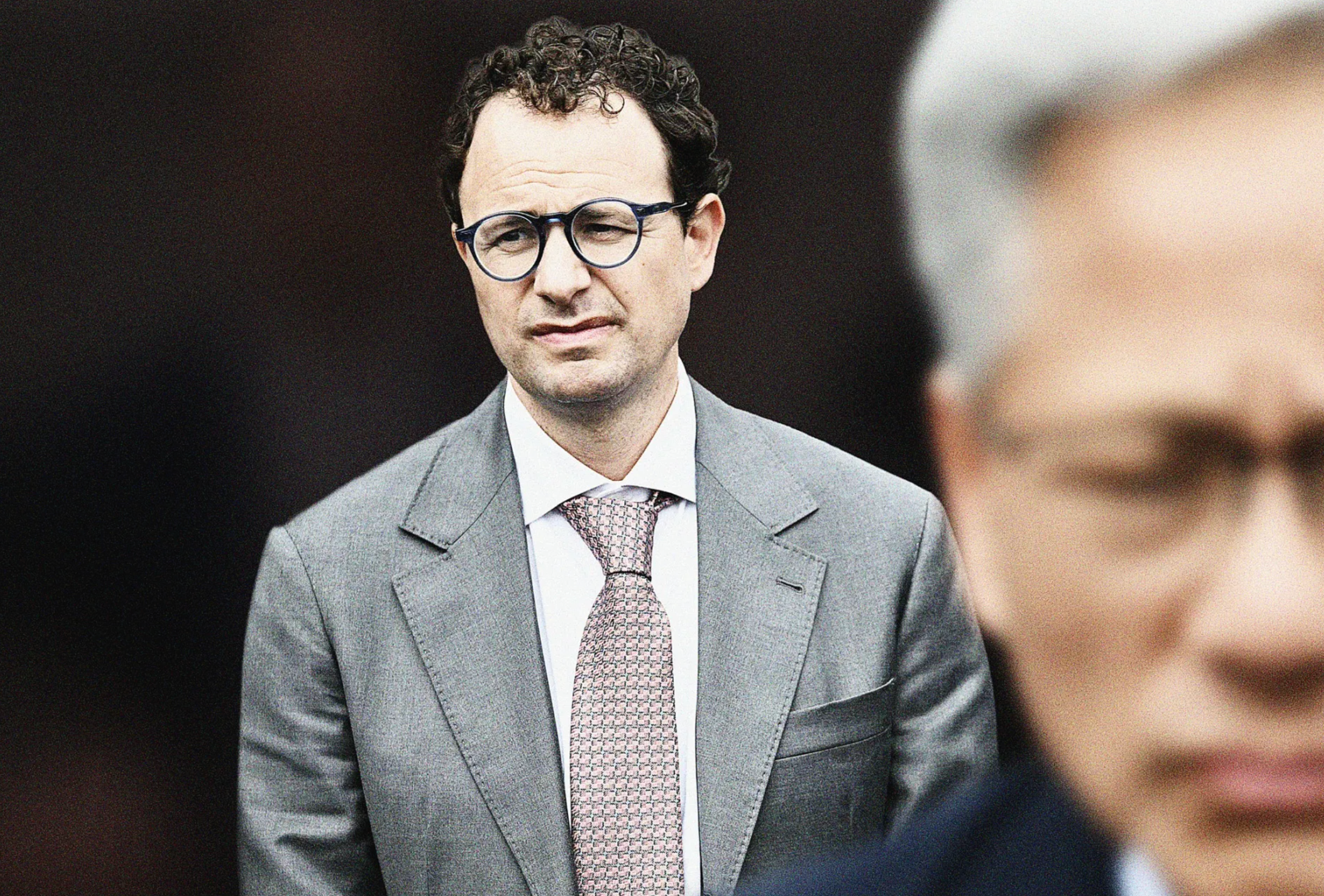
Picture the bind facing a typical IT lead: finance wants proof that last year's AI spend produced revenue, the business unit wants more tools, and the only hard numbers so far come from the companies selling the shovels. Nvidia showed what that side of the trade can be worth — a peak market capitalization of $5.8 trillion. This IPO asks the opposite question: does the gold actually exist?
Why does one listing matter to people who don't trade stocks?
Because it forces a patience test on a market known for wanting returns this quarter, not next decade. Goldman Sachs analysts calculate Anthropic may not reach full-year free cash flow positive until 2030, and the company has more than $900 billion in spending commitments stretching to 2045. Those are not rounded talking points; they are the bill behind the promise.
That bill is entangled with circular deals. Nvidia is arranging financing for Anthropic and for several of its own largest chip customers — effectively helping fund buyers of its own products. Bloomberg's mapping of AI circular deals documents the pattern across the sector. Whether Nvidia's new management keeps the same appetite for risk that defined the Jensen Huang era is now an open question, and this listing will help answer it.
What happened at JPMorgan last Friday?
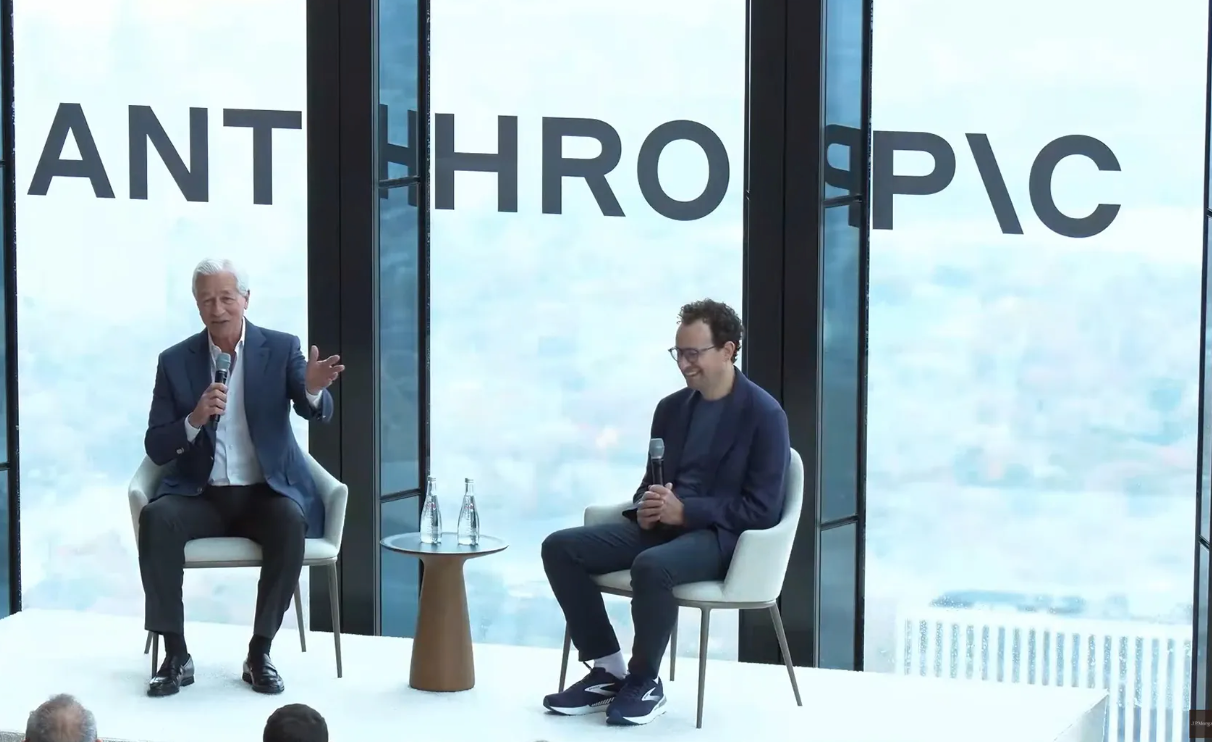
The roadshow tried to wall off the noise. Last Friday, at JPMorgan's new headquarters in New York, Amodei appeared alongside JPMorgan CEO Jamie Dimon, wearing his signature running shoes with white socks and a blue blazer. In the room were fund managers Paul Singer, Bill Ackman and Ron Baron.
To Dimon, Amodei said: “We're not particularly focused on the exact timing of the listing — which month, which day, or what the market environment looks like when we go public.” He also said the most useful advice he received while preparing was: “Never let the company's valuation sit even $1 above its actual value.”
Is this a vote of confidence in AI, or just in one company?
Both, and that is the point. For investors who have spent years guessing what Anthropic is worth, the IPO is simultaneously a vote on the company's own prospects and a guarantee that AI enthusiasm survives — just under new leadership. Angelo Zino, senior vice president and head of technology research at CFRA, put it plainly: “This IPO is extremely important, because Anthropic may be the best barometer of the health of the entire AI ecosystem. In my view, their take on how to monetize AI now matters as much as — or even more than — Nvidia's, given that Jensen Huang is no longer at the helm.”
Amodei
The number on the tin keeps moving. Anthropic is targeting a $1.4 trillion valuation — well below the $2 trillion figure circulating months ago, but far above the $1.1 trillion some on Wall Street shouted during the worst of the recent tech-stock selloff. For context, Reuters reported that Anthropic's last private mark was $965 billion, set by a $65 billion Series H round on May 28, 2026. That gap is why one of our earlier notes framed the story as a valuation repriced within six months.
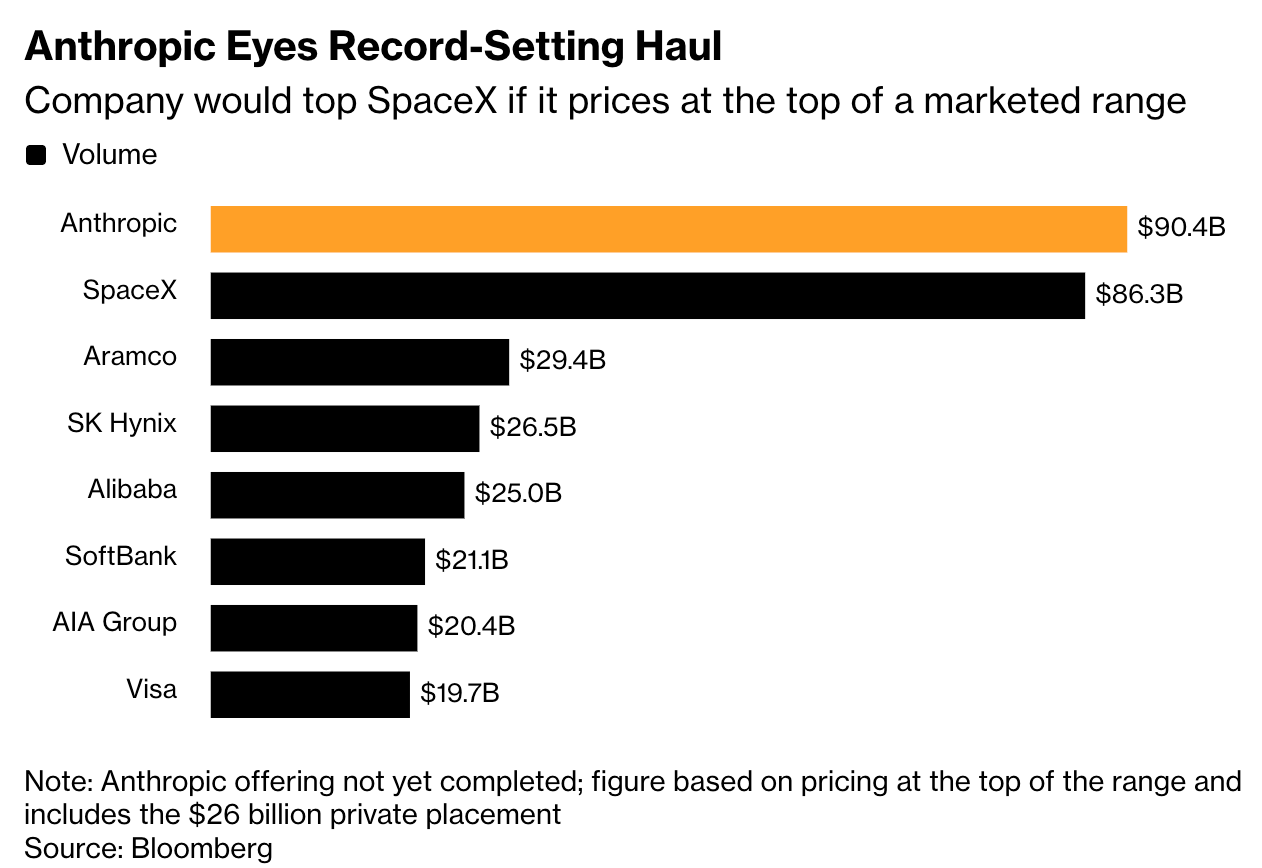
Anthropic and some backers hope to raise as much as $90.4 billion through the IPO plus a separate private placement. Added together, that beats the $75 billion base raise from SpaceX's own IPO and would be the largest listing deal on record. Its S-1 filing lists 825 million Class A shares trading under the ticker ANT on the Nasdaq Global Select Market.
Demand is not the problem. The deal is nearly seven times oversubscribed, and one person familiar said appetite currently exceeds even SpaceX's debut. The closest comparison offered is Snowflake's 2020 IPO, a $3.9 billion deal whose shares jumped 112% on day one. Snowflake was priced at $120, opened around $245 and closed near $254 — a pop that CNBC calculated left about $3.8 billion on the table. That is the cautionary half of the analogy.
How much revenue is actually coming in?
Quite a lot, though revenue is not profit. Barely six years old, Anthropic's annualized revenue — a full-year figure extrapolated from a shorter period — reached $81 billion as of October 31, up $10 billion from the end of September. At that run rate it would sit among the very few companies of that scale globally, ahead of the analyst revenue forecasts for hardware suppliers to the AI boom such as Intel and ASML.
Matt Witheiler, late-stage growth investing chief at Wellington Management, which holds Anthropic shares, said: “Public-market investors are racking their brains trying to figure out just how big AI demand is — which is why everyone is watching the ARR (annual recurring revenue) figures published at the end of each month.” He added: “There's no metric yet for public-market AI demand, because these companies have been private until now. But as Anthropic leads the way into public capital markets, that will change.”
For now the cash buffer holds: more than $130 billion in cash and equivalents, after roughly $141 billion raised to date. But about $71 billion of spending commitments fall due before the end of September 2027. Mandeep Singh of Bloomberg Intelligence warned: “Fiercer price competition could make it harder to sustain gross margins. They also have to drive enough enterprise token consumption to earn enough to cover these infrastructure investment commitments.”
How the two sides of the ledger stack up:
| Shovel sellers (the Nvidia era) | Gold diggers (the Anthropic test) |
|---|---|
| Sell chips and infrastructure; book the revenue early | Must convert that infrastructure into enterprise usage and margins |
| Peak market cap of $5.8 trillion set the benchmark | Free cash flow positivity targeted for 2030 |
| Funding customers is optional amplification | Circular financing is a structural risk to watch |
Why is the baton passing from Jensen Huang to Amodei?
Because the old standard-bearer is gone. Tech stocks have fallen sharply over the past month, and even the end of the US midterms did not lift the cloud: the result hands the next Congress to a Democratic Party unfriendly to the tech sector. Layer on Jensen Huang's forced departure, and uncertainty spiked. For roughly four years Huang was the figure publicly championing AI progress, until reports emerged about multiple extramarital relationships.
Jensen Huang
The fallout dragged Nvidia to its worst week since the selloff triggered by Trump's tariffs in April 2025, and forced Wall Street to re-rate AI exposure. That loads more pressure onto Anthropic to reignite optimism. Huang's exit has also revived the argument over super-voting shares and founder control at large technology companies.
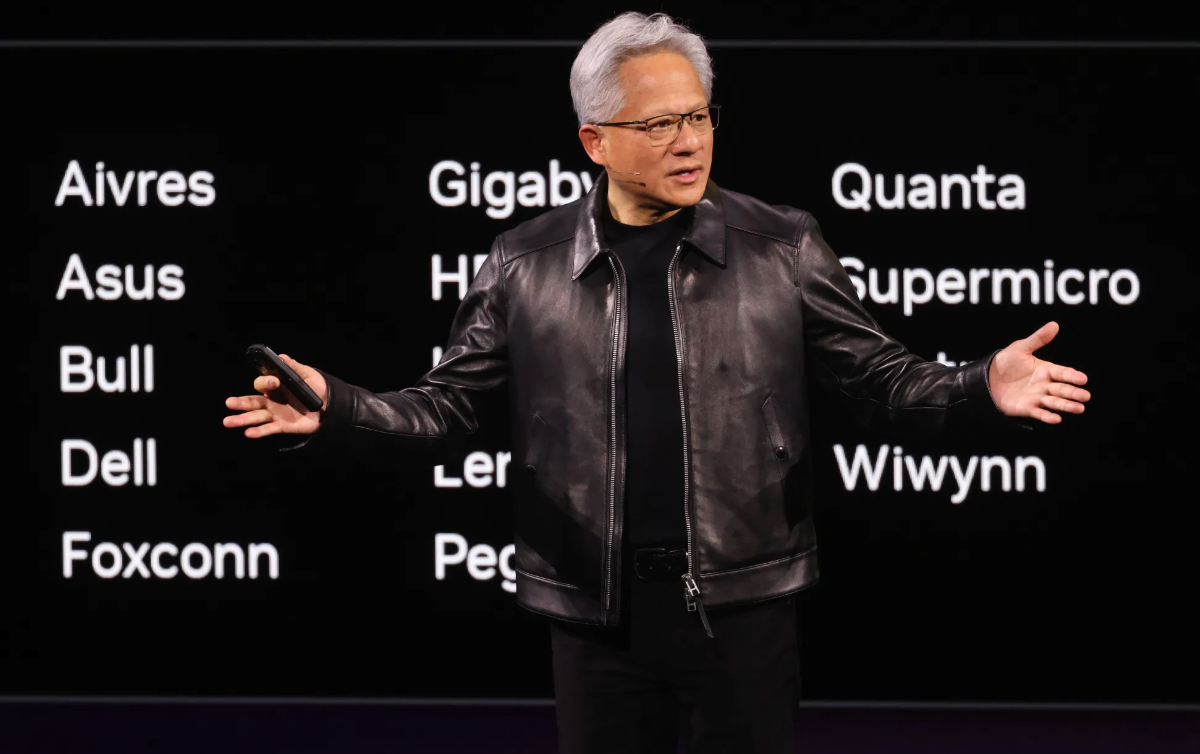
If investors now look to Amodei rather than Huang for reassurance, they will see a study in contrasts: the globe-trotting, star-quality Nvidia chief in his Tom Ford black leather jacket versus the reserved, bookish Anthropic co-founder. Clothing is the surface. Amodei has warned that AI poses existential risks to human society, while Huang's public persona has been uniformly sunny.
The split widened last week. People familiar said Anthropic declined institutional investors from mainland China and Hong Kong for this IPO. Huang, by contrast, spent years pushing Nvidia products into China and cultivating ties there.
Why are analysts calling Anthropic a barometer?
Because attention is shifting from the chips and infrastructure that keep AI running toward the companies building agents and chatbots — the form in which AI actually reaches users. Anthropic fits that shift better than a chipmaker. Mike Smith, head of the growth equities team at Allspring Global Investments, said: “Market expectations are clear, and they're very high. The question is whether the company can stay on the trajectory needed to meet them.” He continued: “Unfortunately for them, trillions of dollars are riding on them. It's one of the key barometers of whether AI commercialization can succeed.”
Kim Forrest, chief investment officer at Bokeh Capital Partners, went further: “Anthropic could become the most important company in the public market, because it will be the archetypal example of AI applied in business. Really, from the start, everyone's attention should have been on the companies using AI and using AI chips.”
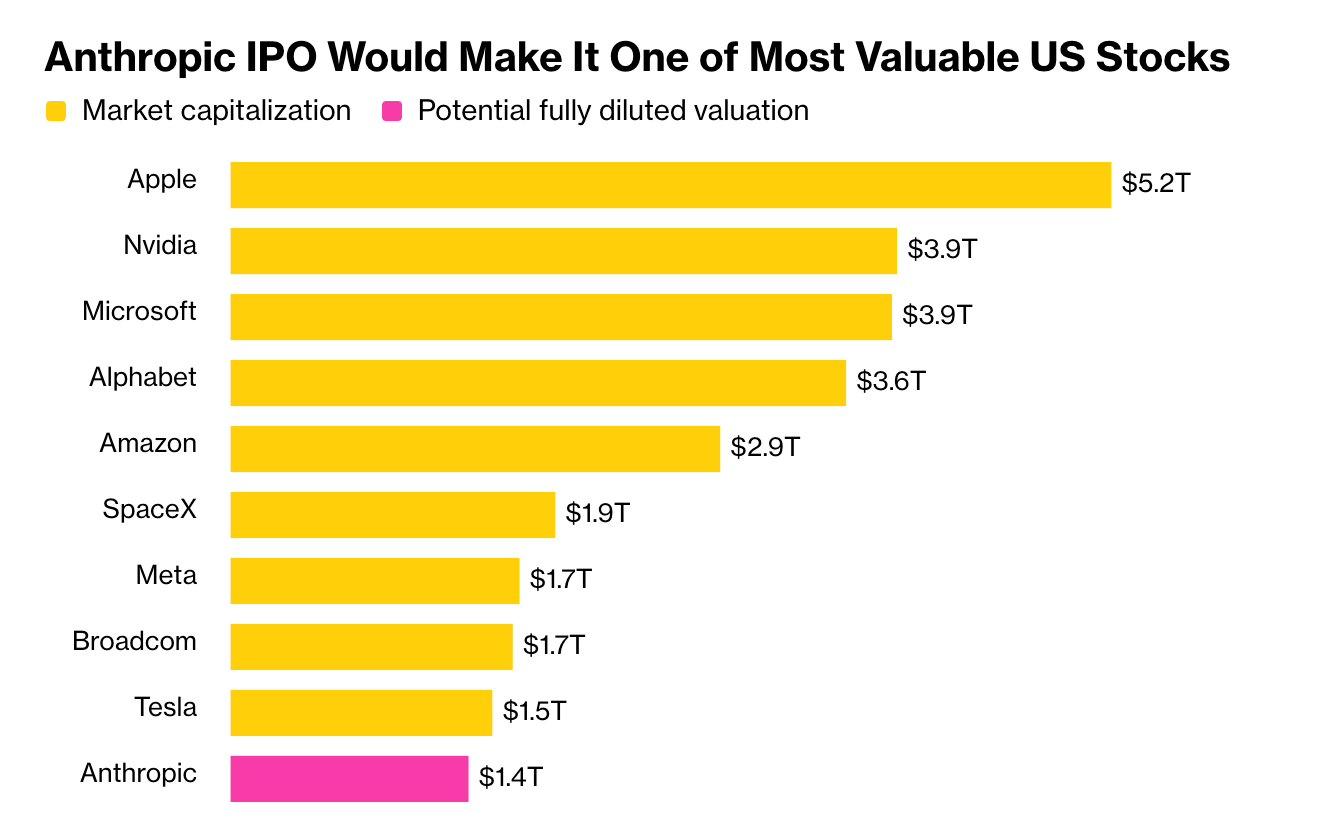
All eyes are on the listing this week. Goldman Sachs and Morgan Stanley, the banks underwriting the deal, expect to close order books on Tuesday — the same day Nvidia reports its first earnings and holds its first call since Huang stepped down as CEO. The coincidence is hard to ignore.
Can it join the biggest names on the market?
Given Anthropic's weight, the allocation and final price will ripple through the broader index. Its quarterly reports will become the window through which the market and the wider economy track AI progress. Allspring's Smith said: “In my view, nothing matters more right now than watching whether the infrastructure already built can actually be monetized. To make this really work, they have to generate more revenue than anyone else within two to three years.”
That is a heavy lift, yet investors seem willing to bet the vision holds — from lifting everyday business efficiency to the grander ambition of ending disease. Speaking to Dimon last Friday, Amodei said: “I hope we can ultimately prove the skeptics wrong, and let humanity look back on every disease you can think of — heart disease, Alzheimer's, cancer — the way we now look at plague or smallpox: as things of the past. It may sound overly idealistic, even a bit crazy, but I truly believe — I truly believe — it can be done.”
Three misreadings to avoid
- “Seven times oversubscribed means the business model is proven.” It means demand for shares, not proof of margins.
- “Raising $90.4 billion removes the funding risk.” The more than $900 billion in commitments through 2045 still has to be paid.
- “A bigger raise than SpaceX means a bigger company.” Those are different metrics; compare like with like.
Questions readers actually ask (FAQ)
Is Anthropic profitable yet?
No. Goldman Sachs analysts see full-year free cash flow positivity around 2030. The $81 billion annualized revenue is a run rate, not profit.
What is ARR and why does it matter here?
Annual recurring revenue, the subscription-style income that investors expect to be published monthly once Anthropic is public — a first public gauge of AI demand.
Who is carrying the risk?
Goldman Sachs and Morgan Stanley are closing the books on Tuesday, while circular financing arrangements leave part of the risk sitting with chip suppliers.
What is the biggest single risk?
Margin pressure from price competition, with roughly $71 billion of commitments due by September 2027.
What should you do next?
Do not treat listing day as a verdict. If you are an IT buyer, write down the two or three metrics your own AI spend must hit before renewal — real usage, real margin, real cash — and hold vendors to them. Then watch three public signals: the first quarterly report, the monthly ARR prints, and whether those September 2027 obligations get refinanced. That is where the answer to the shovel-or-gold question will actually land.
About the author: Sofia Jackson is an enterprise IT observer at ItInsightsWorld, focused on the gap between technology promises and what actually ships.
References
- Reuters — Anthropic's $965 billion Series H valuation: https://www.reuters.com/business/anthropic-raises-65-billion-now-valued-965-billion-2026-05-28/
- CNBC — Snowflake's 2020 first-day pop and $3.8 billion left on the table: https://www.cnbc.com/2020/09/17/snowflakes-first-day-pop-means-ipo-left-3point8-billion-on-the-table-the-most-in-12-years.html
- Bloomberg — mapping of AI circular deals: https://www.bloomberg.com/graphics/2026-ai-circular-deals/