
Amazon's Second Try at the Home Robot: What a "World-First" Machine Means for Ordinary Households
Amazon has assembled a new robotics team and is developing, in its own words, a world-first robot product for the home. The short answer for anyone reading the headlines: this is the company's second attempt at Jeff Bezos's 2017 bet, and the lesson of the first attempt — Astro, which never moved past invitation-only purchase — is that the hard part is no longer the hardware, but proving a room-moving robot earns its floor space every single day.
Reported by IT Insights, editorial desk, James Hartley.
What exactly is the new Amazon robot team doing?
Conclusion first: nothing is shipping yet, and that is the most important fact in the story. Over the past few months Amazon quietly grouped an internal team under its devices arm and filed job descriptions promising a world-first robot product. One engineering posting, since taken down, read: "Robots are about to walk out of the movies and into our homes." The same ad asked for a machine able to navigate dynamic home environments and operate autonomously alongside family members — a far higher bar than the remote-controlled wheeled tablet Astro delivered.
Amazon built its reputation on exactly this kind of opaque, patient spending, and the company is willing to be misunderstood for long stretches when being early buys it a new market. Alexa and Kindle were both funded this way years before they looked like winners. Andy Jassy, chief executive at Amazon, repeated the argument in his latest annual shareholder letter, calling artificial intelligence and robotics one of the biggest inflection points of our lifetimes. Jassy wrote that Amazon works to anticipate what makes customers' lives easier and better every day, and then "to invent the next inflection point."
What the postings imply: a robot that perceives a messy, changing house — toys on the stairs, a dog in the hallway, a door that just closed — and responds without a human pilot steering it.
Why did Astro stall at only several thousand customers?
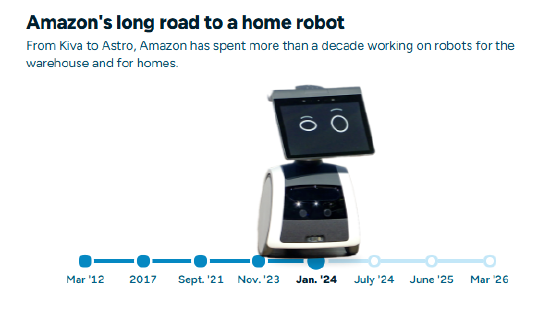
Because the value was thin, not because the gadget failed. In 2017 Bezos, a self-declared science-fiction and robotics fan, told a group of senior device executives to build a robot. Within a few years the team produced Astro, priced at $1,450. Amazon first showed it publicly in fall 2021: essentially a wheeled tablet carrying Alexa, able to drive around a house on its own, recognise faces and patrol as a mobile security camera.
The commercial path never widened. Astro stayed at invitation-only purchase, shipped to several thousand customers, and Amazon's business version, launched in 2023, was discontinued less than a year later. Some owners now assume the machine has little time left. Two forces explain that stall, and both matter for what the new team must fix:
- Competence debt. Everyday autonomy — reliably understanding rooms, objects, pets and people — is unsolved engineering, not a firmware update.
- Category amnesia. Home robots have failed repeatedly on price-versus-usefulness. When Jibo wound down in 2019, IEEE Spectrum's post-mortem on Anki's Cozmo and Vector, Jibo and Kuri blamed shallow repeat value — the same critique Astro faced. Robust vacuum-cleaning robots such as the Roomba won because they do one job completely; the moving companion has never cleared that bar.
What evidence does Amazon already have on its side?
Plenty — but mostly outside the front door. Amazon has been a robotics operator since 2012, when it bought Kiva Systems for roughly $775 million (IEEE Spectrum) and turned that operation into Amazon Robotics. By 2024 it reported more than one million robots deployed across its fulfilment network (About Amazon). That is unmatched experience in motors, batteries, sensors, mapping and costed failure — yet warehouse robots win because their environment is standardised, and a house is its opposite.
The rest of the industry is pushing the same wall from other directions. Apple's research group published HALO, a humanoid "brain" it validated on Unitree's G1 with a Qwen model running task orchestration on a Mac mini. A Berlin developer's post of Claude driving a robotic arm that mixed its own watercolour paint at 4 a.m. shows agents beginning to handle the slow, forgiving physical world.
Is a home robot actually going to sell?
Maybe, and the market math is unusually wide. In a January report Barclays said the global humanoid robotics market is worth $2 billion to $3 billion today, should reach roughly $40 billion by 2035 in its base case, and could hit $200 billion in the most optimistic scenario. Goldman Sachs has projected a $38 billion total addressable market for humanoids by 2035 — close to Barclays' base case, and still far below the hype ceiling. The spread between those numbers in the coming years is the honest answer: nobody knows the size of the category yet, only that investors expect it to grow.
Buyers are the second unknown. Household robots are the rare product that watches you back, and trust is the cheapest feature to lose. SafeHome.org's 2025 home-security survey found 37% of camera owners worry about who can access their footage, while 87% say the benefits outweigh privacy concerns. A robot that roams rooms and remembers faces sits exactly on that trade-off line.
Warehouse robot versus home robot: the difference that sank Astro
| Dimension | Amazon's warehouse robots (since 2012) | Home robots (Astro and successors) |
|---|---|---|
| Environment | Marked floors, fixed shelves, predictable layout | Dynamic home environments that change nightly |
| Success metric | Items moved per hour, uptime | Did it genuinely help today, or was it a toy? |
| Buyer | One operator, one decision-maker | Every family member, including people who dislike it |
| Failure mode | Slow line, fixed by spare robots | Blocked, scared or filming a child — trust lost |
| Price logic | Paid back through labour productivity | A $1,450 gadget must earn its place with no wage offset |
| Scale today | More than one million robots in Amazon's network (2024 disclosure) | Invitation-only, several thousand customers |
| Reference standard | Humanoid fleets, shipping by 2035 at roughly $40 billion (Barclays base case) | IEC 62849:2025 sets household robot test methods: up to 1.75 m tall, under 700 mm wide, 1.5 m/s top speed |
Four common misconceptions about this new robot team
- "Astro was pulled as a failure." Amazon never took it beyond invitation-only purchase; a business edition launched in 2023 and was stopped less than a year later, which is a slow fade, not a public recall.
- "The next robot will look like a person." The world-first wording says function, not shape. Humanoids are the metric Barclays and Goldman Sachs model, not a promise from Amazon.
- "Millions of warehouse robots mean the home problem is nearly solved." The one million robots Amazon runs indoors at work succeed because their environment is standardised. Houses are not.
- "A job posting means a product launch." Postings get deleted, teams get reshuffled, and Amazon's own history shows bets that took years to mature.
What readers should actually do with this news
If you are a household: don't buy on novelty. The practical test for the next robot is whether it removes a chore you already pay for, and whether you can mute the microphone, cover the camera and delete its map of your home without calling support.
If you are building or investing: read the posting text, not the headline. Amazon asked for autonomy in dynamic home environments and comfort around family members — that is the technical frontier, and the line-item where budgets will be judged.
If you are tracking the trend: watch three dates. Whether Amazon reopens the hiring for this team; whether Astro's invitation-only programme finally widens or ends; and whether the base-case figures Barclays published in January hold up as supply chains for actuators and sensors mature over the coming years.
Frequently asked questions
What has Amazon officially confirmed?
Little beyond the recruitment signal itself: a team formed over the past few months working on a world-first robot product. Details, pricing and a launch window remain unannounced.
Can you still buy Astro today?
Astro never left the invitation-only purchase stage and reached only several thousand customers, so it was never a normal retail product.
Is this the same thing as a humanoid robot?
Not necessarily. Humanoid forecasts — Barclays at $2 billion to $3 billion today, roughly $40 billion by 2035 and up to $200 billion in the most optimistic scenario — describe a category Amazon's home team may or may not join.
Should I worry about a robot mapping my house?
Reasonably so, and you can price that risk. Camera owners are split: 37% fear unauthorised access to footage, 87% still consider the benefits worth it (SafeHome.org, 2025). Look for local processing, a physical shutter and exportable maps.
Why keep investing after Astro flopped?
Because Amazon's playbook is to fund long shots early and absorb being misunderstood, as it did with Alexa and Kindle. Jassy's shareholder letter frames AI and robotics as one of the biggest inflection points of our lifetimes.
References
- Barclays Private Bank, "Robots roll out, economies rewire" — https://www.ib.barclays/our-insights/robots-roll-out-economies-rewire.html
- Barclays Research press release on humanoid robotics (January 2026) — https://investingnews.com/barclays-research-finds-humanoid-robotics-on-track-to-become-a-200-billion-market-by-2035/
- Goldman Sachs Insights, humanoid robot market of $38 billion by 2035 — https://www.goldmansachs.com/insights/articles/the-global-market-for-robots-could-reach-38-billion-by-2035
- About Amazon, robots inside fulfilment centres (more than one million robots) — https://www.aboutamazon.com/news/operations/amazon-robotics-robots-fulfillment-center
- IEEE Spectrum, "Amazon Acquires Kiva Systems for $775 Million" — https://spectrum.ieee.org/amazon-acquires-kiva-systems-for-775-million
- IEEE Spectrum, "Anki, Jibo, and Kuri: What We Can Learn from Social Robotics Failures" — https://spectrum.ieee.org/anki-jibo-and-kuri-what-we-can-learn-from-social-robotics-failures
- SafeHome.org, 2025 Home Security Market Report — https://www.safehome.org/resources/home-security-industry-annual/
- IEC 62849:2025, performance evaluation methods of robots for household and similar use — https://standards.iteh.ai/catalog/standards/iec/51fd8e74-339c-4343-86d2-f2490ff5a9a5/iec-62849-2025
Written by James Hartley for IT Insights (ItInsightsWorld). Questions or corrections: contact@itinsights.com.