
Case Study: Apple's HALO, a Unitree G1 and 360 Real-World Tests — What Teams Should Steal
Case in brief: Apple research team built HALO, a three-layer humanoid control stack powered by Qwen models and trained only in simulation, then installed it on a Unitree G1. In 360 single-task tests across 6 real rooms that had never been scanned or mapped, it averaged 91% success; in one real environment, three chained tasks averaged 70%, and the hardest combination dropped to 50%. The lesson is not "a robot butler is here" — it is a repeatable recipe for replacing scarce human demonstrations with compute.
The team submitted the paper Perceptive Humanoid Motion from Simulation to the preprint server arXiv on November 4, alongside the robot "brain" narrative that most coverage has led with. Days later, the project page and code were live. What matters for anyone building AI systems is that the release was a full case: data generation, model training and deployment code covering motion generation, motion tracking and task orchestration, plus both simulation and real-robot runs.
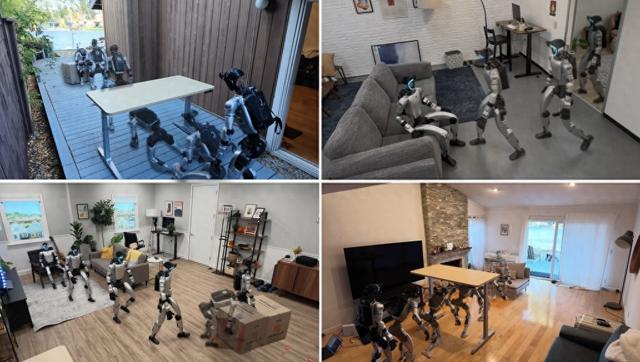
In clips published by the HALO research team, a Unitree G1 running HALO ducks under a table, sits on a sofa and pushes a box in rooms it has never been trained in. Credit: HALO research team
What bottleneck was this case actually attacking?
Conclusion first: the scarce input was demonstration supply, not joint torque. Real-robot teleoperation produces the cleanest trajectories but scales with staff hours, not with hardware. One industry training-data provider puts the yield at roughly 5–50 completed episodes per operator-hour, while simulation multiplies episodes by renting GPUs — the trade-off the HALO team chose to exploit.
Their pipeline answers the question three times over: 1000 procedurally generated simulated homes yielded about 300 hours of primary training data that pairs "what it sees", "what instruction it receives" and "how it moves". Motion comes first, the virtual room second, the rendered robot-eyeball view last. Order matters: generating action before placing it avoids the classic failure of recording footage that no controller can reproduce.
The worked example on the HALO project page is "sit in the armchair", broken into walking forward, turning and sitting fragments. The motion generator produces sequences from text prompts, waypoints and key poses; a geometric screening pass then discards motions with foot sliding or bodies clipping into the floor. Only after that are the chosen motions arranged inside generated rooms, with the system checking robot-to-furniture placement for collisions and rendering the view the robot would see, with lighting, colour tone and blur varied during training so the visual input stays diverse.
Openness is the second lever. The project's public repository states plainly that "this repository contains the code for data generation, model training, and deployment from the HALO paper", which lets outside labs audit claims instead of trusting a highlight reel.
How do the three layers divide the work?
Conclusion first: HALO is not one model, it is a three-layer control architecture with three different clocks — a slow talker, a medium planner and a fast controller. The split is why a desktop-sized computer can drive a walking humanoid.
| Layer | Job in the loop | Engine | Clock |
|---|---|---|---|
| Task orchestration (top) | Resolve ambiguous instructions, break them into subtasks, watch the robot's own video feed, decide success or retry | Visual language model, default Qwen3.6-35B-A3B, running locally on the Mac mini carried by the robot; shares a model serving engine with the action generator so no network is required, with an optional cloud API for harder planning | One explicit subtask at a time |
| Motion generation (middle) | Turn the current scene plus the subtask into a whole-body action plan | A second Qwen model, Qwen3.5-2B, used as a frozen encoder feeding a DiT decoder | Re-plans about 3 times per second over a horizon of about 5 seconds |
| Motion tracking (bottom) | Convert the plan into joint commands from depth images and the robot's own state | Tracker trained through reinforcement learning, policy distillation and related steps | Runs 50 times per second |
The examples the team uses make the value of the top layer concrete. "Sit down" names no target, so the robot must infer which surface in front of it qualifies. "Sit on a chair" with a clear path can run straight through; if a table blocks the route, the orchestrator rewrites it as a sequence — duck under, approach, sit — and only then hands one subtask down. Continuous re-planning at about 3 times per second at the middle layer is what keeps those plans honest when the room shifts.
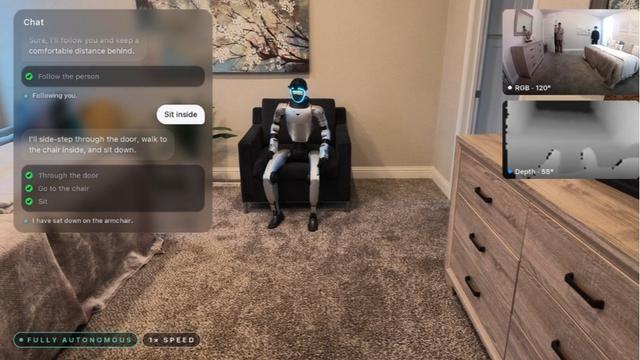
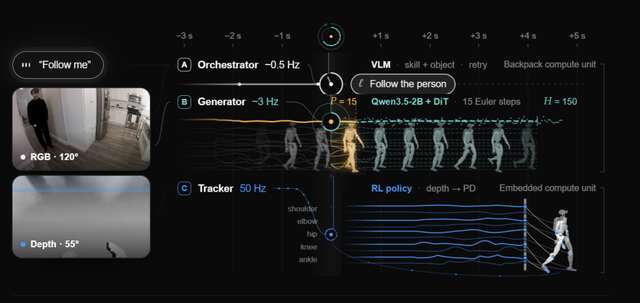
Screenshots assembled from the HALO project page: a vision language model handles task orchestration, an action generation module plans whole-body motion, and a reinforcement-learning-trained tracker issues joint control.
Do 91%, 70% and 50% tell the same story?
Conclusion first: the three numbers measure three different difficulties, and the gap between them is the most useful data point in the whole case.
- Single tasks, 91% — 360 tests spread over 6 real environments that had never been pre-scanned or mapped. This is the sim-to-real claim, and it holds.
- Chained tasks, 70% — in one real environment, 3 task combinations were each attempted 10 times.
- The worst chain, 50% — "duck under an obstacle — walk to the target — push the box".
Our own reading, offered as analysis rather than a finding from the paper: if each single step succeeds about 91% of the time, three independent steps compound to roughly 0.75. The observed 70% sits close to that arithmetic, which suggests most of the drop-off is error propagation rather than a new failure mode. If that holds, the cheapest fix is not a bigger model but better retry and recovery behaviour inside the chain.
Where did the compute go — and what does the bill imply?
| Stage | Hardware reported | Note |
|---|---|---|
| Synthesising the main training data | 250 Nvidia H100 GPU, about 48 hours | The most expensive step, and the one that replaces human teleoperation |
| Motion generator | 64 B200 | Trained by imitation learning on the synthetic pairs |
| Motion tracker | 4 H100 | Reinforcement learning, policy distillation and related steps |
| On-robot inference | Mac mini carried by the G1 | Orchestration and action generation share one local model service |
Read as an engineering budget, the shape is unusual: heavy spending up front to manufacture experience, then comparatively light hardware at run time. That is the mirror image of organisations that pay per token forever, and it echoes the cost discipline visible in our case study on Apple's daily AI budget cuts. Judge the second layer by the same yardstick: the 2B-class Qwen backbone is the size that edge deployment guides treat as laptop- and box-friendly, and its advantage is responsiveness rather than raw reasoning. For the judge-and-retry loop at the top, benchmark-style comparisons of agent leaderboard rankings on long-horizon sessions are a closer proxy than single-shot QA scores.
Why the Unitree G1 became the test bed
Conclusion first: availability decided it. HALO was validated on hardware any funded lab can order — Unitree Robotics lists the G1 from US$13,500 on its own store, while US resellers quote around US$17,990 for higher-configuration units. Compared with the hand-built research humanoids of a decade ago, the strategic shift is obvious: the platform is now the cheap part, and the software stack is the expensive part.
The published hardware profile also explains two results. The G1 is a light, roughly 35 kg machine with a depth camera plus 3D LiDAR and a battery rated around two hours of use — enough to supply the depth images the tracker consumes 50 times per second, but not a solution to the sensing gap the authors flag: with vision as the dominant channel, contact is invisible, and once an object leaves the camera's field of view or gets occluded, contact-heavy tasks degrade. Adding tactile sensing is the stated next step.
The release keeps the honest caveat in plain sight, too: simulated data never fully escaped human involvement. New physical tasks still require hand-written prompts and designed key poses, and some motions draw on human video or motion-capture material.
What the case does not claim — four misconceptions
- "91% means household-ready." It means six rooms, single tasks and a fixed instruction set; the same system loses half its runs on one three-step chain.
- "Local Mac mini means offline forever." The design runs offline by default, but the same layer can call a cloud API when harder reasoning is wanted.
- "Synthetic data means zero human work." Prompts, key poses and occasional human footage still feed the pipeline, and the visible tasks — crawling under, sitting, pushing — stop well short of fine manipulation.
- "Open code equals a product." Public data generation, training and deployment code is a research contribution; there is no shipping consumer robot in this story.
What teams can reuse: a seven-step playbook
- Price the data, not just the model. Write down what one episode costs via demonstration versus simulation before choosing an approach.
- Split by clock speed. Slow reasoning on top, mid-frequency planning, high-frequency control at the bottom; the HALO ratio of about 3 replans per second to 50 control steps per second is a template.
- Keep the planner honest with a frozen encoder. Reusing a pretrained Qwen3.5-2B as an off-the-shelf representation, with a DiT decoder doing the generative work, shrinks training scope.
- Hand down one unambiguous subtask at a time. Ambiguity belongs at the top layer, where it can be resolved against the live camera view.
- Evaluate single skills and chains separately. A blended average hides exactly the compounding problem the 70% and 50% expose.
- Design for the missing sense. If the task touches objects, plan for touch, force or a second camera before promising reliability.
- Publish the boring parts. Data generation plus deployment code is what converts a demo into a citable, reproducible case.
FAQ: the questions readers keep asking
Is HALO an Apple product?
No. It is a research system disclosed in an arXiv preprint on November 4 by Apple research team, with code published for study; nothing in the release indicates a retail humanoid.
Why Qwen models rather than Apple's own?
The paper's default configuration uses Qwen at both reasoning layers — Qwen3.6-35B-A3B for task orchestration and Qwen3.5-2B for motion generation. The published stack treats open models as interchangeable components, which is also why the architecture can switch to a cloud API.
Did the robot see any real room during training?
No. Training data came from 1000 simulated homes totalling about 300 hours. The 6 test environments were real, unscanned and unmapped, which is the point of the sim-to-real claim.
Why is the "duck under an obstacle — walk to the target — push the box" chain so much worse?
Each step is a chance to fail, and failures persist: a slightly wrong approach pose feeds a worse plan downstream. The team's own diagnosis adds a perceptual cause — vision-only sensing struggles once objects are occluded or contact dominates.
What would improve the chain score first?
Two cheap candidates from this case: better mid-chain verification and retries at the orchestration layer, and a perception channel that survives occlusion. The paper points to tactile sensing as the next direction.
References
- Perceptive Humanoid Motion from Simulation, Apple research team, arXiv — https://arxiv.org/html/2611.06908
- HALO public repository (data generation, training and deployment code) — https://github.com/apple-aiml-research/ml-halo
- Unitree Robotics store listing for the G1 — https://shop.unitree.com/products/unitree-g1
- US reseller configuration and pricing overview — https://robostore.com/products/unitree-g1-robotic-humanoid
- Training-data strategy comparison, teleoperation versus simulation yields — https://www.shaip.com/blog/robot-training-data-strategy/
- Edge deployment guidance for the Qwen3.5 series — https://docsv2.aidlux.com/en/tutorials/generative-ai/qwen35_chat_aidgen