
ItInsightsWorld General Playbook: How Selfridges Turned Grand Theft Auto VI Into a Shop — Steps, Pitfalls and the Real Cost
Selfridges turned a Grand Theft Auto VI licence into a walk-through world on Oxford Street, and the lesson for any marketer is blunt: merchandise the setting, not the logo. From 9 to 28 November 2026, the London Corner Shop became a piece of Vice City you could actually enter. The interesting question is not whether fans loved it, but what this kind of world-building costs and what a normal brand can realistically copy.
Picture a marketing director with one budget and two options: license a famous name and stamp it on a T-shirt, or reconstruct an entire fictional city inside a store. The first is safe and forgettable; the second is expensive and could stand empty by day three. That is the real two-way squeeze Rockstar Games and Selfridges resolved by choosing the harder path — and it is why this activation deserves to be taken apart, step by step.
What did Selfridges actually build on Oxford Street?
The short answer: a place that behaves as if Vice City were a real destination, with its own teams, eateries and souvenirs rather than one branded sticker. The product range is the proof.
On the rails: Manatees football kit in teal and pink, basketball jerseys and accessories tied to Vice City Narcos, and a run of Burger Shot-branded shirts, aprons and caps — Burger Shot being a fictional fast-food chain from the game. I Heart VC T-shirts, varsity jackets, postcard-inspired clothing and assorted collectibles fill out the offer.
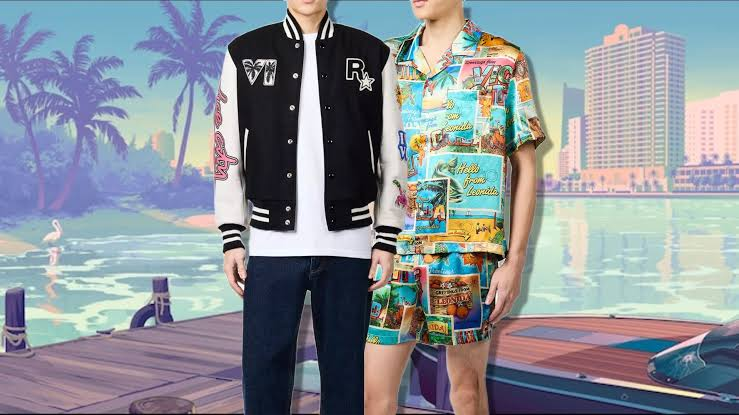
Collaborations listed by Selfridges add a Members Only sports jacket and a Winmau dartboard set, so the assortment runs from pocket-money souvenirs to genuine luxury. As The Standard reported, an exclusive varsity jacket priced at £2,500 had already sold out online — solid evidence of interest, but, as we will see, not proof of profit.
Why sell an entire world instead of one logo?
Because a logo is a claim, while a world is an experience you can photograph. The conclusion from both research and this activation: depth of setting is what turns a product drop into a destination.
Retailtainment — folding entertainment into a store visit — is the industry label, but the mechanism predates the buzzword. Robertson and Gatignon's 2018 study in the Journal of Consumer Research found that the likelihood of visiting a pop-up rises with novel design and perceived product scarcity, and that such spaces generate social-media buzz through the emotional responses they provoke. In plain English: give people something new to see and something they fear missing, and they turn up and post. Selfridges did both.
| Dimension | Logo on a shirt | World-building retail |
|---|---|---|
| Setup effort | Low — one licence, one print run | High — sets, uniforms, custom props |
| Photo value | Low | High — the setting is the content |
| Scarcity signal | Weak | Strong — timed drops and sold-out pieces |
| Dwell time | Minutes | Longer, because visitors explore |
| Downside risk | Small write-off | High fixed cost if footfall disappoints |
When and where could fans actually take part?
Doors opened on 9 November and the run continued until 28 November, deliberately bracketing the game's stated launch date of 19 November. That timing is not decorative; it lets a physical stunt borrow launch-week attention.
Visitors could also pre-order a Goodtime State Collector's Box at The Corner Shop, while a limited-edition Grand Theft Auto VI vinyl album was slated for 19 November. The full installation sat at Selfridges London, with selected products also stocked in Birmingham and Manchester and availability online and in-store depending on stock. That spread gave fans several ways in — photograph the car, wear the city, or collect the box.
What is the £1 million centrepiece actually for?
The showpiece is a real, customised Grotti Cheetah — pink and blue, built with West Coast Customs. Selfridges says the retro sports car can be bought for £1 million through its Personal Shopping service: less a volume product than a headline that makes the whole pop-up photographable.
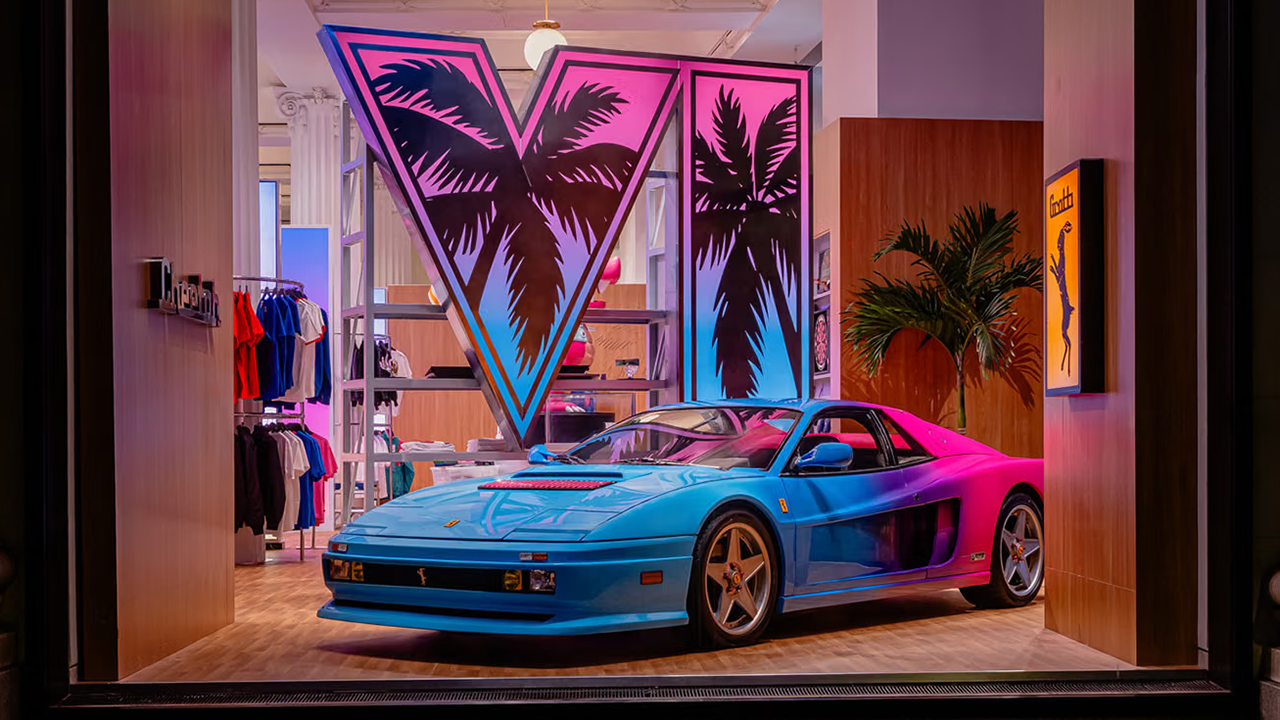
Outside, panoramic Leonida scenes wrap the façade; inside, the décor leans into Vice City's art-deco mood. Time Out reports a towering Macca the Gator figure, lifted from the fictional cartoon MACCA & FRIENDS. Those details make the space feel like a fragment of the game world rather than a standard product display — which is exactly the point.
How can another brand copy it? A step-by-step checklist
The transferable method is less glamorous than the car: it is a sequence of decisions any team can audit — the same steps, pitfalls and a checklist discipline used in other fast-turn brand moments.
- Pick a world with internal depth. Teams, eateries and characters give you many products; a bare logo gives you one.
- Build one undeniable photo object. The Grotti Cheetah is the reason people travelled and posted.
- Layer the environment. Façade, décor and a mascot turn a corner into a set.
- Anchor it to a real date. Tying the drop to 19 November borrowed the launch's attention.
- Open several doors. Online, Selfridges London and regional stores widened access.
- Measure behaviour, not applause. Track footfall, dwell time and conversion rather than likes — a framework detailed by The Storefront.
What does it cost — and what remains unknown?
Here is the sober part. The headline numbers are £1 million for the car and £2,500 for the sold-out varsity jacket, yet neither retailer sales totals nor the activation's broader commercial impact have been disclosed. Sold out is not the same as profitable.
For context, the global pop-up retail market was put at $95.0 billion in 2025 and projected to reach $144.3 billion by 2032 (Stratistics MRC), and a widely cited survey found 44% of pop-up operators spent under $5,000. Selfridges is playing at the opposite, luxury end of that range. Treat its numbers as a ceiling, not a template.
What are the common pitfalls?
Most failures come from copying the props and missing the logic. These are the misconceptions worth killing before you spend.
- 'A famous name is enough.' Without a world to explore, there is nothing to photograph and nothing to discuss.
- 'Bigger always wins.' A custom supercar works because it is singular; ten mediocre props dilute the story.
- 'Sold out means success.' Scarcity can be engineered with small quantities; profit needs volume and margin data.
- 'One flagship store covers it.' The Birmingham and Manchester stocking shows why regional access matters.
Frequently asked questions
Was the Selfridges Grand Theft Auto VI takeover worth it?
On attention, clearly — a £1 million Grotti Cheetah and a £2,500 sold-out jacket generated coverage. On profit, nobody outside the two companies can say, because sales totals were not disclosed.
How long did the activation run?
From 9 to 28 November 2026, with doors open on 9 November and closing on 28 November, deliberately straddling the 19 November game launch.
Could fans buy the merchandise outside London?
Yes. Selected products were stocked in Birmingham and Manchester, and some items could be pre-ordered online through The Corner Shop, subject to stock.
What is the single most copyable idea?
Build around the fictional world, not the title. Turn teams, fast-food uniforms and characters into wearable identities people will use after they leave the store.
What should you do next?
Start small and honest. Before anyone books a flagship space, answer three questions: does our intellectual property have a world deep enough to fill a store; can we afford one memorable centrepiece; and do we have a way to measure footfall and conversion? If the answers are yes, borrow the Selfridges sequence — world, photo object, timed drop, several entry points — and skip the £1 million car. For teams that need a practical playbook for turning news into same-day brand content, the discipline is the same: decide fast, make one thing worth sharing, and check the numbers afterwards.
By Simon Nelson, marketing strategist for ItInsightsWorld's General desk. ItInsightsWorld publishes practical, plain-language guides for readers who want the mechanism, not the hype.
Reference sources
- Robertson, T. S., & Gatignon, H. (2018), 'Pop-ups, Ephemerality, and Consumer Experience,' Journal of Consumer Research — faculty.wharton.upenn.edu
- Stratistics MRC, Pop-Up Retail Market Forecasts to 2032 — giiresearch.com
- The Storefront, 'How to Measure Pop-Up Shop Success' — thestorefront.com