
How Brands Turned the Robert Pattinson 007 News Into Same-Day Posts: A Practical Playbook | ItInsightsWorld General
Faced with a surprise casting headline and a product that has nothing to do with spies, most marketing teams either freeze or publish something forgettable. The brands that won the day did neither: they borrowed one instantly recognisable Bond cue, swapped in their own product, and shipped within hours. Here is the working playbook, and the traps that sink most reactive posts.
The trigger was official: on 16 November 2026, the James Bond account confirmed Robert Pattinson as the newest 007, succeeding Daniel Craig as the seventh actor to play the role in an official film, as The Guardian reported. Pattinson's route — from Twilight's Edward Cullen to the masked vigilante of Gotham — made him an unusually flexible template. Within hours, brands were already posting on Instagram.
Why did one casting headline set off a brand gold rush?
Because the raw material was free, familiar and fast: a handful of Bond cues anyone can recognise in a second. The official account had teased the reveal with an "Identity Confirmed" post, according to MI6-HQ, so the news arrived with a clean hook rather than a rumour. Pattinson himself called the part an "honour of a lifetime" (BBC), giving posts a respectful tone to lean on. And the clock was brutal: one marketing guide puts the peak-attention window for reactive posts at roughly one to two hours (Digital Marketing Knight). Miss it and you are shouting after the crowd has moved on.
What did brands actually post? A side-by-side read
The pattern was remarkably consistent: take one cue, replace one element with your own product, keep the line short. Seven examples cover almost every format a brand can use.
| Brand | Cue borrowed | The post, verbatim |
|---|---|---|
| Arnott's | The famous introduction, with Chicken Crimpy-flavoured Shapes emerging from the shadows | "The name's Crimpy, Chicken Crimpy." |
| Family Mart Malaysia | The gun pose, with a bun in place of the weapon | "The name's Bun, Hokkaido Milk Cream Bun (purchased 007 times today)"; caption: "Min boleh jadi next Bond tak ?" — "Can admin be the next Bond?" |
| Funko | A collectible figure welcoming the new spy | "World domination: unlocked. Congrats to the newest 007." |
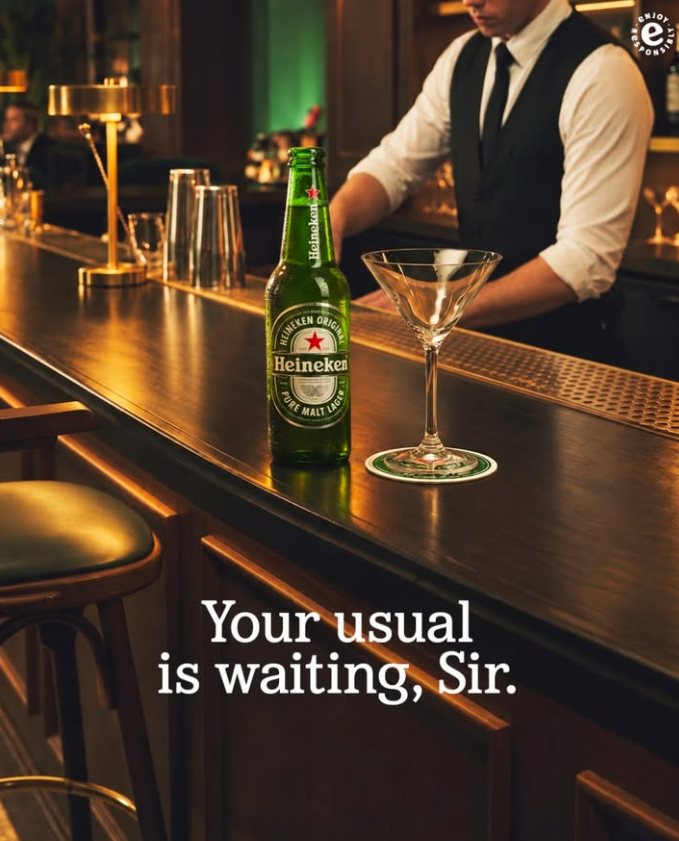
| Heineken | The signature martini, alongside a beer bottle | "Shaken? Stirred? Or ice cold? We don't judge." |
| Heinz UK & Ireland | A martini glass filled with ketchup | "The name's Ketchup… Tomato Ketchup." |
| Mercedes-AMG Petronas F1 | The suited spy, recast as a driver | "Russell, George Russell. Drives fast cars. Wears a nice suit. We know who our first choice would’ve been." |
| Toblerone | Two personalised bars, one nodding to the actor's vampire past | "From vampires to agents, anybody can personalise our bars. Even if they’re the same person." |
A few details matter more than the headline. Funko showed its James Bond Funko Pop! figure; the "world domination" joke works because the collectible already sells that fantasy. Heineken leaned on the drink order, and its image is worth keeping in view:
Heinz UK & Ireland — the account covering the UK and Ireland — proved a ketchup-filled martini needs no explanation. The Mercedes-AMG PETRONAS F1 Team went further than most by putting George Russell forward as the fantasy pick, safe because nobody expects a driver to take the job. Toblerone's bars, labelled Edward and James, turned the Twilight connection into a product demo; the "vampires to agents" line is the whole idea in eight words. That nod to Edward Cullen is a reminder that earlier roles are part of the raw material too.
Which format should your brand copy?
Pick the cue your product can own honestly, not the one that looks funniest on someone else's feed. Five lanes showed up in this wave:
- The introduction pun. Swap a name into "The name's..." — Arnott's and Heinz did this, and Family Mart Malaysia localised it. The structure is universal.
- The prop swap. Replace the gun or the martini with your product. Fast to shoot, easy to read.
- The congrats post. Funko's figure-and-greeting approach needs no joke at all; the product is the point.
- The fantasy pick. Nominate your own person, as the team did with George Russell. Works only when the nomination is obviously playful.
- The legacy nod. Tie an older role to the new one, as Toblerone did with Edward and James.
Preparation beats improvisation. A 2025 study on real-time marketing in social media (Chae, ScienceDirect) found that planned messages modestly lift engagement, while improvised ones tend to reduce it because readers comprehend and appreciate them less. The same discipline sits behind slower-burn entertainment tie-ins such as the 12 district colours Pantone picked for Lionsgate's Panem: the brand adds a layer instead of just shouting. Build the template before the news, not during it.
How do you ship one of these posts without getting burned?
Speed matters, but a short checklist stops the classic errors. Seven steps are enough for most teams.
- Watch the source, not the chatter. Confirm the news from the official account before committing; rumours age badly.
- Decide in minutes. Give one person authority to say yes; the peak window is about one to two hours.
- Choose one cue. A single Bond reference plus your product is enough; two cues look desperate.
- Write the short line first. If the caption needs a second sentence to explain the joke, cut it.
- Check the local language. Family Mart Malaysia's Malay caption ("Min boleh jadi next Bond tak ?") was part of the joke, not a translation afterthought — a point also made in how a Grab Malaysia food trail became a followable dining guide.
- Keep it clearly playful. Avoid anything implying an official partnership; descriptive fun is fine, invented endorsement is not.
- Log the result. Note what was shared and what was ignored, so the next wave starts with evidence.
What does a same-day reactive post really cost?
The cash bill is small; the real expense is preparation and judgement. This is analysis, not a quoted figure: a single-image post needs a designer for an hour or two, a copywriter for less, and a quick legal glance if any franchise marks appear. The expensive part is the template library and the approval habit built before the news breaks. Skip that and the cheap post becomes an expensive correction.
There is also an opportunity cost. Joining a wave with nothing to do with your category burns trust; skipping one that fits costs a rare, free slot in the feed. The seven posts above spent little and bought attention precisely because each cue was already part of the brand's own story — a biscuit called Crimpy, a ketchup bottle, a collectible, a driver, a personalised bar.
Which mistakes trip brands up most?
- Forcing the fit. If your product cannot plausibly replace a prop or finish "The name's...", sit this one out.
- Confusing speed with quality. The research above is blunt: improvised reactive posts score lower on comprehension and creativity than planned ones.
- Dropping the local voice. A literal translation can kill the joke; the Family Mart Malaysia version worked because it sounded native.
- Implying endorsement. Playful reference is fine; suggesting the franchise backs your product is where risk starts.
- Reusing a line without your product in it. The pun only lands when the swap is unmistakably yours.
FAQ: quick answers on reactive brand posts
Do brands need permission to riff on James Bond?
For a playful, descriptive post that claims no official tie-up, most teams proceed with a light legal check. Treat this as general guidance, not legal advice: skip official logos and any wording that suggests endorsement.
How fast is fast enough?
Roughly one to two hours is the peak-attention window cited by reactive-marketing guides. If approval takes a day, the post is a comment, not a headline.
Which cue travels best?
The introduction line — "The name's..." — because it is short, reusable and instantly understood, as Arnott's and Heinz showed.
Can a small brand do this?
Yes. The outlay is modest, but the 2025 study's warning applies: planned templates beat on-the-spot jokes. Start with one cue your product genuinely owns.
What about non-English markets?
Localise the caption, don't translate it. Family Mart Malaysia's Malay line is the model; the same instinct drives region-specific social content.
The next step is unglamorous: write one "The name's..." template, name the person who can approve it within the hour, and list the cues your product can honestly carry. The brands above were not lucky. They were ready before the headline landed.
References
- The Guardian — "New James Bond announced and the name's Pattinson, Robert Pattinson": https://www.theguardian.com/film/2026/nov/16/new-james-bond-announced-and-the-names-pattinson-robert-pattinson
- BBC News — Pattinson on being cast as an "honour of a lifetime": https://www.bbc.com/news/live/ckg5j69ndv2vt
- MI6-HQ — official announcement and production details: https://www.mi6-hq.com/sections/articles/bond-26-robert-pattinson-announcement
- Digital Marketing Knight — newsjacking timing: https://www.digitalmarketingknight.com/newsjacking-in-content-marketing/
- Chae (2025), ScienceDirect — real-time marketing and consumer engagement: https://www.sciencedirect.com/science/article/abs/pii/S014829632500089X