
ItInsightsWorld Q&A: Does Saskatchewan Need Its Own Chip Fab? How Canada's AI, Quantum, Chip and Materials Assets Line Up
Short answer: no. Saskatchewan's semiconductor role is not about assembling every process locally. It is about four assets other regions need — land and power at AI scale, quantum research, chip-design talent, and materials characterization — and about the connections between them in a country where complementary facilities sit hundreds or thousands of kilometres apart.
My own confusion started with a spreadsheet row. I had put a nine-qubit processor on the same line as a gigawatt-scale power plan, and the capital column made the mismatch worse: more than C$50 billion (~$35 billion) against provincial research budgets measured in millions. Reading the Canada semiconductor map is the actual skill here, because expertise is split across regional hubs, and distance turns collaboration into a deliberate act rather than a hallway conversation. Tyler Morhart, associate scientist and beamline lead at the Canadian Light Source's Synchrotron Laboratory for Micro and Nano Devices (SyLMAND), gave the plain version to EE Times: the country is enormous, and its research infrastructure is equally large.
Saskatchewan is the case worth testing that argument on. The landlocked Prairie province has fewer than 1.3 million residents, and its two largest cities are Saskatoon and Regina, the capital. Regina was recently chosen for what could rank among Canada's largest planned data center developments, to be built by Bell Canada. The same province hosts quantum work at the University of Saskatchewan, a Siemens EDA site, a radiation-testing startup and a synchrotron. The useful question is not whether Saskatchewan can do everything. It is how well it links what already exists.
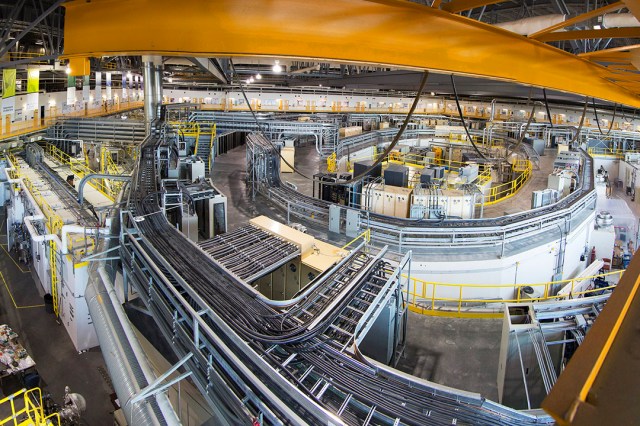 The Canadian Light Source operates 22 beamlines tuned to different experiments, a toolkit Morhart calls a "Swiss army knife," used for advanced materials characterization in semiconductor-adjacent research.
Q1: What is Bell Canada actually building near Regina?
Short answer: a power-and-land position, not a fab. A non-binding agreement announced by Bell and Saskatchewan opens a path to another 900 MW of AI infrastructure capacity, which would lift the potential provincial total to 1.2 GW. Bell also plans to put an AI Fabric head office in the province. The near-term, harder-edged item is the initial 300-MW campus near Regina, where more than 500 people are working on the site and the first data hall is targeted for the first half of 2027.
Public filings sharpen the picture. The federal project registry lists the Bell AI Fabric data centre as a 300-megawatt industrial AI facility on a 65-hectare agricultural parcel, and Bell's own Regina information page states that SaskPower supplies the first 300 MW under a March 2026 agreement, with later expansion planned off-grid from natural gas generation funded by Bell. The Government of Saskatchewan separately published an October 2026 question-and-answer background document on the campus in the Rural Municipality of Sherwood, covering water, power and jobs. Treat those as the audit trail: capacity that is contracted and capacity that is aspirational are not the same number.
One point readers routinely skip: compute hardware does not produce researchers or designers. The University of Regina also runs AI and machine learning research, which matters because incoming tenants arrive with hiring questions.
Q2: Why does a nine-qubit machine belong beside a gigawatt plan?
Short answer: because for a research group the binding constraint is access, not clock speed. The University of Saskatchewan's acquisition of a full-stack quantum computer followed the Bell expansion news. USask's system includes a nine-qubit Rigetti Novera processor, modest next to the ambitions attached to Bell's development, and the justification is grounded: researchers already hold problems they want to run.
Steven Rayan, director of USask's Centre for Quantum Topology and Its Applications, told EE Times earlier this year that the openings span vaccines, agriculture, energy and secure communications. Teams had already used quantum hardware in Quebec to study protein networks relevant to vaccine design, and built a quantum circuit to model northern microgrids combining solar generation and diesel power.
The funding stack is worth recording because it sets expectations about scale. Federal support was announced on 31 March 2026 as $1.93 million through Prairies Economic Development Canada's Regional Innovation Ecosystems program, with a further $400,000 from Innovation Saskatchewan, according to the Government of Canada release. Put that in the national frame: Budget 2021 committed $360 million over seven years to the country's National Quantum Strategy, and the 2025 federal budget earmarked about C$334.3 million for quantum inside a defence and innovation package. A nine-qubit device is a teaching and algorithm-development asset. It is not a competitor to classical clusters, and I would not pretend otherwise. For the harder benchmark on where the field is going, our earlier read on how IBM, AMD and ORNL are approaching quantum error correction covers the co-design problem.
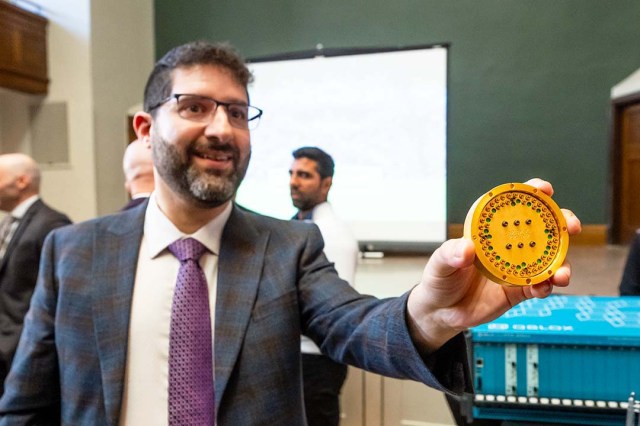 USask's Steven Rayan keeps the scope concrete: the recently acquired quantum computer has real uses across vaccines, agriculture, energy and secure communications.
Hosting arrangements add a third leg. The Canadian government's Quantum Defence Innovation Secure Hub, or DISH, is hosted at the University of Calgary and recently named USask as a primary academic partner. The Bureau of Research, Engineering, and Advanced Leadership in Innovation and Science is assembling a national network of DISHes to provide secure, collaborative space for government, industry, academia, the Canadian Armed Forces and national security partners.
Q3: Should a Canadian chip startup build its own fab?
Short answer: no, and the local examples show the alternative. Siemens EDA's Saskatoon operation is first a talent story. Aaron Genest, technical director at Siemens EDA, explained to EE Times that its growth depended on university relationships, internal training, and an environment that keeps people; senior EDA engineers are not sitting idle on every corner.
The university-to-industry path also produces companies. Novigrad founders Christopher Elash and Lars Kishchuk met as USask engineering students and worked together on university space projects, with an early ambition simple enough: make chips. Customer conversations redirected that energy toward a different bottleneck — establishing whether electronics can survive radiation exposure. Their map of what is available is explicit. TRIUMF in British Columbia supplies radiation-testing infrastructure, and USask contributes expertise in semiconductor radiation effects. It is also incomplete, the way most regional maps are, which is why organizations such as CMC Microsystems matter: shared tools and shared experts are how a small ecosystem buys reach it cannot build.
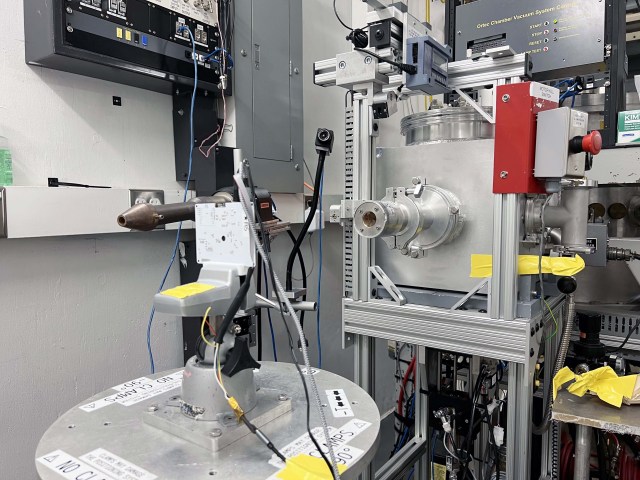 The Saskatchewan startup Novigrad sees room to help Canadian semiconductor companies with radiation-testing needs.
Q4: Why do materials come before machines?
Short answer: because every other layer inherits its failure modes from them. "Everything's downstream of materials," Morhart said. Conversation jumps from software straight to economic opportunity, and the hardware still has to work.
Morhart, an analytical chemist, runs the SyLMAND laboratory at CLS and describes the facility as "essentially a Swiss army knife," with 22 beamlines adapted to different experiments. Its contribution to semiconductor-adjacent research is advanced materials characterization, not conventional CMOS processing; the group concentrates on non-silicon microdevices and X-ray lithography, and the facility's own page lists SyLMAND as Canada's only X-ray lithography beamline (Canadian Light Source SyLMAND).
Synchrotron methods let researchers inspect interfaces, transport and degradation — not only what a material is, but what happens once it becomes part of a working product. That is a national asset and a provincial advantage at the same time, and it explains specialization as a choice: Alberta's nanoFAB in Edmonton provides conventional processing that Morhart's group deliberately chose not to duplicate. Through proton and neutron irradiation facilities, TRIUMF answers a different question again. Characterization, fabrication and radiation testing are three instruments; together they widen the development toolkit.
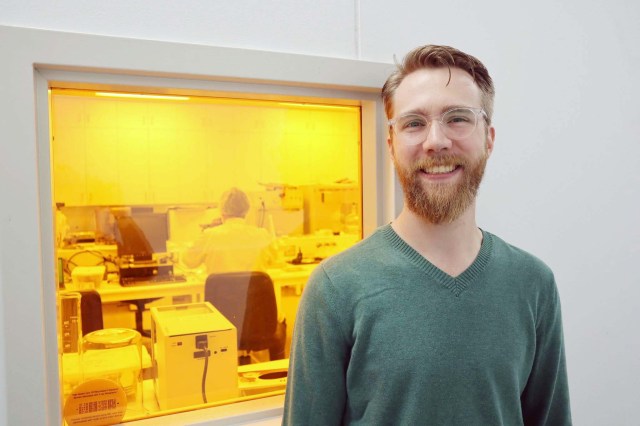 Canadian Light Source's Tyler Morhart.
Q5: What usually breaks first, the capability map or the connection?
Short answer: the connection. Morhart notes that links across Canada require travel, professional networks and deliberate relationship-building; geographic separation does not dissolve just because two facilities are complementary. Three frictions show up in comparable infrastructure programs, and this file inherits all of them:
- Grid sequencing. A 1.2 GW ceiling and one 300 MW phase are different commitments. The off-grid generation plan for later phases, plus water sourcing, is what to watch.
- Instrument access. Beamline hours and test benches are scheduled resources. An oversubscribed facility behaves like a factory at capacity, regardless of how good the map looks.
- Retention. The Siemens EDA Saskatoon case points at the binding constraint: people, not tools.
The School of Public Policy framed the provincial version of this question in a June 2026 policy brief on the Regina-area campus: how Saskatchewan should convert jobs, research partnerships and infrastructure commitments into durable capability (School of Public Policy, University of Saskatchewan). That is where I would leave the honest uncertainty. The ingredients for scaling AI, semiconductor and quantum work are present; whether they combine commercially is still an open variable. Bell's infrastructure, USask's quantum research, Siemens's talent development and Novigrad's testing business each answer part of the problem, and their value rises only when companies and researchers can move between them — including outward, when the next required capability sits in another province.
Four questions readers ask us
Is Saskatchewan becoming a Canadian semiconductor hub?
No, on the evidence so far. It is supplying four distinct inputs: AI-scale power and land near Regina, quantum research capacity, EDA talent through Siemens EDA, and materials characterization at CLS. A hub claim would require local fabrication, which the province's own actors have chosen not to duplicate.
Can nine qubits do useful science?
Yes, for small-model work and for training people who will write the larger programs. The documented examples are protein-network study in Quebec and a northern microgrid circuit; neither needs a fault-tolerant machine.
Who pays for facilities like this?
Layered. Federal regional innovation money and provincial top-ups bought the USask machine; telco capital and utility contracts drive the data center; federal strategy funding underwrites quantum research nationally. Each layer has a different reporting cycle, which is why timelines drift.
What is the next signal worth checking?
Whether the Bell and Saskatchewan agreement converts from non-binding to contracted, and whether the first data hall holds its target for the first half of 2027. Those two facts change the read on everything downstream.
My reusable checklist for regional tech announcements
- Separate contracted capacity from announced ambition. "Non-binding" is a legal term with a physical meaning.
- Identify which instruments are schedulable: beamline hours, radiation test benches, cleanroom slots.
- Count retention mechanisms, not startup counts: university pipeline, internal training, reasons people stay.
- Trace the funding stack in order — federal program, provincial contribution, private capital.
- Look for what a region refuses to duplicate. Specialization is a decision, and it tells you more than a brochure.
Sources cited
- Government of Canada — support for quantum computing in Saskatchewan (31 March 2026)
- Impact Agency of Canada — Bell AI Fabric Data Centre Project registry entry
- Bell business markets — AI Fabric Regina campus information
- Government of Saskatchewan — RM of Sherwood campus questions answered (October 2026)
- ISED — Canada's National Quantum Strategy
- Canadian Light Source — SyLMAND beamline
- School of Public Policy, University of Saskatchewan — policy brief on the Regina AI data centre