
Quantum Error Correction, Compared: How IBM, AMD, and ORNL's New Platform Measures Up on the Road to 2028
Short answer: IBM, AMD, and Oak Ridge National Laboratory (ORNL) have chosen the "wire the fridge to a supercomputer" route to quantum error correction — placing a noisy quantum processor beside very fast classical hardware so decoding, control and orchestration are tuned as one machine, instead of chasing raw qubit counts or waiting for one elegant code.
That is the bet behind the new quantum/AI platform announced on Nov. 5 by IBM, AMD, and the U.S. Department of Energy (DoE)-funded Quantum Science Center (QSC) at Oak Ridge National Laboratory (ORNL). Two rival routes are competing for the same prize: developer stacks that bury error correction inside orchestration software, and code-first machines that squeeze more logical qubits out of fewer physical ones. As part of the Department of Energy's Quantum Genesis Mission, the alliance aims to accelerate the creation of scientifically relevant quantum computers by 2028, and leading quantum companies view error correction as the gate. For a non-specialist reader the useful question is not who owns the biggest quantum computer, but which architecture clears the milestone first and what each trade-off costs.

Left to right: Travis Humble, director of the Quantum Science Center, Oak Ridge National Laboratory; Gina Tourassi, associate laboratory director for Computing and Computational Sciences, Oak Ridge National Laboratory; Stephen Streiffer, director of Oak Ridge National Laboratory; Jay Gambetta, director of IBM Research and IBM Fellow; Mark Papermaster, CTO and executive VP, AMD; Ralph Wittig, corporate fellow and CVP, head of Research and Advanced Development, AMD; Jerry Chow, IBM CTO of Quantum-Centric Supercomputing and IBM Fellow (Source: ORNL)
What exactly was announced, and what is being put next to what?
Conclusion first: this is a classical-computing partnership wrapped around a quantum processor. The Oak Ridge laboratory places IBM's quantum computers, including the company's most powerful quantum processor, the 120-qubit IBM Quantum Nighthawk, alongside ORNL's Umbra HPC system, which runs AMD Instinct MI355X GPUs and 5th Gen AMD EPYC CPUs. AMD supplies the classical computing foundation for research into error correction, decoding optimization, and software orchestration.
Distance is the hidden variable. A quantum error arises when the delicate quantum state of a qubit is disrupted; the qubit operates near absolute zero and typically needs temperatures between 10 and 20 millikelvin (–273.15°C or –459.67°F), so measurement data has to be interpreted almost immediately. Under development at Oak Ridge in the U.S. state of Tennessee, the co-designed platform will let researchers evaluate how to combine classical and quantum computing to advance quantum error correction.
Two published specifications show why these particular boxes were chosen. AMD's product page lists the MI355X accelerator with 288GB of HBM3E memory and 8TB/s of bandwidth per GPU, a memory-heavy profile that suits decoders chewing through syndrome data (amd.com). IBM, for its part, describes the Nighthawk r2 revision of the same chip family as executing more than 100,000 circuits per second, roughly 25 times the circuit throughput of its earlier Heron processor (ibm.com, posting dated Aug. 31, 2026). Throughput matters because an error-correction experiment is, in practice, a vast number of very short runs.
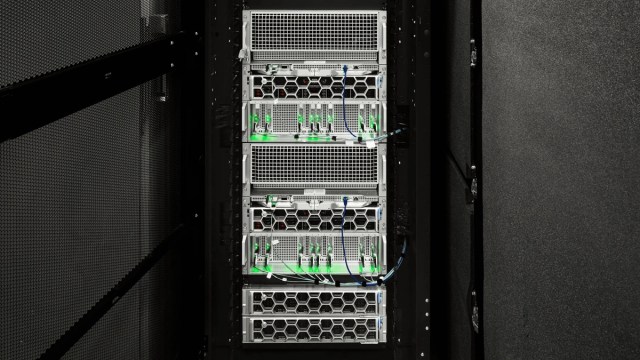
Close-up of ORNL’s Umbra high-performance computing system, composed of AMD Instinct MI355X GPUs and 5th Gen AMD EPYC CPUs. Umbra is co-located with IBM quantum computers to form a co-design platform for quantum error correction. (Source: IBM)
Which yardstick should you trust: physical qubits, logical qubits, or hard operations?
Conclusion: count operations, not qubits. Resource theory in quantum computing splits operations into easy (Clifford) and hard (non-Clifford) sets. Seetharami Seelam, chief architect of Classical System Co-Design for Quantum-Centric Supercomputing at IBM, told EE Times that non-Clifford operations are especially resource-intensive in fault-tolerant quantum computing because they cannot generally be implemented as cheaply as Clifford operations and require additional error-correction resources. Seelam noted that all error-correcting codes admit instructions that are cheap to implement and others that are expensive, so what is hard is a result of the choice of code on any given platform.
| Yardstick | What it really measures | Blind spot | Public reference point as of Nov. 2026 |
|---|---|---|---|
| Physical qubits | How much raw control wiring exists | Silent on noise, latency and error budget | 120-qubit IBM Quantum Nighthawk |
| Logical qubits | Protected information that survives correction | Depends entirely on encoding rate and code choice | DoE target of 100 logical qubits; IBM has demonstrated up to 70 logical qubits; Quantinuum reported 48 error-corrected logical qubits at a 2:1 encoding rate on its Helios machine (quantinuum.com) |
| Hard operations | Depth of a genuinely fault-tolerant workload | Definition shifts with the code on each platform | DoE target of 100,000 hard operations by late 2028 against IBM's 438 hard operations — a roughly 230-fold gap |
| Circuit throughput | How fast experiments can be repeated | Speed without fidelity is meaningless | Nighthawk r2 rated above 100,000 circuits per second (ibm.com) |
Put those numbers side by side and the difficulty becomes concrete. IBM said it has demonstrated experiments with up to 70 logical qubits and 438 hard operations; for the partners to reach the DoE target, they will need to achieve a roughly 230-fold increase in hard-operation count. Washington has also published its ladder of steps: the DOE Quantum Genesis Q Competition, launched in September 2026 with up to $215 million in planned federal funding, asks early prototypes for roughly 10 logical qubits and about 1,000 hard operations before the first-generation goal of 100 logical qubits running 100,000 hard operations by late 2028 (energy.gov). The physical price is another reality check: mainstream surface-code designs can require upwards of a thousand physical qubits per logical qubit to reach algorithmically useful error rates (Nature Communications), which is why low-overhead codes and faster decoders — not bigger qubit numbers — are the contested ground.
"Today, the question is how to accelerate and optimize error correction to build systems that scientists can use to tackle meaningful problems," Jay Gambetta, IBM Research director, said in a press statement. "This new co-design platform for quantum error correction allows us to evaluate different approaches and determine the architectures, software, and workflows that will scale."
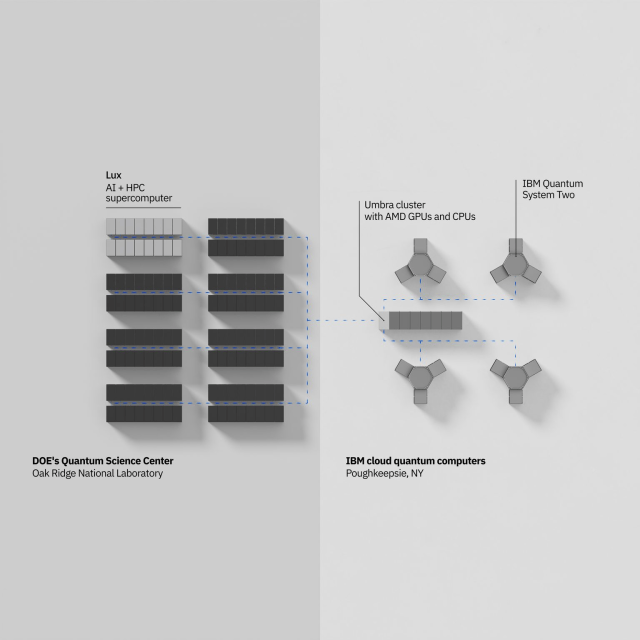
Illustration of IBM, ORNL, and AMD’s new co-design platform for quantum error correction (Source: IBM)
Are GPUs enough? Where each chip option wins and loses
Conclusion: GPUs buy flexibility and volume now; the tightest real-time correction loop still leans on FPGAs and ASICs. Riverlane says its engineers have demonstrated FPGA-based decoders achieving sub-20-microsecond latency for real-time error correction (riverlane.com), while research decoders running on GPUs for quantum low-density parity-check codes have been reported in the sub-63-microsecond range. A high-bandwidth GPU node is excellent for offline decoding, code benchmarking and orchestration; the loop that must close between two physical gate operations is a different race entirely.
| Classical option | Best at | Main cost | Role in this platform |
|---|---|---|---|
| GPU clusters (AMD Instinct MI355X GPUs) | Throughput, memory-hungry decoders, rapid software iteration | Highest latency per single decoding event | Where the partners expect the biggest early payoff — Umbra's nodes run decoding and orchestration research |
| FPGA (e.g. Riverlane's Javelina-class designs) | Deterministic microsecond-scale, in-the-loop correction | Longer design cycles, less flexible once taped out | Not supplied here; the realistic alternative readers should compare against |
| ASIC | Lowest latency at volume | Fixed to one code and one error model | A later-stage option once the winning code is settled |
| CPU orchestration (5th Gen AMD EPYC CPUs) | Scheduling, workflow glue between QPU and HPC | Not a decoder by itself | Keeps hybrid jobs moving end to end |
IBM said Nighthawk's high maximum circuit throughput and real-time pulse control enable researchers to test error-correction techniques. According to IBM, researchers can use the company's quantum hardware to measure qubits mid-calculation and act on the results in real time, set the exact timing of the signals that protect qubits from noise, see exactly what the hardware ran, and work directly with raw measurement signals. By comparing what each technique requires in qubits, time, samples, and classical resources, researchers will learn where GPU accelerators, such as AMD's nodes in the Umbra system, can help the most.
According to AMD EVP Mark Papermaster, the next era of computing will combine quantum computing with decades of innovation across the classical hardware and software ecosystem. "We are advancing a holistic approach that integrates quantum processors, HPC, and AI," Papermaster noted. "This co-design platform is an important step toward building the scalable, efficient computing infrastructure needed to make fault-tolerant quantum computing a reality." According to Travis Humble, director of the Quantum Science Center at ORNL, solving quantum error correction challenges is essential to making quantum computing a practical tool for scientific discovery, and that is a priority for Oak Ridge National Laboratory.
Co-located testbed, developer stack, or code-first machine: which route fits which user?
Early demonstrations that protect quantum information from noise are among the advances in error correction. IBM claims quantum advantage using techniques with guaranteed correctness, showing that quantum computers integrated with classical computers can solve relevant problems better than classical systems alone. The three main routes now on the table are not interchangeable.
| Route | Typical example | Strength | Trade-off | Best suited to |
|---|---|---|---|---|
| Co-located quantum + HPC testbed | IBM Quantum Nighthawk with the Umbra HPC system at Oak Ridge | Full control of the decoding loop; real-time pulse access; shared error models | Access is limited to programme participants; hardware choices are frozen for years | National labs, HPC centres and teams designing codes rather than running them |
| Developer platform that automates correction | Quantinuum's Nexus quantum system | Application builders work at the logical level without owning the physics | You inherit the vendor's code and error model | Software teams, algorithms groups, early commercial pilots |
| Public, co-funded HPC-integrated fleet | Systems deployed under the European High Performance Computing Joint Undertaking | Multi-vendor comparison, free or co-funded access | Queues and network hops, so little co-design of the control loop | University researchers and benchmarking consortia |
The second route is scaling fast on evidence. Through 2029, Quantinuum expects its Nexus quantum system to automate and simplify error correction, resource management, orchestration, and deployment, enabling developers to build and integrate increasingly capable applications at the logical level. A total of $2 billion from the administration of U.S. President Donald Trump has gone to nine U.S. companies, including IBM and Quantinuum, to secure the nation's quantum leadership. The company said in a press release that the Nexus system supports more than 200 organizations, a 45% increase this year, and that total job submissions increased tenfold in the 12 months through August 2026 compared with the preceding 12-month period.
"Quantum computers are on the brink of achieving fault tolerance at scale," José Ignacio Latorre, director of Singapore's Centre for Quantum Technologies, said in the press release. "It’s exciting: we are entering terra incognita for what we can compute. The new challenge is putting our high-level quantum algorithms into the right form to successfully run on error-corrected hardware. Developer platforms like Nexus help us bridge that gap between quantum algorithm design and deployment."
Is Europe doing the same thing differently?
Conclusion: same destination, different purchase order. Europe has led the concept of hybrid classical/quantum computing, the Center for Strategic & International Studies, a Washington, D.C.-based think tank, noted in a March 2026 report. Czechia, France, Germany, Italy, Poland, Spain, the Netherlands, and Luxembourg are working to deploy on-site quantum computers that are integrated with classical supercomputing under the European High Performance Computing Joint Undertaking. That fleet approach broadened in June 2026, when the EuroHPC JU opened a continuous pilot call giving European users free access to co-funded quantum systems hosted alongside Tier-0 supercomputers (eurohpc-ju.europa.eu).
The contrast is instructive for anyone deciding where to spend research budget: Europe optimises for many users touching many machines; the Oak Ridge model optimises for a few users touching the wiring itself. IBM took a less geopolitical view. "IBM has been leading the way in developing quantum-centric supercomputing for several years, including a reference architecture for integrating quantum processors with CPUs and GPUs into HPC environments that has been used in deployments in both Europe and Japan," Seelam said. "The ORNL collaboration represents an important next step in applying that approach in the U.S., bringing IBM quantum computers together with ORNL’s high-performance computing infrastructure and AMD CPUs and GPUs."
The partner history that de-risks the claim
- The new co-design platform for quantum error correction extends IBM's existing collaborations with ORNL and AMD.
- Earlier this year, IBM and ORNL showed that workloads running on quantum computers and ORNL's Frontier supercomputer can simulate magnetic materials and calculate molecular configurations of promising materials for the production of fusion fuel.
- AMD GPUs have been used by IBM to accelerate the classical diagonalization step in sample-based quantum diagonalization (SQD), a key quantum-centric supercomputing workflow.
- Last year, an algorithm that efficiently decodes quantum errors on AMD chips was demonstrated by the two companies.
- Oak Ridge and AMD are partners in what was possibly the world's first exascale computer.
- IBM said the partners' effort with error correction and HPC workflows may support IBM's path to its Quantum Starling system, the company's first fault-tolerant quantum computer.
Five common misconceptions about this race
- More physical qubits means closer to useful computing. Hard operations and logical-qubit fidelity decide usefulness; a 120-qubit machine is a laboratory instrument, not a 100 logical qubits computer.
- Error correction is a software patch. It is a cryogenic timing problem as much as an algorithm problem — hence the millikelvin constraints and the push for real-time pulse control.
- Co-location automatically beats the cloud. It wins on control-loop latency and shared error models, but loses on breadth of access, which is precisely where the European pilot-access model is stronger.
- 2028 means practical quantum computers. The date is a DoE milestone for 100 logical qubits running 100,000 hard operations; IBM's own fault-tolerant machine, the Quantum Starling system, sits further along its roadmap.
- Demonstrated results equal verified advantage. Claims that integrated systems beat classical ones should be treated as vendor claims until independent groups reproduce them on different codes and hardware.
So what should you do with this comparison?
Use the same four-part test whatever platform a vendor pitches, and attach your decision to the calendar rather than the headline.
- Ask for the operation count, not the qubit count. If a supplier cannot state hard operations and logical error rates, treat the announcement as marketing.
- Ask where the decoder runs. GPU-side decoding means offline or near-real-time work; in-the-loop correction requires FPGA or ASIC-class latency.
- Ask who gets access and on what terms. A testbed you cannot schedule is a research result, not a tool — the free pilot calls on the European side are the comparison point.
- Set checkpoints. Reassess at the DoE's late 2028 milestone and again through 2029, when competing roadmaps such as the Nexus quantum system and the Quantum Starling system are scheduled to mature.
- Budget for hybrid, not replacement. The near-term winner is the workflow that pairs quantum jobs with existing HPC and AI capacity, which is why sample-based quantum diagonalization on the Frontier supercomputer is the practical template.
FAQ: what readers ask first
What is quantum error correction in plain terms?
Qubits decay constantly; error correction spreads one logical qubit across many physical ones, measures the differences, and uses a classical decoder to work out what went wrong. Without it, deep computations collapse into noise.
Why does IBM need AMD hardware at Oak Ridge?
Because decoding and control are classical jobs with quantum deadlines. The Umbra high-performance computing system, built from AMD Instinct MI355X GPUs and 5th Gen AMD EPYC CPUs, sits next to IBM Quantum Nighthawk so researchers can test which techniques cost the fewest qubits, samples and classical cycles.
How far is the field from the 100 logical qubits target?
Furthest on depth. IBM has demonstrated up to 70 logical qubits and 438 hard operations against a DoE goal of 100,000 hard operations by late 2028 — a roughly 230-fold increase still to be found.
Can an ordinary company use any of this today?
Indirectly, mostly through developer platforms and public access calls. The Nexus system already serves more than 200 organizations, and Europe's pilot call offers free access, but the Oak Ridge co-design testbed itself is a research facility.
Is this an arms race between continents?
Partly. The Center for Strategic & International Studies argued in a March 2026 report that Europe has led the hybrid classical/quantum concept, while IBM's Seelam frames the ORNL work as applying an existing reference architecture, already deployed in Europe and Japan, in the U.S.
Sources consulted
- IBM Newsroom — Oak Ridge National Lab, IBM, and AMD Launch New Co-Design Platform for Quantum Error Correction (Nov. 5): https://newsroom.ibm.com/2026-11-05-oak-ridge-national-lab,-ibm,-and-amd-launch-new-co-design-platform-for-quantum-error-correction
- U.S. Department of Energy — DOE launches competition to accelerate the world's first fault-tolerant quantum computers: https://www.energy.gov/science/articles/doe-launches-competition-accelerate-development-worlds-first-fault-tolerant
- IBM Quantum blog — Nighthawk r2 circuit throughput: https://www.ibm.com/quantum/blog/nighthawk-r2
- AMD — Instinct MI355X accelerator specifications: https://www.amd.com/en/products/accelerators/instinct/mi350/mi355x.html
- Riverlane — GPUs, ASICs or FPGAs for quantum error correction: https://www.riverlane.com/blog/gpus-asics-or-fpgas-here-s-how-they-measure-up-for-quantum-error-correction
- Quantinuum — Introducing Helios: https://www.quantinuum.com/blog/introducing-helios-the-most-accurate-quantum-computer-in-the-world
- EuroHPC JU — opening access to its quantum computers: https://www.eurohpc-ju.europa.eu/quantum-technologies/quantum-computing-access_en
- Nature Communications — yoked surface codes and physical-qubit overhead: https://www.nature.com/articles/s41467-025-59714-1
Analysis for the ItInsightsWorld General desk by James Hartley, IT Insights. Corrections and story tips: contact@itinsightsworld.com.