
ItInsightsWorld General Explainer: Why Huaqiangbei's RTX 50 Series Reversed — and What Still Holds Prices 1.7 Times Above Retail
Prices in Huaqiangbei turned down because hoarded inventory finally hit a frozen demand wall. After a run of 11 trading days, quotations broke on October 28 and the RTX 5080 slid from nearly 20,000 yuan to about 16,000 yuan — a correction of several thousand yuan, roughly 20% off the peak. Supply did not loosen, which is why the RTX 50 series still trades at 1.7 times the suggested retail price and why this reads as a pause, not a return to normal.
What Actually Happened in Huaqiangbei
The sequence is unusually clean for a spot market. Overseas talk that a flagship of the RTX 50 series was being wound down lit the fuse in mid-October; CCTV Finance then tracked 11 trading days of uninterrupted gains before the direction flipped on October 28. Losses landed in the range of several thousand yuan on individual models, and traders described a market where a morning quote could already be stale by the afternoon.
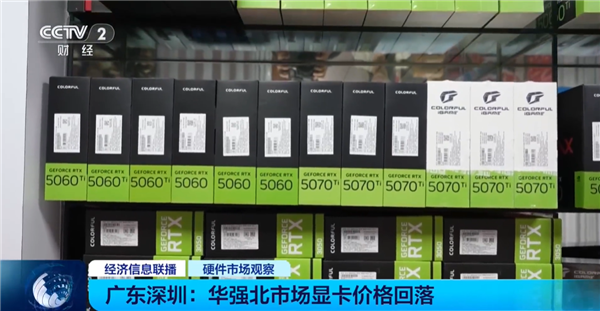
Two things have to be separated here. What fell on October 28 was the panic premium — the part of the price created by fear of a discontinuation notice. What did not fall is the scarcity premium, which is set by wafers, memory and shipping capacity.
How Wide Was the Move? A Model-Level Snapshot
Reported channel data in the same coverage shows the squeeze was far from uniform across the RTX 50 series.
| Model | Reference retail level | Peak channel quote | Reading after the reversal |
|---|---|---|---|
| RTX 5080 | roughly 8,000 yuan at launch | nearly 20,000 yuan in late October | about 16,000 yuan, about 20% below the high |
| RTX 5090 | about 15,000–16,000 yuan initial retail | spot offers clustered at 51,000–55,000 yuan, some above | still more than triple the reference level |
| RTX 5060 | about 2,300 yuan two months earlier | above 4,000 yuan, topping out near 4,200 yuan | volume model, still elevated |
| RTX 5060 Ti 8GB | close to 3,000 yuan | 4,300–4,400 yuan | roughly 40% above the earlier level |
| RTX 5060 Ti 16GB | lower base, bought for local AI workloads | up about 70–80% | the fastest-rising midrange card |
| Series average | manufacturer recommended retail | well above 2 times on halo models | 1.7 times recommended retail |
The pattern is the informative part: the two ends moved hardest. Halo cards moved on rumour, while 16GB midrange cards moved because buyers who cannot get data-centre parts are quietly purchasing consumer GPUs for inference work — a demand shift that does not reverse when a headline does.
Why the Spike Happened in the First Place
Rumour, then an incomplete denial. Nvidia senior vice president Jeff Fisher, who runs its PC graphics business, said the RTX 5090 was not discontinued and would keep shipping, while conceding that capacity is genuinely tight — as reported by Mixed News on 21 October 2026. In a channel market, a denial that confirms scarcity does not reset prices; it reframes them.
Capacity reallocation. 21st Century Business Herald reported on 24 October 2026 that multiple Huaqiangbei merchants pointed to the same root cause: chip capacity being steered toward AI computing, leaving consumer cards and their components supply-constrained.
Upstream cost inflation. TrendForce said on 4 August 2026 that RTX 50 board prices in South Korea might climb as much as 30% from August on higher TSMC wafer and GDDR7 memory costs. Its 30 September 2026 outlook projected conventional DRAM contract prices up 10–15% quarter on quarter in 4Q26 and NAND up 15–20%. Supplier shares reinforce the point — DRAM revenue share data: Samsung 38%, SK hynix 29%, CXMT 9% — because a handful of memory makers allocating lines to server products is a pricing decision that reaches consumer cards within a quarter.
Hoarding. Distributors and shops bought ahead. CCTV Finance quoted merchants saying this pre-positioning is exactly why quotations swing within a single day.
Why the Correction Stops at 1.7 Times Retail
The downside broke for demand-side reasons: buyers went quiet at the peak, some traded down to cheaper models or the second-hand market, and hoarders with large stock began discounting to move volume. That is an unwind of positioning, not of fundamentals.
Meanwhile the reference price itself kept moving up. Wccftech reported on 4 November 2026 that board makers confirmed RTX 50 increases across models for November. And the memory-cost wave is not confined to GPUs: our own analysis of why Meizu, Asus and Black Shark walked away from phones traces those exits to the same storage-price surge. When component bills are large enough to kill small hardware brands, a 1.7 times channel premium is unlikely to evaporate quickly.
The arithmetic is blunt: a 20% haircut taken from roughly double the guide price still leaves you near 1.6 times it. The channel can fall hard and remain expensive.
Who Is Buying Now: The Overseas Rush
CCTV Finance, citing Shenzhen Customs, reports that Shenzhen's computer and computer-part exports reached 313.33 billion yuan in the first three quarters of 2026, up 32.6% year on year. Buyer profiles in the market shifted too — Russia, India and the Middle East were named most often, and the shopping list was not only graphics cards but memory and solid-state drives. One merchant said overseas customers accounted for more than 50% of their sales in October of this year.
Hu Yang, chief electronics analyst at Southwest Securities, framed the phenomenon for the same report as regional price arbitrage: overseas buyers come to Huaqiangbei because global GPU supply is tight and European, US and Southeast Asian retail channels are squeezed by AI capacity claims more directly. That, he argues, keeps cross-border enquiry heat elevated as long as consumer GPU shipment cadence does not recover — an interpretation we would classify as supply-driven rather than demand-driven.
Three cautions for cross-border shoppers
- A gap measured against inflated foreign street prices is not a discount to official retail.
- Warranty follows the buyer: export units often lack local service, so a 20% saving can become a full replacement cost on failure.
- Intraday repricing is an unstated fee — an order bought at the top of the day can be underwater before it ships.
How to Judge Whether Any GPU Price Is Fair Today
- Test against MSRP. Anything well above roughly 1.3 times recommended retail is paying for urgency, not performance.
- Check the two-week range. A card a few hundred yuan below its all-time channel high is not in bargain territory.
- Price the wait. If contract memory keeps rising as TrendForce forecasts, waiting can cost more than buying; if supply recovers, the premium grinds down.
- Watch quote stability, not quote level. Half-day repricing is the clearest sign a market has not found its footing.
Common Misreadings of This Reversal
- “Prices are returning to normal.” They fell from an abnormal high to a still-abnormal 1.7 times retail.
- “Nvidia's denial settled the question.” It removed the rumour premium, not the capacity constraint.
- “Dealers caused this on their own.” Hoarding amplified the move; wafer and GDDR7 costs created it.
- “Foreign buyers signal oversupply.” They signal arbitrage against global scarcity.
- “Wait for the crash.” Positioning unwinds fast; cost inflation unwinds over quarters.
Action Advice: What to Do Next
- Current owners: do nothing. A 20% trim from double retail is not a buying signal.
- Must-build now: take the cheapest card that clears your workload, with a written ceiling of about 1.3 times recommended price.
- Can wait one quarter: track three items only — official RTX 50 supply updates, next-quarter DRAM contract-price forecasts, and two straight weeks of stable daily quotes.
- Buying from abroad: budget for warranty, freight and volatility, and never treat one day's Huaqiangbei price as a benchmark.
- Anyone comparing generations: remember that cheaper compute is a software race as well — path-tracing optimisations have delivered up to 20% gains without new silicon.
FAQ: The Questions Readers Are Actually Searching
Did RTX 50 graphics card prices really fall?
Yes, but selectively. After October 28 the RTX 5080 dropped from nearly 20,000 yuan to about 16,000 yuan, roughly 20% off its high, and other mainstream models gave up several thousand yuan.
How long did the rally last before the reversal?
11 trading days for the RTX 50 series, as tracked by CCTV Finance, with the break coming on October 28.
Are cards still expensive versus official prices?
They are. The series average still sits at 1.7 times manufacturer recommended retail, because the earlier gains have not been fully digested.
Why do quotes change twice a day?
Because agents and merchants bought ahead of demand. A hoarded position facing a shifting market gets repriced by the half-day — morning to afternoon.
Is overseas purchasing a sign of a healthy market?
No — of price gaps. In October of this year one Huaqiangbei merchant put foreign customers above 50% of turnover, while Shenzhen's computer and parts exports rose 32.6% year on year over the first three quarters of 2026.
Will prices keep falling?
The next leg depends on supply, not rumour. With DRAM contract prices forecast up 10–15% quarter on quarter for 4Q26, the most probable outcome is a slow compression of the 1.7 times premium rather than a collapse.
Trend Judgment
The likeliest path is a long exhale: fear-driven premiums unwind in days, cost-driven premiums unwind over quarters. Read today's prices as evidence that scarcity, not speculation, is still in charge — and set your own buy-or-wait line before the next headline, not after it.
References
- CCTV Finance — Huaqiangbei RTX 50 series price reversal, model-level quotes, overseas buyer traffic and Shenzhen Customs export figures
- 21st Century Business Herald, 24 October 2026 — Nvidia end-of-life talk rattles Huaqiangbei as cards reach 60,000 yuan quotes
- TrendForce, 4 August 2026 — RTX 50 prices in Korea may rise up to 30% on higher TSMC wafer and GDDR7 costs
- TrendForce, 30 September 2026 — AI server demand sustains memory contract price increases in 4Q26
- Mixed News, 21 October 2026 — Nvidia says the RTX 5090 is not discontinued, though supply is constrained
- Wccftech, 4 November 2026 — RTX 50 GPUs set for a price increase in November
- IT Insights — DRAM share shift: Samsung 38%, SK hynix 29%, CXMT 9%; when memory got too pricey