
ItInsightsWorld General Analysis: How Nova Scotia Turns Microelectronics Integration Into an Ocean-Tech Advantage
By Nathan Hale | ItInsightsWorld
Bottom line: Nova Scotia is skipping wafer fabs and building rugged, integrated microelectronic systems for the ocean, defense, healthcare and energy — a bet that plays to its research base and geography rather than to chip-manufacturing scale. Here is why that choice matters, and what it signals for the wider industry.
For years, the playbook for a regional semiconductor hub was written in wafer fabs, process nodes and multibillion-dollar plants. Nova Scotia is reading a different script. As AI and autonomous systems push computing out of the data center into harsh, power-constrained environments, the province is staking its microelectronics future on integration — combining sensing, processing, communications, power and packaging into systems that work where a standalone chip is only one part of the answer.
What Is Nova Scotia Actually Building?
The short answer: highly integrated systems, not standalone devices. That distinction matters, Jean-François Bousquet, program director of Dalhousie University's MINDI Hub, told EE Times in an interview. He argued the province's strength is not inventing the next discrete semiconductor but assembling technologies that must work reliably in remote, power-constrained and unforgiving settings.
"Semiconductors will scare people away if we talk about semiconductors, but if we talk about integration of microelectronic systems, I think there’s a strong capability of integrating into various domains, especially in ocean tech" Bousquet said.
Why Integration Instead of Standalone Chips?
Most semiconductor ecosystems are measured by global chipmakers, process nodes, venture rounds or fabs. Nova Scotia's approach starts elsewhere: with an operational problem, then the applications that answer it — ocean observation, underwater robotics, sonar, fisheries, environmental monitoring, naval systems, medical technology and renewable energy. The microelectronics stack follows the use case.
Consider an autonomous underwater vehicle operating below Arctic ice for months. It must sense, communicate, navigate, classify events, process data locally and conserve every joule. Some applications add AI acceleration, FPGA-based processing, GPUs, MEMS devices, photonics, lasers, specialized communications and advanced sensing — all inside a small, rugged, waterproof package.
"We have to find innovative ways of integrating our microelectronics and make our autonomous vehicles smart enough to be able to go under the ice in the Arctic" Bousquet said.
"They have to communicate, they have to sense, and they have to know what’s around them."
In effect, this is an edge-computing story — and the edge can be underwater, far offshore or embedded in a compact defense or environmental platform. Bousquet's group is working on autonomous underwater drones and on coordination between underwater and aerial systems for remote monitoring — capabilities that are inherently dual-use, serving defense and surveillance as well as science, environmental monitoring, resource exploration and climate observation.
"We developed sensors that will measure the biological, chemical, and geological content of water in the ocean" Bousquet said.
What Do Low-Power Breakthroughs Look Like Below the Surface?
Bedford-based Innovasea shows the thesis in practice. It designs and manufactures aquatic technology, including acoustic telemetry systems that track fish in oceans, lakes and rivers. Small acoustic tags attach to — or, in some cases, are implanted in — fish; underwater receivers detect the signals, letting researchers identify tagged animals and, using multiple receivers, pinpoint locations with fine precision. The tags can also carry sensor data such as temperature or pressure.
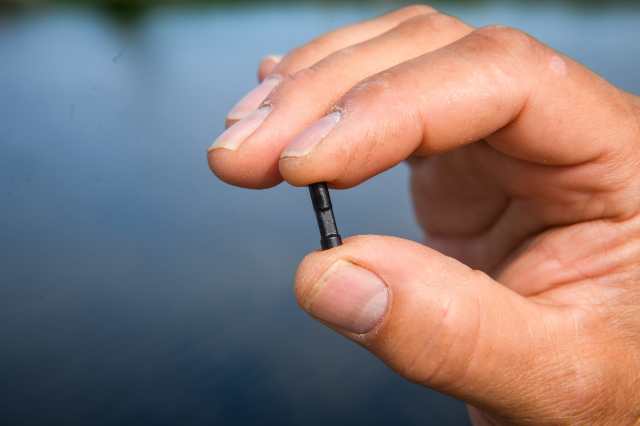 Small acoustic tags from Innovasea attach to (or, in some cases, are implanted in) fish. (Source: Innovasea)
Jean Quirion, VP of R&D for fish tracking at Innovasea, told EE Times the advantage lies in integrating components into compact, power-efficient systems that stay reliable in demanding environments. More efficient microcontrollers let designers do more computation within the same power budget, or hold performance while drawing less energy — but that is only part of the story.
"Most of the innovations that we’ve come up with that really reduce power consumption and reduce size have been in some tricks that we’ve developed internally to just make the system behave in a more power-efficient way."
That engineering depth is fed by university ties. Quirion described Dalhousie University as both a source of engineering talent — through co-op placements and full-time hiring — and a partner for research carrying more uncertainty than routine product development. Together with organizations such as COVE, those links connect research, workforce development and commercial engineering across Atlantic Canada.
Who Is Connecting the Ecosystem?
Halifax is the anchor. The capital concentrates defense research, a naval presence, defense primes and suppliers, universities, ocean-technology firms and the Centre for Ocean Ventures & Entrepreneurship. Proximity to the Atlantic, Arctic routes, fisheries, offshore resources and shipbuilding is less a branding exercise than a set of practical engineering requirements.
At the local level, the MINDI Hub — short for Microelectronics Innovation Design Hub — is meant to provide connective tissue. Backed by the provincial government, it supports industry, develops curriculum around microelectronics for ocean technology, trains students and expands the local workforce.
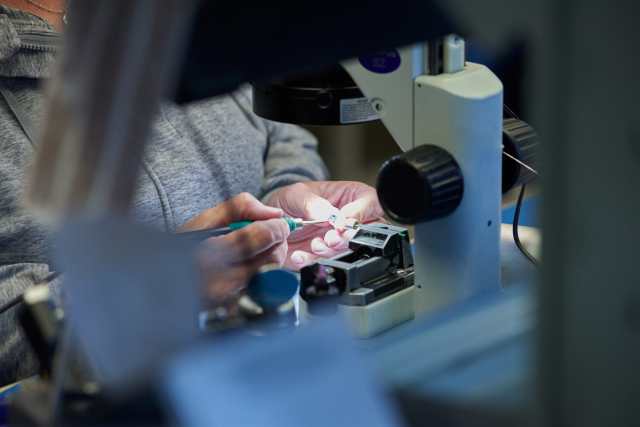 The multidisciplinary team at MINDI Hub develops more efficient semiconductors, enables autonomous devices, builds state-of-the-art communications networks, and creates next-generation sensing technologies for ocean, health, aerospace, and IoT applications. (Source: MINDI Hub)
"This is an incubator that’s intending to support industry, and we’re training students" Bousquet said. "We’re building new curriculum around microelectronics for ocean technology. We want to create more momentum, and we want to create a bigger workforce that will actually support the local industry."
MINDI sits inside a wider Canadian tapestry. Hosted at Dalhousie University, it collaborates with Quebec-based experts, including those at the University of Sherbrooke and Zero Point Cryogenics, while exploring international partnerships. Rather than duplicate every capability locally, the goal is to link Nova Scotia's systems-level strengths to specialized facilities, research talent and suppliers elsewhere in Canada and among allied countries.
What Does the Data Say About the Opportunity?
The integration thesis is easier to credit once the numbers are on the table. Three data points frame it:
- Public commitment: On 21 January 2025, the province announced $1,415,250 for Dalhousie University through its Community Economic Development Fund to establish the industry-focused microelectronics research hub — concrete backing, not rhetoric (Government of Nova Scotia).
- Addressable market: Nova Scotia's ocean economy contributes more than $5 billion annually to provincial GDP, and the province counts more than 300 ocean-technology organizations — a large local test bed for rugged systems (Invest Nova Scotia).
- Tailwind: The global edge-AI market was valued at about $24.9 billion in 2025 and is projected to grow at a 21.7% CAGR, underscoring demand for intelligence that runs locally on constrained devices (Grand View Research).
How does this compare with a fab-led approach? The trade-offs:
| Dimension | Fab-led cluster | Nova Scotia's integration model |
|---|---|---|
| Capital intensity | Multibillion-dollar fabs, high fixed cost | Targeted public funding; $1,415,250 hub investment |
| Primary metric | Process nodes, wafer output | Systems that work in remote, harsh environments |
| Market entry | Global commodity chip cycles | Niche, exportable ocean/defense/health systems |
| Talent pipeline | Process engineers, fab operators | Embedded, sensing and systems engineers |
| Key risk | Capital overcapacity | Scaling niche systems, workforce depth |
What Are the Risks and the Wider Payoff?
Chris Morrissey, CEO of Invest Nova Scotia, sees microelectronics as an enabling layer inside a broader economic strategy rather than a standalone vertical. The province has identified six priority sectors, including energy, defense, natural resources, AI and the digital economy; semiconductors and embedded systems cut across all of them.
Nowhere is that clearer than in defense. Nova Scotia has naval and Coast Guard activity, shipbuilding, aerospace and drone capabilities, defense primes and a growing supplier base. Morrissey said the province has between four and six major defense prime contractors and more than 100 defense companies, creating procurement opportunities and demand for locally relevant R&D.
"The advantage that Nova Scotia has is the research and development expertise that we have here, both in the public and private sectors" Morrissey said, citing MINDI as a good example of public funding.
Opportunities are not limited to military contracts. Sonar and tracking technologies can serve naval requirements and fisheries; drones can support defense missions and wildfire management; sensing systems can aid environmental monitoring, energy operations and safety. Dual-use is a recurring theme — companies extend one core competence into adjacent markets. Across Atlantic Canada, Morrissey argued, provinces should identify complementary strengths instead of chasing identical projects. Newfoundland and Labrador's Marine Institute, for example, has capabilities in marine simulation. Against the pull of Silicon Valley, the emphasis is on fit over imitation.
"We can be complementary to each other" he said. "We’re trying to find each of our own lanes and what’s the competitive advantage for each one but also working together and leaning on each other to make sure we can take advantage of the greater opportunity."
That cooperative stance now reaches beyond the country. Bousquet's quantum-sensing work depends on Quebec partnerships; Atlantic Canadian firms can tap national expertise and markets; and defense, ocean technology, photonics and AI systems rely on supply chains that cross borders. Internationally, Nova Scotia's ocean-facing industries have natural links to Europe, NATO allies and global marine research communities. National policy reinforces the direction: recent federal investment has favored design and advanced packaging over new fabs, including a $662 million packaging expansion announced in late 2025 — lending weight to the "integration, not fabs" logic.
"We do have a lot of the capability; it's just a matter of growing it" he said.
Common Misconceptions
A few assumptions get in the way of reading this strategy correctly:
- "It's a small-time chip hub." It is a different thesis: selling integrated, exportable systems rather than competing on wafer volume.
- "Dual-use means defense-only." The same electronics serve fisheries, environmental monitoring, climate observation and healthcare.
- "Without fabs there is no moat." The difficulty — and the value — lies in making systems survive cold, pressure and power limits, which is hard to replicate.
- "One province can do it alone." The model relies on partnerships across Canada and allied countries.
What Should Enterprises Take Away?
For CIOs, architects and digital-business leaders, the practical implications are concrete:
- Match silicon to environment first. Start from operating conditions — power, connectivity, physical stress — before choosing components.
- Budget for integration, not just chips. Power efficiency and packaging often yield more gains than a faster processor.
- Look to regional ecosystems. Centers like MINDI and COVE show how university talent and industry R&D combine without a fab.
- Plan for dual use. Design sensing and communications platforms that can cross into adjacent markets.
Frequently Asked Questions
Why isn't Nova Scotia building wafer fabs?
Because fabs demand enormous capital and do not match the province's strengths. Its advantage is systems integration for harsh environments, backed by research talent and ocean and defense demand — not high-volume chip manufacturing.
What is the MINDI Hub?
The Microelectronics Innovation Design Hub at Dalhousie University, backed by provincial funding, supports industry, trains students and builds curriculum around microelectronics for ocean technology.
Which product proves the model works?
Innovasea's acoustic fish tags in Bedford — compact, low-power systems that track aquatic animals and carry sensor data — show how integration, not a standalone chip, creates an exportable advantage.
Reference Sources
- Government of Nova Scotia — Province Invests in Advanced Technologies Design Hub (21 January 2025)
- Dalhousie University — industry-focused R&D hub receives $1.4M (22 January 2025)
- Invest Nova Scotia — Ocean Technology sector
- Grand View Research — Edge AI Market Report
- Innovation, Science and Economic Development Canada — semiconductor packaging investment (28 November 2025)