
Why Physical AI Stumbles at the Wireless Link — and What SDR Fixes
A robotics team can have an excellent vision model and still lose hours to dropped links on a factory floor. The weak point is rarely the AI; it is the radio. Software-defined radio (SDR) is the most practical fix because it turns the wireless link into programmable software, letting robots, drones, and sensors change how they connect instead of being locked to a fixed modem. That adaptability is what lets intelligence act on the physical world in real time.
AI models keep getting more capable, and the computing platforms behind them keep getting more powerful. Yet as AI moves into robots, industrial machinery, vehicles, and drones, progress depends on a mundane question: can these systems get the right information at the right moment? Processing power alone is not enough. A machine also needs data about its surroundings, the state of other machines, and the conditions it is operating in. Some of that comes from onboard sensors; the rest has to arrive over a wireless link from nearby devices, infrastructure, remote systems, or shared computing resources. The value of that data depends on its quality, timing, and availability.
Wireless therefore matters more than most AI roadmaps admit. Only information a device can capture, process, and transmit is useful to AI. If the connection is unreliable, inflexible, or mismatched to the environment, data arrives too late, loses context, or never reaches the systems that depend on it. The next phase of physical AI is as much a communications problem as a computing one — and the build-out is already straining shared infrastructure, from AI data centres to the radio access networks that sit at the edge.

AI applications across the physical world rely on seamless, reconfigurable, dynamic connectivity.
Why does physical AI keep failing at the last metre?
Because the requirements change faster than the hardware. A factory robot may need predictable, low-latency communication to coordinate with adjacent machines. An inspection camera may need serious uplink capacity to send detailed images for analysis. A drone flying beyond terrestrial coverage may need a non-terrestrial link, while a remote sensor has to stretch its battery as far as possible.
Requirements also shift during a mission. A robot can alternate between coordinated movement and image collection. When infrastructure coverage drops, a suitably equipped system can exchange data through nearby devices. Each mode places different demands on capacity, delay, and energy.
Joint design of AI processing and communications helps balance those demands. A device can analyse routine observations locally, send short status updates, and upload detailed recordings only when needed. That cuts unnecessary traffic and keeps capacity for information that must arrive promptly. Standard modems cover some of this, but developers often have limited access to the communications software underneath. When an application needs behaviour the modem does not support, configuration changes alone are not enough.
The result is a development gap. AI software can evolve in weeks; adapting a wireless device can mean changes to signal processing, radio hardware, and system design, followed by extensive testing. SDR closes that gap by giving developers more control over communications through software, within the limits of the hardware.

Different AI applications demand unique connectivity requirements.
What makes software-defined radio different from a standard modem?
A standard modem is a fixed function block: it implements a defined set of behaviours, and you get what it exposes. SDR moves the key radio functions into programmable processing — software running on CPUs, DSPs, vector engines, or GPUs, supported by FPGAs and dedicated ASIC accelerators. Within the hardware's capabilities and the standards' requirements, developers can configure and optimise those functions.
3GPP standards define capabilities for many needs: low-latency services, high throughput, direct device-to-device (D2D) links, and non-terrestrial connectivity. But a product still has to implement and integrate the relevant capabilities; being in a standard does not make them available on every platform, because of business and use-case constraints. The standards also keep moving. 3GPP Release 18 expanded 5G sidelink capabilities for public safety and IoT, and Release 19 adds up to two extra relay hops to the single-hop sidelink defined earlier — useful when a direct path is blocked and traffic has to hop through another device.
| Dimension | Standard modem | SDR |
|---|---|---|
| Control | Fixed functions; limited access to internals | Software-configurable within hardware limits |
| Adaptability | Behaviour set at design time | Reconfigurable for changing missions |
| Update path | Vendor-led hardware revision | Software update, where licensed |
| Time to market | Fast if the fit is good | Slower at first, faster to pivot later |
For example, a robot may need low latency for movement coordination, higher uplink capacity for inspection images, and direct links when talking to nearby robots. Supporting shifting needs like that requires an integrated software framework that manages the available communications features and resources. Communications software IP supplies the algorithms, protocol implementation, and hardware integration that make this practical. Standards set interoperable behaviour; implementation choices determine the resources needed to deliver it. Reusable, validated software gives developers a starting point and reduces what they have to build themselves.
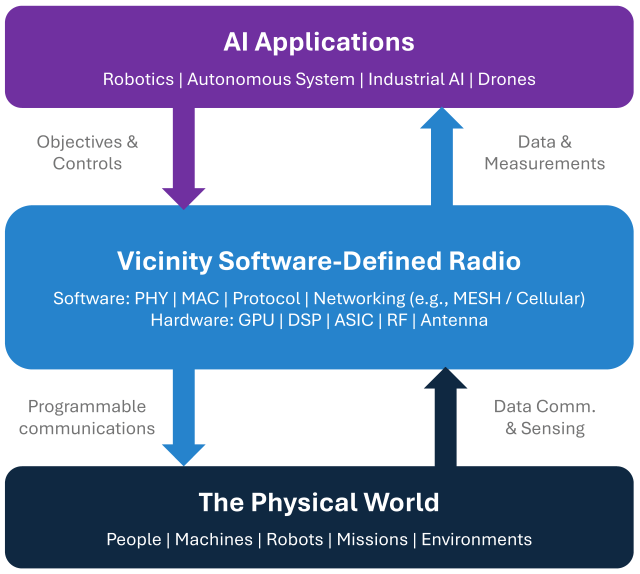
SDR enables programmable connectivity that links AI with the physical world, creating a feedback loop for observation, decision-making, and adaptation.
How do you turn radio measurements into better decisions?
A programmable radio can also report on the conditions it is operating in. Link quality and interference measurements explain whether a connection can support the application. With suitable hardware, signal processing, and system support, radio signals can also contribute to positioning and sensing.
These functions do different jobs. Link measurements describe communications conditions; positioning estimates where devices are; sensing may detect movement or changes in the surroundings. Combining them can improve decisions, but each capability needs its own implementation and validation. In a network that supports relaying or mesh operation, routing can account for signal quality, delay, and available capacity. Position and movement information may help anticipate a weakening link, so the system can assess an alternative route before the current connection fails — where a suitable path exists.
Radio measurements only matter when they trigger an appropriate response. A device might change its transmission settings, defer a large upload, or report that the requested service cannot be maintained. The response must reflect both the application's priorities and the options the network actually has.
Software-defined processing is already proving this in the field. On 29 October 2025, SoftBank reported a trial in which radio signal processing for massive MIMO ran entirely in software on NVIDIA GPUs, achieving 16-layer multi-user MIMO outdoors without bespoke physical-layer silicon. That does not mean general-purpose hardware replaces every radio, but it shows how far the line between hardware and software in the physical layer has moved.
How do you connect AI decisions to radio controls?
The next step is to expose that feedback through application interfaces. An AI application states what information it needs to exchange and its delivery requirements; the communications software maps those requests onto supported controls. This separates application intent from the details of radio implementation.
For example, a robot may request priority for coordination messages or extra capacity for inspection images. The framework evaluates the requests against current resources, applies the supported settings, and reports the resulting service. A request for a particular performance level has to be checked against what the system can actually deliver. Information also flows back: if a link degrades, the robot can reduce its upload rate, process more data locally, or reconsider a task that depends on remote information. That makes network conditions part of mission planning instead of a hidden assumption.
This programmability is also the main security concern. Because the radio's behaviour lives in software, it can be changed — including by an attacker. Reviews of SDR security point out that the same flexibility that makes these radios attractive also opens the door to malicious software and manipulated transmit behaviour, which is why update signing, secure boot, and strict separation between control and data paths belong in the design from the start.
What does it take to go from prototype to a shipping product?
Turning a laboratory prototype into a commercial product is unforgiving. The device must deliver the required wireless performance within practical limits on power consumption, cost, size, and heat, while staying reliable and easy to maintain. Meeting those requirements depends on how efficiently the software uses the hardware. Open-source software offers flexibility, but adapting and optimising it for different platforms can take substantial effort, particularly where processing capacity and power are tight.
That effort is real. SDRs generally need more processing resources than a fixed hardware radio, which can push up size, cost, and power consumption — a genuine constraint for battery-powered drones and small sensors. The industry has been candid about this: power consumption, size, weight, and cost remain the classic barriers to practical handheld SDR devices.
Platform-specific optimisation is where the work pays off. Starting from the customer's application and practical constraints, the software and system design are tailored around the chosen hardware. Validation then checks performance under representative conditions: throughput, latency and its variation, behaviour during movement or interference, recovery after interruptions, and operation with multiple devices. Acceptance criteria should follow the application's needs, so a passing test demonstrates useful performance in the intended setting. After deployment, regression testing, version control, and careful feature integration keep new capabilities from breaking behaviour customers already rely on.
What should buyers watch out for?
Three questions separate a viable SDR programme from an expensive experiment. First, who controls both ends of the link? Improving a terminal is hard when its requirements depend on infrastructure behaviour that cannot be changed; improving a base station has limited value if the connected devices cannot support it. Where a deployment allows control of both ends, coordinated development creates far more room to optimise the whole system. Vicinity's work across base stations, terminals, and direct D2D communications is built around exactly that principle.
Second, what are the real ownership terms? Customers retain ownership of their commercial products and control over their roadmap, but access to and rights to modify the underlying communications software depend on the licensing arrangement. Making that distinction clear avoids surprises later.
Third, is the cost story credible? SDR's flexibility is not free: it trades higher compute load for adaptability. Buyers who do well count the power, thermal, and licensing costs up front rather than discovering them at integration.
FAQ: SDR and physical AI
What is software-defined radio in plain terms?
It is a radio whose core functions — modulation, encoding, filtering — are implemented in software on general-purpose or programmable hardware rather than fixed in silicon. That lets the same hardware support different waveforms and behaviours through updates.
Does SDR replace a 5G modem?
Not directly. SDR is an implementation approach; 5G and 3GPP define the behaviours and interfaces. An SDR-based product can implement 5G capabilities, but it still has to meet the same standards and pass the same interoperability tests.
Is SDR only for defence and military use?
No. Defence remains a large buyer, but industrial robotics, drones, satellite connectivity, and IoT are the growth areas. Market researchers estimate the global SDR market at roughly $15.2 billion by 2030, growing about 6% a year from 2024.
What are the main risks?
Higher compute and power draw than a fixed modem, security exposure from software-controlled radios, and the engineering effort needed to optimise open-source code for a specific platform. Each is manageable, but none should be ignored in the business case.
Who owns the final product?
The customer owns its product and roadmap. The underlying communications software is typically licensed from the IP vendor, and the terms of that licence determine how much the customer can modify and reuse.
Where to start
A practical collaboration begins with a defined use case and measurable operating requirements: what must be exchanged, how quickly, and over what coverage area. From there, select the required capabilities, validate them together, and build a route to commercial production. For hardware partners, device manufacturers, AI developers, researchers, and system integrators, that is the concrete path from an initial idea to products that can be deployed and supported at scale. Vicinity's model is to supply the communications software IP and integration expertise while partners bring platforms, applications, and deployment knowledge.
References
- Research and Markets — Software Defined Radio Market Report, forecast to 2030: https://www.researchandmarkets.com/reports/6008036/software-defined-radio-market-report-trends
- SoftBank Corp. — AI-RAN realises software-only massive MIMO on GPU, 29 October 2025: https://www.softbank.jp/en/corp/news/press/sbkk/2025/20251029_02/
- NVIDIA — Software-defined AI-RAN: https://blogs.nvidia.com/blog/software-defined-ai-ran/
- RF Globalnet — The Trouble With Software Defined Radio (and how to overcome them): https://www.rfglobalnet.com/doc/the-trouble-with-software-defined-radio-and-how-to-overcome-them-0001
- Springer Cybersecurity — Security issues in software-defined radio: a review: https://link.springer.com/article/10.1186/s42400-025-00433-x
- 3GPP — Release 19 summary presentation: https://www.3gpp.org/ftp/Information/presentations/presentations_2026/2026_04_Rel19.pdf
- Qualcomm — A closer look at 5G Advanced Release 18: https://www.qualcomm.com/content/dam/qcomm-martech/dm-assets/documents/a-closer-look-at-5g-advanced-release-18-web.pdf