
ItInsightsWorld Explains: Muse Wonder's Agent Skills Move Into Meta's Free Tier — Who Still Needs a Muse Subscription?

Short answer: on November 6 Meta is not launching a new frontier model, it is moving capabilities that used to sit behind a paywall into products people already use for free. A batch of "specialized versions" trained from the flagship Muse Wonder starts serving Muse and Meta AI users, carrying the two behaviors the Wonder series introduced first — Active Memory and Active Focus. The heavy lifting stays paid: Muse Wonder and the stronger Wonder Full remain aimed at subscribers handling more complex, higher-difficulty work.
What exactly changed on November 6?
Meta's own description is narrow but consequential. From November 6, Muse and Meta AI run a new set of models that belong to the existing model family as "specialized versions," produced by training on Muse Wonder. Their names are still undisclosed. What is confirmed is that they retain the two capabilities — that is, of the Wonder series — and that they are pointed at consumer use rather than at raw capability records.
- The free layer gets agency. Everyday assistant tasks in Muse and Meta AI get the memory and recovery behaviors, not just better answers.
- The ceiling stays behind a subscription. Muse Wonder and the stronger Wonder Full continue to serve paid users who need harder jobs finished.
- The timeline. Muse Wonder and Wonder Full were released in October 2026; Wonder is already integrated into the Meta Model API and the Muse Code programming assistant, while Wonder Full remains limited to high-end Muse Code paying users. The personal assistant app Muse itself launched this September with a free usage tier, where some competitors' comparable products open only to premium subscribers.
Meta's scale explains why the consumer layer matters more than the leaderboard. In its third-quarter 2026 results published on October 21, 2026, the company reported that more than 10 million people in the United States and Canada had set up Muse about six weeks after the September launch, with roughly a quarter using it daily, on quarterly revenue of $64.60 billion. Upgrading the free experience is, in effect, a conversion experiment run on millions of live agents.
Why retrain instead of simply shrinking Muse Wonder?
Because an agent's job is behavioral, not encyclopedic. Meta says it did not just publish a reduced-size Wonder model; it retrained around real consumer scenarios so the new versions spend capacity on three decisions that dominate daily use: when to execute autonomously, when to pause and check with the user, and how to hold context continuous after the user corrects something mid-task.
The more common industry route is different — a large model trains a smaller one so frontier capability can reach a mass audience at lower cost. Meta has not detailed its training method, but emphasizes the optimization target: personal-assistant needs, not wider general-knowledge coverage.
The company's stated bar for a good personal agent is refreshingly small: it should book a restaurant, manage an inbox, remember what you mentioned a week earlier, and keep pushing a job forward when a website throws an error or a task gets interrupted — without carrying the whole knowledge base of a frontier model.
How much better are they? The only numbers Meta gave
Two figures, both from internal testing rather than public benchmarks.
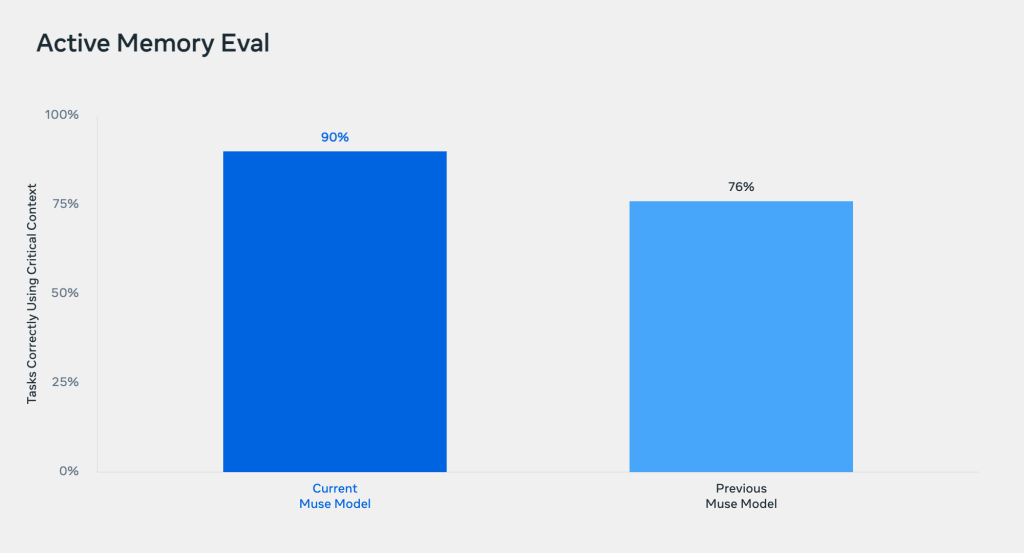
- Context use: 90% versus 76%. During task execution, the new models correctly used key contextual information 90% of the time, against 76% for the previous generation.
- Recovery under surprise: +67%. Inside the Muse app, the new models improved by 67% in completing routine tasks when unexpected problems appeared.
Meta published no benchmark methodology, saying only that gains show up in autonomous decision-making, absorbing changes made mid-course, and continuing a task to the end. Until third-party numbers land, run your own acceptance test: give the agent a four-step errand, change one requirement after step two, break the target checkout page, then count whether it reports the obstacle with a workaround or simply stops. Launch-day guidance from agent-testing outfit Apito pressed the same discipline from the developer side — Meta's announcement confirmed only that Wonder Full serves high-end Muse Code subscribers, so confirm what your console and the official docs actually expose before you build on it.
Which model can you use, and where?
| Model or tier | Who can use it | Where it shows up | Best fit |
|---|---|---|---|
| Muse Wonder | Paying users and developers | Developer access through Meta's model interface, billed per input and output token | The most complex, highest-difficulty tasks |
| Wonder | Developers and coding subscribers | Integrated into the Meta Model API and the Muse Code programming assistant | Build and coding work inside existing tooling |
| Wonder Full | High-end Muse Code paid users only | Not offered through the open API | Users already buying top usage tiers |
| New specialized versions | Muse and Meta AI users, including the free tier | Inside the consumer assistant experience | Scheduling, email triage, reminders, follow-through |
Free specialized model or paid plan: what are you actually choosing?
| Dimension | Specialized versions (free layer) | Wonder Full (premium subscription) |
|---|---|---|
| Core strength | Remembering you and staying on task when things break | Headroom for long, complex, multi-step work |
| Typical job | Booking, inbox, follow-ups, cross-day context | Deep research, heavy coding, hard reasoning |
| Access route | Muse and Meta AI, from November 6 | High-end Muse Code plans; no API route announced |
| Cost signal | Free tier plus paid plans; industry coverage at the October 2026 launch reported Muse app plans around $20 and $100 a month, and Muse Code's upper tiers near $50 and $200 a month | Same plan ladder, capped by the usage allowance you buy |
| Caveat | Model names undisclosed, so behavior can shift without notice | Confirm live tiers and pricing in the app or console; third-party write-ups are secondary sources |
What Active Memory adds — and the risk nobody mentions
Conclusion: memory is the most visible upgrade in this release, and also the setting most worth reading.
Active Memory is built to hold and reuse information about you over long stretches. Meta says the new versions can separate throwaway content from what deserves long-term storage, and reason across time to decide which details are still relevant and which have gone stale. Active Focus, the second of the two behaviors, handles surprises: Meta says the models were trained across large volumes of real-world obstacle scenarios, so a blocked path triggers more attempted solutions, self-recovery or a detour instead of a stop.
Persistent memory is a two-way feature. The OWASP AI Agent Security guidance tells builders to set memory expiration and size limits, audit contents before they are persisted, and protect long-term memory with integrity checks — because a stored wrong fact, or an injected one, survives the session that created it. For consumers the practical version is simpler: review what your agent has learned about you, delete the obsolete, and keep health, financial and address details out of storage unless the task truly needs them.
Memory also compounds with the interface layer. Meta has been extending the same app outward; our breakdown of Muse's real-time voice and on-screen avatar shows where spoken conversation and stored context start to overlap in daily use.
Why this is a strategy story, not just a version bump
Commercially, Muse Wonder is served to developers through Meta's model interface with charges based on input and output tokens, while Meta AI is already distributed across WhatsApp, Instagram, Facebook and Messenger. Letting every user call the flagship directly would be prohibitively expensive; serving the crowd with Wonder-trained lightweight specialized models, and selling full-strength capability as subscriptions, lets Meta price the mass layer and the ceiling separately.
That is the newer consumer-AI playbook in one line: use the most advanced frontier model to train scenario-specific specialists, then deploy them at lower cost and larger scale inside consumer products. It is the same logic behind the spending race we examined in why Meta is pouring capital into AI to catch OpenAI, Anthropic and Google. Expect the split to widen rather than close.
Four misconceptions about the November 6 update
- "Free tier now means a frontier model." It means a specialized version trained from one; names, sizes and caps are still undisclosed.
- "I can buy Wonder Full if I pay enough." Meta's announcement puts it inside high-end Muse Code subscriptions only, with no API route.
- "90% and 67% are benchmark scores." They are Meta's internal test results, published without benchmark data.
- "More memory automatically means a better agent." Only if what is stored stays accurate and current; stale memory is a failure mode, not a feature.
What to do now: a five-step checklist
- Start free. Point the specialized versions at the errands that fail today for boring reasons — interrupted bookings, email chains that need yesterday's detail.
- Score the recovery, not the answer. One real task with a deliberate mid-course change tells you more than any demo.
- Audit memory monthly. Clear obsolete facts before they shape a decision.
- Upgrade for headroom, not convenience. Long multi-file coding, batch jobs and deep analysis are where Muse Wonder and Wonder Full justify the fee.
- Builders, read the meter. Token-billed access via the Meta Model API means the same task can cost very differently across tiers; verify availability and price in your console first.
FAQ: what readers are asking
Do I have to pay for the new Muse capabilities?
No. From November 6 the specialized versions run for Muse and Meta AI users, including on the free tier the app has offered since its launch this September. Muse Wonder and Wonder Full remain paid options for more complex tasks.
What are the new models called?
Meta has not published specific names, and has confirmed only that they are trained from Muse Wonder and keep Active Memory and Active Focus.
Can I call Wonder Full through an API?
Not per the current announcement, which limits it to high-end Muse Code subscribers. Wonder itself is already integrated into the Meta Model API and Muse Code; check your own console and the official docs for what you can invoke today.
Is a remembering agent safe to use?
Manageably so. Apply the OWASP-style hygiene — expiry limits, review before persistence, integrity protection — and treat stored personal context as data you may later want to erase.
Does this change how I should compare Muse with rivals?
Shift the comparison from raw model quality to follow-through: how well the agent keeps context, recovers from errors, and stays inside a price you would actually pay.
Takeaway: the interesting part of this release is not a new model but a new distribution trick — frontier behavior licensed down into a free assistant, with the ceiling sold separately. For readers, the move is a net gain in daily usefulness and a new chore: managing what your agent now remembers.
References
- Meta investor relations, Meta Reports Third Quarter 2026 Results (October 21, 2026) — Muse agent adoption and quarterly figures.
- OWASP Cheat Sheet Series, AI Agent Security — memory expiration, pre-persistence auditing and integrity checks for agent memory.
- Apito, launch-day note on Muse Wonder acceptance testing and billing (agent-testing checklist on API availability).
- Industry pricing coverage at the October 2026 Muse Wonder launch, ebrun.com.