
ItInsightsWorld General Guide: Judging Maybelline's 'Maybe.' Rewrite in Five Practical Steps
The short answer: Maybelline swapped one pronoun, added full stops, and made the result permanent. Since November 10 the line reads “Maybe. We're born with it. Maybe. It's Maybelline.” — an edit small enough to miss in a headline, and large enough to change who the sentence is about. The test for any brand team watching is not whether the words sound familiar, but whether an edit that small can carry a promise that broad.
The mechanics were plain. The announcement landed on November 10 with Miley Cyrus fronting a new global platform, and the brand framed the wording change as permanent rather than a seasonal variation, 35 years after the line first appeared. What follows is a working guide for the people who have to judge a slogan edit like this one — including the parts the launch material leaves open.
What Exactly Changed in the Line — and What Stayed the Same?
Only the subject and the punctuation moved; the rhythm did not. That is the whole technical edit, and it explains why the line still sounds like the one audiences have heard since 1991.
| Element | Original wording | Wording from November 10 | What it means for a brand team |
|---|---|---|---|
| Subject | “she's” — one woman being assessed | “we're” — a collective | Widens the audience without enlarging the product claim |
| Punctuation | The question runs on in one breath | Full stops give “Maybe” its own beat | Turns an open question into a statement |
| Promise | Beauty may be inherited, or it may be assisted | Possibility and self-expression | Needs product-level proof to land |
| Status | Signature line for 35 years | Permanent replacement, not a seasonal variant | Any measurement baseline has to be rebuilt |
Maybelline is altering its wording permanently, 35 years after the original line appeared, according to the brand's November 10 announcement, which dates the original to 1991. Nothing else in the sentence was touched: same beat, same brand name at the close, same two-part structure that lets a listener finish it unprompted.
For an audience that knows the slogan, the old shape supplies the point of recognition, while the altered subject gives the campaign something new to explain. A collective subject moves the sentence from judging how one person looks toward the different versions of herself a person might try out. That is a shift in point of view, not a rewrite of the tune.
The risk sits in precisely the same place. A one-word change has to be explainable in a single sentence, or it reads as a copy edit dressed up as an idea.
Why Is Miley Cyrus Fronting the Change Rather Than Just Voicing It?
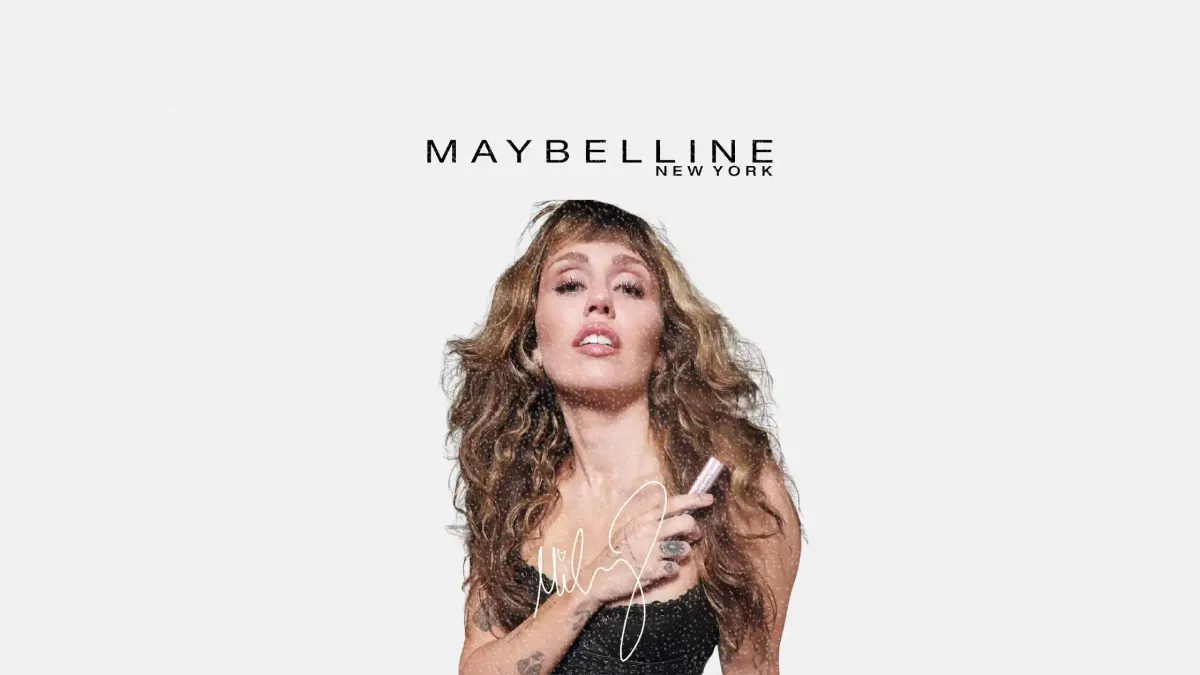
Because her own catalogue is a series of restarts, she can demonstrate the idea instead of asserting it. The campaign borrows a career that already resembles the sentence.
ContentGrip
Cyrus gives the abstraction a worked example. The campaign links her changing sounds and looks to the freedom to experiment with makeup, presenting distinct creative chapters without reducing her to a single one of them.
“I think of 'Maybe.' as all the doors being open,” Cyrus says in the announcement.
Her role also supplies continuity. In the previous campaign she gave Maybelline's jingle a new performance; here she helps explain a change to the words themselves. Those are separate jobs for an ambassador. One refreshes how a brand is heard, while the other translates a revised brand promise for people who already know the old version by heart.
The rewrite is also the vehicle for a named global platform, “The Beauty of Infinite Possibility,” per the brand's November 10 release distributed through PR Newswire. That framing matters to anyone judging the work, because the slogan is carrying a broader claim rather than standing alone as a clever line.
Nor is the pattern new. Trade coverage in September 2024 already recorded a “Maybe It's Maybelline” revival rebuilt for short-form video (Retail Dive), which places the November 10 change as another pass at a long-lived asset rather than a first attempt. Each pass raises the bar: audiences have watched the line get refreshed before, so novelty by itself will not carry the campaign.
Where Does the Message Have to Meet the Product?
On the shelf and in the bathroom mirror. The campaign page connects the self-expression story to familiar categories — mascara, lip color and concealer — with Cyrus's own product preferences and application guidance placed beside the wider narrative about experimentation.
That connection is the load-bearing wall. A brand platform has to work beyond a manifesto; a viewer who nods at the film still needs to understand what the idea means at a display unit or during a five-minute morning routine.
Maybelline says the platform will develop through additional women's stories, product innovations, collaborations and campaigns. Those plans leave room for different readings of the same idea. They do not establish that the positioning has already changed consumer behavior.
The comparison with the earlier jingle remains the most useful check. Familiarity makes a campaign easy to recognize, but recognition alone cannot explain why the message should mean something different now. The new work has to carry both jobs at once.
Which Five Checks Tell You Whether a Small Rewrite Will Hold?
Run them in order, and write the answers down before the launch film ships. An earlier ItInsightsWorld General read, How to Read the Maybelline Maybe. Tagline Refresh as a Practical Signal, covered the signal-reading half of this; the list below covers the doing half.
- State the old line's job before touching it. In this case the job was a compliment about appearance; the new job is permission to explore. If you cannot name the old job, you cannot judge whether the new one is an upgrade or a swap.
- Isolate the smallest variable you can defend. Maybelline moved a pronoun and the punctuation and kept the melody. A change that can be described in one sentence is easier to explain, easier to test and easier to reverse than a full replacement.
- Check whether the spokesperson's story is continuous. Cyrus performed the jingle, then explained its rewrite. A face with a thread between campaigns does narrative work that a new celebrity cannot do on day one.
- Force the idea onto a shelf. Ask what the line changes in product copy, in store, in a tutorial. If the answer is nothing, the platform is a manifesto with no distribution.
- Register the measurement plan at the same time as the creative. The November 10 release footnotes category research — McKinsey's 2026 report on the beauty categories, channels and concepts shaping the next decade, and Cosmetics Europe's 2026 consumer perception study — which shows the change was argued from market context rather than taste. Your own evidence has to be equally concrete.
Which Mistakes Trip Up Brand Teams Most?
Most failures are measurement failures wearing creative clothes. The table below is the short version of what goes wrong when a famous line is edited.
| Mistake | How it shows up | Fix |
|---|---|---|
| Reading recognition as meaning | The team proves people remember the line, not that they can say what changed | Add one unaided question: what does the line mean now? |
| Treating day-one reaction as the verdict | Punctuation jokes dominate the first 48 hours; Forbes had already described the rollout as polarizing on November 11, a day after launch | Track sentiment across weeks against a pre-launch window |
| Letting the manifesto outrun the merchandising | A strong film lands and the shelf language never catches up | Ship product-level copy in the same cycle as the campaign |
| Changing two things at once | New words, a new platform and a new narrative all arrive together | Keep the tune and the face; move only the wording |
| No baseline | Nobody recorded recall or sentiment before the announcement | Field the pre-wave anyway and label the gap honestly |
How Should a Team Measure a Slogan Change Like This?
Measure what the edit was designed to do, not what is easiest to count. Five indicators cover most of the ground.
- Unaided recall of the full line, not just the brand name, split by age cohort — the collective subject is aimed at younger audiences, and the split tells you whether it landed there.
- Correct attribution of the change. If consumers cannot say that the subject moved from one woman to everyone, the edit is being felt rather than understood.
- Sentiment trend over four to eight weeks. Day-one mockery about punctuation is expected noise; a flat line after two months is a signal. Treat this as analysis, not as a published brand metric.
- Shelf and search behavior. Branded search for the phrase, product page visits and tutorial engagement show whether curiosity converts into consideration.
- Earned coverage quality rather than volume. The useful question is whether outlets repeat the new subject or only the joke about it.
Maybelline has not disclosed results for the new campaign. Its commercial impact will depend on what the platform becomes across products and markets, beyond the opening film.
Frequently Asked Questions
Is the 1991 wording gone for good?
According to the brand's November 10 announcement, yes — the change is permanent, not a seasonal variant. The original dates to 1991, which makes the line 35 years old at the point of replacement.
Did punctuation really change the meaning?
It changes how the sentence is read. Full stops give “Maybe” a beat of its own and turn a question into a statement, while the subject shifts from one woman to everyone. The melody does the continuity work; the stops do the repositioning.
Has the reaction been positive?
Mixed. Forbes framed the launch as polarizing the day after it went live, and much of the early commentary focused on the stops rather than the strategy. That is a reaction to the wording, not evidence about sales.
Has Maybelline published any numbers?
No results were disclosed with the announcement. Any figure circulating now is an external estimate rather than a brand-reported outcome.
Does a collective “we're” change what the makeup claims to do?
Not directly. The product guidance — mascara, lip color, concealer, application advice — carries the promise into everyday use. Without that translation, a collective subject stays a sentiment.
What Should Brand Teams Take Away This Week?
- Write down what the old line was doing before you touch it. That note is your only honest baseline.
- Keep the variable small and the explanation shorter than the campaign film.
- Budget for the shelf, not just the launch — ambassador-led edits live or die in product copy, as reviews like Jung Kook Styles Calvin Klein's Holiday 2026 Edit keep showing.
- Read week-eight sentiment, not hour-eight sentiment.
For brand teams, the interesting part is the balance between memory and meaning. A recognizable line gives an audience a way in. The work that follows has to make the revised promise worth remembering.
This article is produced by ContentGrow; the checklist, the measurement framework and the ItInsightsWorld edit are by Nathan Hale.
Sources
- Maybelline New York brand announcement, November 10, 2026, distributed via PR Newswire Asia: release text
- Forbes, “Maybelline Rolls Out Polarizing New Tagline To Replace 'Maybe She's Born With It, Maybe It's Maybelline' Slogan After 35 Years,” November 11, 2026: forbes.com
- Retail Dive, “'Maybe It's Maybelline' returns, reworked for TikTok era of marketing,” September 3, 2024: retaildive.com
- 9NEWS, report on the removal of “she” from the iconic tagline, November 11, 2026: 9news.com