
A Practical Checklist for Judging a Global Fan Campaign: Liverpool FC's Nice one, Reviewed
Start with the smallest checkable detail rather than the film. A code — “Nice One” — buys free entry to the Liverpool FC Museum between 1 to 30 November, provided you book online first. That single line carries more signal than the slogan does. Short answer: judge any fan campaign on three axes — where it physically runs, how long it runs, and whether it removes a real cost for the people it claims to thank.
What did Liverpool FC actually ship
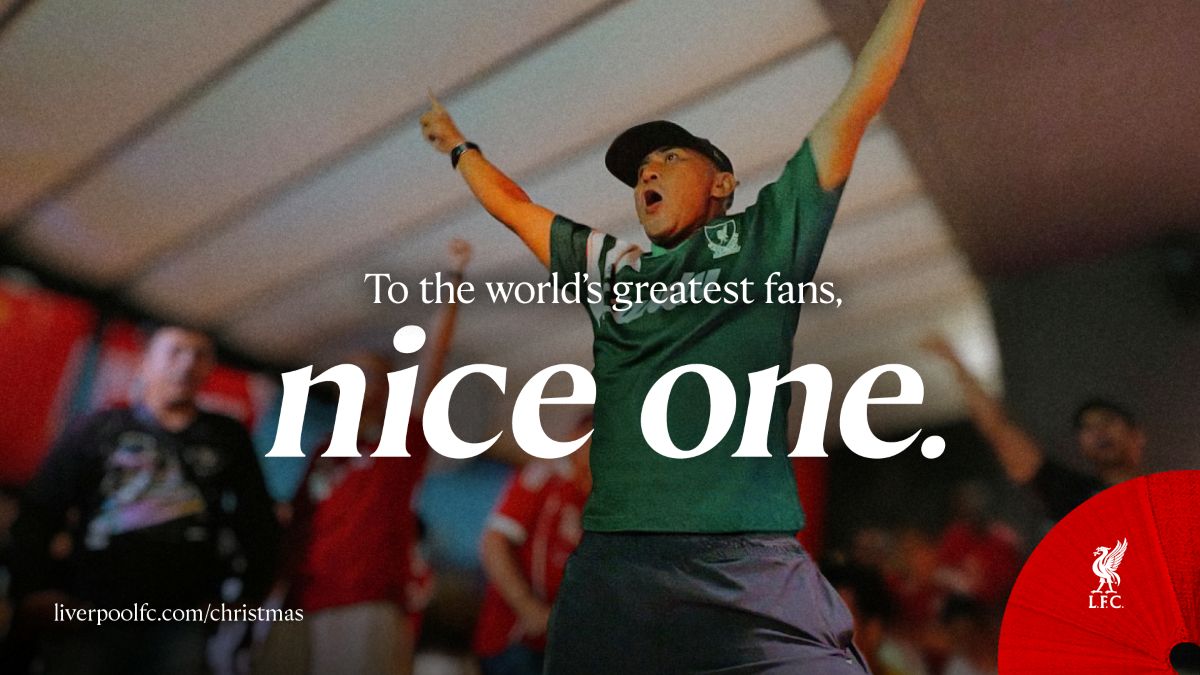
Conclusion first: Nice one is a distribution exercise wrapped in a greeting. The club took its annual Christmas slot and widened it into a multimedia push that spans 24 cities, 16 countries and five continents. The spine is Dear Reds, a short film in which captain Virgil van Dijk, Alexis Mac Allister, Alisson Becker and Florian Wirtz thank supporters for staying loyal. The film closes on a written line: “This club doesn't belong to us. But we're honoured to represent it. And it's an honour to play for you. To the world's greatest fans, nice one.”
Placement runs on out-of-home (OOH), digital and social media until the end of December 2026, with further fan-focused activations still to be announced across the festive period. The club's own framing is the most extensive effort of its 134-year history, addressed to a supporter base of more than 450 million.
Which numbers in this release can you verify
Conclusion: geography and calendar are checkable; audience size is not, because no measurement method is published. In outdoor media, reach, frequency and impressions are three separate quantities — reach counts unique individuals exposed inside a campaign window, frequency counts how often the average person sees the ad, and impressions count exposure events, usually modelled from traffic counts and mobile location data. The OAAA's OOH measurement guide draws the same distinction between modelled exposure and claimed audience.
Applied to this campaign, “more than 450 million” reads as an audience inventory figure — the club's global supporter base — not as campaign exposure. The same caution applies to more than 227 million social media followers and more than 1.5 billion social media engagements, the numbers behind the claim that Liverpool FC is the Premier League's most engaged club for the third consecutive season, according to the club. Labelled as analysis rather than fact: self-reported totals are useful context and poor proof, since no third party, window or counting rule is named in the brief.
Why the city list is the most useful line in the brief
Conclusion: the media plan buys community addresses, not raw footfall. Outside Liverpool, boards appear around Official Liverpool Supporters Club locations in 24 cities across 16 countries, including Singapore, Bangkok, Hong Kong, Tokyo and Jakarta, with London, New York, Los Angeles, Dubai, Cape Town and Paris also covered. A supporters' club is a pre-qualified audience: people who already meet, pay subscriptions and travel to watch together. Buying relevance this way is cheaper than buying a high-traffic site, and it is the one decision here that any brand with a membership list can copy without a film budget.
What the offer mechanics reveal: a fan's decision path
- Read the window. Deals such as £10 off purchases of £70, plus an additional £10 saving when paying with PayPal, are live only until 19 November — well ahead of the festive period the campaign claims to serve.
- Check your tier. Red members receive an additional 10% discount, so the offer stacks unevenly between logged-in members and anonymous visitors.
- Book the free item. Supporters can enter the Liverpool FC Museum at no cost from 1 to 30 November using the code “Nice One”, booked online in advance.
- Watch the partner stack. Further fan-focused activations and giveback initiatives arrive during the Christmas period with PayPal, Carlsberg and Expedia.
- Decide what you are actually buying: a discounted basket, a museum visit, or nothing. The thank-you costs the club a media line; the merchandise is where cash moves.
One operational trap for anyone replicating the format: supporter-captured images and videos are fed into digital and social executions, which makes the organiser a processor of other people's files. Where those files land matters. Media pushed through public iCloud links now fall under Apple's announced scanning policy from iOS 27.3, with removal, account limits or referrals possible, so a fan call-out built on shared cloud folders can lose assets mid-flight. Route submissions through a form on infrastructure you control instead.
How Nice one compares with the club's other 2026 activations
| Activation | Scope stated | Output reported | What a reader can check |
|---|---|---|---|
| Nice one / Dear Reds | 24 cities, 16 countries, five continents | No reach, frequency or conversion figure published | City list, placement dates |
| The Famous CFC (Ascott) | Kuala Lumpur | more than 200 supporters and loyalty programme members | Attendance scale |
| Invest like champions (Standard Chartered) | 12 markets | Not published in the brief | Market count only |
| Signs of unity (Carlsberg) | British Sign Language teaching around You'll Never Walk Alone | Not published in the brief | Accessibility change, not audience size |
| Carlsberg 'Champions' title activation (earlier) | 32 markets, sales into 55 countries | Post-campaign research: 1 in 2 aware fans | Hard partner-side numbers do exist |
The pattern across the year is activation-heavy and reporting-light. Earlier this month, Ascott brought its Chelsea FC fan engagement programme, The Famous CFC, to Kuala Lumpur, gathering more than 200 supporters and loyalty programme members for meet-and-greets, fan activities and a live match screening. In March, Liverpool FC and Carlsberg's Signs of unity initiative worked on making the club's anthem more accessible, teaching supporters British Sign Language (BSL) so deaf and hard-of-hearing fans could take part in a matchday tradition. In February, Standard Chartered partnered with Liverpool FC on Invest like champions, a campaign across 12 markets that drew parallels between football discipline and wealth investment. Coca-Cola and the club also extended their partnership, re-focused on fan experiences, rewards programmes and digital campaigns.
Worth noting from the comparison row: partner work has been measured before, with post-campaign research published by the sponsor. A thank-you campaign shipped without such figures is a messaging choice, not a limit of the medium.
Is “fans at the centre” strategy or copy
Hannah Pym, senior vice president of marketing and digital at Liverpool FC, put the intent plainly: “With 'Nice one', we're putting the world's greatest fans at the heart of our Christmas campaign and delivering football's biggest-ever thank you to the people who help make this club so special,” Pym said. She added that the campaign reflects the club's growing cultural influence beyond football, aimed at supporters who follow sport, entertainment and popular culture. Virgil van Dijk described it as an honour to represent supporters both at Anfield and around the world. Grace Fisk, captain of Liverpool FC Women, treated the same slot as a chance to recognise her team's growing supporter community.
Plain reading: that statement is brand language, and nothing in the release attaches a metric to it. The one line with a structural decision behind it is the use of supporter-captured material, which hands a narrow slice of editorial control to fans.
The community layer, and what the reporting does not split out
The campaign runs alongside the LFC Foundation's annual Christmas Magic initiative, which supports families across the Liverpool City Region through the festive season. Last year's edition reached more families than ever before, with food support a core part of the work. For scale, the Foundation's own impact reporting records 145,617 people supported in 2024/25 and 239,421 across 2025-26, a 65 per cent rise, in its independently verified social impact figures.
Nothing in the campaign brief separates the women's team audience from the men's, and no giveback number is broken out by channel. A missing breakdown is not a failure; it simply caps what an outsider can conclude.
Common misreads
- Treating more than 450 million as campaign reach. It is a supporter-base inventory, not exposure bought or earned.
- Assuming the 24 cities carry the film. The release specifies OOH placement around supporter-club locations; the film's local distribution is not stated per market.
- Reading the discount mechanics as Christmas offers. The strongest stack closes on 19 November, before December placement even peaks.
- Counting social followers as proof of activation quality. Followers measure history, not this campaign.
- Equating “fan content used” with “fan control shared”. One is a sourcing decision, the other is governance.
Questions readers keep asking
Is Nice one just a Christmas advert?
No. It is a multi-channel run on OOH, digital and social that keeps airing until the end of December 2026, with the film as its anchor asset rather than its whole payload.
How do I tell whether the claimed scale is real?
Check three items only: the physical city list, the date ranges you can test yourself, and whether any third party published reach or conversion data. Here, two of the three pass.
Can supporters outside the UK take part?
Yes, in two practical ways — boards near Official Liverpool Supporters Club venues in the named cities, and free museum entry booked online between 1 to 30 November with the code.
Does any of this reach families in Liverpool itself?
That is the part least dependent on media spend: the Christmas Magic initiative supports households in the Liverpool City Region, and the Foundation's reporting shows a rising number of people supported year on year.
A reusable checklist before you trust or copy a campaign like this
- Separate audience inventory from campaign exposure before repeating any big number.
- Map placements to pre-existing community nodes, the way this plan maps to supporter clubs in Singapore, Bangkok, Hong Kong, Tokyo and Jakarta.
- Write down the offer window and check whether it aligns with the story being told.
- Ask who owns the fan-submitted files, and where they are stored.
- Look for one independent measurement; if there is none, present the figures as claims.
- Check whether accessibility work — a British Sign Language version of a tradition, for example — is funded or merely mentioned.
- End with a decision: what would you have to see next quarter to know this worked.
Sources
- Liverpool FC newsroom, “Nice one” campaign announcement: https://www.liverpoolfc.com/news/nice-one-lfc-uses-christmas-campaign-biggest-ever-thank-you-to-fans
- Ministry of Sport on the 24-city rollout (9 November 2026): https://ministryofsport.com/liverpool-football-club-executes-historic-global-campaign-to-thank-international-fanbase/
- OAAA, OOH Measurement and Analytics Guide: https://oaaa.org/wp-content/uploads/2022/09/OOH-Measurement-and-Analytics-Guide.pdf
- Clear Channel Outdoor, OOH metrics explained (reach, frequency, impressions): https://clearchanneloutdoor.com/blog/ooh-metrics-explained-a-guide-to-impressions-reach-cpm-and-more/
- Sponsorship.org ESA Awards, Carlsberg and Liverpool FC 'Champions' campaign record: https://sponsorship.org/esa-awards/carlsberg-liverpool-fc-champions-campaign/
- LFC Foundation impact reporting, 2024/25 and 2025-26 figures: https://www.football-ecology.org/en/football-news/premier-league/lfc-foundation-helps-239421-people-social-impact-rise and https://sportlocalaction.org/impact-report/lfc-foundation-impact-report-2024-25