
164,000 Signatures vs. One Treasury Secretary: The Real Odds on Jensen Huang Returning to Nvidia | ItInsightsWorld General
Nvidia is living the dilemma every board dreads: one camp wants the founder back, the other wants a clean break. As of 9:15 a.m. Beijing time on November 16, 164,000 people had signed a public letter demanding the return of Jensen Huang — including more than 9,000 current and former Nvidia employees and nearly 90,000 shareholders. At the same time, the United States Treasury Secretary Bessent has publicly pushed the company to recruit its next CEO from outside. The short answer to the question in the title: the comeback campaign is real and runs unusually deep inside the company, but the call belongs to a board that, on current evidence, is in no hurry to bend.
What do the 164,000 signatures actually prove?
First conclusion: this is not a social-media stunt. The signature base maps directly onto Nvidia's own roster, which is what makes it unusual:
- Total signatures: 164,000 (as of 9:15 a.m. Beijing time, November 16, per the petition site)
- Current and former Nvidia employees: more than 9,000
- Self-identified shareholders: nearly 90,000
- Other supporters: more than 60,000
- Set against a workforce of about 42,000, the signed employees equal roughly 19.3% of the whole company
Read plainly: roughly one in five employees was willing to put a name on a letter about their own CEO within days of his exit. That is a loyalty signal, not a governance mechanism. Boards answer to fiduciary duties, not petition counts — and the gap between the two is exactly where the uncertainty lives.
Why are Nvidia's own engineers taking this personally?
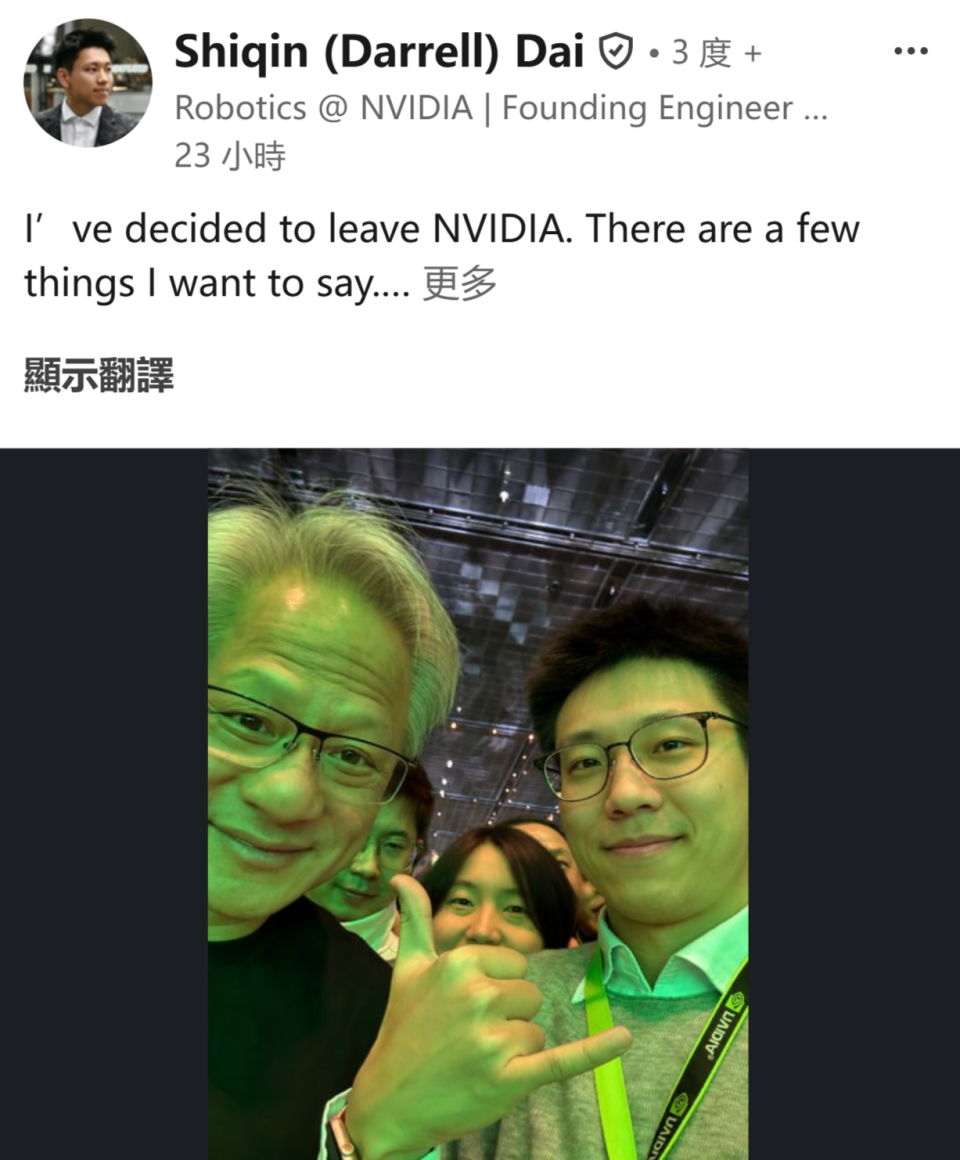
Conclusion first: the exits that followed Huang's resignation are about a twenty-year investment bet, not sentimentality. Jiemian News reported on November 16 that Nvidia robotics learning engineer Dai Shiqin, known as Darrell Dai, announced yesterday that he was leaving the company. In his account, Huang was never just a chief executive: he admired Huang's willingness to fund technologies with no visible short-term payoff. Long before the deep-learning boom, Huang had already committed to CUDA — Nvidia's software layer that lets programmers use graphics chips for general-purpose computing — and had laid out the AI groundwork before AI became everyone's business. Those decisions, Dai argued, built the infrastructure the entire AI industry now runs on, and Huang's departure convinced him that his own chapter at Nvidia should close too.
Some context the petitions rarely spell out: Nvidia announced CUDA in November 2006, so the platform the engineer praises is marking its twentieth year this month — two decades in which it looked to many investors like an expensive side project before it became the substrate of modern AI. Huang co-founded the company in 1993, and his resignation on November 12 ended a 33-year run as its leader. When the person who made a twenty-year bet on your field walks out, some engineers reasonably recompute their own timelines.
Bring him back or hire from outside — which path holds up?
Conclusion: on the public record, neither path is risk-free, and the board is treating this as its decision, not the crowd's. Here is the comparison as we read it (analysis, not sourced fact):
| Dimension | Reinstate Huang | Hire externally | Stay interim (Colette Kress) |
|---|---|---|---|
| What it signals | Continuity; the 33-year strategy stays intact | Governance reset once the investigation closes | Stability without a verdict |
| Who is pushing for it | Petition signers, some large shareholders, Silicon Valley allies | United States Treasury Secretary Bessent | Nobody campaign-style; it is the default since November 12 |
| Main risk | Undercuts the integrity question the probe is meant to answer | Strategy drift; more exits of the Darrell Dai kind | Investor patience runs out quarter by quarter |
| Cheapest test to watch | Whether the board formally engages the return option | Speed and profile of the search shortlist | Tone of the November 17 earnings call |
Who actually decides — and what are they saying?
Conclusion: the pressure is real, but the people holding the vote are not moving yet. Three developments frame the standoff. First, United States Treasury Secretary Bessent publicly demanded that Nvidia look outside for a new chief executive and make major adjustments to the company — an unusual degree of involvement by a cabinet official in a private company's personnel choice. Second, two of Nvidia's major shareholders sent the board an open letter urging it to weigh every option for future leadership, including the possibility of Huang's return, and not to rush the search. Third, DW, citing the Financial Times, reported that Huang's Silicon Valley allies were organizing lobbying and that he had discussed a possible return with close aides.
Against that, a Wall Street Journal report on November 17 said the board is not considering reinstalling Huang despite the noise from investors and employees, while it runs its own independent investigation into Huang. That probe, not the signature count, is the actual decision gate. In the meantime, interim CEO Colette Kress is running the company with her team.
What should the November 17 earnings actually tell you?
Conclusion: watch the call, not just the headline numbers — this is the first hard datapoint since the resignation. Nvidia reports its fiscal 2027 third-quarter results on November 17, the first earnings release since Huang stepped down. Markets are watching two things at once: whether the growth streak continues, and what Colette Kress says about operations and future strategy. The cost of uncertainty is already on the tape — last week the stock fell a cumulative 12.75%. If guidance holds and customer spending commentary stays firm, the leadership question becomes a governance story; if guidance wobbles, the two problems compound, and the price of a leadership vacuum gets measured in the open market rather than in op-eds.
Three misconceptions worth clearing up
- '164,000 signatures mean the board must respond.' No. A petition carries no formal standing in a Delaware corporation's choice of CEO; it is a sentiment gauge, and a time-sensitive one.
- '19.3% of employees signed, so the company is coming apart.' No. Signing a letter is not a walkout. Most of the roughly 42,000-person workforce has stayed quiet, and Dai is one publicly known exit so far.
- 'A strong earnings beat ends the crisis.' No. Operations and governance run on separate tracks. Good fiscal 2027 third-quarter numbers do not answer the investigation, and weak ones do not settle it.
FAQ
Has Jensen Huang himself said he wants to return?
Not in his own public words. DW, citing the Financial Times, reported that he has discussed the possibility with close aides while supporters lobby the board. Treat anything beyond that as speculation.
Who is running Nvidia right now?
Colette Kress, as interim CEO, together with her team. The board continues the CEO search and the independent investigation in parallel.
When will there be a clearer answer?
The nearest fixed date is November 17, the fiscal 2027 third-quarter earnings, where Kress is expected to speak. The investigation's timeline has not been published.
What to do next
- If you hold the stock: anchor your judgment on the November 17 print and the guidance commentary, not on petition counts that move by the hour.
- If your company runs on Nvidia's stack: nothing in the public record suggests a CUDA roadmap change — the platform is twenty years old and deeply embedded. Watch R&D signals on the call rather than reshuffle headlines.
- If you are tracking the story: quote the signature number with its timestamp — November 16, 9:15 a.m. Beijing time, 164,000 signatures — because stale counts mislead faster than they inform.
The next step is unglamorous: read the earnings transcript on November 17, note exactly what Colette Kress commits to, and only then decide whether a return is a live scenario or a closed one. Everything else right now is lobbying.
Reference sources
- NVIDIA Blog, 'CUDA at 20' (CUDA announced November 2006): https://blogs.nvidia.com/blog/20-years-cuda/
- Britannica Money, 'Jensen Huang' (co-founded Nvidia in 1993; November 12 resignation ended a 33-year tenure): https://www.britannica.com/money/Jensen-Huang
- The Wall Street Journal (Chinese edition), November 17, 2026 (board not considering reinstatement): https://cn.wsj.com/articles/%E8%8B%B1%E4%BC%9F%E8%BE%BE%E8%91%A3%E4%BA%8B%E4%BC%9A%E6%97%A0%E6%84%8F%E8%AE%A9%E9%BB%84%E4%BB%81%E5%8B%8B%E5%A4%8D%E4%BB%BBceo-aac100fd
- CNBC report via C114, November 15, 2026 (major shareholders' open letter; interim CEO Colette Kress): https://www.c114.net.cn/industry/146658.html
- DW Chinese, November 17, 2026 (FT-reported return lobbying): https://www.dw.com/zh/%E9%BB%84%E4%BB%81%E5%8B%8B%E9%87%8D%E8%BF%94%E8%8B%B1%E4%BC%9F%E8%BE%BE%E6%9C%89%E6%97%A0%E8%83%9C%E7%AE%97/a-79959163
- PANews via Zhihu ('Stand with Jensen' petition site): https://zhuanlan.zhihu.com/p/2105296080556634876
- Jiemian News, November 16, 2026 (Darrell Dai's departure announcement)