
Apple's The Dreamer, Decoded: A Practical Holiday Campaign Playbook | ItInsightsWorld General
Apple's 2026 holiday film The Dreamer works because the MacBook Neo arrives only after the emotional need is already visible: a boy who stopped drawing receives permission, not a feature tour. Below is the practical version — what shipped and when, why Apple paired the story with its cheapest Mac, where the campaign can mislead you, and a checklist you can reuse before your own seasonal brief.
Start with the scene I kept returning to. The morning the film landed — coverage of the release ran on November 12, 2026 — I had two tabs open: Apple's official channel streaming The Dreamer, and the March launch reporting on the MacBook Neo. Reading them side by side is the fastest way to see the decision Apple made. This is an entry-level product carrying an entry-level human story, and the pairing is not accidental.
The film itself is quiet by design. A boy's love of drawing fades as he grows older, until his parents hand him a MacBook Neo and a reason to try once more. Strawberry Guy's Give Me A Dream carries most of the mood; dialogue is nearly absent. Director Melina Matsoukas — whose credits include Beyoncé's Formation and Queen & Slim — worked with cinematographer Bradford Young and Chicago-born artist Hebru Brantley, with production through TBWA\Media Arts Lab, PRETTYBIRD and De La Revolución. Matsoukas's background in music videos and narrative film explains why the result reads as a short story rather than a product demonstration.
What is The Dreamer, and when did it ship?
Conclusion first: it is a dialogue-light narrative film released on Apple's official channel on November 12, 2026, and its emotional thesis sits in the gap between how a family sees you and how you see yourself. The boy's early years are filled with sketches and invented worlds; social pressure and ordinary growing-up push him away from drawing in public, even as he keeps creating privately. The Christmas gift answers something his parents remember about him — something he may no longer recognize in himself.
Brantley, who created the boy's drawings from the earliest sketches through to the animated character the young man eventually builds on the MacBook Neo, framed the theme from his own life. "My mother saw the artist in me before I could see it in myself," he said in remarks published with the campaign. That sentence is why the parents' role feels personal rather than staged: the film's maker genuinely lived its premise. A companion piece, Creating the Art, follows Brantley's process for viewers who want to go from the finished film back into the craft.
Why did Apple cast the MacBook Neo instead of a flagship?
Because the product's market position and the story's emotional position match. Apple introduced MacBook Neo in March as the entry point to the Mac lineup, positioned around everyday work and creative hobbies at a lower starting price. Reuters reported the announcement on March 4, 2026, with a starting price of $599 (U.S.) and 8GB of memory. Apple's newsroom lists availability beginning Wednesday, March 11, at $499 (U.S.) for education, in four colors including blush and indigo. CNBC called it Apple's first dedicated budget Mac in more than a decade.
The trade-off is legible in that data. An entry machine needs an entry story — a first real creative tool, not a status object. The film supplies exactly that: once he has the laptop, the young man returns to the characters he used to draw and begins shaping one into an animation. The unboxing is not the payoff; the return to work is. Had Apple attached this narrative to a top-tier flagship, the story would have argued against its own casting.
The campaign's visual language is visible in the frame below.
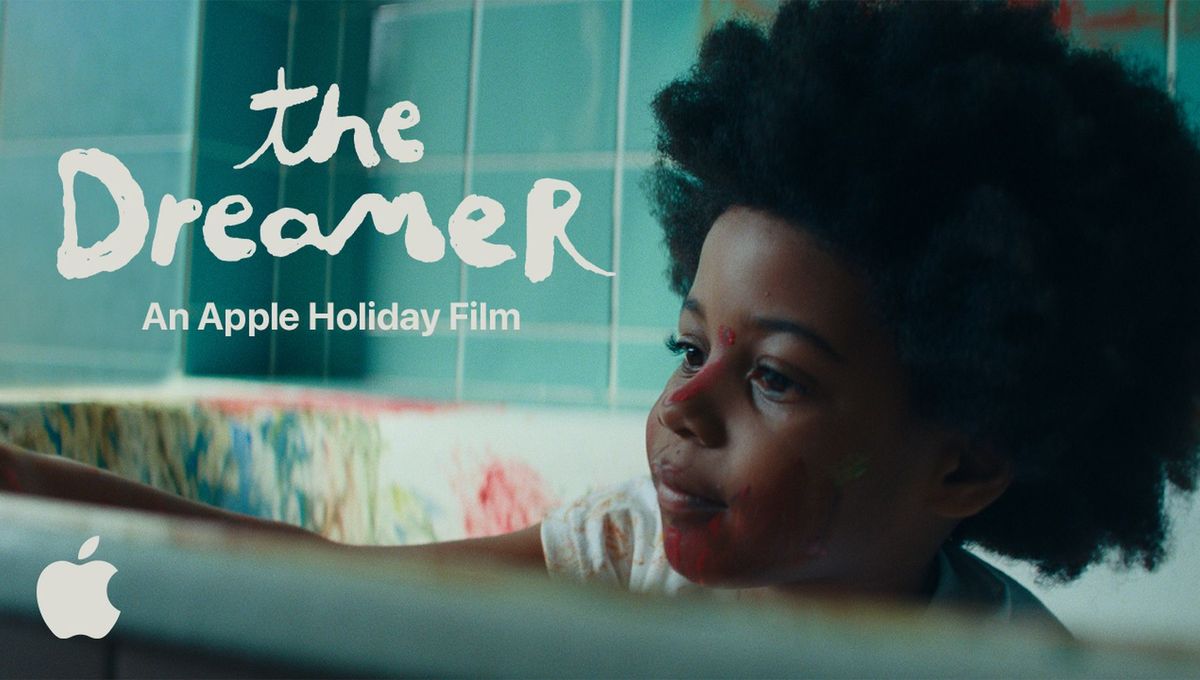 A scene from Apple’s 2026 holiday film The Dreamer.
One honesty note before the lessons: no sales lift and no measured brand response have been disclosed for The Dreamer in the available campaign material. Treat the analysis below as craft reading, not proof of commercial performance — the same caution we applied to same-season work from other brands, including Marshalls' Unwrap the Internet push with Lindsay Lohan.
How does it differ from 2025's A Critter Carol?
The contrast with Apple's 2025 holiday film A Critter Carol is structural, and the comparison is best done dimension by dimension. Last year's story followed handmade woodland puppets who discovered a lost iPhone 17 Pro and used it to record a musical video; coverage pegged its release at November 27, 2025, directed by Mark Molloy. The Dreamer keeps the visible craft but changes who stands in the spotlight: a person who has stopped creating, not an ensemble already busy making something.
| Dimension | The Dreamer (2026) | A Critter Carol (2025) |
|---|---|---|
| Release timing | November 12, 2026 | November 27, 2025 |
| Protagonist | A young artist who stopped drawing | Handmade woodland puppets |
| Product role | MacBook Neo as a gift of permission | iPhone 17 Pro as the camera recording the song |
| Craft on screen | Hebru Brantley's drawings, later animated | Hand-built puppets performing |
| Core emotional claim | Being seen by family first | Making something together |
Neither film leans on feature claims; both let creative labor viewers can recognize — imagination, rehearsal, revision — carry the emotion. The wider holiday category is crowded with cinematic sentiment: Disney's 2026 short The Invisible Horse draws on the same childhood-imagination territory. Apple's distinction is that its object of affection is a tool, while the central reward is a person recovering an abandoned part of themselves.
How do you run a story-first holiday campaign? Five steps
Distilled from what this film actually does, in the order I would apply them:
- Start with a recognizable human moment. The lost sketchbook, a parent's encouragement, the awkwardness of growing up — all understandable before any technology appears. If the human observation is unclear, no product entrance will fix it.
- Time the product's entrance late. The MacBook Neo matters because it changes what the character can do. If the product leads the narrative, the film collapses into a demo with actors.
- Give the makers a place in the story. Brantley's hand-drawn work and his memory of his mother make the credits load-bearing rather than decorative. Behind-the-scenes material works when it reveals something real about the process.
- Decide your continuity, not just your novelty. From puppets to an illustrator, Apple repeats a recognizable value — human creativity — even as characters, formats and products change. Planning seasonal creative against a written framework helps; we broke down the mechanics in our Christmas campaign playbook built around LEGO's holiday workshop.
- Keep dialogue minimal and let sound carry the mood. A viewer who knows nothing about the laptop's specifications can still follow the emotional change, because Give Me A Dream does that work.
What are the common pitfalls?
The mistakes I see most often when teams imitate this format:
- Sentiment that could sell anything. A moving film with no product connection attracts praise while leaving the brand behind. The Dreamer avoids this by making the computer part of the act of creation, not a prop in the final scene.
- Product as hero. The gift works because of the relationship behind it; feature-first storytelling breaks that mechanism.
- Reading applause as measurement. No sales lift has been disclosed for this campaign. Praise and demand are different signals; plan for both.
- Mismatched product tier and story scale. An entry-price machine paired with a status narrative feels false in both directions. Match the story's stakes to the product's position.
- Assuming you need a name director. Matsoukas's name helps, but the mechanism is the late product entrance and the honest maker's biography — both copyable at smaller budgets.
Frequently asked questions
What is Apple's The Dreamer about?
A boy whose love of drawing fades as he grows up, until his parents give him a MacBook Neo on Christmas morning and he begins animating his old characters again. It runs without dialogue, carried by Strawberry Guy's Give Me A Dream.
Who created the drawings in the film?
Hebru Brantley, a Chicago-born multidisciplinary artist, drew the boy's sketches and developed the final animated character using the MacBook Neo itself, so the craft on screen reflects a real artist's process.
When did the MacBook Neo launch, and what does it cost?
It was announced in March 2026 — Reuters dated the announcement March 4 — with availability beginning March 11, starting at $599 (U.S.), $499 for education, in four colors.
Is there evidence the campaign sold more MacBooks?
No. No sales lift and no measured brand response have been disclosed. The observable fact is the creative decision to make the product a supporting character in somebody else's story.
The checklist to reuse before your next holiday brief
- The human moment is recognizable before any product appears.
- The product enters late enough that its arrival feels earned, and it changes what the character can do.
- The makers' biography is load-bearing, not a credit-roll decoration.
- You can write your own version of the line "I remember who you are." for the product — if you cannot, the story is not ready.
- Sound design can carry the mood with minimal dialogue.
- Your measurement plan does not confuse applause with demand; this campaign disclosed no sales lift, and yours will face the same question.
- You compared the work against your own prior seasonal output for continuity, not just novelty.
References
- Apple Newsroom — Say hello to MacBook Neo: https://www.apple.com/newsroom/2026/03/say-hello-to-macbook-neo/
- Reuters — Apple debuts $599 MacBook Neo to challenge Chromebooks, Windows PCs: https://www.reuters.com/business/apple-debuts-599-macbook-neo-challenge-chromebooks-windows-pcs-2026-03-04/
- CNBC — Apple announces MacBook Neo, its most affordable laptop ever: https://www.cnbc.com/2026/03/04/apple-macbook-neo-budget-laptop.html
- MacRumors — Apple Releases Emotional 2026 Holiday Ad Featuring MacBook Neo: https://www.macrumors.com/2026/11/12/apple-2026-holiday-ad/
- 9to5Mac — Watch Apple's new musical holiday ad 'A Critter Carol': https://9to5mac.com/2025/11/27/watch-apples-new-musical-holiday-ad-a-critter-carol-featuring-iphone-17-pro/
- Ad Age — Hebru Brantley on the art behind The Dreamer: https://adage.com/creativity/creative-strategy-tactics/aa-apple-the-dreamer/