
ItInsightsWorld General: Useless on TV, Worth a Second Look — three verdicts for nine neon lamps in a Bud box
Verdict first: the flashing box that Candid Camera paraded as pointless was never useless — it was unreviewed. A Bud enclosure driving nine NE-2 neon lamps has three credible exits today: recycle it properly, convert it into a night-table companion after a safety pass, or keep it as a teaching rig. Every lab drawer holds the same standoff — one device nobody can justify keeping, and nobody can justify throwing out.
Why did a box of nine blinking lamps become a street joke?
Because the verdict came from comedy, not from an engineering review. Candid Camera, the hidden-camera format that premiered on ABC on August 10, 1948 according to the Museum of Broadcast Communications, ran a segment in which producer Alan Funt presented a device he called utterly and absolutely useless. Inside a Bud enclosure sat nine NE-2 neon lamps set three-by-three in rubber grommets, each lamp blinking at its own private rate. Funt and his co-host Durwood Kirby — who fronted the show through its 1961–1967 run, with 124 episodes to his credit per IMDb — carried the thing out to the street and asked passersby what it could possibly be for. People strained, failed, and the studio laughed.
The consultant behind this reflection, John Dunn — an electronics consultant and graduate of The Polytechnic Institute of Brooklyn (BSEE) in Brooklyn, New York, and of New York University (MSEE) — read the gag differently. Nobody on that street suggested what he considered obvious: a children’s night light, or a blinky little friend standing on the night table beside the bed. I side with Dunn. A comedy format needs losers on camera; it does not need to be right about the hardware.
What is actually inside — and why does the display never repeat?
First conclusion: the randomness is engineered, not broken. Each lamp is a relaxation oscillator — in plain words, a tiny bucket. A resistor lets current trickle into a capacitor; when the voltage climbs high enough, the neon gas ionizes, the lamp flashes and drains the bucket, and the cycle starts over. The classic build paired a 90 volt battery with a multi-mega-ohm feed resistor and a 0.1 µF capacitor wired across the NE-2.
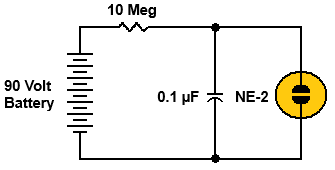
Figure 1 The circuit of a relaxation oscillator exemplifies simplicity.
Because all nine oscillators free-run with nothing clocking them together, the grid flashes in a pattern that looks random and never quite repeats. The mechanism even has a name — the Pearson–Anson effect, described in the literature as one of the simplest relaxation oscillators ever built. And the lamp at its center was serious hardware: component references note that small neon lamps like the NE-2 fire between roughly 90 and 110 volts, and Wikipedia’s neon lamp entry documents the same glow driving tone generators in electronic organs, stroboscopes, time bases in early oscilloscopes — even digital logic and binary memory circuits in the 1960s. A box like this is not scrap. It is a museum of one idea.
Retire it, repurpose it, or keep it — which option wins?
Conclusion first: keep it as a teaching rig if you teach or tinker; convert it only if a specific person will use it nightly; recycle it the moment it fails the safety checklist. The hardware is rarely the deciding factor. The human who will touch it is.
| Option | Best for | Effort | Ongoing cost | Main risk |
|---|---|---|---|---|
| Recycle / retire | Failed inspection, no willing user | Low — one e-waste drop-off | None | Regret, briefly |
| Bedside conversion | A named night user (adults, supervised older kids) | Medium — inspection, dimmer, diffuser, enclosure check | One specialty battery every few years (analysis) | A live 90 volt circuit near a pillow |
| Teaching rig | Classes, demos, collectors | Low — document and display as is | Negligible | Shelf dust, not shock |
The trade-offs in one line each: recycling is the only path with no safety tail; conversion buys nightly charm at the price of live high-voltage wiring near a bed; the teaching rig costs almost nothing and quietly teaches more than most sealed modern modules, because every part stays visible.
How would you actually convert it?
Only after it passes inspection. Work the list in order and stop at the first failure:
- Test before you trust. Confirm all nine lamps fire. A dead lamp usually means a dried-out capacitor or a corroded grommet contact — fixable, but not on a crib-side deadline.
- Open and inspect. Old 90 volt batteries are notorious for leakage. If the compartment shows crust or corrosion, replace the holder, not just the cell.
- Dim, don’t mask. The glow runs at a design current of roughly 0.3–0.5 mA per lamp; if it is too bright for a bedroom, raise the feed resistance to slow and soften the flash rather than wrapping the box in cloth.
- Diffuse the grid. The rubber grommets that held the lamps three-by-three also collimate the light. A strip of frosted acrylic over the face softens the pattern without touching the wiring.
- Isolate or abandon. If children share the room, the enclosure must lock or the conversion is a no. Ninety volts is not a toy, whatever a comedy show once implied.
- Label the back. Write the circuit — battery, feed resistor, capacitor, NE-2 — so the next owner inherits knowledge, not a puzzle.
What does keeping it really cost?
Less than you would expect in money, more than you would expect in attention. My read of the circuit: a multi-mega-ohm feed resistor means the oscillator sips charge at a microamp-scale average, so the battery’s shelf life, not its capacity, sets the replacement clock. Budget one specialty 90 volt battery every few years and one afternoon of inspection — that is the entire bill. The real cost shows up at the other end of the drawer. The world generated 62 million metric tons of e-waste in 2022, and only 22.3% of it was properly recycled, per figures summarized by Human-I-T. A working nine-lamp oscillator binned because a TV gag called it useless is precisely the leak that number measures. Most drawers don’t lack gadgets; they lack a verdict.
The dismissal reflex hasn’t retired either — it rebranded. Slap an AI sticker on a product and reviewers stop asking what it does, the way street pedestrians once stopped at a flashing box. Our field note on why physical AI stumbles at the wireless link makes the mirror-image argument: check the connective layer, not the label. And I would file this box with quiet infrastructure that keeps working while flashier things trend — the same nerve our review of libcurl at thirty, a one-maintainer backbone touches: what we nearly discard is often what already does its job.
Which misconceptions are worth retiring first?
- “A comedy segment proved it useless.” The verdict came from a format engineered to produce failure on camera, not from a bench test.
- “Random flashing means it is broken.” Unsynced oscillators are the design. If the pattern ever locked into unison, that would be the fault.
- “Neon night lights are harmless toys.” The lamp is benign; the 90 volt battery behind it is not. Same glow, different risk class.
- “Repurposing is free.” The parts are cheap, but sourcing a battery for an obsolete format and doing a proper safety pass cost real time.
Who should actually bother?
Educators and mentors should bother most: a visible relaxation oscillator beats a sealed module for teaching how timing circuits think. Collectors of mid-century electronics get a documented piece of television history. Parents of young children, and anyone unwilling to service a high-voltage battery, should walk away and drop the unit at an e-waste point with a clear conscience — a verdict is allowed to be “no”.
Frequently asked questions
Was the flasher box genuinely useless?
No. It was a functioning nine-lamp display with no marketed purpose. Uselessness was the punchline, not a measurement.
Why does the display look random?
Nine relaxation oscillators free-run independently. With no shared clock, their flash intervals drift against each other, so the grid never settles into a repeating pattern — the Pearson–Anson effect doing exactly what it does.
Is a 90 volt battery dangerous?
Treat it as yes. It sits in the range that can deliver a painful shock, and vintage holders leak. That disqualifies casual placement near a crib and demands an enclosure check before any bedside conversion.
Could you build one today?
Yes. NE-2 lamps, resistors and capacitors are still commodity parts, and the Pearson–Anson circuit is a classic weekend build. Most modern versions swap the neon for an LED — you lose the firing-voltage physics, which is arguably the best lesson in the box.
What should you do next?
Three moves this week. First, pull the ignored device from the drawer and run the six-point inspection list — tonight, not someday. Second, if it passes and a named person will actually use it, do the conversion with the safety pass intact. Third, if it fails or nobody claims it, book the e-waste drop-off and close the file. A verdict deferred is the only truly useless outcome a drawer can produce.
Nina Roberts writes on enterprise IT and consumer hardware for ItInsightsWorld (IT Insights). Argue with the verdict at contact@itinsightsworld.com.
Related reading
- The 2024 CES: It’s “AI everywhere”, if you hadn’t already guessed
- A holiday gift wish list for 2020
Sources
- Museum of Broadcast Communications, “Candid Camera”: https://www.museum.tv/tv-encyclopedia-3/candid-camera
- IMDb, “Candid Camera (1960–1975)”: https://m.imdb.com/title/tt0053489/
- Wikipedia, “Neon lamp” (breakdown voltage, organ and oscilloscope applications, logic and memory circuits): https://en.wikipedia.org/wiki/Neon_lamp
- Wikipedia, “Pearson–Anson effect”: https://en.wikipedia.org/wiki/Pearson%E2%80%93Anson_effect
- Human-I-T, “How Right to Repair Laws Can Reduce E-Waste” (62 million metric tons in 2022, 22.3% properly recycled): https://www.human-i-t.org/right-to-repair-e-waste/
- Huluic Encyclopedia, “Extinction voltage” (NE-2 design current of about 0.3–0.5 mA): https://huluic.com/page/extinction-voltage