
Crushed Double 11 Cartons: A Practical Checklist for Evidence, Compensation, and Prevention
If a carton from this year's Double 11 arrives crushed, the practical first step is not to debate the brand: photograph or video the sealed package before opening, keep every label, and request remedy from the seller or carrier. Damaged packaging reflects a cost-and-flow failure across brands, warehouses, and courier sorting, especially for hygiene-sensitive goods.
During Double 11 and the days around November 11, many shoppers received boxes that felt as if they had been stepped on, had messy tape, or had holes. In several complaints, the items were tissue, feminine hygiene products, and skincare, categories where clean is the minimum expectation. The phrase many used was simple: the packaging had turned flimsy.
What changed in this year's Double 11 boxes?
According to Xinshi Research Institute, consumers reported offers of 2 yuan, 3 yuan, or 2 to 3 yuan after contacting merchants. Others did not complain because the product itself was not damaged. The dispute is not only about a few yuan; it is about whether the basic seal and carton integrity are negotiable.
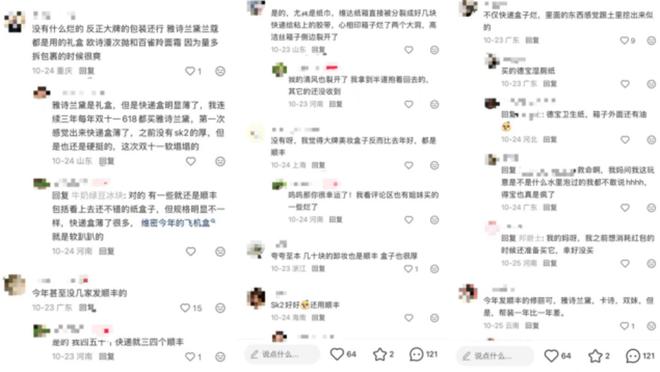
A widely shared social-media post asked whether many brands' express boxes had become worse this year. The poster said she had received 30 to 40 parcels and found many cartons soft, naming Xu Cuihua, Victoria's Secret, Zhanyan, and Kérastase. Because these were repeat purchases, the gap from prior years felt sharper: earlier gift boxes could be reused, while later boxes looked like bare products.

(Image source: social-media screenshot)
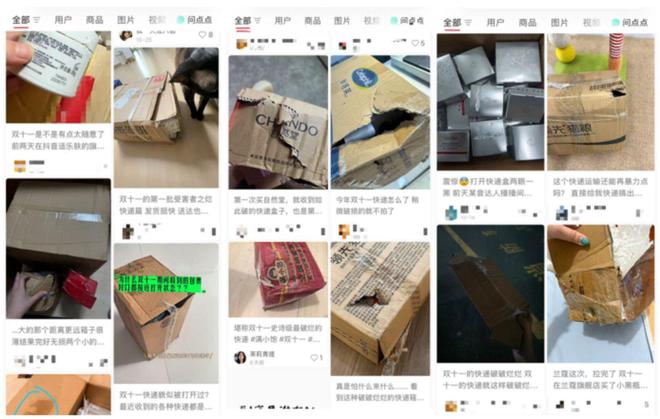
- Some users said not only boxes were damaged, but products looked dirty.
- Others said Vinda cartons were split into pieces and held together by courier tape; Hearttex boxes had two large holes; Kotex cartons were split on the side.
(Image source: social-media screenshot)
Not everyone saw the same picture. A few users said some major beauty brands were better in 2026 because shipments moved through SF Express, while others pointed to Estée Lauder and Lancôme gift boxes. Still, Xinshi Research Institute observed that many people had posted complaints about damaged Double 11 cartons.
(Image source: social-media screenshot)
Why does a torn carton sting more than a small refund?
For hygiene-sensitive goods, packaging failure is read as a trust failure, not a cosmetic issue. A Hebei netizen said she bought Breeze Black Gold toilet rolls from Li Jiaqi's livestream room. The carton was not sealed, had multiple damages, and the plastic wrap of several rolls had opened. After contacting support, she was offered 2 yuan, 3 yuan. The reply included "a broken carton does not affect use," and described the open plastic as a ventilation hole. If some rolls had holes and some did not, the explanation felt weak.
The user told Xinshi Research Institute that after the post spread, the merchant contacted her again. She asked for the price difference of 9 packs of tissues and was paid. Her point was not a large payout; it was that clean and sealed are baseline expectations. When support reduces the issue to a money matter, it avoids the real question: whether the product can be trusted for hygiene.
For brands, packaging is the last step of the experience. A broken carton can make a first-time buyer decide the brand is unreliable. Old customers may tolerate a bad box because they already trust the product, but new customers may equate the broken carton with the brand not caring. In another case, a Jiangsu netizen said the first Chando order arrived with a badly damaged box. She did not pursue it because the product was intact, while another buyer who received damaged Chando skincare requested replacement. If the first unboxing is poor, the money spent acquiring that customer is wasted.
Is this brand cost-cutting or courier handling pressure?
The short answer is both, plus a promotional wave structure that concentrates risk in the last mile.
Some people say brands are trying to save. Cartons become softer, gift boxes are removed, and tape looks careless. For tissues and sanitary products, low unit prices and high sales volumes mean a small packaging saving can move a noticeable amount of profit, making the cost cut visible in consumer complaints.
Brands did not directly answer whether packaging had become worse. Breeze official flagship store said it has long-term paper product shipping experience, checks products in the warehouse, and ships only after packaging is inspected. Chando official customer service said transit shaking may cause damage and asked the consumer to send damaged images to the seller for processing. These responses focus on outbound condition and transport, not the packaging specification itself.
Logistics pressure is also real. State Post Bureau data cited in the original report show that in the first three quarters of 2026, China's express delivery volume reached 151.3 billion items, up 4.3% year on year, while express delivery income reached 1,163.44 billion yuan, up 7.2%. The industry is in a phase of volume steady, prices rising, but festival operations can still create short-term peaks. Unlike the old single burst around November 11, promotions start earlier, the buying period stretches, and parcels arrive in waves. Chao News reported a courier delivering four to five hundred items daily normally and about 700 items during peak, but with multiple smaller peaks because campaigns run in stages.
The Paper reported couriers saying most damage occurs during loading, unloading, long-haul compression, and sorting errors. Trucks are full, warehouse space is tight, parcels are jammed together, and external wear becomes part of the flow. Glass skincare bottles and soft feminine-hygiene outer packs are fragile in that environment.
Broader postal-sector data add context. China Business reported that China handled 164.13 billion postal-sector items in the first three quarters of 2026, up 3.7% year on year. The State Council's English portal also reported 30.49 billion express parcels in the first two months of 2026, up 7.1% year on year. Together, these figures suggest the system is still large and fast enough to move goods, but size alone does not guarantee a clean box.
Who should you contact first?
YTO Express official customer service said the carrier can handle the issue, or the consumer can contact the merchant. YTO customer service said the cause depends on the case, but if cargo damage occurs, the user should immediately record video and evidence for handling. YTO also responded to online claims of violent sorting by denying such behavior at its end.
Consumer-law guidance offers a practical sequence: when a parcel is damaged in delivery, the seller is often the first contact because the buyer has a purchase contract with the merchant, not with the sorting facility. A legal guide citing Gao Shan, a lawyer at Beijing Dacheng's Shenyang office, notes that the seller can compensate the consumer first and then pursue the carrier if transit damage is established.
How to turn a damaged carton into a usable claim
Most disputes fail because evidence is thin, not because damage is imaginary. The following checklist applies especially when the goods are tissue, sanitary products, skincare, or any item with an inner seal.
- Before opening, photograph the full carton from several sides. Capture the shipping label, barcode, tape line, dents, holes, and any damp area.
- Record an unboxing video in one take whenever possible. Show the seal being opened, then the outer carton, inner packaging, and product condition.
- For hygiene items, photograph each individual wrapper or roll seal, not only the outer box. Opened plastic on toilet rolls is a product-level issue, not just a carton-level issue.
- Keep the original packaging, inserts, gift boxes, and tape until the seller or carrier finishes review.
- Save the order number, payment screenshot, tracking page, and chat history in one place.
- Ask for a specific remedy: replacement, refund, price difference, or written confirmation of the packaging standard. Avoid accepting vague "we will check" promises without a timeline.
Common mistakes are well documented in consumer advice: signing without noting outer damage, deleting photos after chat, discarding the carton, and leaving only verbal claims. Those errors weaken the case because the chain from warehouse to doorstep becomes harder to reconstruct.
Common misconceptions that make the problem worse
- "The product is fine, so the box does not matter." For clean goods, seal integrity and outer protection are part of the product experience.
- "A 2 yuan, 3 yuan refund solves everything." It may close a ticket, but it does not explain whether the packaging standard is acceptable.
- "Every soft carton proves violent sorting." Sometimes the box choice, flute quality, stacking plan, and promotional wave volume do enough harm without any dramatic mishandling.
- "This is only a logistics issue." If brands reduce packaging without testing real shipping paths, the problem moves into couriers' hands at the worst moment.
- "Double 11 is too big, so damage is unavoidable." High volume increases risk, but it also gives platforms more reason to monitor damaged-carton rates and repair the feedback loop.
Why damage becomes normalized
The real fault line is a misalignment of incentives. Brands want speed and lower cost. Logistics networks want throughput. Consumers want clean, intact, predictable delivery. Each group optimizes a metric, and the damaged carton becomes the place where their costs meet.
| Perspective | What it sees | What it can miss | What should change |
|---|---|---|---|
| Brand side | Double 11 sales targets, packaging spend per order, and product margin | Whether a cheaper carton fails on long routes, not just in sample checks | Test packaging under real festival routes and publish replacement policy |
| Carrier side | Sorting volume, truck utilization, loading windows, and delivery waves | Hygiene products have higher sensitivity than general consumer goods | Mark high-risk parcels and give damaged-goods teams a faster evidence path |
| Consumer side | Whether the box looks safe and whether the product feels clean | Whether the issue should be raised before opening or after | Use video evidence and a written claim, not only social complaints |
| Industry framing | Some damage becomes an accepted loss because perfect handling is expensive | Experience collapses when the most sensitive goods repeatedly arrive broken | Price the value of a higher intactness rate instead of treating damage as noise |
This year's frustration is not limited to one platform. Public complaint-monitoring summaries cited by Baidu Baike for the 2025 Double 11 season showed more than 20,000 express-logistics complaints, with damage accounting for 20.90%, loss for 19.70%, and delay for 18.96%. Livestream-related complaints also reached 13,872 items. That older dataset is not the same as this year's Double 11, but it shows why carton damage sits close to the front of consumer trust: it touches delivery reliability, hygiene expectations, and promotional hype at the same time.
What brands and shoppers can do next
For shoppers
- Put hygiene products in a separate mental risk category. A carton that is merely ugly is cosmetic; a carton that is split open with inner wrappers visible is a trust issue.
- Do not assume a large beauty brand automatically uses better packaging. The user reports are mixed: SF Express, Estée Lauder, and Lancôme were praised in some posts, while other categories faced heavy complaints.
- Ask the merchant for the packaging standard when buying repeat-use gift boxes or sealed rolls. If the answer is only "intact before shipment," request post-transit remedy terms.
For brands
- Stop treating packaging as the cheapest part of the order. The box is the last step before trust is confirmed or broken.
- Run box tests under festival conditions: full-truck stacking, long-haul compression, tape failure, repeated handling, and multiple wave shipments.
- Train support scripts around hygiene goods. Saying "does not affect use" may be true for the product, but it is not a good answer when sealed rolls are exposed.
- Give customers a simple remedy path instead of forcing them to post publicly first. The Breeze tissue case shows that escalation often starts because the basic explanation fails.
For platforms and carriers
- Use one evidence standard across seller and carrier support: image, video, tracking, and item-level seal status.
- Track damaged-carton rates by category, not only by overall delivery volume. Tissue, feminine hygiene products, and glass skincare bottles need different thresholds.
- Review packaging material with structural engineering, not just cardboard weight. Packaging guides from corrugated suppliers explain flute grades and edge crush test values, which can help brands choose a design that survives stacking without simply buying heavier board.
If you are tracking where delivery cost and reliability decisions go next, our analysis of unmanned delivery vehicles in 2026 compares cost, road rights, and city reliability across real logistics scenarios.
FAQ
Is a damaged carton always the courier's fault?
No. The courier can be responsible for transit damage, but the brand may be responsible for weak outer packaging, poor inner protection, or an unrealistic festival shipping plan. YTO customer service said damage is assessed by case and advised consumers to record video evidence.
Should I accept a 2 yuan or 3 yuan refund?
Only if you agree the issue is purely monetary. If hygiene products have exposed or opened inner packaging, ask for replacement, refund, or a written explanation. The damage may not be a money matter, but a clean-product confidence matter.
What is the strongest evidence?
Unopened outer carton photos, a continuous unboxing video, item-level seal photos, tracking number, payment proof, and chat records. Consumer-law guides warn that deleting evidence or discarding packaging often weakens claims.
Why did some people say their boxes were better?
Packaging performance varies by brand, carrier, route, and product shape. SF Express, gift boxes, and larger beauty orders may look better, while soft paper products and low-margin bundles are more exposed to compression and handling wear.
Final judgment
A Double 11 carton may look cheap, but it carries an expensive promise: the product should arrive as the consumer expected it to arrive. The industry can prove that it moves parcels, earns faster than volume growth, and handles multiple demand waves. What consumers judge is simpler. Did the tissue, sanitary product, or skincare box stay clean and intact?
If damage remains an accepted loss, every promotional success story needs a question mark at the moment of unboxing. The practical fix is not to debate whose hands caused a dent. It is to align brand packaging tests, carrier handling standards, and merchant after-sales scripts around one target: a higher intactness rate that shoppers can verify with a photograph, a video, and a fair remedy.
Written by James Hartley, IT Insights. For site questions, contact contact@itinsights.com.
References
- Xinshi Research Institute Double 11 packaging report, republished by Sina Finance
- Consumer cases, YTO customer-service response, and brand responses on damaged Double 11 cartons
- China Business: China postal-sector handling volume in the first three quarters of 2026
- State Council English portal: China express delivery data for the first two months of 2026
- LawTime: common mistakes in damaged-package claims
- Legal guide on Double 11 delivery disputes and seller-first evidence practice
- Corrugated box strength guide: flute grades and edge crush test basics
- 2025 Double 11 consumer complaint data summary