
ItInsightsWorld General Review: ChatGPT Pro Deactivation, Appeal Channels, and Risk Signals Compared
Short answer: At press time, the reports of ChatGPT Pro accounts showing “account_deactivated” look like scattered enforcement cases, not a confirmed mass ban. For readers, the practical question is not “was OpenAI wrong?” but “which signal matches my situation, which appeal route has the best chance, and what data should I save before waiting.” This ItInsightsWorld General comparison breaks down trigger types, channels, and decision rules.
What happened to ChatGPT Pro accounts?
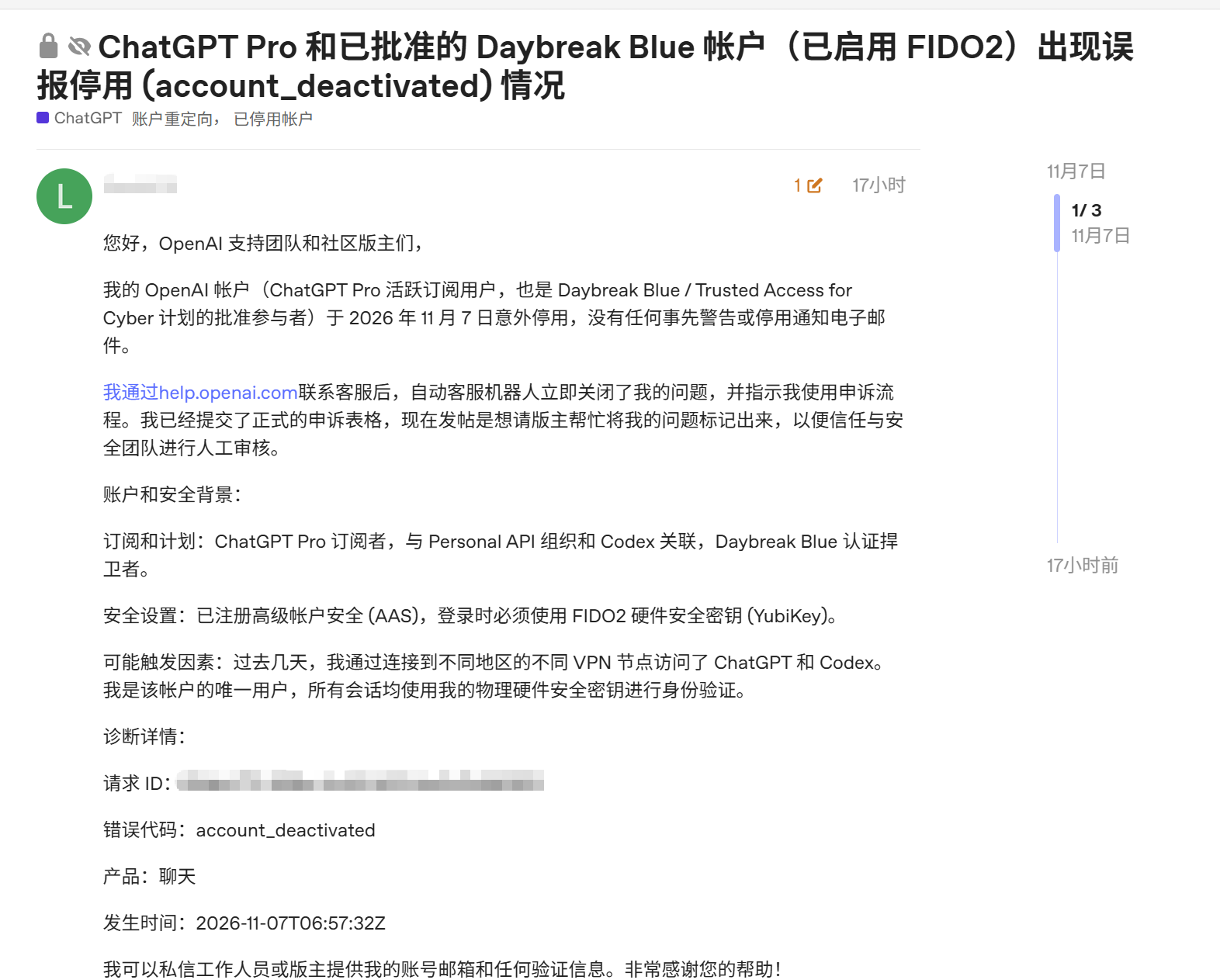
Recently, several posts on Reddit and the OpenAI official developer community described sudden deactivations affecting paid ChatGPT accounts. One case said to have been posted on November 7 claimed that a ChatGPT Pro account was deactivated that same day, with the error text “account_deactivated” and no prior warning email. The account holder also described a security setup that included the OpenAI cybersecurity-related access program and physical security key verification, and said he had used VPN nodes in different regions to access ChatGPT and Codex. That VPN detail is the user’s own suspicion, not an official cause.
Under that community post, the OpenAI Support account replied that account-specific issues cannot be handled in a public forum. The recommended route was the link in the deactivation notice; if no notice email could be found, users should submit an official appeal form or contact the Help Center. The reply did not explain why the account was stopped.
Do paid users have any special protection?
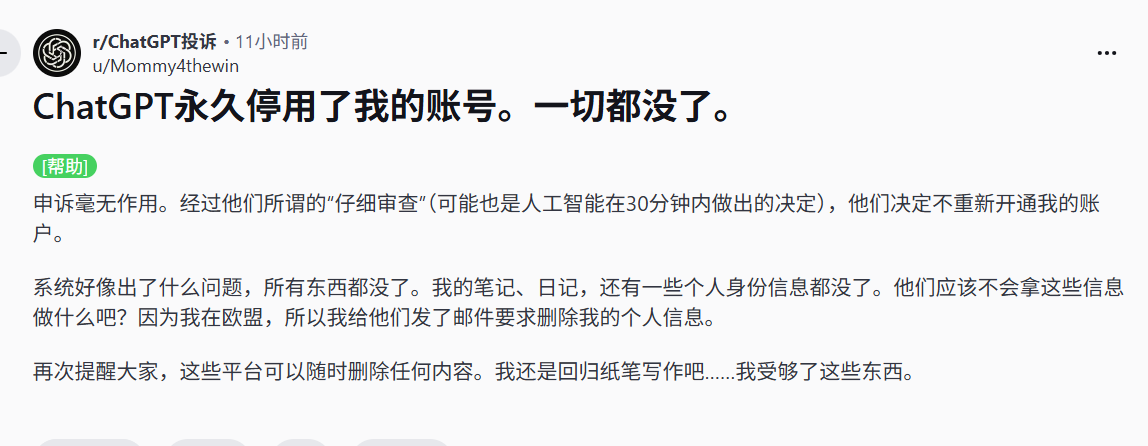
Not in the public evidence. The posts include users who pay USD 200 each month, but payment tier alone does not appear to create a different review lane. In a Reddit complaint, another ChatGPT Pro user said the account was linked to a previously closed account and that the user denied owning or using any second account. After an appeal submitted about one hour after deactivation, the answer was reported to be that the ban stood. This contrast is useful: a paid subscription may prove commercial intent, but it does not prove that the account was isolated from fraud, sharing, payment, or device signals.
Is this a confirmed mass ban?
Currently, the safest answer is: no. At press time, OpenAI had not issued a unified explanation for the recent user reports, nor disclosed how many accounts were affected. The available case reports do not prove that these accounts were part of one central enforcement action. Some users mention linked-account concerns; others mention region access; others describe notes, chats, and work materials becoming inaccessible. Those are different risk paths, not a single diagnostic.
OpenAI official Help Center guidance on account closures and safety suspensions also makes a useful distinction: a permanent closure and a temporary safety suspension are not the same enforcement state. That matters because an appeal should be written differently for each case. If the user is trying to restore access, the goal is to prove identity, ownership, and clean history. If the account was only suspended, the goal is to remove the specific behavior or credential that triggered review.
Which appeal channel should be used first?
Use the channel that can verify the account privately. Public forums are useful for noticing patterns, but they are poor venues for submitting evidence. The table below compares the three routes mentioned in the OpenAI Support reply and OpenAI Help Center articles.
| Route | Best for | What to prepare | Practical limit |
|---|---|---|---|
| Appeal link in the notification email | Users who received a deactivation or closure email | Account email, approximate deactivation date, subscription plan, payment context, and a calm explanation of any VPN, shared device, API key, or linked-account concern | Works only if the email arrived; it may also be missed if filters or forwarding rules hide it. |
| Official appeal form | Users who did not receive the notice or the link is invalid | Full account email, exact error phrase, payment records if available, and a short timeline of the last login | A form cannot prove every account detail; missing records can slow review. |
| Help Center contact path | Verification issues, identity checks, or unclear email routing | Support ticket ID if one exists, identity-verification status, and the page where the block appeared | Not a substitute for the formal appeal path when the issue is a closed account. |
For the exact official process, OpenAI’s account closures and safety suspensions page is the cleanest first read. For location-related questions, readers should compare it with the ChatGPT supported countries list and the unsupported-country guidance instead of relying on forum anecdotes.
What risk triggers matter most?
The recent reports point to five common questions. This is not a checklist of guilt; it is a decision map.
- Linked-account suspicion: reported after deactivation, but it can be a false positive if users share devices, payment cards, or login environments.
- Region or VPN signals: OpenAI supported-country pages are the reference. Using VPN nodes from different regions does not automatically mean the account violated regional access rules, especially if the user’s normal location was supported.
- API or key sharing: this is one of the broader enforcement categories in OpenAI Help Center reasons; readers should treat any transferred key or borrowed subscription as a review risk.
- Identity verification: incomplete verification can turn an ordinary account into one that cannot be restored quickly.
- Security anomalies: unusual logins, new devices, or high-risk settings can prompt protective suspension; the user needs to prove the action was theirs.
OpenAI’s official reason categories listed in the recent reporting include violating usage policy, bypassing security or access restrictions, improper account or API key sharing, unusual account security behavior, and failed identity verification. Those are broader than “used VPN.” That difference is the reason the story should not be simplified into one cause.
What is the biggest hidden cost?
Access loss, not just subscription loss. Several complaints mention long-accumulated chat history, notes, diaries, and work materials becoming unavailable after deactivation or permanent closure. Even if an appeal succeeds, users may face a gap between “service restored” and “workflow restored.” The practical comparison for readers is: if the account is only suspended, a short wait may be tolerable; if the account is permanently closed and contains unique personal history, the cost is much higher.
Action checklist: what to do in the first 24 hours
- Search every mailbox folder, including spam, promotions, trash, and any alias used for registration. Look for “deactivation,” “closure,” “suspension,” and “appeal.”
- Do not post the account email, API key, payment card detail, or identity document in public comments. Those items turn a support case into a security case.
- Write a short timeline: last successful login, date of “account_deactivated,” devices used, VPN or proxy details, and whether a second account, shared card, or shared API key was ever involved.
- Use the email appeal link first if present; otherwise use the official appeal form. Keep the submission number and exact wording.
- If account data is still visible, export chat history, notes, or connected files before waiting. If data is locked, avoid paying third parties that promise guaranteed unbanning.
- For work accounts, separate personal login from team login. Review who has access to passwords, 2FA recovery codes, and security keys. Our OpenAI workplace security checklist covers credential hygiene that reduces avoidable review triggers.
- If the issue affects API, billing, or enterprise access, document the business dependency and payment records before appealing. Commercial context can make the request clearer, but it cannot replace official review.
Common misconceptions to avoid
- “Paid means protected.” The current reports include a USD 200 monthly tier, but no public evidence shows paid accounts receive a different decision process.
- “One error code means one cause.” “account_deactivated” is a status message, not a reason code. Linked-account flags, verification problems, and access policy concerns can lead to different appeal outcomes.
- “VPN equals violation.” Region access may matter, but the question is where the account is normally used, whether the supported list applies, and whether the user attempted to evade access restrictions.
- “More posts equal mass enforcement.” Currently, there is no disclosed affected count. At press time, OpenAI has not confirmed a coordinated campaign, and existing cases cannot prove one.
- “Creating a new account solves it.” If the closed account is tied to the same identity, payment, or device signals, a new account can raise more risk rather than reduce it.
Which scenario matches which decision?
| Scenario | First move | Second move | Not recommended |
|---|---|---|---|
| Pro user paid USD 200 per month and sees “account_deactivated” | Find email appeal path and document payment plan | Explain security settings, no linked accounts, and recent device history | Public tagging or posting screenshots with private info |
| Suspicion of a previously closed linked account | State ownership of only one account | List shared devices, cards, or team logins if any | Ignoring the link and resubmitting without facts |
| VPN or region confusion | Check ChatGPT and OpenAI API supported countries | Explain normal work location and recent travel or proxy use | Assuming VPN alone caused the ban |
| Notes or chat history lost | Ask appeal whether data access can be restored | Back up future chats monthly and keep offline copies | Relying only on Cloud storage for unique documents |
FAQ: quick answers for readers affected by ChatGPT deactivation
Why did my ChatGPT Pro account say “account_deactivated”?
The error indicates the account cannot currently be used. Public reports mention reasons such as linked-account concerns or security signals, but the exact cause is only known to account review systems unless OpenAI provides it.
Does an appeal usually take about one hour?
No. One user reported a decision after about one hour, but that is a single case, not a service-level commitment. The faster a case can be verified, the more it depends on clear account ownership and a clean timeline.
Can I still use ChatGPT and Codex if my subscription was paid?
Users in the recent reports said access stopped suddenly, including paid tiers. Payment alone does not guarantee continuation while an enforcement review is unresolved.
Will OpenAI say whether this was a false ban?
At press time, no unified explanation or number had been disclosed, and the evidence cannot confirm wrongful enforcement for every case. Appeals should describe why a specific account may have been misidentified.
Should I use a VPN to test whether the account works?
No. That can add signal noise. Check OpenAI supported-country information and submit an appeal if access is denied.
Final judgment: what general readers should do
For ItInsightsWorld’s General audience, the practical takeaway is not to treat the reports as a single verdict. Read them as three layers: enforcement status, policy risk, and personal data exposure. The best next step is a private, evidence-based appeal through the official route, combined with backups and a review of devices, payment cards, API keys, and security settings. If OpenAI later discloses more details, the decision framework may change; currently, disciplined documentation is more useful than speculation.
References
- OpenAI Help Center: “OpenAI account closures and safety suspensions,” https://help.openai.com/en/articles/10562188-openai-account-closures-and-safety-suspensions
- OpenAI Help Center: “ChatGPT Supported Countries,” https://help.openai.com/en/articles/7947663-chatgpt-supported-countries
- OpenAI Help Center: “ChatGPT and API services in unsupported countries and territories,” https://help.openai.com/en/articles/9131992-chatgpt-and-api-services-in-unsupported-countries-and-territories