
Aura Ink 10-Inch vs the 13-Inch Ink: How to Pick a Spectra 6 E-Paper Frame | ItInsightsWorld General
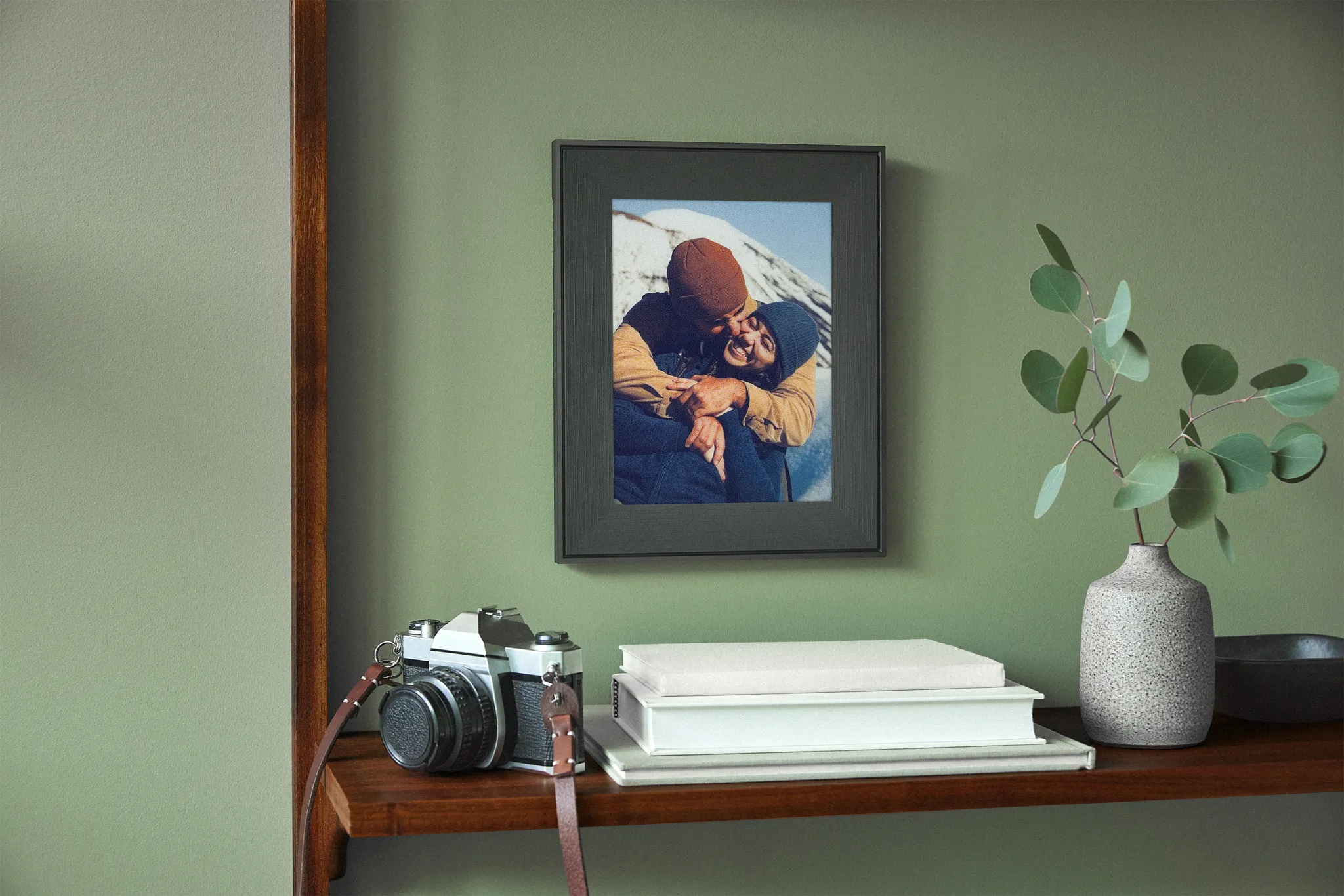
Short answer: the size is not the real decision. The Aura Ink 10-inch carries the same E Ink Spectra 6 e-paper idea as the 13-inch Ink photo frame, costs $349 rather than $499, and lifts pixel density from 150 PPI to 200 PPI. Aura rates it at up to three months on a single charge; TechCrunch measured about one month on the 13-inch unit. Choose it for a wall with no outlet and a photo rotation you can leave alone; skip it if you need color accuracy or moving images.
Those two runtime numbers disagree by roughly a factor of three, and the gap is where this product class gets misjudged. A vendor figure assumes a fixed rotation cadence in a lit room. A reviewer figure assumes a household that pushes new photos constantly. Everything below sorts which assumption your home actually matches.

What is Spectra 6, and why six colors is the whole problem
Conclusion first: Spectra 6 is a color e-paper technology, not a color display in the LCD sense. Unlike most digital photo frames, which run on LCD or OLED, the Ink series from Aura reflects room light, so the surface reads closer to a printed photograph than to a glowing screen.
Eric Jensen, Aura's co-founder and chief technology officer, has said the company wanted from the start a device that presents images like paper yet still changes them automatically, and that e-ink was not capable enough at the time. Maturing color e-paper is what turned that idea into a product line.
The hard limit is native capability. Spectra 6 works from six colors — white, black, red, yellow, green and blue, as described when the 13-inch model launched — and it cannot render millions of colors the way an ordinary monitor does. So the engineering task is not adding colors; it is making six of them behave.
Aura's answer is a proprietary dithering algorithm. Pixels of different colors are arranged in fixed patterns so that, at a normal viewing distance, the eye integrates them into gradients and continuous tones.
Panel numbers cap all of this. E Ink's own Spectra 6 page lists resolution optimized up to 200 PPI, a typical contrast ratio of 30:1 and an operating range of 0 to 50 degrees Celsius. Those are panel limits, not photo-quality claims, but they define the box the product has to work inside.
On the Ink 10-inch, Aura went one step further: working with E Ink, it added three proprietary colors on top of Spectra 6 — off-white, mustard yellow and orange. With more options available at photo edges and color transitions, the system reduces the abrupt patches that limited palettes used to produce, so outlines come out smoother and some local detail reads better.
Skin is the clean test case. Where the earlier palette needed white pixels placed next to red ones to simulate an intermediate tone, the added colors cut that substitution, and faces look less processed. That matters commercially because the main use of a photo frame is showing family members and children, not test charts.
What has not changed: this is still not exact reproduction. Saturation sits below a print, and the overall read carries a slightly retro cast. TechCrunch made the same point about the 13-inch version — the colors are visibly not identical to the original photo — and added that the softened palette pushes landscapes toward film photography rather than toward a phone screen.
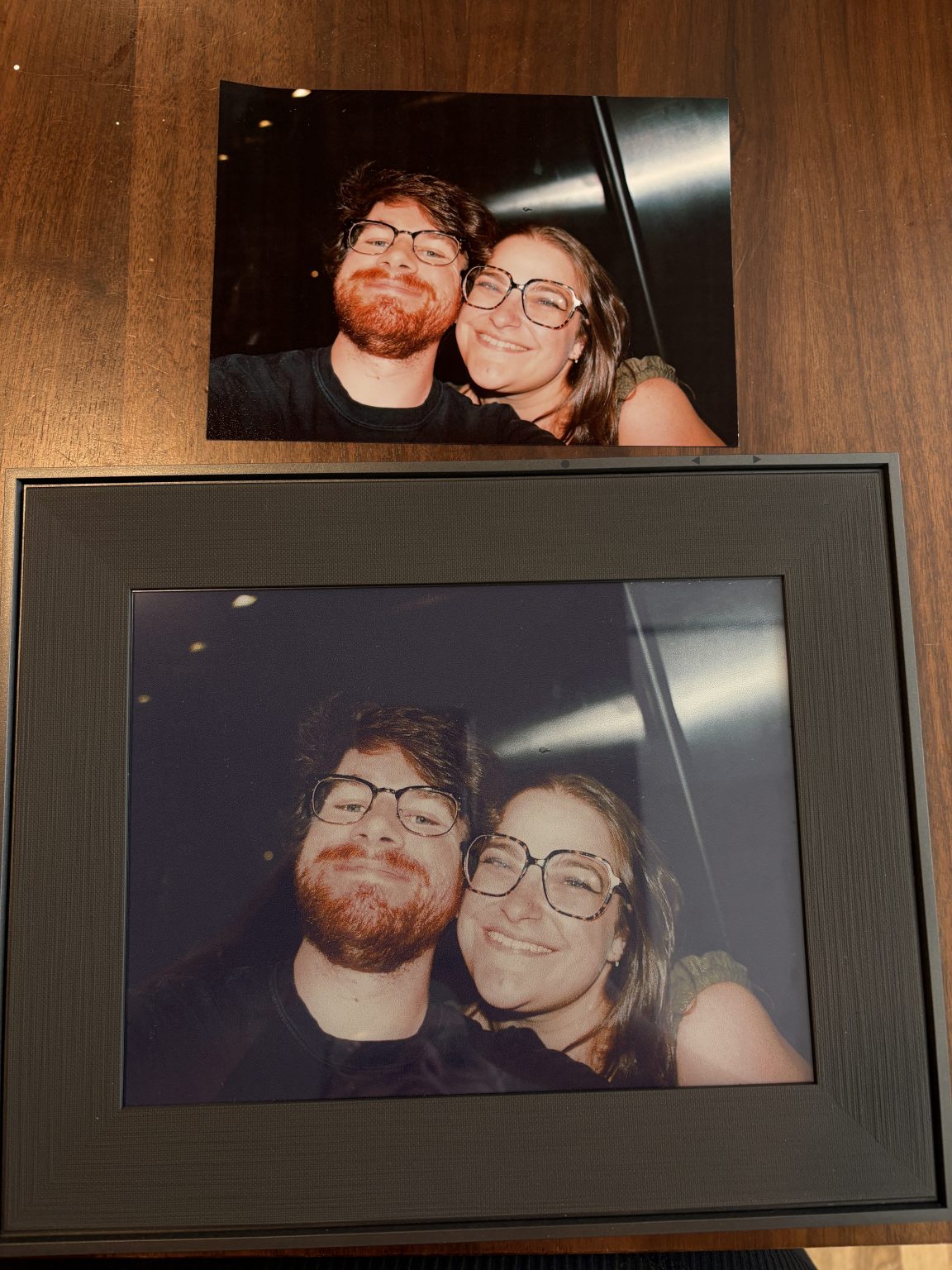
Ink 10-inch vs 13-inch Ink vs a normal LCD frame: what differs
| Decision axis | Aura Ink 10-inch | 13-inch Ink e-paper photo frame | Typical LCD digital frame |
|---|---|---|---|
| Price | $349 | $499 | Clearly below $349 |
| Color source | Six colors plus three proprietary colors, built up by dithering | Six colors, built up by dithering | Full color spectrum directly |
| Pixel density | 200 PPI | 150 PPI | Depends on panel; self-emissive |
| Power | USB-C, up to three months on a single charge (vendor) | USB-C, multi-month claim; about one month in hands-on use | Continuous wall-power draw |
| Light | Reflective, plus front light | Reflective, front light at roughly one-sixth of LCD brightness | Backlight, bright enough to be the loudest object in the room |
| Sharing | Aura mobile app, shared albums, about four people per frame | Same app model | Same app model, usually one admin |
| Best fit | Gallery wall, shelf, stairwell, desk | One large focal portrait across a room | Nightstand, kitchen counter, short-look use |
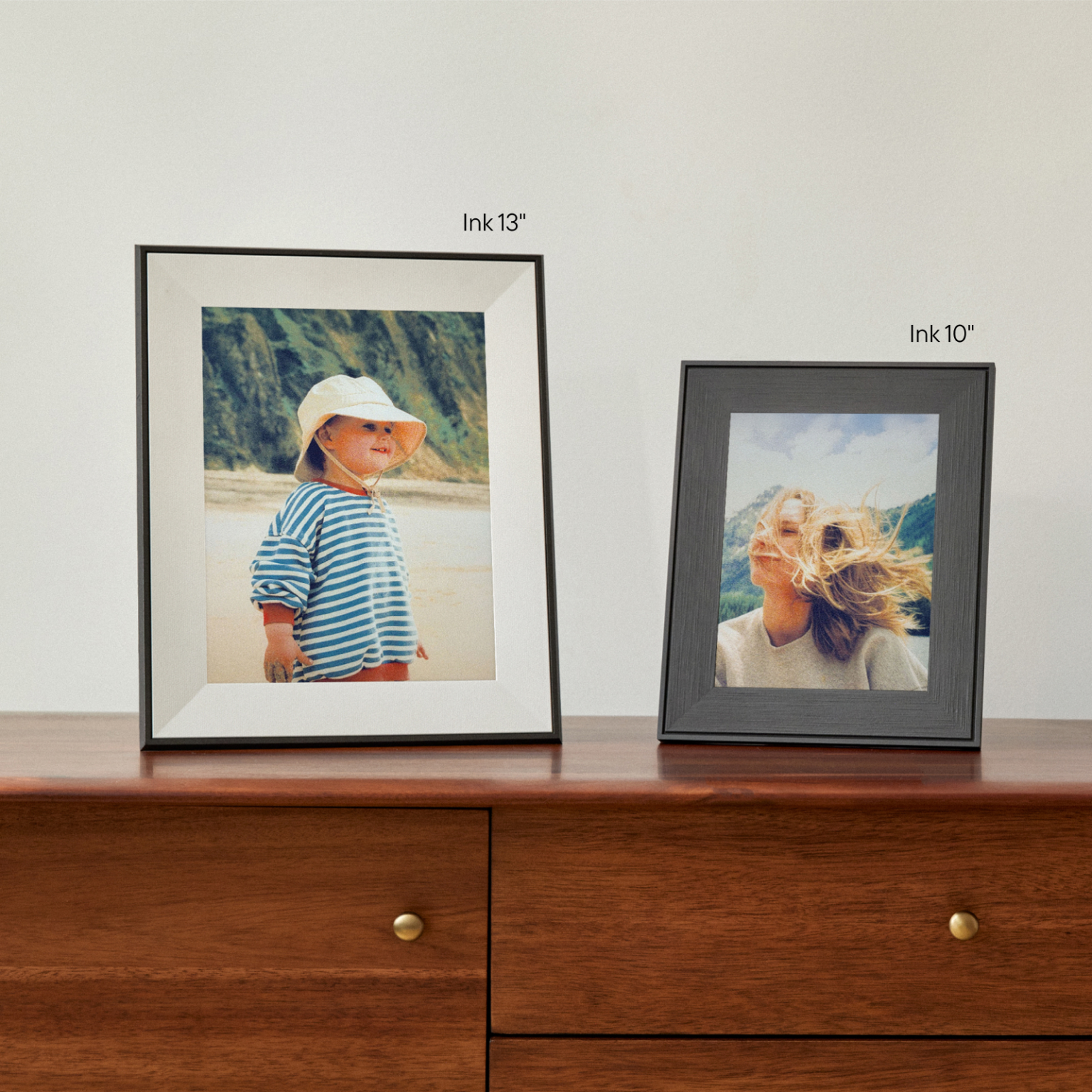
The arithmetic between the two Aura models is simple: $150 less, a price drop of about 30%. Aura's comparison guide puts it plainly — the Ink 10-inch offers the same benefits as the Ink 13-inch in a smaller size, with higher pixel density — and The Verge reported the same 200ppi versus 150ppi figures at launch in November 2026.
Positioning is the other half of the comparison. The Ink 10-inch is not built to fight cheap LCD frames. Its value is not beating a monitor on color, but letting a digital photo sit in a room as a paper-like object for months at a time, while keeping remote updates and multi-person sharing. In that frame of reference, $349 is a decor budget, not a gadget budget.
Why 200 PPI is a placement question, not a spec line
Conclusion: the density gain pays off at arm's length, not across a room.
Treat the next paragraph as our own calculation, not a vendor statement. A 200 PPI grid has a dot pitch near 0.127 mm; using the conventional one-arcminute limit of human vision, those dots stop being individually separable at roughly 44 cm. A 150 PPI grid moves that threshold to about 58 cm. Both panels sit in the same pixel budget, so shrinking the glass is precisely what buys the sharper figure.
Two consequences follow. Hung above a sofa, where people view at more than a metre, the 13-inch is already past the distance at which extra density changes what you see; the money there buys area. On a desk, a banister or a photo wall you pass close to, the Ink 10-inch stays visibly sharper.
Placement also inherits two physical limits that marketing does not mention. A reflective display needs ambient light to be read, and the operating window E Ink specifies — 0 to 50 degrees Celsius — rules out a wall above a radiator or a spot in all-day direct sun. The near-180-degree viewing angle in the same materials is the upside: e-paper holds its image when someone views it at an angle on a staircase.
What the three-month battery claim actually assumes
Conclusion: three months is a low-cadence number, and a household that pushes photos daily will not reproduce it.
Energy here has exactly two line items. In the launch statement for the first Ink, E Ink said the display draws power only when the front light is on and when images change, which is what makes a multi-month battery possible. Everything else is standby.
Aura's own guidance follows from that physics: set the frame to update once a day. The company gives two reasons — lower draw, and not making you watch an image assemble itself through dithering over and over. Reality is messier. TechCrunch's reporter measured about one month of actual use on the 13-inch version, and a dim room that runs the front light every evening shortens any estimate further. Jensen described that front light as very soft compared with an LCD, at about one-sixth the brightness, and said people usually only notice it exists when it switches off in a dark room.
The unmeasured cost is logistics. Cordless means a mounted frame comes down for a USB-C recharge. At one month of runtime, that is a dozen handling cycles a year; at three months, about four. If the frame goes high on a stairwell wall, count those ladder trips before concluding the price gap is the main trade-off.
Who should buy it, and who should not
Buy it if:
- the spot has no outlet — a living-room wall, a stairwell, anywhere a cable would spoil the room;
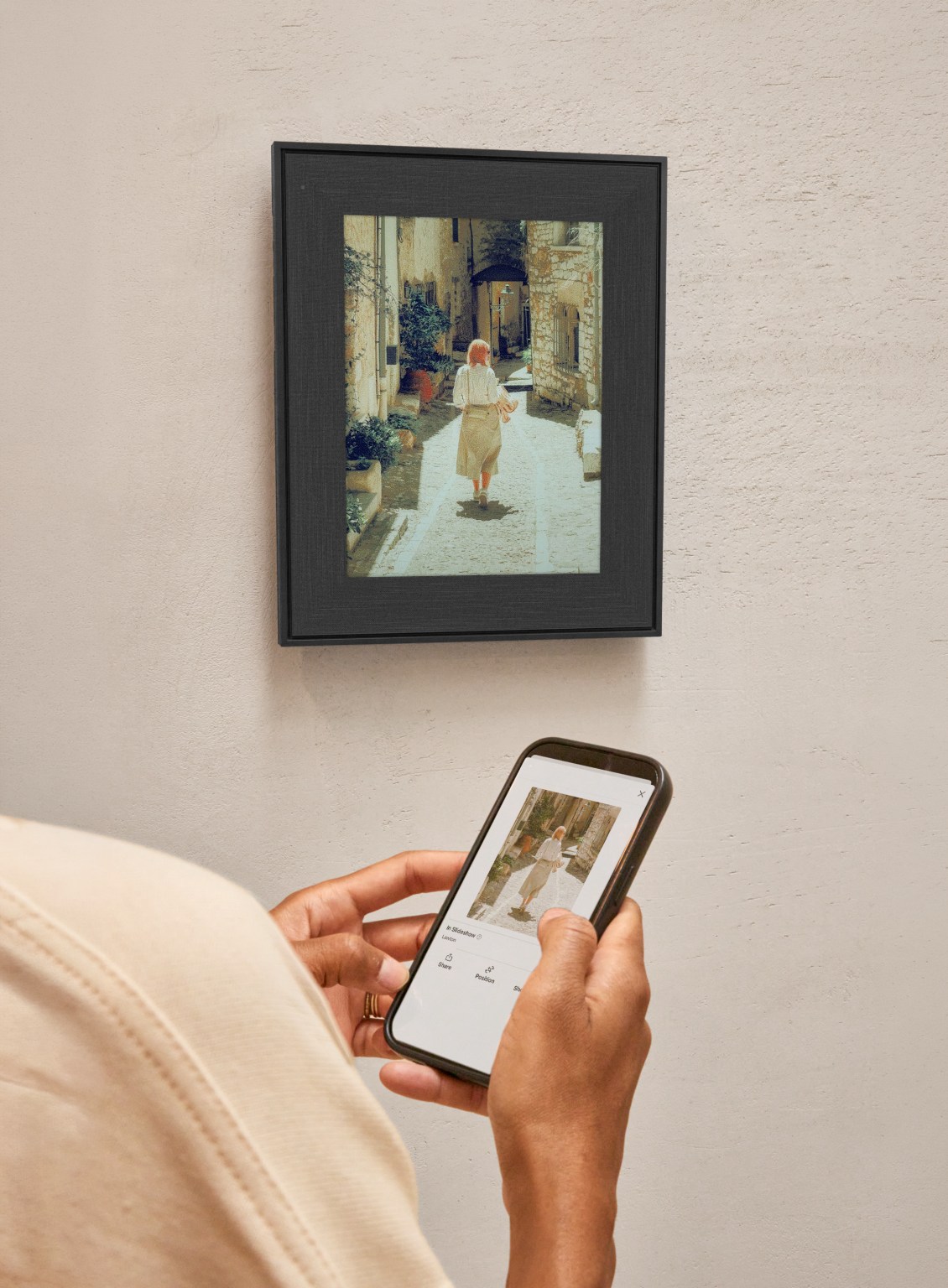
- several people feed it. Aura says the average frame has about four people contributing photos; the Aura mobile app handles uploads and shared albums, so children can keep pushing new pictures to a family home;
- the content is people. Faces are the case the three added colors improve most;
- it must read as decor. The black frame with a dark gray linen-textured mat was chosen, in Aura's words, to reduce the visual contrast between bezel and display so the whole object looks like an ordinary mounted print.
Skip it if:
- you need the photo to match the original file; the palette stays below print saturation;
- you want motion or living-room video. No e-paper frame does that, and the honest alternative is a powered display such as Apple's two $299 home display devices that launched on November 13;
- you open the app and reshuffle photos constantly, because rotation cadence is the battery budget;
- price alone drives the choice. Spectra 6 is no longer exclusive to one brand: roundups such as Creative Bloq's e-paper art frame list include 10-inch color models priced from about $199 to $249.
FAQ: four questions that decide this purchase
Is the 10-inch just a smaller, worse 13-inch?
No. It is the same Spectra 6 family with three extra proprietary colors and higher pixel density — 200 PPI against 150 PPI — for $150 less. What you give up is screen area, not sharpness.
Does an e-paper frame suffer burn-in the way a TV panel does?
Different failure mode. E-paper holds a static image without power, so the practical risk is incomplete refresh and faint ghosting after many swaps, not permanently dimmed pixels. That is not the same problem we quantified in our side-by-side read of WOLED edge decay and QD-OLED burn-in, where 14 of 16 tested televisions showed edge defects after 18,000 hours. Expect to run a rotation on a new unit for a week and look for residue between refreshes.
Can I read it in a dark hallway?
Only with the front light, and that is the single biggest battery variable. In a dark room, a front-lit frame is a lit object again, which is exactly what the paper-like effect avoids.
Should I trust three months or one month?
Plan on the lower number. Three months is what Aura claims for the Ink 10-inch on a single charge; the measured 13-inch figure was about one month. If your rotation runs once a day and the front light stays off, the gap narrows.
Pitfall checklist before you order, and after it arrives
- Measure viewing distance first. Above 60 cm, size matters more than density; below 50 cm, take the Ink 10-inch.
- Set rotation to once a day before the first upload, then observe runtime for one full cycle before judging the claim.
- Check ambient light at the hour you actually look at it. Hallway scenes are often darker than the showroom photo suggests.
- Keep the unit out of direct sun and away from heat sources; the panel's 0 to 50 degrees Celsius window is not a comfort range.
- Judge faces first, landscapes second — that is where the three added colors show up.
- Give every contributor access via shared albums, then agree on who can overwrite the queue; the average Aura frame has about four people feeding it.
- Accept the retro cast. If you want a color-accurate reference, this product class is not it.
Sources
- TechCrunch, "Aura's newest e-ink photo frame is even better and more affordable than its last" (10 November 2026)
- TechCrunch, "Aura introduces a $499 e-ink digital photo frame that lets you go cordless" (21 October 2025), including Eric Jensen's remarks on front-light brightness
- Aura Help Center, "Aura Frame Comparison Guide" — Ink 10-inch at 200 PPI versus Ink 13-inch at 150 PPI
- The Verge, "Aura's next color E Ink photo frame is smaller, cheaper" (November 2026)
- E Ink, "E Ink Spectra 6" product page — 200 PPI, 30:1 contrast, 0 to 50 degrees Celsius operating range
- E Ink newsroom, "Aura Launches Aura Ink Featuring E Ink Spectra 6" — power drawn only when the front light is on and images change
- PetaPixel, "Aura's New, Improved E-Paper Picture Frame Looks Like a Printed Photo" (10 November 2026) — $349 price and availability
- Creative Bloq, "The best e-ink art frames" — market price context for 10-inch color e-paper frames