
Kimi K3.1 Pro Leads the Arena Agent Ranking: An ItInsightsWorld Deep Explainer
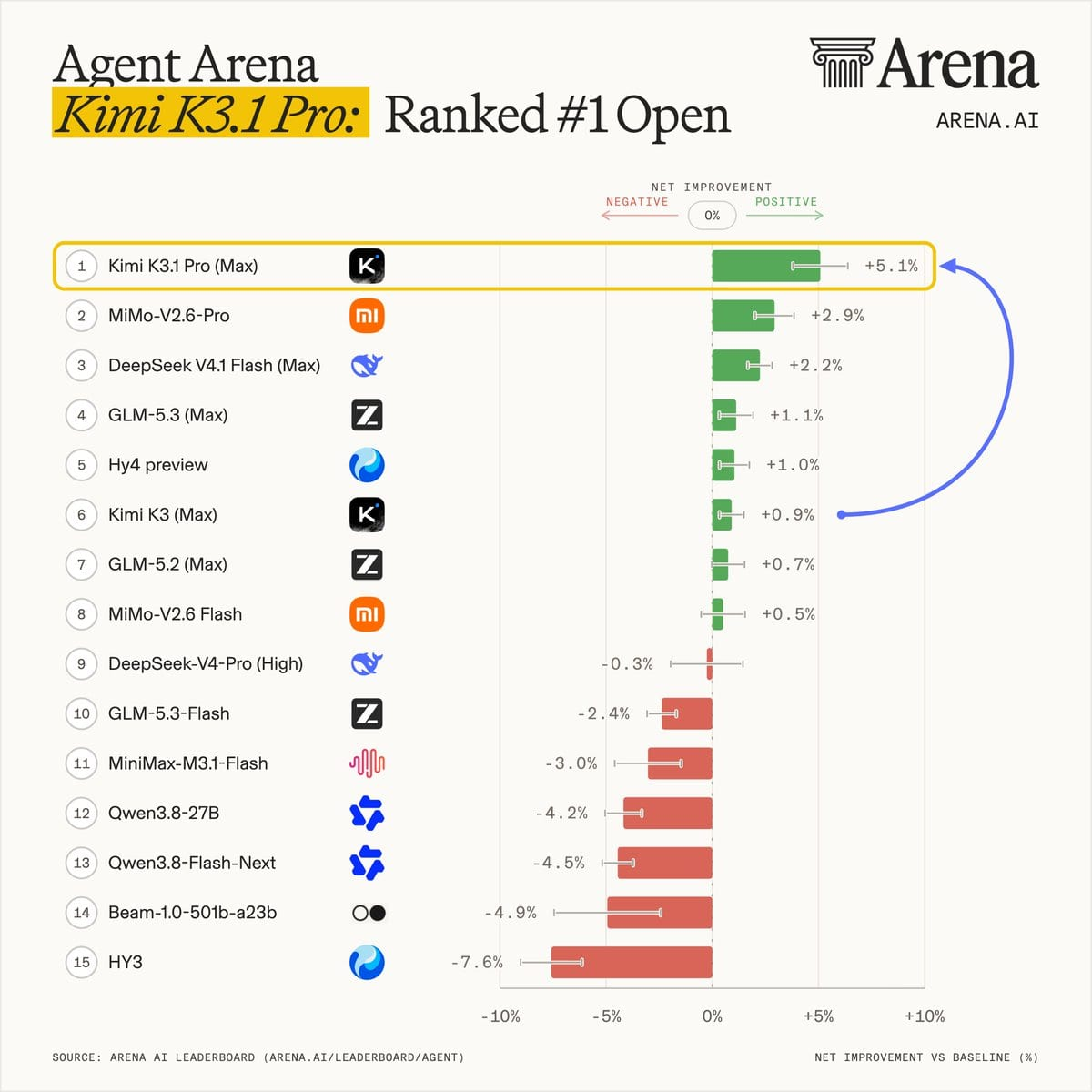
Moonshot AI's Kimi K3.1 Pro (Max) now sits at the top of Arena's open-weight agent ranking, posting a net improvement rate of +5.1% — a gain of 4.2 percentage points over the +0.9% recorded by Kimi K3 (Max). The score is built from more than 17,500 real, long-horizon agent task sessions, so it describes completed work, not test-set accuracy. This explainer unpacks what moved, how the number is produced, and what a general reader should do with it.
What exactly changed on the leaderboard?
Short answer: the gap between open-weight models and the best closed systems narrowed on the tasks people actually delegate — and Arena's data, rather than a vendor benchmark sheet, is what says so.
The updated ranking draws on more than 17,500 genuine sessions in which users handed an agent a multi-step job and let it run. Kimi K3.1 Pro (Max) finished with a net improvement rate of +5.1%, against +0.9% for the previous generation, Kimi K3 (Max). Arena's four published sub-signals show where the jump came from:
- Bash Reliability: +7.9%, ranked first among open models; the earlier K3 scored -4.5% and sat in 13th place.
- Praise vs Complaint: +7.7%, up sharply from +1.3%.
- Steerability: +6.5%, again first among open models.
- Confirmed Success: +3.9%, fourth among open models, a hair above the previous +3.8%.
Read together, the pattern is unusual. The biggest gains are in the least glamorous skills — keeping a terminal command from breaking, accepting a course correction mid-task, and staying pleasant enough that users praise rather than report. Those are operational qualities, not reasoning fireworks.
How does Arena calculate "net improvement"?
Conclusion first: net improvement is not an accuracy percentage. It estimates how much better (or worse) a model changes the outcome of a real user task compared with an average model handling comparable work.
Arena describes the figure as a causal treatment effect rather than a win rate, aggregated from several outcome signals — confirmed success, praise versus complaint, steerability and related measures — and publishes 95% confidence intervals alongside the scores (see the Arena methodology note). In practical terms, +5.1% means tasks handled by this model ended measurably better than comparable tasks handled by an average model.
Scale helps. Arena's Pareto frontier view, which plots net improvement against median cost per task, spans roughly -21.9% to +20.2% with task costs ranging from about $0.01 to $6.80. That context explains why the headline is not "+5.1% is huge" but "+5.1% is the top mark anyone has reached among openly downloadable models". The claim worth repeating is the ranking, not the decimal.
Which signals improved, and what does each one mean?
The four published indicators each answer a different user question: does it work, does it annoy me, does it listen, and did it actually finish.
| Arena signal | Kimi K3.1 Pro (Max) | Previous generation | Open-model rank | Plain-English meaning |
|---|---|---|---|---|
| Bash Reliability | +7.9% | -4.5% (13th) | First | Shell commands run without breaking — the single biggest flip |
| Praise vs Complaint | +7.7% | +1.3% | Reported as improved | Users thank the agent rather than complain about it |
| Steerability | +6.5% | — | First | Mid-task feedback actually changes the execution direction |
| Confirmed Success | +3.9% | +3.8% | Fourth | The user explicitly marks the task as done |
One caution belongs here: Confirmed Success moved by only 0.1 percentage points, which is well inside ordinary statistical noise. The honest reading is that reliability and cooperation improved dramatically, while the raw completion rate stayed roughly where it was.
What is actually inside Kimi K3.1 Pro?
According to the model documentation published by Moonshot AI, K3.1 Pro is a mixture-of-experts (MoE) architecture with 2.8 trillion total parameters, around 104 billion active parameters per inference pass, and a context window of roughly 1 million tokens. It is natively multimodal, and the vendor says the release concentrates upgrades in coding, 3D creation, financial research, factual accuracy and complex agent-task execution. Alibaba Cloud's model-service documentation additionally frames the release as the large-scale post-trained version of the Kimi K3 base model (model card listing).
Moonshot AI has stated that the weights are now downloadable on Hugging Face, and that the company will keep pushing an open intelligence ecosystem. That single sentence is the reason a leaderboard result becomes a business story: capability that used to be rented behind an API is now something organisations can audit, tune and host.
Why does an open model leading this ranking matter beyond one vendor?
Because the buying behaviour has already shifted underneath it. A September 2026 survey of 200 enterprise respondents, reported by Constellation Research and Techstrong.ai, found open-weight models already carry 34% of enterprise AI token usage, up from 23% a year earlier, with a projection of 41%. Meanwhile Menlo Ventures counted enterprise AI deployment spend scaling to $177 billion by September 2026, from $33 billion the year before.
Cost pressure is the second engine. Arun Chandrasekaran, an analyst at Gartner, told TechTarget that cheaper model pricing is what makes more agentic, high-volume enterprise workflows feasible — falling unit prices, not raw benchmark scores, decide whether an agent runs 200 times a day or twice.
Put the three facts in a line: open weights are mainstream, agent budgets are exploding, and Arena now says the best openly available agent is measurably better at finishing work. That combination is a trend signal, not a one-off product announcement.
Five common misconceptions worth clearing up
- "A rank is a guarantee for my workload." Net improvement averages thousands of heterogeneous sessions; your narrow, domain-specific pipeline may look completely different.
- "+5.1% means my tasks run 5.1% faster." It is an outcome effect size, not a latency or throughput claim. Speed depends on serving hardware, batching and context length.
- "Open weights mean free and easy to run." In an MoE design, all 2.8 trillion parameters must be resident in memory even though only about 104 billion are computed per token. Community sizing guides covering this model family cite vendor guidance of 64 or more accelerators for full-scale serving (Akash sizing note). Most teams will reach it through hosted inference providers instead.
- "Open license means unrestricted." The model repository publishes its own licence file; verify the terms, attribution and usage conditions before any commercial rollout (Hugging Face licence page).
- "One leaderboard settles the debate." Arena measures crowdsourced real sessions. Safety testing, structured-output accuracy and tool-schema compliance still need separate evaluation.
Should you test it? A six-step decision checklist
- Define one delegated task, not a chatbot. Pick a job with a verifiable end state: a report assembled, a ticket resolved, a script that runs.
- Instrument the four Arena-style signals in your own logs — command success rate, corrections needed, explicit completion confirmation, complaint tickets.
- Run a 30–50 task pilot against the model you use today, keeping prompts, tools and budget identical.
- Price the total journey, not the token rate: context length, retries and tool calls dominate agent cost at scale.
- Check licence and data-residency terms before sending real records to any hosted endpoint or self-managed cluster.
- Set a kill switch: automatic fallback when success confirmation drops below your agreed threshold.
Frequently asked questions
Is +5.1% a good score in absolute terms?
It is mid-range on Arena's overall scale, which runs to roughly +20% at the frontier, but it is the leading value among open-weight entries — and that second fact is the news.
What does "(Max)" mean in the ranking name?
It denotes the evaluation configuration Arena lists for that model, typically the highest-effort setting with full tool access. Scores for other configurations are published separately, so compare like with like.
Why did Bash Reliability improve so much more than Confirmed Success?
Command execution is where earlier agents broke silently, so fixing it produced a large measurable effect. Explicit completion was already close to the ceiling in the previous generation, moving from +3.8% to +3.9%.
Can a small company actually use this model?
Realistically through hosted inference providers, which remove the memory problem of serving 2.8 trillion parameters yourself. Self-hosting makes sense mainly when data control or fine-tuning justifies the infrastructure.
Does a top open model close the gap with closed frontier systems?
On crowdsourced agent sessions, the gap narrowed to the point where price, control and auditability become the deciding variables. Capability parity on every enterprise workload is still not established.
Three trend calls and what to do about them
1. Rankings move from chat quality to task completion. Expect more platforms to publish outcome-based, causal-style metrics rather than static accuracy tables. Treat any single number as one data point among several.
2. The competition shifts to serving economics. When frontier and open weights converge on reliability, the decisive variable becomes cost per completed task and the infrastructure required to deliver it.
3. Open weights become the default test option, not the rebel choice. With a third of enterprise tokens already running on openly downloadable models, benchmark evidence like this mainly accelerates an existing migration.
For a general reader, the practical translation is simple: AI assistants are getting better at finishing errands rather than sounding clever. For anyone paying for those errands, the useful move is a measured pilot before any switch.
Sources and further reading
- Arena — Agent Arena methodology and scoring: https://arena.ai/blog/agent-arena-methodology
- Arena — Agent Pareto frontier (net improvement vs cost per task): https://arena.ai/leaderboard/agent/pareto
- Alibaba Cloud Model Studio — Kimi K3.1 Pro model documentation: https://help.aliyun.com/zh/model-studio/kimi-k3-1-pro
- Hugging Face — Moonshot AI model repository and licence file: https://huggingface.co/moonshotai/Kimi-K3.1-Pro/blob/main/LICENSE
- Constellation Research — enterprise use of open-weight models (September 2026 survey of 200 respondents): https://www.constellationr.com/research/blog/evidence-shows-enterprises-use-open-weight-models-mainstream
- Techstrong.ai — open-weight models projected to reach 41% of enterprise token usage: https://techstrong.ai/articles/open-weight-ai-models-expected-to-capture-41-of-enterprise-token-usage/
- Menlo Ventures — 2026: The State of Enterprise AI: https://menlovc.com/perspective/2026-the-state-of-enterprise-ai/
- TechTarget — Gartner analyst commentary on pricing and agentic workloads: http://www.techtarget.com/news/openai-slashes-price-for-model-again/872942/