
Anthropic IPO Expectations Cool: What a Below-60% Odds Shift Means for the $1.5 Trillion Debate
Anthropic IPO odds fell from close to 90% before the U.S. midterm elections to below 60%, according to Kalshi traders, while investors question whether the $1.5 trillion valuation can survive a sharp AI-stock selloff, slower growth, and Claude Code departures. A trillion-dollar listing is still possible, but pricing now depends on cash burn, compute commitments, and whether the roadshow can happen before investor attention narrows.
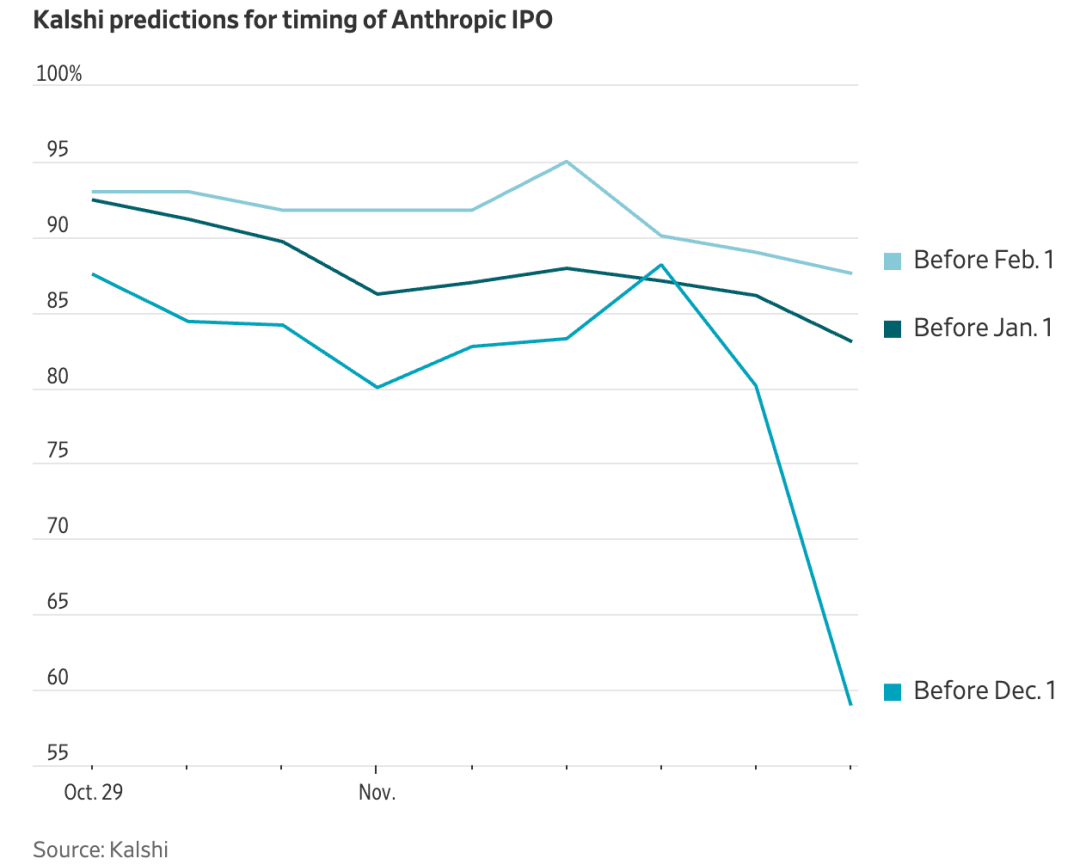
What moved Kalshi's Anthropic IPO odds from close to 90% to below 60%?
Traders on Kalshi treated Anthropic's IPO less as an inevitable calendar event and more as a risk asset. Before the U.S. midterm elections, the probability had been close to 90%; by early November it was below 60%. The change was not caused by a single announcement. It reflected three linked concerns: a falling AI-stock tape, doubts about the $1.5 trillion valuation level, and talent losses that arrived at an inconvenient moment. Claude Code lost three key members within two weeks, and two prominent names, Cat Wu and Austin Lau, moved to OpenAI. That made the IPO story more fragile because investors could no longer separate Anthropic's financing window from its operational momentum.
How did the Nov. 5 AI-stock selloff change IPO pricing?
Market conditions are the first reason the IPO became harder to sell. On Nov. 5, United States equities sold off broadly. The Dow dropped 1,833 points, or 3.44%; the S&P 500 index fell 4.36%, its biggest one-day loss since the April 2025 tariff shock; the Nasdaq fell 5.52%, the largest single-day decline in 19 months. AI infrastructure bore the sharpest repricing. The Philadelphia Semiconductor Index fell about 12.3%, the deepest one-day drop since March 2020. Nvidia dropped about 9%, AMD about 17%, CoreWeave about 10%, and Nebius about 15%; CoreWeave and Nebius had both fallen from their Oct. 6 highs. Microsoft slipped 3.6%, while Amazon and Alphabet each declined 2.2%.
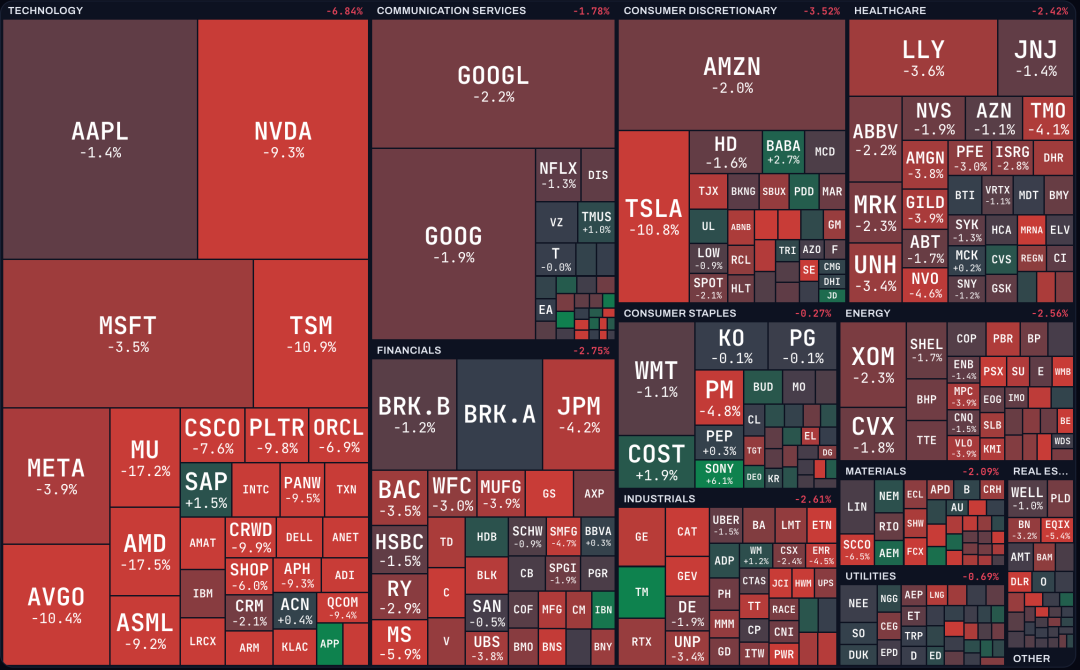
What made the decline more than a valuation correction was its political reading. In the United States, data centers have become a local-infrastructure issue: power demand, water use, land use and grid strain can shape elections. UBS estimates that about 30% of expected United States data-center capacity additions in 2028 could be affected by potential construction pauses. A widely cited market report quotes Bruce Zaro, a managing director at Granite Wealth Management: "There's going to be a lot of pushback about those data centers being geographically located in someone's backyard, straining the power grid, straining the water systems." The point is not that every project will stop; it is that permitting timelines can change the return model.
For readers trying to understand the damage, ItInsightsWorld's plain-English field guide explains how the Nasdaq move translated into sector-level pressure.
Why is a trillion-dollar IPO plan becoming a pricing test?
Anthropic is unusual in this AI wave: it buys compute at enormous scale and also sells AI services directly to businesses and consumers. That makes it both a spending story and a revenue story. Investors are trying to judge whether AI capacity purchases eventually convert into durable margins. The pricing mechanism is circular: institutions evaluate a new listing by reference to public tech-stock multiples, earnings expectations and market risk. When those reference points fall, they can still like the company but demand a bigger discount or write a smaller check. Anthropic had been expected to raise as much as $100 billion. A deal that large cannot rely on momentum alone; it needs enough stable institutional appetite to avoid lowering valuation, shrinking the raise, or waiting for calmer tape.
The timing question became public on Nov. 5. Reports said investors questioned whether Anthropic could start its roadshow in the week of Nov. 9 and finish a listing in November. Some said the about $1.5 trillion level discussed earlier was still too high and wanted more room for a discount. Anthropic declined to comment. Its prospectus language is deliberately limited: it says the company "plans to conduct a public offering as soon as practicable after the SEC registration statement becomes effective".
Why has the valuation moved from $2 trillion to $1.5 trillion and lower?
The trajectory is mainly about growth speed. A $2 trillion expectation briefly appeared in September this year, then cooled. On Oct. 14, Anthropic disclosed third-quarter figures during an investor day: revenue rose about 45% quarter-over-quarter to $16.8 billion. Growth remained strong, but it was well below the about 145% increase reported for the second quarter. The next day, media reports said some existing and prospective investors discussed moving the IPO valuation from about $2 trillion to $1.5 trillion. Roughly $500 billion of hoped-for value vanished before a formal price was set. Some commentators argued that June would have been a better listing window, when the revenue curve still looked explosive.
On Nov. 2, Anthropic updated its prospectus with third-quarter numbers: revenue of $16.956 billion, growth of about 47% quarter-over-quarter, and long-term compute purchase and lease commitments totaling $895.4 billion. The same day, reports said investors preparing for the IPO preferred a $1.5 trillion to $1.6 trillion range. That was already a cut. By the time the AI-stock selloff deepened, some investors were discussing $1.2 trillion to $1.3 trillion, and others pushed toward $1.1 trillion.
Other reported filing details sharpen the context. A review of the amended prospectus noted roughly $33.2 billion in nine-month revenue, $895.4 billion of aggregate commitments, and $131.9 billion in cash and short-term investments as of Sept. 30. Another market report added that total liquidity, including an available credit line, reached $146.6 billion. Those figures are not a green light by themselves. They show that the company has resources, while the market remains focused on whether October and subsequent months can prove that the deceleration seen after the second quarter was only temporary. As of the reporting covered here, October revenue had not been separately disclosed in the Nov. 2 prospectus, so investors are still pricing from fragments.
| Scenario | What it implies | Key evidence |
|---|---|---|
| $1.5 trillion to $1.6 trillion | Investors still want direct frontier-AI exposure, but want a discount from the prior peak. | Nov. 2 reporting on institutional IPO pricing preferences. |
| $1.2 trillion to $1.3 trillion | The AI trade is being repriced, and policy or supply-chain friction enters the valuation. | Nov. 5 selloff and UBS data-center capacity estimate. |
| $1.1 trillion | Investors demand a deeper haircut if growth stabilization is not confirmed. | Later discussion reported after the AI-stock decline. |
| Delay scenario | Timing risk becomes as important as price. | Questions over a roadshow in the week of Nov. 9 and a listing in November. |
What do the Claude Code departures to OpenAI tell investors?
Talent movement often looks like noise until it happens during a financing window. U.S. time Nov. 3, Cat Wu, former product lead for Claude Code, announced her departure after about two years at Anthropic. She had helped turn Claude Code from an internal experimental tool into a commercial product. Two days later, she announced she was joining OpenAI to lead product management for core products, reporting to Tibo Sottiaux. On the same day, Austin Lau, Anthropic's first growth-marketing hire, also moved to OpenAI. Anthropic had highlighted him in January this year as an employee who used Claude Code to build marketing tools and reduce ad-asset production time from 30 minutes to 30 seconds.
The market reads this as a competitive signal, not a moral verdict. Anthropic and OpenAI are fighting for enterprise AI workloads, coding-agent adoption, and the same developer mindshare. The employees who helped Anthropic make Claude Code commercially credible and Claude user acquisition more disciplined now sit in the rival camp. Anthropic's prospectus argues its people advantage remains real: it reported a "regretted attrition" rate of about 1% over the past 12 months. However, that statistic does not yet include the departures recorded since late October. Cat Wu also said she did not leave because she could not sell shares early. More detail is in ItInsightsWorld's explainer, Cat Wu leaves Anthropic.
Why does OpenAI's fundraising pressure matter?
Anthropic is not the only frontier-AI company being repriced. On Oct. 19, reports said OpenAI was accelerating a raise of about $30 billion to lock in capital ahead of Anthropic's IPO, with a target valuation of more than $1.4 trillion. By Oct. 30, that fundraising goal had narrowed to about $20 billion, and the target valuation moved to $1.25 trillion. On Nov. 6, reports said OpenAI had completed a first tranche of about $11 billion, with the remainder still being assembled.
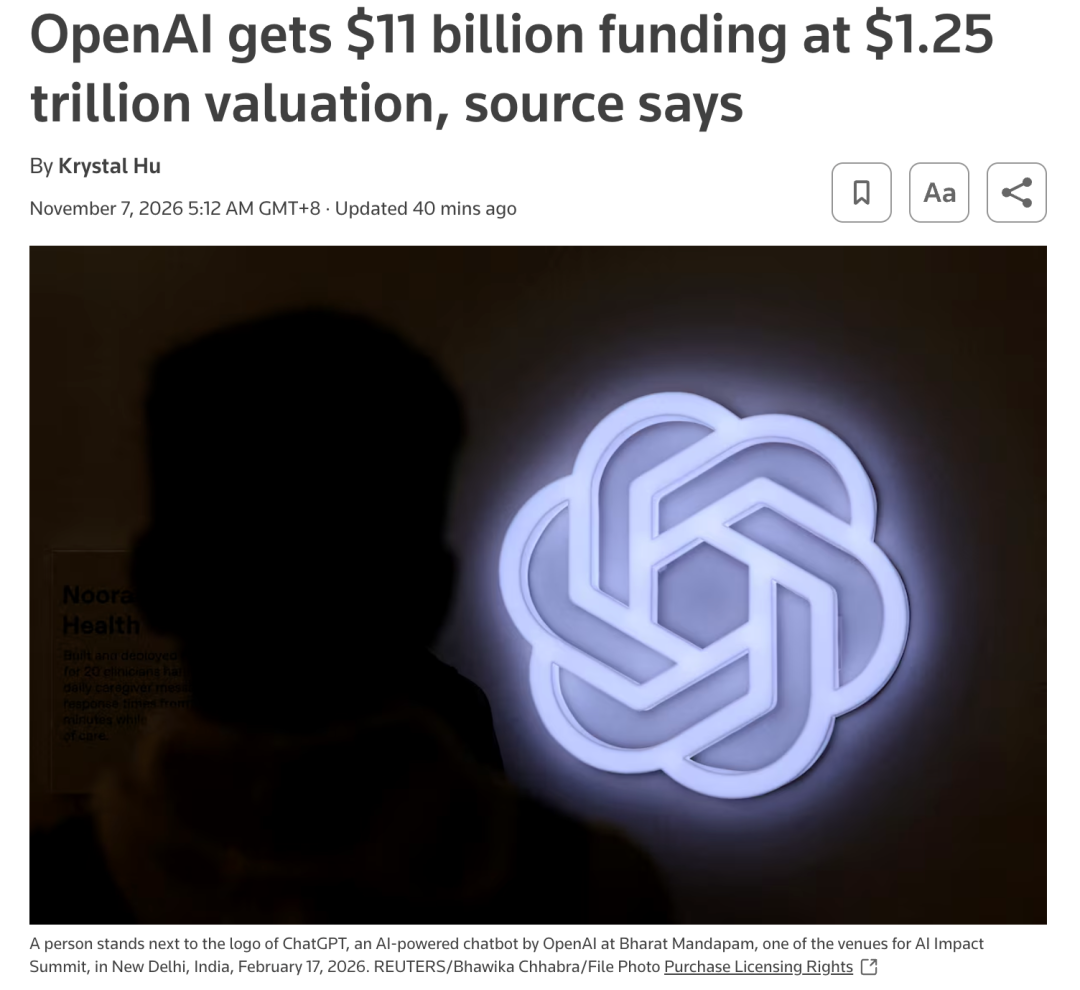
OpenAI wanted money before a public-market comparable appeared. Anthropic wanted a record listing. Both are now exposed to the same investor pool. If one company's private financing terms get marked down, the other's public pricing expectations tend to move with it.
Will the AI IPO wave still give investors a pricing anchor?
Compared with the broader AI listing rush, Anthropic is one of the few companies still pressing forward. As of Oct. 22, data-center operator Switch, AI infrastructure company Nscale, and SoftBank-backed SB Energy had delayed IPOs. Nvidia-backed Firmus and Blackstone-backed AirTrunk REIT had withdrawn or paused their offerings. Some companies apparently did not want to compete for the same institutional attention and capital. Large investors still saw Anthropic as one of the few direct ways to own frontier AI. Two weeks later, however, even Anthropic's schedule came under doubt.

For public investors, the issue is comparison. Listed chipmakers and cloud giants are easy to benchmark. OpenAI and Anthropic, as direct frontier-model developers, lack close public-market comps. If Anthropic lists, even at a lower valuation, the market gains a reference point: how investors value revenue growth, profitability, compute costs and long-term commitments. That makes the IPO more than an exit story. It may set the template for how OpenAI and others are later judged.
Does a delayed IPO mean Anthropic is about to run out of cash?
Not immediately. The latest prospectus says Anthropic held about $131.9 billion in cash and short-term investments as of Sept. 30. The reported liquidity cushion, including an available credit line, gives the company room to absorb timing risk. A delay would be painful, but it would not automatically create a solvency problem.
The harder constraint is commitment size. Anthropic has signed nearly $900 billion of long-term compute purchase and lease commitments, including about $69.8 billion due before Sept. 30, 2027. If financing costs rise, investor appetite cools, or listing windows slip, the company may need to slow expansion, renegotiate projects, or reshape investment plans. Data centers, chip suppliers, lenders and infrastructure investors that count on Anthropic's future orders would feel the effects too. Missing one IPO window is manageable. Missing confidence in the AI capital cycle is more expensive.
Common misconceptions about the Anthropic IPO reset
- A lower Kalshi probability is not an SEC rejection; it is a market-implied chance of listing timing.
- A lower valuation target is not proof of business failure; it often reflects the price investors are willing to pay for future growth and risk.
- Strong revenue is not enough. The market is reacting to growth deceleration from about 145% in the second quarter to about 45% in the third quarter, even though quarterly revenue remains large.
- Employee departures are not automatically a sign of collapse; they become material when key product and growth talent moves to a direct competitor during an IPO attempt.
What readers should watch next
- Whether Anthropic keeps a roadshow schedule for the week of Nov. 9 or shifts the timetable without a formal update.
- Whether October revenue appears separately, because investors want to know if growth can reaccelerate after the third-quarter slowdown.
- Whether the valuation conversation lands near $1.5 trillion to $1.6 trillion, $1.2 trillion to $1.3 trillion, or $1.1 trillion, and whether the raise remains close to the previously expected $100 billion scale.
- Whether compute-commitment disclosures show more near-dated obligations beyond the about $69.8 billion due before Sept. 30, 2027.
Frequently asked questions
Why did Kalshi odds fall?
Traders moved from close to 90% to below 60% because IPO success is now seen as conditional on AI-stock stability, investor demand and the ability to execute a trillion-dollar-scale listing.
Is $1.5 trillion still possible?
It is part of the debate. On Nov. 2, some investors preferred $1.5 trillion to $1.6 trillion, but after the selloff some discussed $1.2 trillion to $1.3 trillion and $1.1 trillion.
Did Cat Wu and Austin Lau leave because of the IPO?
No direct link has been established. Cat Wu said share-sale timing was not a factor. Still, their moves to OpenAI matter because they happened in the same window.
What would delay mean for Anthropic?
A delay tests patience more than liquidity. The company has about $131.9 billion in cash and short-term investments, but it has nearly $900 billion of compute commitments and needs a stable financing path.
Reference sources
- The Wall Street Journal: Major Investors Are Skeptical Anthropic IPO Can Achieve $1.5 Trillion Valuation
- The Business Times: Investors wipe US$2.5 trillion off Nasdaq as blue tsunami prompts AI fears
- Yahoo Finance: Anthropic filing reveals scale of AI spending behind $33B in revenue
- Fortune: Anthropic's growth slowed and costs jumped in the third quarter
Prepared by James Hartley for ItInsightsWorld. Contact: contact@itinsights.com.