
Cat Wu Left Anthropic for OpenAI: Why It Matters in the AI Coding Agent Race
By James Hartley · IT Insights
Cat Wu, the product leader who helped turn Claude Code from an internal experiment into one of the most widely used AI coding tools, has left Anthropic and joined OpenAI. She announced the departure on the X platform on November 3 and said October 30 was her final working day there. The switch moves a proven AI-product operator to the other side of the fastest-growing category in software: autonomous coding agents.
If you never write code, this is still worth five minutes. The story shows where value is created and contested in the AI business right now — not in model papers, but in the products, workflows and distribution channels that convert raw capability into something people actually pay for.
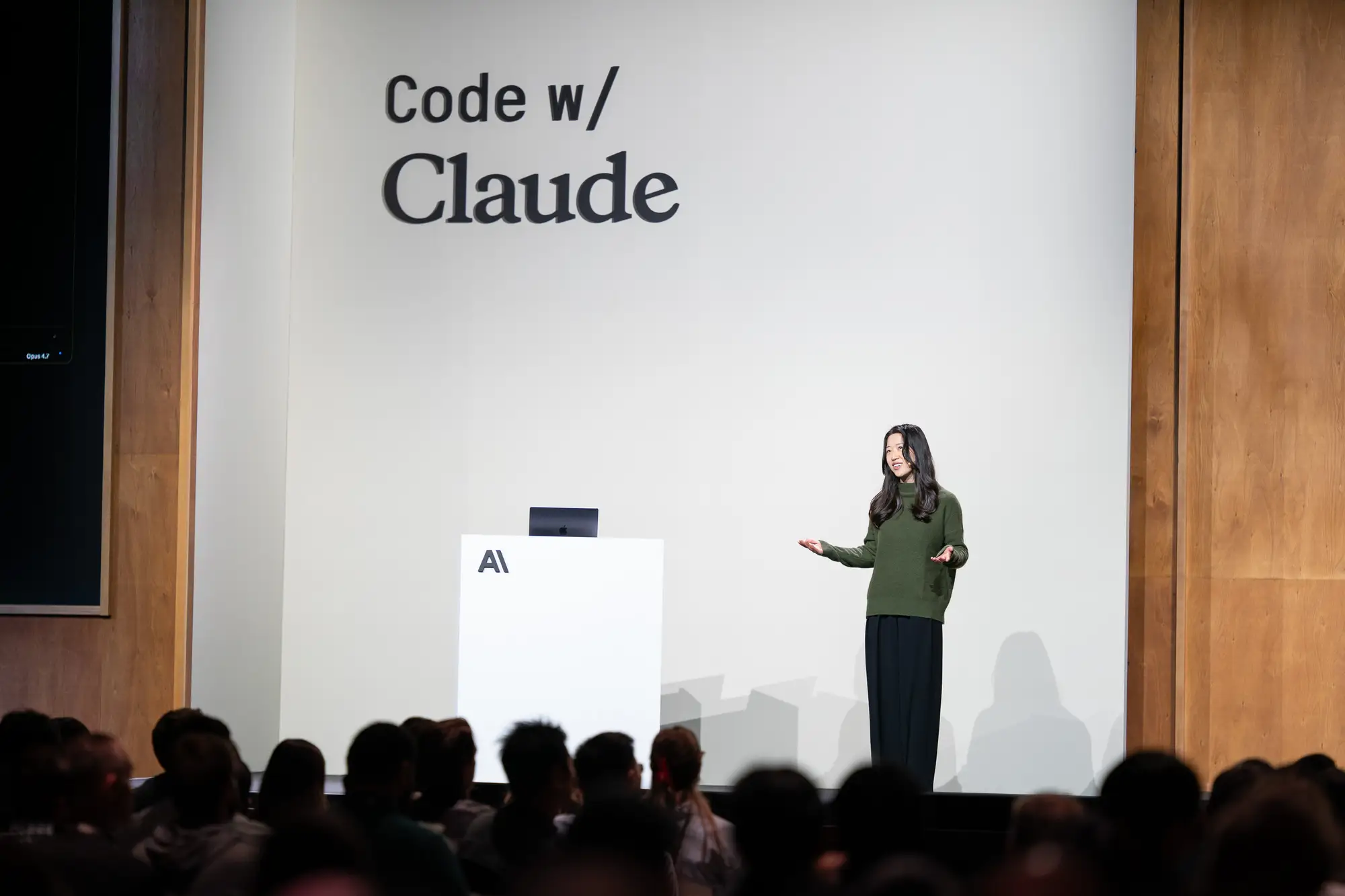
What is she actually going to do at OpenAI?
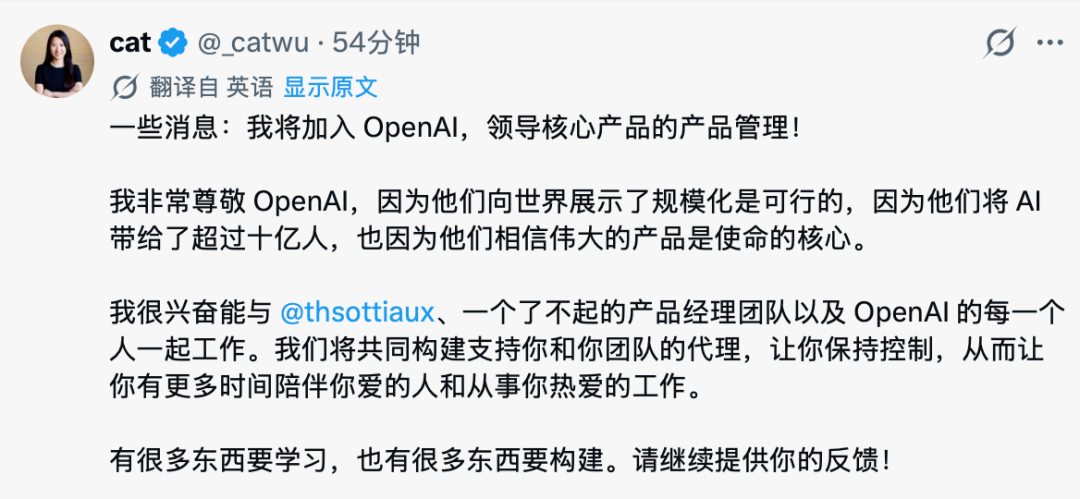
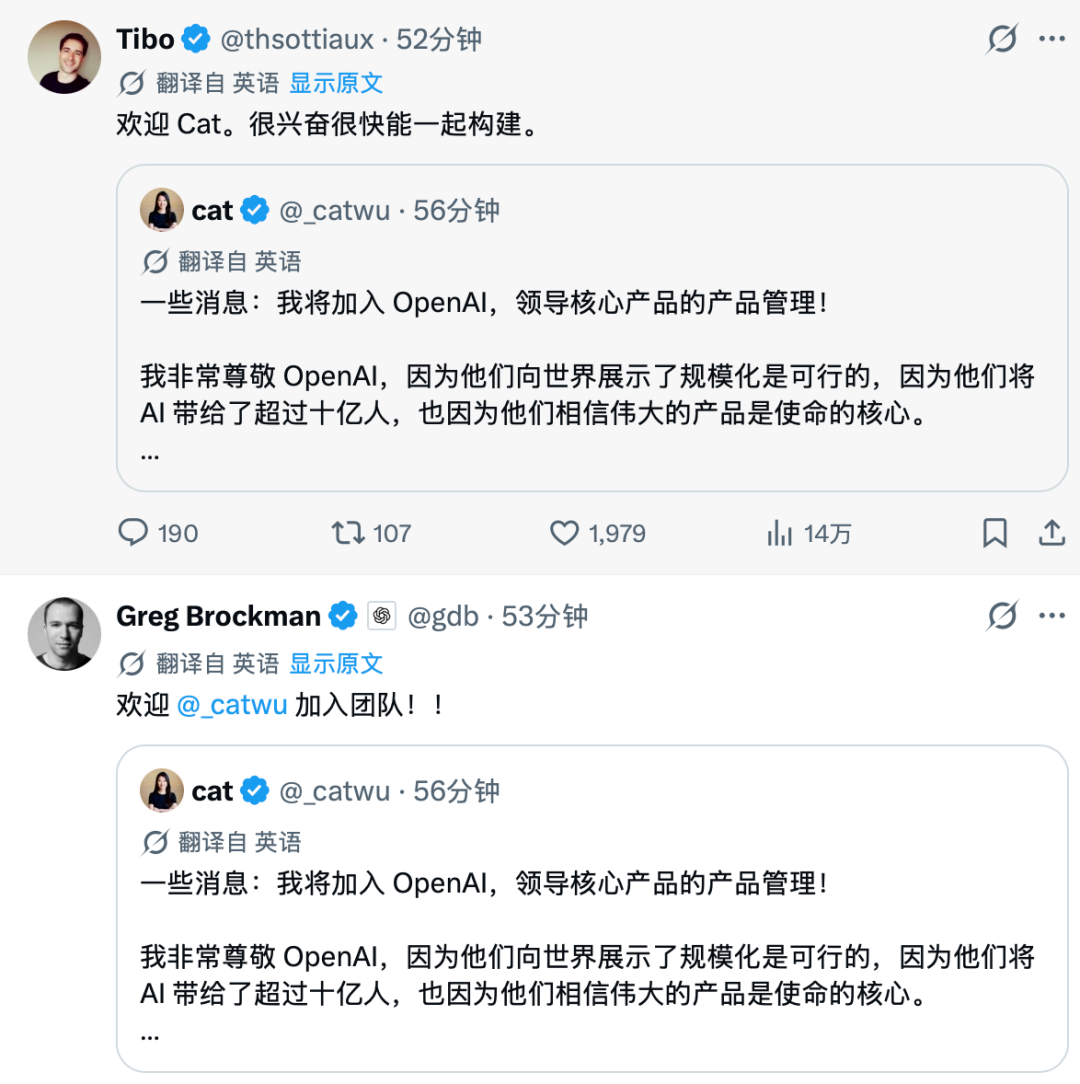
Short answer: she joins an integration push, not a single app. An OpenAI spokesperson said Cat Wu will work alongside Nick Turley on enterprise products and with Ashley Alexander on consumer products, reporting to OpenAI executive Tibo Sottiaux.
In her own note on the X platform she said she has great respect for OpenAI, and singled out its scale, pointing out that the company already serves more than 1 billion users. The work she wants to do next, in her description, is building AI agents that support both individuals and teams while keeping users in control, so people have more time for the work and life they care about.
Two details stand out. The pairing structure — enterprise products with Nick Turley, consumer products with Ashley Alexander — suggests OpenAI is deliberately fusing two audiences that historically ran on separate product tracks. And the reporting line to Tibo Sottiaux puts her inside the core product decision loop rather than in a peripheral role.
She is not the only name in motion. Reports from 36Kr and product-media coverage on Woshipm described the switch as effectively seamless, and noted that within roughly two weeks Anthropic saw three other senior Claude Code-related departures, among them the creator of the desktop client, a core engineer and the product's first growth marketer.
What did she build at Anthropic?
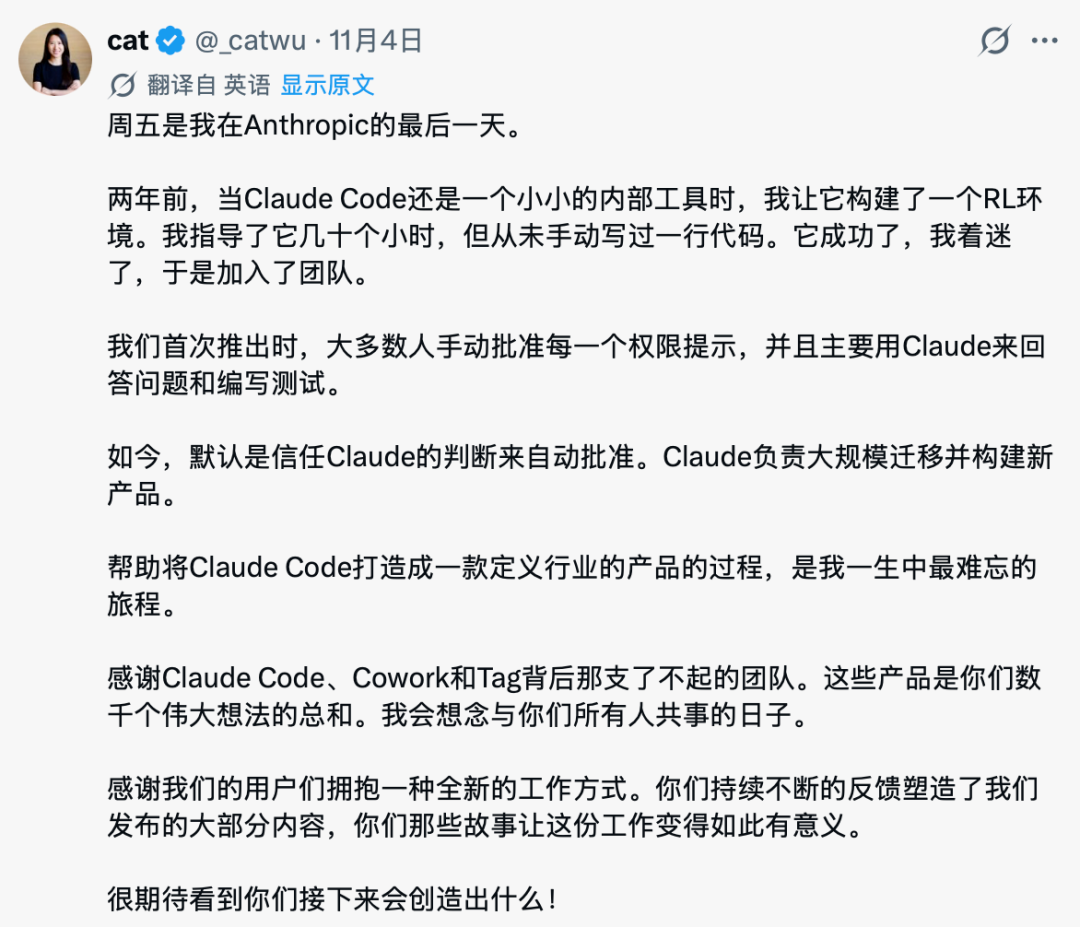
Cat Wu entered Anthropic in summer 2024, responsible for Claude Code and for tools aimed at non-programming work such as Cowork. Together with the product's creator Boris Cherny, she turned an internal experimental tool into something developers adopted fast.
Claude Code launched its research preview in February 2025, and its ability to write and run code autonomously quickly made it an important growth driver for Anthropic. Her own retrospective of the arc is unusually concrete: early users had to manually approve most operations, and the AI was mainly used to answer questions and write tests; today, Claude can carry out large code migrations and build new products.
Market context she leaves behind: third-party trackers summarising company disclosures place Claude Code at roughly $2.5 billion in annualised run-rate revenue by early 2026, up from about $1 billion in the closing months of 2025, with enterprise use accounting for more than half of that. These are estimates, not audited statements — but they explain why the person who ran the product function of that engine is considered a high-value hire on any side of the fence.
Why is the timing of her exit discussed so much?
Her departure lands in the middle of Anthropic's public-market preparation. Business Insider previously reported that Anthropic planned to carry out its initial public offering later in November. Asked about speculation that the exit was tied to when she would be able to sell shares, Cat Wu stated clearly that this was not a factor in her decision.
The listing itself is under close watch. Reuters reported in late October that Anthropic had opened its books to investors, showing soaring sales alongside steep losses, and that some current and prospective investors were valuing the company at about $1.5 trillion, down from roughly $2 trillion. Against that backdrop every pre-IPO departure is read as a signal, fair or not.
Our own read, offered as analysis rather than reporting: one executive leaving weeks before a listing is ordinary market noise. A cluster of senior exits around a single product line inside two weeks is the item worth watching, because coding agents are sold on continuity of iteration — customers buy a roadmap, not a snapshot.
What changes in the OpenAI versus Anthropic race?
The move matters because the two companies are chasing the same budget: the money firms spend on software engineering and, increasingly, on non-technical work. OpenAI continues to push Codex toward wider software-development and non-technical task scenarios, and Cat Wu's experience in Claude Code's product development, user growth and commercialisation may bring new help to OpenAI's core products and agent business.
Money alone does not explain this kind of transfer. The Financial Times reported that OpenAI's offer range for engineers runs from about $212,000 to $2.5 million as AI talent wars push pay to superstar levels. When cash is abundant on both sides, the scarce asset is the handful of people who have taken an agent from prototype to revenue.
| Dimension | Anthropic | OpenAI | Why Cat Wu matters |
|---|---|---|---|
| Flagship coding product | Claude Code, research preview launched February 2025 | Codex, widening beyond software development | She has run both the 0-to-1 phase and the growth phase of a category leader |
| Non-coding agents | Cowork for non-programming tasks | Consumer product track with Ashley Alexander | A playbook for extending agents to people who never write code |
| Distribution | Developer-led adoption plus enterprise contracts | An installed base of more than 1 billion users | Agent features can reach a mass audience almost immediately |
| Leadership continuity | Several senior Claude Code-related exits within two weeks | New hire reporting to Tibo Sottiaux | Talent flow is now a competitive variable, not just HR news |
| Financial moment | IPO planned for later in November, per Business Insider | Still private, consumer scale as its edge | Timing signals get over-read; release cadence is the honest test |
Four misconceptions worth dropping
- "She just cashed out early." Cat Wu said directly that share-selling timing did not shape her decision. Absent evidence to the contrary, that is the record.
- "This means Claude Code is failing." The product she leaves is the one that grew from a February 2025 research preview into a major growth engine. A leadership change is not a decline.
- "It is purely a salary story." Her remit spans enterprise products with Nick Turley and consumer products with Ashley Alexander — a product-structure signal, not a compensation arbitrage.
- "One hire closes the gap." OpenAI was already pushing Codex hard. Watch shipped releases over the next two quarters, not résumés.
How to judge AI personnel news yourself: a six-step checklist
- Name what the person actually owned: a product surface, a model line, a growth channel or a platform.
- Place the date against funding events, launches and listing windows, then check whether the person addressed the timing themselves.
- Count corroborating moves. One exit is noise; a cluster around one product line is information.
- Ask what the receiving company lacks — distribution, enterprise trust, workflow depth — and whether the hire matches that specific gap.
- Separate capability claims from revenue claims, and label estimates as estimates.
- Set a review date and hold the prediction to it.
Frequently asked questions
Who is Cat Wu?
A product leader who joined Anthropic in summer 2024, helped build Claude Code with its creator Boris Cherny, and also oversaw Cowork, the company's AI tool for non-programming tasks.
When did she leave Anthropic and what comes next?
She announced her departure on November 3 and identified October 30 as her last working day. At OpenAI she will work on enterprise products alongside Nick Turley and on consumer products with Ashley Alexander, reporting to Tibo Sottiaux.
Is her exit connected to Anthropic's planned IPO?
Business Insider reported that Anthropic intends to go public later in November, which is why the timing drew scrutiny. Cat Wu stated that share-sale timing was not a factor in her decision.
Is she competing directly against the product she built?
Partly. OpenAI is extending Codex into broader software-development and non-technical scenarios, so her background in Claude Code's productisation, growth and monetisation is directly relevant. Anthropic, however, keeps the product, the team and the roadmap.
What should an ordinary reader take from this?
Expect AI agents to arrive faster inside the consumer tools you already use. Competition for the people who can ship those agents has become one of the better leading indicators of where features land next.
The bottom line
Read as an industry signal rather than a personnel note, this one transfer says three things. Product judgement — the ability to turn a model into a workflow people pay for — is now the scarce input in AI, ahead of raw research talent. Distribution is the asymmetry that tempts builders to move: a product leader weighing her next job will notice the difference between a developer niche and more than 1 billion users. And the coding-agent race has entered its consolidation phase, where the same people, the same enterprise budgets and the same non-technical task lists are contested from both directions, with Codex and Claude Code as the flagships. The practical takeaway for readers: follow the release cadence of the two companies over the next two quarters, and treat headline jumps in either direction as a leading indicator of where your own tools are heading.
Reference sources
- Reuters, reporting on Anthropic opening its books to investors and valuation expectations: https://www.reuters.com/legal/transactional/anthropic-opens-books-ais-explosive-growth-staggering-costs-2026-10-26/
- Financial Times, "AI talent wars lead to superstar salaries for top tech staff": https://www.ft.com/content/d48e7cfe-7b04-4cdd-8769-c88c83522118
- 36Kr reporting on the Claude Code departures and the move to OpenAI: https://m.36kr.com/p/4056162615350407
- Woshipm product-media coverage of the same personnel cluster: https://www.woshipm.com/ai/6489621.html
- Third-party tracker summary of Claude Code run-rate revenue used above: https://www.contextstudios.ai/blog/claude-code-25b-arr-what-it-means-for-builders
Written by James Hartley for IT Insights. Editorial or correction requests: contact@itinsights.com.