
Near Space, Ground Truth: What Red Balloon Aerospace's Vista, Altis and Helix Teach Deep-Tech Founders About Timing, Cost and Survival
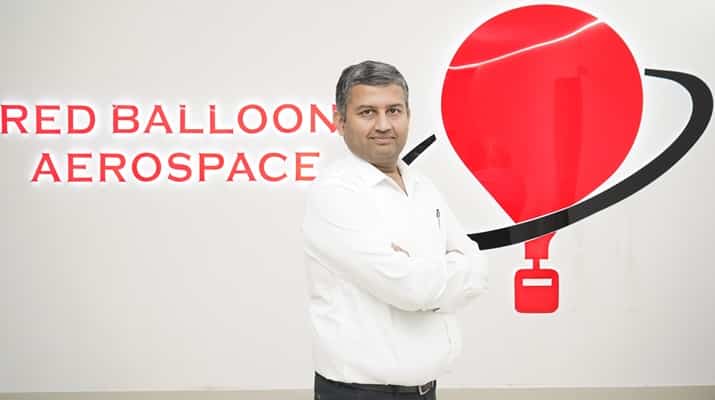
Dr Venkata Sai Kiran, Founder, Red Balloon Aerospace
Every hardware founder in telecoms meets the same two questions on the same day: who pays us before the product actually works, and which regulator opens the door. Red Balloon Aerospace has taken a side on the first one — it sells flight time in near space, not flying machines, with platforms that operate between 20 and 50 kilometres above Earth. Read as a startup case rather than a science story, the company's account of itself (given in an interview with EFY, conducted by Nitisha) shows a credible wedge, a cost claim that needs stress-testing, and three failure modes that will decide whether it survives the decade.
What is Red Balloon Aerospace actually selling?
Answer first: lift and loiter time, priced per mission. The company is a deep-tech space startup working in the band known as near space, using lighter-than-air systems — super-pressure balloons, tethered aerostats and airships — to deliver services that satellites and drones normally provide, at lower cost.
Super-pressure, in plain language, means a sealed envelope that stays tighter than the air around it, so it holds one altitude for days instead of drifting up and down with temperature. That is the whole commercial point: a station that parks over a region and stays there.
The portfolio is deliberately narrow — three named platforms, each at a different stage:
- Vista, the high-altitude super-pressure balloon, is the one that has already carried paying relevance: it was commercialised and flown during Mission SANA, lifting payloads for several aerospace firms and partners, with launch services offered at customer locations and customisation options.
- Altis, a tethered aerostat aimed at communication and surveillance, is still under development.
- Helix, the long-endurance stratospheric airship for telecommunications and cargo, is progressing towards its first prototype, targeted for completion by December 2026, with flight trials expected in early 2027.
That sequencing matters more than the hardware. Founders who build a network-first story usually run out of cash before the network exists; this company is flying someone else's experiment, charging for it, and keeping its own network ambition as the second act.
Why has this band of the atmosphere stayed empty?
Because the environment punishes you and the rulebook barely exists. Between conventional aviation ceilings and orbit lies a stretch of air with temperature swings, pressure differentials and radiation that destroy ordinary airframes, which is why so few organisations entered. Regulators have, however, defined the zone: the ITU Radio Regulations treat a high-altitude platform station as a radio station placed at an altitude of 20-50 kilometres and held at a specified nominal, fixed point (itu.int).
Durability is measurable here, and the reference numbers come from public balloon programmes rather than startups. In 2016, a NASA super-pressure balloon completed a circumnavigation after 14 days, 13 hours and 17 minutes of flight, and the agency's later test goal was a 100+ day float at mid-latitudes (nasa.gov). Any near-space commercial pitch should be benchmarked against those figures, not against a slide.
Red Balloon Aerospace's response to the physics is vertical integration: proprietary multi-layered nanocomposite materials that stay light, hold hydrogen for extended periods, and survive temperature and pressure cycling; and roughly 80 to 90 per cent of the technology developed and manufactured in-house, covering materials, balloon systems, structures and avionics. Where no suitable machine existed, the team built its own production infrastructure — because very few reference points existed in India. Some specialised components are still imported, with the stated intent to localise more electronics as the domestic semiconductor ecosystem matures.
The honest read: in-house manufacturing is a control advantage and a capital trap at the same time. It shortens iteration; it also means the balance sheet owns the factory, the test rigs and the talent gap.
Is altitude the entire value proposition?
Largely, yes — the pitch is geometry. Satellites sit hundreds of kilometres away; a near-space station sits roughly four hundred times closer to the ground it serves, which is what enables lower latency, potentially higher-resolution imaging and cheaper operations. For buyers, the comparison looks like this:
| Dimension | Satellite | Near-space platform (Vista, Altis, Helix) | Terrestrial tower |
|---|---|---|---|
| Height above Earth | hundreds of kilometres | between 20 and 50 kilometres | metres |
| Stays over one area | passes, or very high for GEO | yes — loiters for extended periods | yes, where the mast exists |
| Economics claim | launch plus build cost | 70 to 80 per cent more affordable, per the company | land, backhaul, power, permits |
| End of life | debris or burn-up | reusable; payloads recovered, upgraded, redeployed | decommissioned in place |
| Coverage math | wide but distant | one platform potentially replaces hundreds of cell towers | one small patch |
Industry bodies use the same mental model: the HAPS Alliance describes these platforms as functioning "like a cell tower in the sky", serving devices directly with the throughput and low latency that 5G-class links demand (hapsalliance.org). Layered on top is the standards story — non-terrestrial networks, meaning radio links that are neither on a mast nor on the ground, are expected to be a component of 6G, where near-space nodes would carry vehicles, IoT devices and backhaul with lower latency than many existing satellite options.
Does the product-market fit hold up?
Today it holds in validation, not in broadband. Current revenue comes from near-space flight services for customers who need experiments, sensors, communication equipment and technology demonstrators tested before orbital deployment; they pick rideshare missions, which put multiple payloads on one flight, or dedicated flights, with systems designed for payloads from 1 kilogram to 20 tonnes depending on mission profile. Target buyers are space startups, communications providers, research organisations, defence agencies and environmental monitoring companies.
That is a real, invoiceable pain: a sensor team that cannot prove its hardware in representative conditions cannot raise its next round. The applications most often sold as the prize — replacing towers in remote regions, restoring communications after disasters, real-time crop and pest monitoring, industrial emission tracking, border surveillance — are network businesses, and they wait on spectrum, per-hop pricing and integration with operators.
Where do startups in this category actually die?
Ask the graveyard. Alphabet shut down Loon, its nine-year internet-balloon unit, in January 2021, concluding the business could not justify the path to profitability — despite a parent company that could fund losses indefinitely (bbc.com). A startup with one-tenth of that budget inherits the same physics and none of the subsidy. The failure modes worth pricing in:
- Wrong first customer. Selling coverage to consumers before the regulatory door opens. The defensible first customer is the one with a payload and a deadline.
- Cash absorbed by capability building. Making your own materials, machines and avionics is a moat only after you survive the spend.
- Imported dependencies. Any specialised component sourced abroad is a schedule risk wearing a procurement label.
- Milestone drift. Prototype by December 2026 and trials in early 2027 are the dates to hold the team to; slip here re-prices everything.
- Regulatory single point of failure. HAPS-style services need frequency assignment and landing rights in each market, and India's satellite and non-terrestrial authorisation framework is still being worked through by TRAI.
Three misconceptions recur in pitch decks about this sector, and they are worth naming: that near space makes satellites obsolete (it displaces some services, not all); that low latency alone sells a network (coverage obligations and spectrum do); and that reusability equals sustainability (recovered payloads reduce waste and cost, but flight-hour economics still have to work).
Is the funding window open for this category in India?
Materially, yes — but for the service layer, not for every dream. India set up a fund of Rs 10,000 crore (about US$1.18 billion), led by IN-SPACe, to invest across more than 40 space companies, alongside a stated ambition to grow the country's space economy from roughly $8.4 billion toward $44 billion within a decade (ibef.org). Meanwhile, the global high-altitude pseudo-satellite market was estimated at about USD 1.16 billion in 2025 (marketdataforecast.com) — a category large enough to fund a company, too small to support dozens of full network operators.
The trend judgment: capital will follow whoever can put payload on station cheaply and repeatedly. Operator economics — per-square-kilometre cost, endurance, recovery rate — matter more than a 6G label.
FAQ: what founders, telcos and investors keep asking
Is this a satellite company?
No. It sells lighter-than-air stations operating between 20 and 50 kilometres above Earth, positioning itself below orbit and above drones, and offering flights rather than a constellation.
How much cheaper is it than a satellite?
The company's own comparison puts its platforms at 70 to 80 per cent more affordable than satellite-based alternatives, with more operational flexibility. Treat that as a design target to verify in a statement of work, not an invoice.
Which platform is proven in flight?
Vista, which flew during Mission SANA carrying payloads for several aerospace firms and partners. Altis is in development, and Helix has a prototype due by December 2026 with trials in early 2027.
Should a startup copy the vertical-integration model?
Only if the missing capability is genuinely unavailable. Most teams are not short of technology; they are short of someone willing to sign off on the expensive parts of building it. Buy what the market supplies, build what the market cannot.
Who should buy near-space flight time this year?
Sensor makers, research groups, defence and environmental monitoring programmes, and comms vendors who need representative-condition data before committing to orbital or field hardware.
What to do in the next 90 days
If you are building in this category: get one paid validation flight booked before you raise on a network narrative, and put a written endurance figure — hours on station at altitude, not days on the ground — into your data room.
If you evaluate vendors for a telco or enterprise innovation team: run the procurement test. Ask for two things a competitor cannot fake — flight hours logged and a payload that came back upgraded and reflied. Compare the vendor's numbers against the public balloon benchmarks above, and make the spectrum position explicit in the contract.
If you invest: watch four signals only. Helix prototype completion by December 2026, trial flights in early 2027, the ratio of rideshare to dedicated missions, and how fast the imported component list shrinks. Everything else in this story is engineering theatre.
Red Balloon Aerospace has chosen the harder path and the saner first customer. The next quarter is not about vision; it is about whether a flying station can be delivered on the date on the slide. That is the only proof this category needs.
By Sofia Jackson, IT Insights · ItInsightsWorld Startups. Corrections and tips: contact@itinsights.com
References
- EFY interview with Dr Venkata Sai Kiran, conducted by Nitisha (master account of Red Balloon Aerospace, Vista, Altis, Helix, Mission SANA and the cost and payload figures quoted here)
- ITU Radio Regulations background on high-altitude platform stations — itu.int
- NASA Wallops super-pressure balloon circumnavigation, 2016 — nasa.gov
- HAPS Alliance on HAPS in non-terrestrial networks — hapsalliance.org
- BBC News on the shutdown of Loon, January 2021 — bbc.com
- IBEF on India's private spacetech funding — ibef.org
- Market Data Forecast, high-altitude pseudo-satellites market estimate — marketdataforecast.com