
Optical Interconnect Startup Data: What the $115 Billion Marvell-Lumentum Wave Tells Founders
For founders and early-stage investors, the data point is clear: This week’s reported $115 billion Marvell-Lumentum deal, together with Salience Labs’ $125 million Series B and Voyant Photonics’ chip-scale OCS push, shows optical interconnects are becoming a purchasable AI-infrastructure category rather than a lab promise.
External trackers add density to that conclusion. Cignal AI’s July 2026 Optical Component Startup Tracker now maps nearly 70 venture-backed optical component companies, while Mordor Intelligence values the optical interconnect market at USD 19.39 billion in 2025 and forecasts USD 35.97 billion by 2030. The category is no longer scarce; attention is.
What changed since the OFC inflection question?
Just two years ago, a workshop panel at the OFC conference in San Diego asked whether AI would become the killer application for silicon photonics. At that time, the panel report stated: It was clear from the presentations that we are at a potential turning point for silicon photonics. But there were still challenges in terms of scaling, energy efficiency, packaging, ecosystem, and tools like EDA and third-party IP, as well as materials.
The same question looks different today. The reported $115 billion Marvell-Lumentum transaction is the loudest proof, but it is not the only proof: funding, switch architectures, and foundry alignment are now moving in parallel.
Which startup signals matter most?
Salience Labs raised $125 million in Series B funding to accelerate deployment of its optical circuit switching technology. Its backers include Applied Ventures, AMD Ventures, and Intel Capital. CEO and co-founder Vaysh Kewada argues that the company can lower normal supply-chain friction because its architecture is deliberately built on foundry processes able to support volume production and because it aligned with co-packaged optics manufacturing strategies early on. She also points to 2027 as a critical inflection year for volume production and deployment.
In remarks to EE Times, Kewada said: We’ve taken the approach of developing out an optical circuit switch that’s optical end-to-end so we’re never transforming the payload or the data into the electrical domain. The second differentiating standpoint is that we’ve chosen to take a fully integrated on-chip approach. And we’ve overcome the loss aspect of integrating optics onto the chip through the development of our own amplifiers that are also integrated on chip.
In the same week, Voyant Photonics said it is developing a chip-scale OCS engine for AI data center networks. It plans to offer customers a compact optical switching building block that can be integrated into next-generation data center switching platforms.
Voyant is not starting from scratch. It has already developed a high-density silicon photonics switch matrix that routes light for its FMCW LiDAR systems. Instead of moving mirrors or continuous analog beam steering, the architecture uses discrete, solid-state optical paths. The company said this technology can be adapted because a data center OCS implementation uses the same fundamental architecture, which can be configured to route optical signals among communication ports. Voyant plans to offer the OCS technology as an engine that optical networking companies can incorporate into their own platforms.
What does independent market data add?
Cignal AI’s tracker is useful because it moves the discussion beyond a few headline rounds. It identifies a broader startup field and notes at least one high-capital benchmark: a San Jose company that emerged from stealth in August 2026 with more than $900 million in total funding at a $5.51 billion valuation. For founders, that is a reminder that optical networking now competes with compute-scale capital intensity.
Market-size data also varies by boundary. Mordor Intelligence puts optical interconnect at USD 19.39 billion in 2025 and USD 35.97 billion by 2030. Grand View Research’s narrower ultra-short reach optical interconnect estimate is USD 2.03 billion in 2024 and USD 5.95 billion by 2030. A startup pitching to hyperscalers therefore needs to state which layer it is claiming: module, chiplet, switch, or engine.
Over the past year, the buyer language has shifted: integrated silicon photonics is less often described as an emerging alternative to copper and more often treated as a physical backbone for scaling next-generation AI infrastructure. That is the practical reason a deal, a funding round, and an OCS product update can now belong to the same story.
How should founders read the Woodside land-grab signal?
A report published last month by Woodside Capital Partners, titled The Interconnect Imperative—Why AI Is Forcing the Semiconductor Industry to Go Global, stated: In the space of fifteen months, Marvell paid $3.54 billion for Celestial AI; Nvidia put $2 billion each into Coherent and Lumentum—and then $3.2 billion more into Corning; Ayar Labs closed a $650 million Series E at a $5.0 billion valuation; and Credo, Molex, GlobalFoundries, Ciena, AMD, and FormFactor each bought their way into a different layer of the stack.
Woodside Capital added: Our view is that this is a land grab for control points—lasers, optical engines, chiplets, packaging, test, and foundry capacity—and that it will not run forever. Each deal removes a control point from the board and raises the scarcity premium on what remains; but as the gaps fill, urgency will decline. For founders, the window for premium strategic exits is open now. For acquirers, the cost of waiting is compounding.
For a startup team, that sentence splits the market into two jobs: prove you control a scarce layer, and prove you can be absorbed, licensed, or integrated without becoming a bespoke project.
This context helps explain why Marvell is interested in bringing Momentum into its already strong connectivity portfolio.
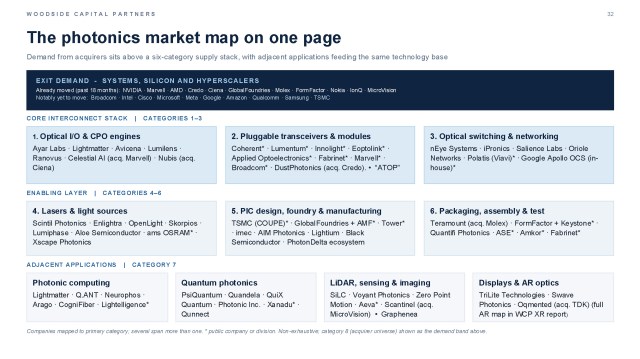
Woodside Capital Partners’ photonics market map places acquirer demand from systems, silicon and hyperscaler companies above a six-category supply stack of core interconnect and enabling technologies, while adjacent applications draw on the same technology base. It maps companies to their primary category, marks public companies or divisions with an asterisk, and is non-exhaustive. Image courtesy of Woodside Capital Partners.
What are the main risks and common misconceptions?
- Mistaking strategic interest for volume orders. A $115 billion deal or a $125 million round does not mean every optical switching startup can ship at cloud scale. Foundry access, test, and serviceability still gate adoption.
- Assuming standards exist. CPO, OCS, NPO, and optical I/O are being defined by ecosystem power, not only physics. Startups that bet on one architecture must also survive another becoming the default.
- Ignoring reliability. Futurum Group research director Brendan Burke, quoted in industry coverage of Lightmatter’s optical roadmap, points out that hyperscalers are considering optical networking options, but serviceability of lasers and fiber inside chip trays remains an adoption barrier.
- Overlooking acquisition timing. Woodside Capital says the window for premium strategic exits is open now; that is also a warning because future exits may be priced lower as control points are filled.
What actions should early-stage founders take?
- Map your wedge to one of the six-category supply layers: lasers, optical engines, chiplets, packaging, test, or foundry capacity. If you span more than one, explain which layer creates the acquisition premium.
- Build a volume-readiness narrative around 2027. Founders should show not just switch loss or bandwidth, but packaging yield, test coverage, supplier depth, and field service assumptions.
- Treat hyperscaler pilots as validation milestones, not revenue. Ask for a written path from sample to rack-level deployment.
- Compare capital plans against category benchmarks. Cignal AI’s nearly 70-company field means differentiation is now about customer design-in and financing runway, not simply being in photonics.
- Position for both outcomes: integration and platform licensing. Voyant Photonics’ engine model and Salience Labs’ integrated on-chip switch show two viable go-to-market templates.
FAQ: what do optical interconnect startup signals mean?
Is the $115 billion Marvell-Lumentum deal a bubble warning?
It is a timing warning, not necessarily a bubble verdict. The deal tells buyers the control-point race is real; it tells founders that waiting for proof may mean selling later into a thinner premium.
What does the $125 million Salience Labs round show?
It shows investor appetite for optical circuit switching when the architecture is tied to volume foundry processes and CPO-compatible manufacturing. The round does not prove adoption; the 2027 deployment milestone does.
Why is Voyant Photonics relevant to startups?
Because it demonstrates reuse: a LiDAR switch matrix becomes a data-center OCS engine. Founders should ask which existing optical path can be repositioned into AI networking before inventing a new component from scratch.
Does market growth guarantee startup revenue?
No. Mordor Intelligence and Grand View Research show large TAM expansion, but Cignal AI’s crowded startup map and hyperscaler reliability concerns mean many companies will be consolidated, licensed, or left out.
The data-backed takeaway for ItInsightsWorld Startups readers is narrower than the headline: optical interconnect is investable because AI infrastructure is hitting copper’s limits, not because photonics suddenly became easy. The strongest teams will be the ones that can connect a credible control point, a foundry-friendly design, and a 2027 path to shipped volume.
Reference sources
- Cignal AI, Optical Component Startup Tracker
- Mordor Intelligence, Optical Interconnect Market
- Grand View Research, Ultra-short Reach Optical Interconnect Market
- Fiber Online, Lightmatter optical interconnect coverage citing Futurum Group
- Woodside Capital Partners, The Interconnect Imperative—Why AI Is Forcing the Semiconductor Industry to Go Global, as cited in the source article