
From LLM to agent engine: what a software development team gets from the eight Ahead of AI reasoning-model sessions in Python and PyTorch (11 hours)
Reasoning models usually reach an ordinary software development team as an API endpoint: prompts go in, answers come out, and nobody in the sprint can explain what changed between the two. The material covered here is the opposite exercise. It is a coding series recorded in the last few months by Ahead of AI, eight lectures long, running to 11 hours, in which a small pre-trained model is upgraded step by step with Python and PyTorch code that the viewer types and runs. Its written sibling is Build Reasoning Model (From Scratch), and the package is about implementation rather than opinion.
Coverage over the last two years in the same publication has been broad; one recent article examined mechanisms to control reasoning effort levels in contemporary LLMs. That matters because reasoning models have not become niche: almost every current-generation LLM today is a reasoning model or offers a reasoning mode. For engineers, the interesting questions are inference scaling, reinforcement learning and distillation, and the quickest route to internalising them is to rebuild those methods from the ground up in PyTorch instead of reading about them.
How the layers stack: conventional LLM, reasoning model, agent harness
A recurring question in planning conversations is how reasoning models relate to today's AI agents, so the series opens with a short positioning note. A reasoning model is essentially an upgrade of a conventional LLM: more post-training through reinforcement learning with verifiable rewards, plus optional inference scaling techniques, so the same architecture handles harder problems. Classically these models were developed for math and code, but the capabilities generalise to other problem domains.
That reasoning model then acts as the engine inside an agent harness. The harness is the software or tooling framework wrapped around the LLM or reasoning model, and it is what lets a team take on even more challenging work: bigger coding tasks, travel booking, and other personal assistant tasks. Its two jobs are sophisticated context management and giving the model access to tools.
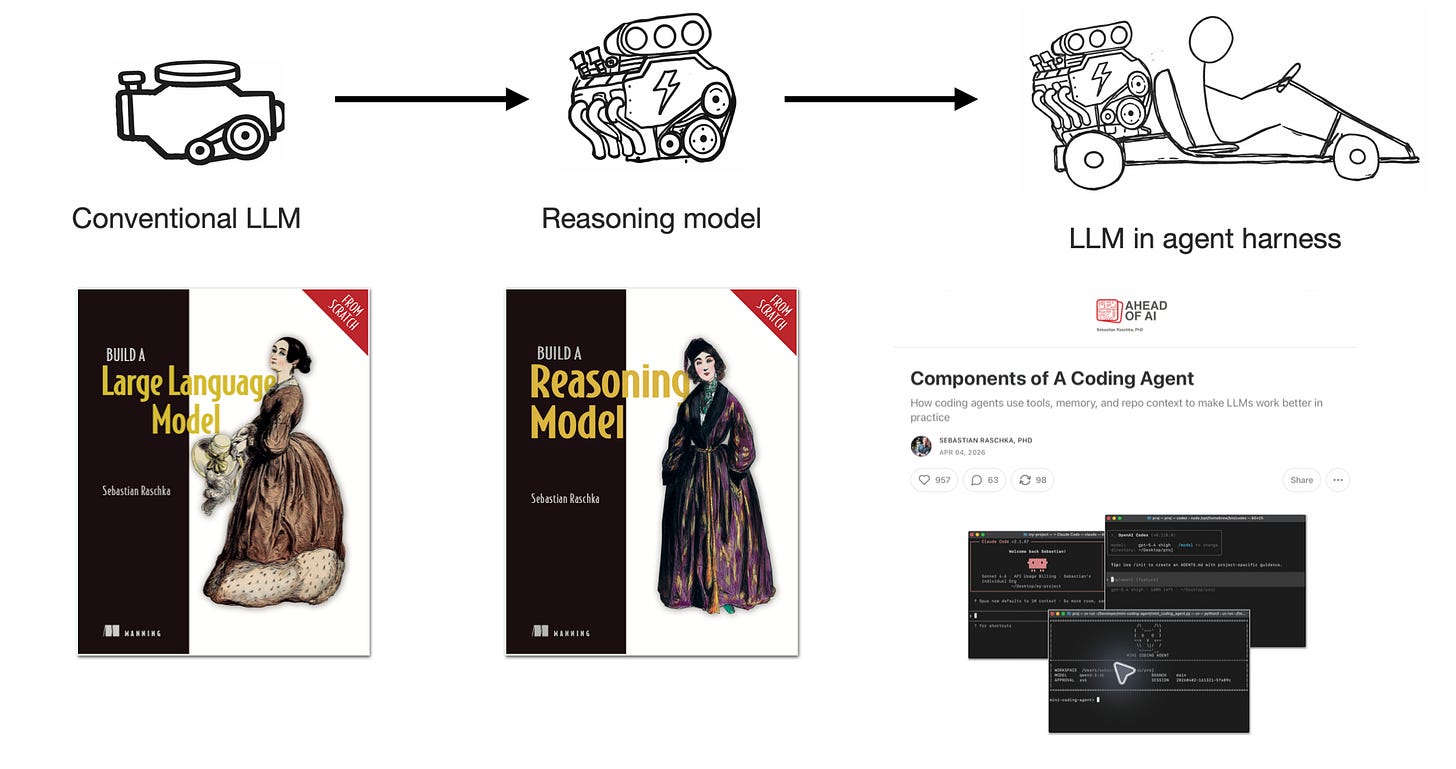
Figure 1: the engine analogy placing conventional LLMs, reasoning models and agent harnesses in one pipeline, taken from the Components of a Coding Agent article.
| Layer | What it is | What it contributes | When a team reaches for it |
|---|---|---|---|
| Conventional LLM | The pre-trained model behind a plain chatbot interface | Baseline capability | Chat-style interaction is sufficient |
| Reasoning model | An upgrade of the conventional LLM | Post-training with verifiable rewards, optionally inference scaling | Harder math and code problems, and domains the skill generalises to |
| Agent harness | Software and tooling framework around the model | Context management plus tool access | Bigger coding tasks, travel booking, personal assistant workflows |
An agent can be built on either a conventional LLM or a reasoning model, but reasoning models are the more typical choice because they are more capable, and most current-generation LLMs already ship as reasoning models with variable reasoning effort settings. The practical conclusion for a delivery team: the engine layer remains an important part of understanding modern LLM agents.
Scope, prerequisites and the compute question
The build target is a small pre-trained Qwen3 model, and every reasoning method added around it is implemented by the viewer in Python and PyTorch. Starting from a pre-trained checkpoint keeps the effort on the interesting part: evaluation, inference-time scaling, reinforcement learning and distillation.
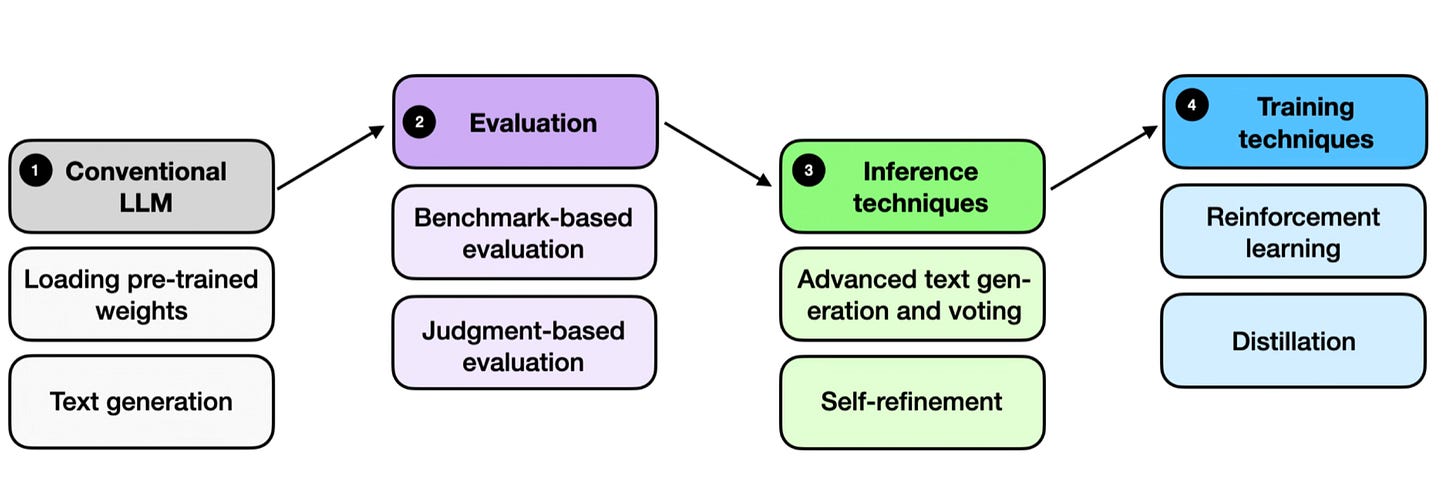
Figure 2: overview of the topics the sessions cover.
- Prerequisites: being comfortable with Python and PyTorch. The reasoning material was designed as standalone content, so the earlier Build a Large Language Model (From Scratch) material is recommended but not strictly required.
- Relation to older material: the series is essentially the sequel to the Coding LLMs from the Ground Up course released last year, and it can be watched without that course as a prerequisite.
- Compute: the early text-generation and evaluation examples can be worked through on a CPU. Later experiments, training in particular, become much more practical on a GPU.
- Where the setup advice lives: the first video covers setup and extra recommendations, and the repository also carries hardware and environment recommendations.
The eight sessions read as a build pipeline
Taken in order, the lectures form one dependency chain: a working baseline generator, a verifier, two inference-time upgrades, two reinforcement-learning stages, and finally a distillation alternative to them.
- Motivation and code setup
- Loading the base model, text generation, KV caching
- A verifier for evaluation and reinforcement learning
- Inference-time scaling: sampling and self-consistency
- Inference-time scaling: scoring and self-refinement
- Reinforcement learning: GRPO for RLVR
- Reinforcement learning: tracking, clipped policy ratios, KL terms
- Distilling a reasoning model
Stage 1 — Motivation and setting up the code
The first lecture explains how conventional LLMs, reasoning models and agents relate, then spends its time on the coding environment: installing the Python and PyTorch dependencies with uv, discussing hardware choices, and walking through common setup issues.
Topics covered
- The relationship between conventional LLMs, reasoning models and agent harnesses
- Why implementing things in code helps you learn how they really work
- The scope of the video series
- Installing Python dependencies
- Hardware choices, plus checking CUDA or Apple Silicon support
- Working on a remote GPU with VS Code, and troubleshooting the environment
Session 1 video · setup instructions
Stage 2 — Loading the base model, text generation and KV caching
Reasoning methods need a working model underneath them. Training one would be a whole other book — that is what Build a Large Language Model (From Scratch) is for — so this stage downloads the pre-trained weights of a Qwen3 0.6B model and implements the text-generation process as a streaming generator, then adds KV caching and model compilation to make generation more efficient. The result is the baseline that later stages evaluate and improve.
Topics covered
- Turning text into tokens and decoding it back into text
- Downloading the Qwen3 weights and loading the model on the chosen compute device
- Inspecting tensor shapes, logits and next-token predictions
- Greedy decoding plus a streaming text generator
- End-of-sequence handling and measuring generation speed
- A KV cache so attention keys and values get reused
- KV caching combined with torch.compile, with hardware performance compared
Session 2 video · code for chapter 2
Stage 3 — Building a verifier for evaluation and reinforcement learning
Here a math-answer verifier is assembled step by step: final-answer extraction, then normalisation, then checking mathematical equivalence. Its first job is scoring the base model on MATH-500. Its second job appears later in the series, when the same verification logic supplies the reward signal for reinforcement learning with verifiable rewards, or RLVR.
Topics covered
- What verifiers are and the role they play in LLM evaluation methods (further methods are in the book's appendix)
- Reusing answer verification as the reward signal for RLVR, picked up again in chapter 6
- The verifier flow: extracting final answers, normalising them, checking mathematical equivalence
- Writing an answer grader and an evaluation loop for MATH-500
- Base model versus reasoning model compared on MATH-500
Session 3 video · code for chapter 3
Stage 4 — Inference-time scaling: sampling and self-consistency
Next come improvements that leave the model weights fixed. Because generating diverse answers for the same prompt is standard practice in proprietary LLM chatbots such as ChatGPT, the stage first implements temperature scaling, multinomial sampling and top-p filtering. Multiple candidates are then combined through self-consistency, using majority voting over their final answers, and the accuracy-versus-computation tradeoff is measured.
Topics covered
- How additional compute benefits model performance during training versus during inference
- An easy introduction to inference scaling through chain-of-thought prompts
- Temperature scaling and multinomial sampling for diverse answers
- Top-p filtering as a quality gate on those diverse answers
- Self-consistency, one of the most popular inference scaling techniques, by combining candidates
- MATH-500 accuracy evaluated against the cost of additional inference compute
Session 4 video · code for chapter 4
Stage 5 — Inference-time scaling: scoring and self-refinement
Building on the previous session, scoring functions are implemented so several answers to the same prompt can be compared; the same functions also break ties inside self-consistency. The stage covers token and sequence log probabilities — later reused in the reinforcement-learning chapters — a simple heuristic scorer, and a self-refinement loop in which the model critiques an answer and attempts a revision, followed by an evaluation of how useful those extra steps really are.
Topics covered
- Scoring functions for comparing multiple answers and breaking ties
- A simple heuristic scorer
- Token probabilities and sequence likelihoods, relevant to the following lectures too
- Log probabilities for improved numerical stability
- A self-refinement loop producing critiques and revised answers
- Self-refinement evaluated on MATH-500
Session 5 video · code for chapter 5
Stage 6 — Reinforcement learning: implementing GRPO for RLVR
Training starts with a simplified version of Group Relative Policy Optimization (GRPO): groups of responses are generated, scored with the verifier built in stage 3, and their relative rewards drive the model weight updates.
Topics covered
- Generating reasoning traces, and what answer length says about problem-solving ability
- The two main LLM post-training methods compared: RLHF and RLVR
- Converting verifier scores into rewards and relative advantages
- Sequence log probabilities and a simplified GRPO loss
- The training loop assembled with logging and checkpoint saves
- Checkpoint evaluation, training stability and memory needs
Session 6 video · code for chapter 6
Stage 7 — Reinforcement learning: tracking, clipped policy ratios and KL terms
With the loop in place, the seventh lecture revisits it for instrumentation and analysis: entropy and advantage statistics, clipped policy ratios, KL loss term values and formatted rewards are added, then the training logs and evaluation results are reviewed to judge whether additions such as clipped policy ratios and KL loss terms are helpful.
Topics covered
- Longer training experiments and how to interpret their logs
- Tracking advantages and entropy to understand training behaviour
- Clipping inside the policy loss and analysing its effects
- A KL loss term, and the reward hacking problem it raises
- Limitations of the simplified KL formulation
- Format rewards conditioned on answer correctness
- Checkpoints compared on MATH-500, plus further GRPO research to explore
Session 7 video · code for chapter 7
Stage 8 — Distilling a reasoning model
The final lecture takes the other road to a small reasoning model: learning from answers produced by a stronger, bigger teacher model. Distillation variants are discussed, reasoning data is prepared, the supervised training loop is implemented, and the distilled model is evaluated on MATH-500 and compared — closing the series with an alternative to building reasoning capability through reinforcement learning.
Topics covered
- The different combinations and approaches to distillation: soft versus hard, on-policy versus off-policy
- Creating and collecting teacher-generated answers for the MATH dataset, produced with DeepSeek R1
- Preparing the distillation dataset, including tokenization and training/validation/test splits
- Answer-token log probabilities and the cross-entropy loss
- Supervised training with training and validation losses tracked
- Checkpoints evaluated on MATH-500 and distillation results compared
Session 8 video · code for chapter 8
Companion book and the short conceptual route
The videos accompany the book Build A Reasoning Model (From Scratch). Reading suits anyone who wants the explanations in more detail and at their own pace, plus exercises; the suggested loop for the deepest learning is one chapter read, its code worked through alongside the matching video, then the exercises attempted. The book is available from Manning and Amazon, and the print edition is in colour.
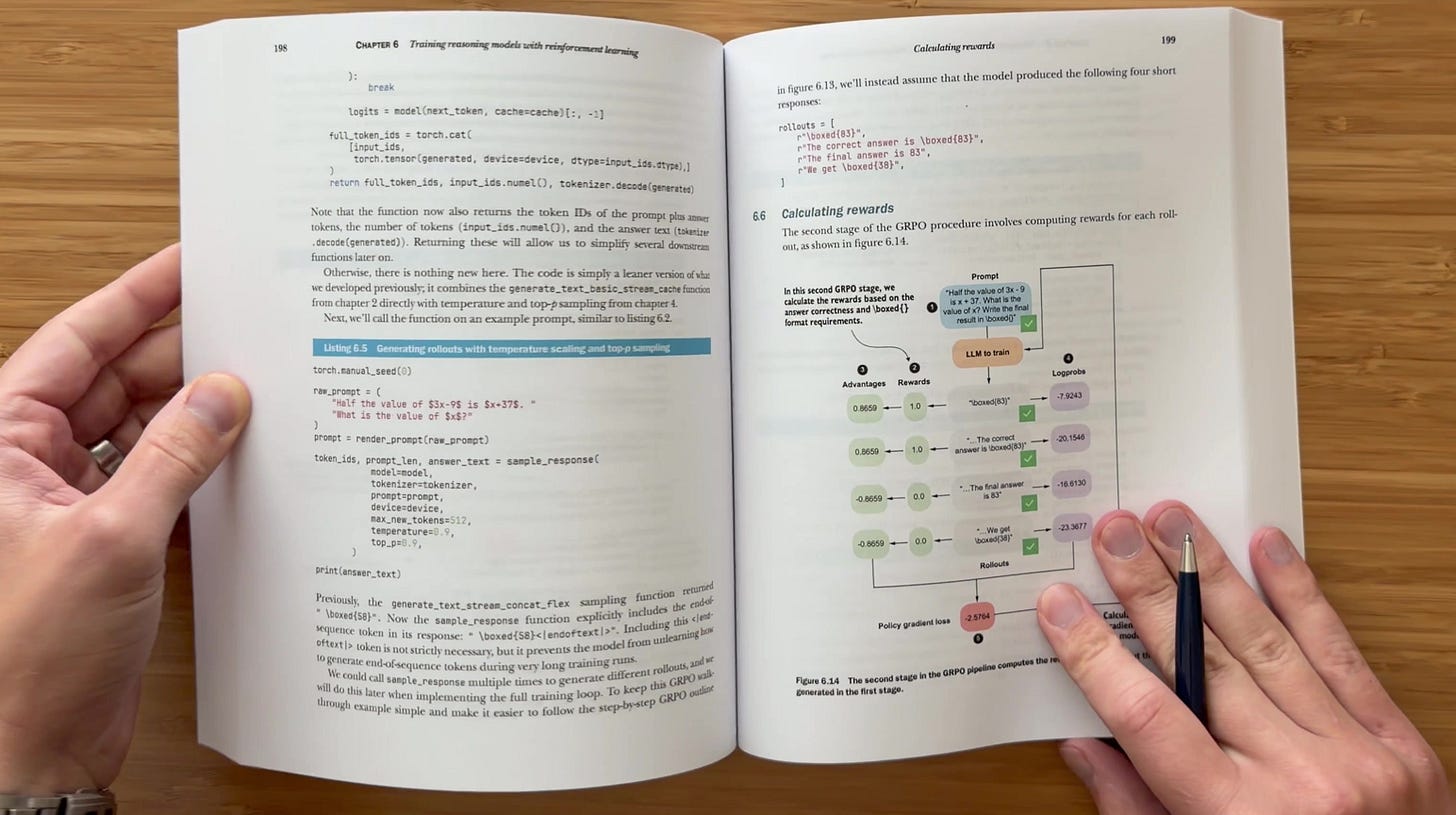
Figure 3: a random excerpt from the Build a Reasoning Model (From Scratch) print book.
For a shorter, more conceptual overview before the implementations, there is the AI Reasoning Models course on LinkedIn Learning. It runs about 90 minutes and explains how reasoning models work, covering the main ideas behind inference-time scaling, reinforcement learning and distillation. Accessing it through the link on its page should be free for 24h, which should mean a LinkedIn Premium subscription is not required. It is a good optional preview, not a substitute for the code.
The resource set the series points to
- The Build a Large Language Model (From Scratch) book and videos
- The Build A Reasoning Model (From Scratch) book, described above
- The Components of a Coding Agent article, published on Substack
Common misconceptions that stall this kind of build
- "Finish the earlier course first." The reasoning material was designed as standalone content; the prior course is recommended, not strictly required.
- "Book a GPU before the first session." The early text-generation and evaluation examples run on a CPU; the later training experiments are where a GPU makes the work practical.
- "Reasoning models are only about math." They were classically developed for math and code, but the capabilities generalise to other problem domains.
- "The verifier is just a test script." The same answer-checking logic becomes the reward signal for RLVR in chapter 6.
- "Extra inference compute is free." Sampling more candidates and running self-refinement both buy accuracy at a cost the series measures against MATH-500.
- "An agent needs a particular model type." A harness can wrap a conventional LLM or a reasoning model, although reasoning models are the more typical choice because they are more capable.
FAQ
Which languages and frameworks does the code use?
Python and PyTorch throughout. Dependencies are installed with uv in the first session, and the generation stage adds KV caching plus torch.compile for efficiency comparisons.
How much viewing time should a team budget?
The series is eight main lecture videos with 11 hours of content, recorded in the last few months.
Is there a faster conceptual pass?
Yes — the AI Reasoning Models course on LinkedIn Learning, about 90 minutes, on inference-time scaling, reinforcement learning and distillation. Via the link there it should be free for 24h and should not require a LinkedIn Premium subscription.
Which model and datasets are involved?
A pre-trained Qwen3 0.6B model is the starting point; answers are graded against MATH-500; the distillation stage uses teacher answers for the MATH dataset generated by DeepSeek R1.
Do I need the book to follow the videos?
No. The videos carry the implementation track; the book adds detailed written explanations, figures and exercises at your own pace, and is available from Manning and Amazon.
How does this connect to coding agents?
The reasoning model is the engine; the agent harness is the framework that manages context and gives the model tools. That split is described in the Components of a Coding Agent article on Substack.
Action suggestions for your first week with the series
- Run session 1 end to end before anything else: install the Python and PyTorch dependencies with uv, settle the hardware choice, and verify CUDA or Apple Silicon support, or a remote GPU reached through VS Code.
- Establish the stage 2 baseline — streaming generation, KV cache, torch.compile — so later gains are measurable against something fixed.
- Treat the verifier as shared infrastructure: it is both your evaluation harness on MATH-500 and your reward signal for RLVR.
- Schedule GPU time before the training-heavy stages 6 to 8.
- Pause occasionally and try one small experiment of your own: change the sampling settings, inspect a few failed answers, or vary an idea along the lines of the exercise suggestions.
- If you own the book, alternate chapter reading, code-along with the matching video, then exercises.
- Keep the accuracy-versus-compute tradeoff visible in your review notes when deciding which technique to keep in a pipeline.
Closing note
The author is currently on a short break to regenerate and will be back next month with more LLM research roundups, and the eight sessions stay available in the meantime for any team that would rather see a reasoning model assembled line by line than called through an endpoint. Thanks are owed to everyone who picks up a copy of the companion book or recommends it to a friend, since that support is what keeps these materials coming. Happy viewing and happy tinkering.

Reviewed for ItInsightsWorld by James Hartley, IT Insights · SoftwareDevelopment.