
Google Took Down the XCPE Botnet — Why Your Android Boxes, Signage Players and Kiosks Still Need a Remediation Plan
Short answer: taking the command servers offline does not delete a backdoor that lives inside firmware. Every Android TV box, signage player, karaoke terminal or telehealth cart carrying the XCPE implant stays exposed after the disruption, and the only fixes that actually work are isolation, replacement firmware, or disposal. Google’s Threat Intelligence Group says Videostrong Technology deliberately built that implant into more than 1.3 million devices, which means the remediation half of this incident now sits on your desk.
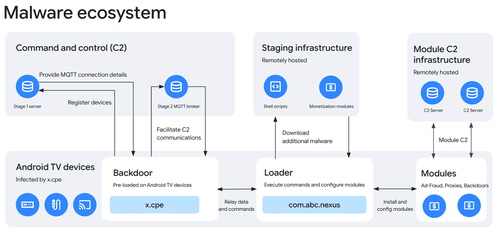 XCPE malware overview
What Did Google Actually Take Down?
The control layer, not the implant. Google disclosed the operation on 2 November 2026, describing disruption completed in late October plus a legal track running alongside it. Analysts concluded with high confidence that Videostrong Technology deliberately embedded a backdoor in Android firmware, sold device access to criminal affiliates, and let those affiliates install their own malware modules on boxes that had already shipped. Those devices were enrolled in a botnet covering over 1.3 million units, monetised through residential proxy resale and advertising fraud.
The coalition included Japan’s National Police Agency, Lumen and HUMAN Security, with Plume, Synthient and TrendAI also contributing. Google prohibited Videostrong from producing certified Android devices or supplying software to other certified vendors, tightened its own review and firmware-integrity checks, and pursued seizure of related servers and domains. Google estimates that breaking the affiliates’ control infrastructure could cut off access to at least 10 million additional compromised devices — a wider estimate covering other infection routes, not a count of XCPE-infected boxes.
Why Won’t a Factory Reset Fix This?
Because XCPE is not an app you can uninstall. It ran as a privileged system process and could rebuild itself from an unmodifiable firmware partition after rebooting, so ordinary app removal was ineffective. Silent application installs, arbitrary command execution, screenshots and internal network scanning were all part of its capability set, and it may also interfere with Google Play Protect. On AOSP-based units, where Play Protect never had a foothold in the first place, defensive coverage is thinner still.
Google’s own account of the certification bypass is worth reading twice. The company said it found the malicious software “built directly into many different device models and brands over multiple years, supported by dedicated infrastructure”, and that Videostrong “employed obfuscation techniques to exploit a gap in our tests and load malicious code after the device’s first boot” (see the GTIG write-up). Code that only wakes up after a unit leaves the test bench is code no pre-shipment audit reliably catches.
How Far Does the Blast Radius Reach Beyond the Living Room?
Further than the headline number suggests. TrendAI’s observation window, from 3 June to 1 October 2026, counted roughly 1.47 million Android devices enrolled by the botnet across more than 170 countries and territories, with Malaysia around 300,000, Brazil around 150,000, Iraq around 120,000 and Taiwan around 88,000 — ranked fifth globally (reporting by iThome). Those are sample counts from one vendor’s telemetry, not a census, but they locate the problem squarely in the markets where enterprises buy cheap Android hardware by the pallet.
Device mix is the second warning. Android TV boxes dominated, while telehealth equipment, karaoke machines and digital signage were also involved — three categories that sit inside offices, clinics, hotels and retail estates rather than living rooms, and are usually owned by facilities or a vendor, not by IT.
Which Devices in Your Estate Should You Look at First?
| Device class | Where it usually turns up | What the XCPE case tells you |
|---|---|---|
| Certified Android TV box | Hotel rooms, boardroom displays, lobby media | Most affected devices were in this shape, but Google’s report does not name the affected models or say how many infected devices were certified |
| AOSP-based box or stick | Kiosk contractors, wayfinding screens, queueing TVs | Another study shows some affected devices were certified and others were AOSP-based, so certification cannot be assumed for any single box |
| Telehealth equipment, karaoke machines and digital signage | Clinic carts, entertainment venues, retail networks | Also involved; firmware often comes from an ODM whose name never appears on the case |
| Mainstream-brand streamer, Windows or Linux signage PC | General office AV | Outside this campaign, but they still need patch and lifecycle management |
Attribution evidence is what procurement should be reading. Synthient published a list of device identifiers and indicators linked to the campaign — reportedly covering 182 model names, with emphasis on MECOOL-branded set-top boxes — while stressing that matching a model alone does not confirm infection. Reporting on that investigation describes a GitHub account named yf-videostrong hosting installer packages, the x.cpe component passing command-server configuration to Videostrong’s own YokaTV Player, and a document signed by a Videostrong research and development director found in an open directory on one of the control servers (Synthient). The brand printed on a shell may not reveal whose firmware is inside it.
What Is the First 72-Hour Sequence?
- Inventory by firmware, not by brand. Pull serial, model, build string and supplier for every Android-based display, kiosk and media unit; flag anything bought through marketplace channels or installed by an AV contractor.
- Isolate before you investigate. Move suspect units to a restricted VLAN with no route to internal file services, clinical systems or staff devices; the malware scans the network it sits on.
- Block indicators at the resolver. Apply the published control-domain and IP indicators to DNS filtering and perimeter deny rules, then confirm the traffic you blocked was real and not noise.
- Watch egress for a week. Sustained outbound connections from a TV or signage VLAN to proxy or ad-exchange endpoints are the tell; residential proxy abuse turns your exit IP into somebody else’s identity.
- Ask the vendor two written questions. Who wrote the firmware, and can you produce a signed build for this exact image? Silence is an answer.
- Retire what cannot be proven. Researchers advise replacing firmware with a verified safe version or disconnecting the device; when neither is available, dispose of the unit and document it.
- Change the buying rule, not just the box. Add firmware provenance, update commitments and a right-to-audit clause to AV and signage purchases.
Isolate, Re-Flash or Replace — Where Does the Money Go?
The table below is our analysis, a way to price the decision rather than sourced market data.
| Option | What you pay | Residual risk | When it makes sense |
|---|---|---|---|
| Isolate and monitor | Network segmentation work plus a week of log review per site | Device-level implant survives; local snooping and camera-adjacent risk remain | Large fleets with no budget line, as a stopgap with an end date |
| Replacement firmware | Vendor engagement effort; often zero support response | Only closes if the image provably removes XCPE from the protected partition | Units where the ODM publishes a signed, versioned image |
| Hardware disposal | Unit cost plus install and disposal labour | Cleared, once destruction is documented | Clinical, karaoke and signage estates where the device touches people and payments |
Most enterprises are not short of tools here; they are short of someone willing to sign off on switching the old system off. A device that cannot be patched, cannot be attested and cannot be explained by its supplier is not an asset worth defending — it is a subscription to somebody else’s proxy business, paid from your IP address.
Five Mistakes I Keep Seeing
- Assuming the takedown means remediation. Servers went dark; the implant stayed in the firmware partition, and owners cannot remove it themselves.
- Restoring to factory settings and closing the ticket. Rebuild-on-reboot makes that step cosmetic.
- Treating the certification label as proof. The available research does not establish how many affected devices were certified; some were AOSP-based.
- Skipping the shared-bandwidth apps. Google advises avoiding applications that pay users to share excess internet bandwidth; a staff-bought “earn while you stream” app does the same job as a backdoor.
- Counting only IT-owned assets. If the AV contractor bought the box, someone still owns the risk.
FAQ: What Buyers and Security Operators Ask Now
Is my box protected because Google disrupted the botnet?
No. The disruption removes affiliate control, not the firmware implant. Google advises buying devices from reputed manufacturers, using trusted application stores, and activating Play Protect, while acknowledging ordinary app removal will not eliminate a firmware-level backdoor.
How much of this touches my region?
Regional telemetry exists for some markets and not others: TrendAI put Taiwan near 88,000 devices and Malaysia near 300,000 within its June–October 2026 window. The available research does not establish how many affected devices are located in India, and the disruption has not necessarily cleaned devices already sold, so owners of potentially affected boxes may remain exposed until the firmware or hardware is replaced.
Can I just require a “certified” label in the next purchase order?
As a starting filter, yes; as assurance, no. This case is the clearest argument yet for proof tied to a specific build rather than a label, which is the distinction we drew in comparing the proof objects you can actually buy for model security.
Does Google bear responsibility for the test gap?
Google has acknowledged the mechanism: obfuscation let the code load after first boot, outside what compatibility and security checks saw. The company says it has revised review and firmware-integrity checks in response.
What To Do Next
Three moves this week, not a strategy paper. First, list every Android-based display, kiosk and media unit your organisation actually owns, including contractor-supplied hardware. Second, put suspect units on a restricted network today and block the published indicators at the resolver, then verify what you blocked. Third, write the firmware-provenance clause into your next AV purchase before the discount conversation starts — because the next time this happens, it will be a different model number in a different country, and the same cheap-device logic.
Written by Nina Roberts, IT Insights. For fleet assessments or corrections, reach the desk at contact@itinsights.com.