
Security Deep Dive: What Google's XCPE Takedown Reveals About Certified Android TV Supply-Chain Risk
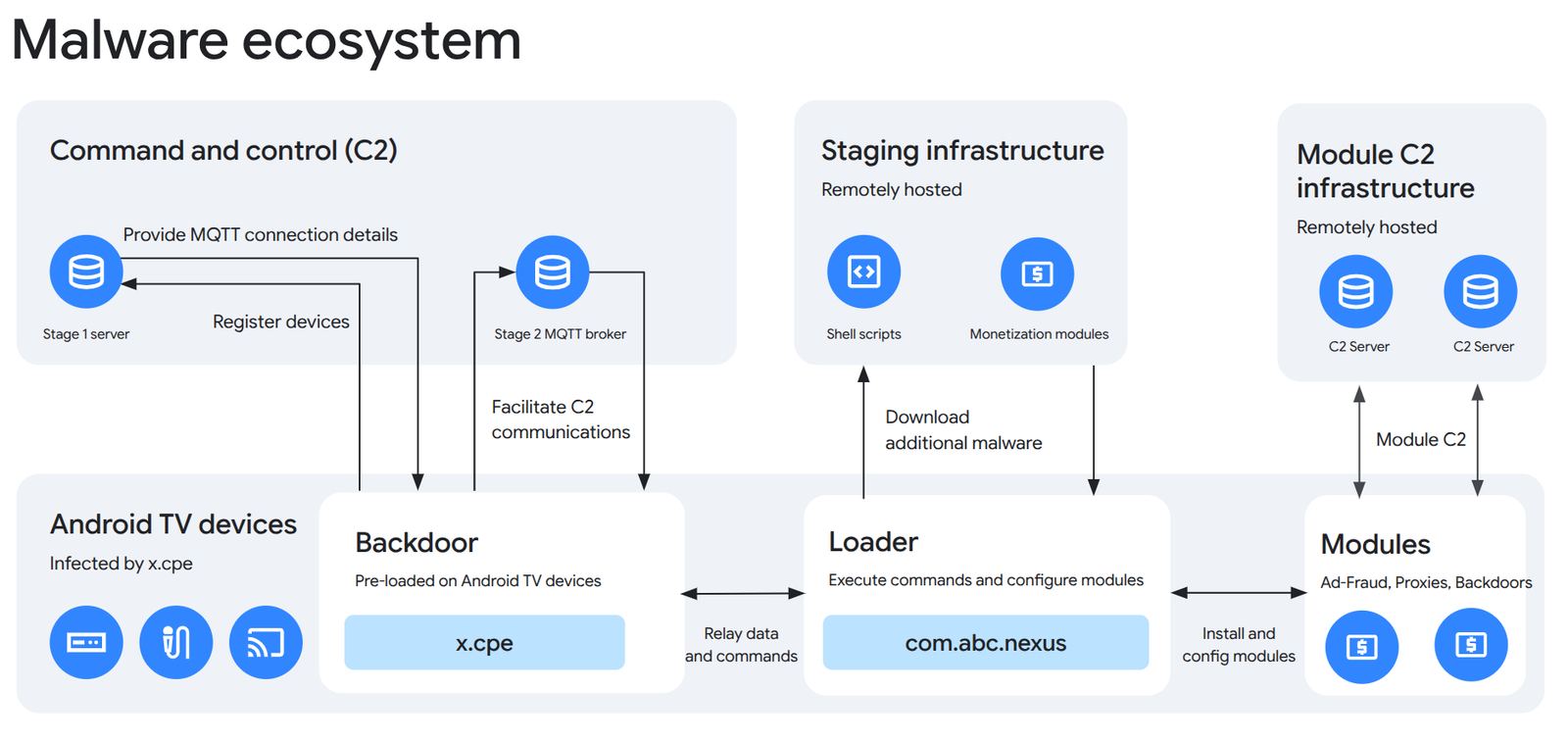
Television hardware rarely appears on a risk register. It has no privileged credentials, holds no system of record, and is usually owned by facilities rather than by IT. The disruption of the XCPE operation changes that assumption: Google recently disclosed that a manufacturer inside the official Android ecosystem shipped certified devices carrying a deliberate, remotely controllable implant. For anyone operating Android-based screens in lobbies, hotel rooms, classrooms or clinic spaces, the incident is not a consumer story. It is a vendor-trust failure with a measurable detection gap behind it.
The confirmed record, separated from the open questions
Google's threat-intelligence write-up on the disruption was published in early November 2026 and was followed by coordinated reporting from industry researchers. The verified core, and the parts that still sit outside the confirmed record, are worth reading side by side.
| Dimension | Confirmed position | Still unconfirmed |
|---|---|---|
| Responsible party | Videostrong, an Android OEM/ODM based in Shenzhen, China, assessed with high confidence to have built and run the implant itself | Whether other licensed manufacturers ran comparable loaders |
| Platform footprint | Android TV and Google TV set-top boxes, with Mecool identified as one heavily affected brand line | Exact model-level lists per SKU and per market |
| Scale | Google estimates the action cut communications for at least 10 million additional affected devices | How many units remain in active enterprise use today |
| Response | Partnership terminated, future certified-device production barred, legal action taken against the domains and servers controlling XCPE | Long-term fate of devices whose firmware still holds dormant code |
Public reporting suggests the pattern was visible well before attribution landed. As early as September 2024, security researchers described more than 1.3 million Android TV set-top boxes whose firmware had been tampered with to allow later payload downloads (iThome, 16 September 2024). What was missing then was not the symptom but the chain of custody back to the factory.
Why the certification gate missed a purpose-built implant
The mechanism, not the malice, is what defenders should study. Google describes hidden code pre-positioned in shipping firmware, wrapped in obfuscation, with the functional malicious module downloaded or activated only after the user's first boot. That sequencing is the exploit.
Android device qualification is a layered process: the Compatibility Test Suite validates API behaviour, the GMS suite gates Google services, and the Security Test Suite checks that Android security patches are actually installed (source.android.com). Each of these is a point-in-time assertion against a build submitted for review. Continuous behavioural verification of post-shipment firmware is a different problem, and it is the gap the manufacturer is accused of using: a compliant image at test time, a dormant trigger that only fires once the device is in the customer's home or in a production deployment.
Google acknowledged the weakness directly, stating that the vendor exploited blank areas in the review flow, and said it has since modified how device makers are assessed, with stronger verification of firmware and of subsequent software behaviour.
Three structural lessons for procurement and appsec teams
- Trust is inherited, not tested. A certification badge transfers trust from the reviewer to the reseller, the integrator and eventually the buyer. Nobody re-tests the firmware path.
- First-boot behaviour is an unmonitored attack surface. Most networked AV devices join an environment once, update rarely, and are never baseline-scanned afterwards.
- Brand is not manufacturer. Multiple consumer brands are served by the same ODM board support package, which is why one compromised supplier can light up several logos at once.
Follow the economics: a backdoor sold as a platform
The commercial model is what made this durable rather than opportunistic. Google states that the implant was monetised by selling access to criminal affiliates and by loading those affiliates' modules onto enrolled devices. Observed module behaviour covers ad fraud, silent enrolment into residential proxy and bandwidth-sharing networks, and delivery of further malware. Google also took legal action against command-and-control domains serving more than a dozen malware families that had been loaded as modules through this backdoor (Google Cloud, Threat Intelligence).
That second category deserves special attention from security operations teams. Residential-proxy enrolment turns an endpoint into an anonymisation exit for other people's traffic. In February 2026, Google and partners disrupted the IPIDEA proxy network, an action Google said reduced the pool of hijacked devices by millions; the same bandwidth-resale economy sits behind the XCPE modules. Practically, this means corporate or guest network capacity can end up relaying credential-stuffing, scraping or fraud traffic that traces back to your public IP, not to an attacker's infrastructure.
How independent researchers closed the attribution gap
Google's platform view was only half the picture. A coordinated investigation published by research firm Synthient, "The Internals of a Badbox Operation", traced the implant to the manufacturer by buying retail hardware and taking it apart rather than by inferring intent from telemetry. The reported method is instructive for anyone who has to attribute supply-chain issues themselves:
- A retail Android TV box from a widely resold brand line was purchased, imaged and examined for pre-installed code that never appears in the public app store.
- Loader and implant traffic was mapped to operator-controlled hosting. Reporting defangs one such endpoint as file[.]anyevonline[.]com, where an exposed directory held artefacts used to serve the implant.
- Artefacts inside that exposure tied the operation back to staff and corporate identities at the manufacturer, closing the loop that telemetry alone could not.
- Google combined this external evidence with internal visibility to state, with high confidence, that the implant was intentional and not the work of a rogue employee or a development oversight.
The transferable technique is the ordering: physical purchase, firmware extraction, infrastructure pivot, then attribution. Teams that start from log data alone will not detect a factory-resident implant.
Blast radius beyond the living room
Affected hardware is not limited to consumer boxes. Digital signage players, karaoke units and telehealth terminals in the same firmware lineage have been reported to contain identical malicious components. Each of those enterprise profiles carries a distinct downstream risk.
| Deployment profile | Primary exposure | Mitigation priority |
|---|---|---|
| Lobby and conference signage | Content tampering plus egress abuse from a segment that is often trusted for convenience | High - segmentation first |
| Hotel and hospitality media | Long-lived, unpatched devices on guest Wi-Fi with weak asset ownership | High - inventory and replacement plan |
| Clinic and telehealth kiosks | Privacy exposure of patient-adjacent workflows and data-protection obligations | Critical - treat as a regulated endpoint |
| Classroom and lab displays | Sideloaded apps, admin defaults and shared credentials | Medium - kiosk enforcement |
Exposure checklist: do you own affected hardware?
- Inventory AV and signage endpoints by board/ODM and firmware build fingerprint, not by retail brand name.
- Record the Android security patch level and note devices frozen at an old build.
- Confirm certification status on the device itself: Play Store, then profile icon, Settings, About, Play Protect certification (Google Play Help).
- Ask resellers in writing which ODM authored the board support package, and whether the SKU shares it with other brands.
- Query DNS and proxy logs for unexplained low-reputation domains resolving repeatedly from TV or signage VLANs.
- Baseline egress bandwidth per device; steady outbound transfer from a display that plays local content is a red flag.
- Verify sideloading, unknown-sources installs and ADB are disabled under policy, not left at defaults.
- Check whether devices are enrolled in MDM at all; unmanaged hardware is unmonitored hardware.
- Confirm whether factory reset returns the unit to the same firmware image - a reset does not remove factory-resident code.
Containment steps for security operations
- Move suspect units into a restricted VLAN with no path to file servers, identity systems or clinical applications.
- Replace permissive outbound rules with an egress allowlist; deny arbitrary outbound connections from display devices.
- Preserve evidence before touching the fleet: pull a firmware image and network capture from one representative unit.
- Push monitoring deltas, not just alerts on known indicators - the operators rotated architecture and loaders repeatedly, so signature-only hunting will miss the next rename.
- Track re-registration behaviour: after a takedown, dormant implants may attempt new infrastructure, which is a strong post-disruption detection signal.
- Escalate replacement decisions on risk, not on vendor reassurance; Google itself points users towards assessing device provenance and considering better-regarded brands as the prudent option.
- Update incident playbooks to include physical hardware acquisition as an evidence source.
Four misconceptions this incident should retire
- "Certified means audited for malware." The suites are primarily compatibility and patch-presence checks; the trust mark does not equal a behavioural malware audit of every system partition.
- "The takedown fixed the devices." Cutting the control servers removes remote tasking. It does not rewrite firmware sitting in a unit you still operate.
- "Only grey-market knock-offs are at risk." This ran through officially licensed hardware, which is precisely why it went unnoticed for years.
- "A factory reset cleanses the box." Code shipped in the system image survives a user-level reset.
FAQ
Is my home Android TV compromised?
If the box came from the affected manufacturer's production lines, it likely carried the implant, and the reported risk is now much lower because the control infrastructure was shut down. The residual question is whether dormant code remains in firmware. Treat the purchase channel and the ODM behind the brand as the deciding factors, and replace hardware you cannot attribute.
Can Play Protect detect a factory-resident implant?
Do not rely on it as the sole control. Play Protect is oriented towards application behaviour on devices that are already verified; code that ships inside the system image and activates at first boot is a different class of problem, which is why Google says it is strengthening validation of firmware and later software behaviour.
What is the fastest enterprise-side signal of abuse?
Sustained unexplained egress from an AV segment, repeated resolution of throwaway domains, and outbound traffic patterns consistent with bandwidth resale. A display appliance should not be a consistent net contributor of uploaded traffic.
Does this make Android TV unsuitable for business deployments?
No, but it changes the control set. Treat the platform like any other IoT estate: segmented network, allowlisted egress, MDM and kiosk enforcement, a documented update path, and contractual clarity on who authored the firmware.
What should procurement demand now that it did not before?
The ODM identity behind each SKU, a firmware bill of materials, a defined patch and disclosure commitment, and the right to reject or re-baseline devices that stop matching the tested build.
What changes next: from voluntary badge to statutory duty
The structural trend is that certification-by-snapshot is being replaced, slowly, by obligations that survive shipment. In the EU, the Cyber Resilience Act applies reporting duties for products with digital elements from 11 September 2026, with the substantive obligations taking effect from 11 December 2027 (European Commission, Digital Strategy). Set-top boxes, signage players and kiosks fall squarely in scope, which means a vendor's silence about a known firmware implant becomes a legal exposure rather than a reputational one.
Two further judgments follow from this case. First, expect takedowns to become a standard response for platform owners: legal action against domains and servers, plus revocation of licensing rights, is faster and more scalable than criminal pursuit of an OEM. Second, expect detection content to shift from indicators to attestations - the durable defence is not blocking one C2 domain but requiring evidence that the running image is the tested image. Teams should budget for that shift now, because in the interim the trust model for Android-based display hardware is exactly what this incident broke.
Action recommendations: 30, 60 and 90 days
- By day 30: complete an inventory of Android TV and Google TV hardware across signage, hospitality and clinical use, keyed to ODM and build fingerprint; segment anything you cannot attribute.
- By day 60: enforce egress allowlists on AV and signage VLANs, enable DNS logging there, and add unexplained-upload thresholds to monitoring.
- By day 90: rewrite hardware purchase terms to require vendor disclosure of the manufacturing source, update SLAs and coordinated vulnerability handling; start replacement of the highest-risk unmanaged units.
- Ongoing: run one quarterly firmware spot-check on a purchased sample from each major AV supplier, using the extraction-and-pivot method rather than trusting the compliance sheet.
Analysis for the ItInsightsWorld Security desk by James Hartley, IT Insights. Readers maintaining hunting lists or vendor questionnaires derived from this case can reach the editorial team at contact@itinsights.com.