
ItInsightsWorld Security Analysis: Mitigating CVE-2026-97631 in TianoCore EDK II Network Boot
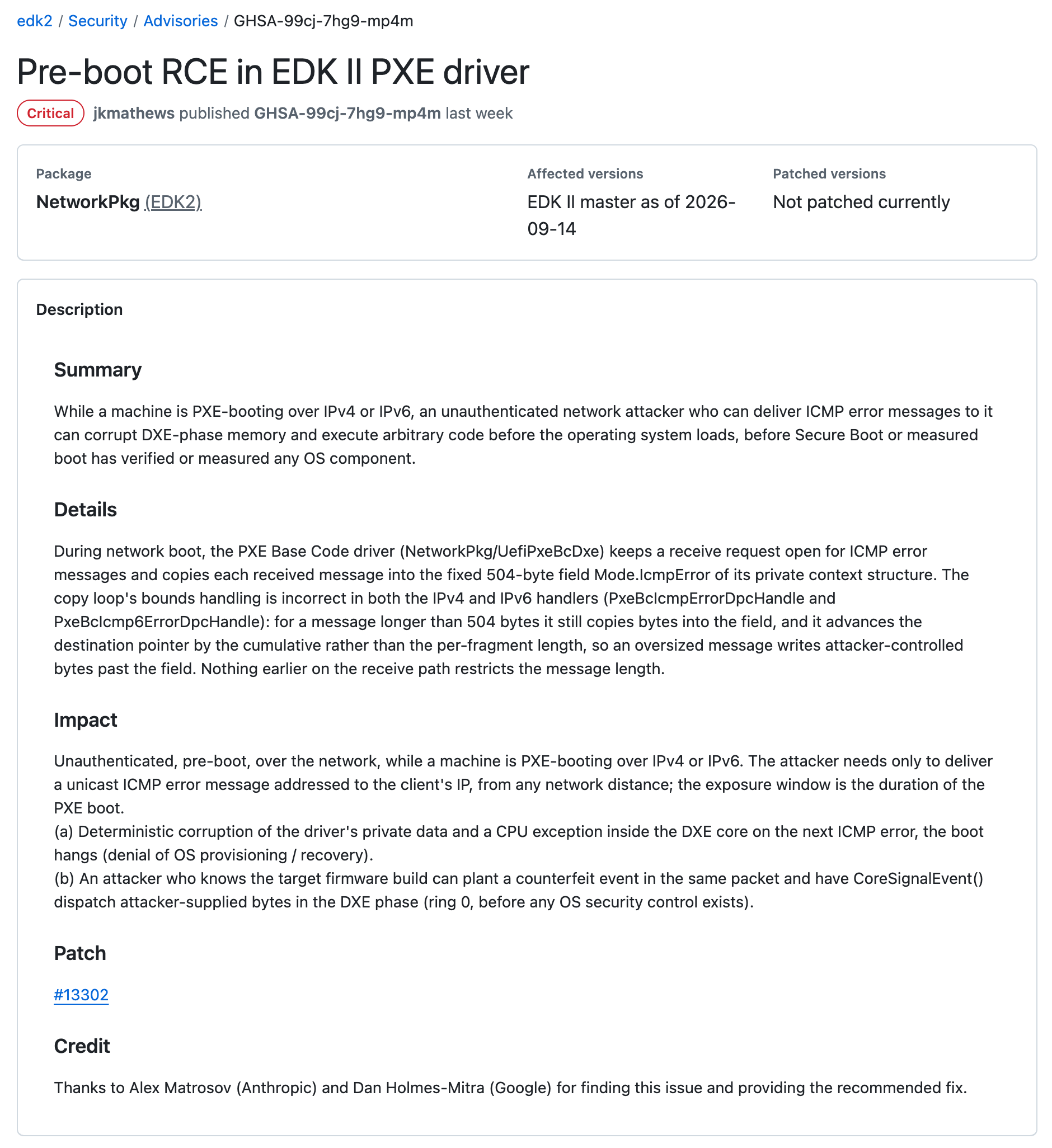
Security teams that manage servers and appliances should treat a newly disclosed firmware defect as a boot-chain risk review, not only as another vulnerability advisory. The issue affects a UEFI implementation used in many products, and the exposure point is the interval when a machine obtains startup instructions from the network before the operating system becomes available. In that interval, a maliciously formed ICMP error message can corrupt memory, interrupt startup, and, when the attacker already knows details about the firmware image, create conditions for code execution prior to OS load.
What has been disclosed and how far the fix has traveled
The advisory identifies the flaw as CVE-2026-97631 and places it in TianoCore UEFI environments, especially servers whose boot firmware is built from the open-source EDK II project. The upstream corrective change was merged on October 15, but that milestone is only the beginning of the operational path. Real devices still need updated firmware binaries, and those binaries may have to be assembled, tested, and released by the software vendors and OEMs that ship the final platform.
For enterprise administrators, the practical question is therefore different from the public disclosure question. The public answer is that the source fix exists. The enterprise answer is whether the exact server model, firmware revision, PXE configuration, and boot network path have been updated. Until that chain is verified, the exposure must be managed through configuration and segmentation.
Why TianoCore EDK II sits near the center of platform trust
UEFI is the low-level firmware interface that initializes hardware and loads later boot components. TianoCore EDK II is a widely used open-source UEFI implementation, which means it functions as a foundation for vendor-specific firmware rather than as an isolated library. Hardware manufacturers and cloud providers rely on it to build UEFI startup code, so a defect in one shared component can propagate through many distinct product families.
The project’s reach is broad. AMI, Insyde, and Phoenix are firmware vendors commonly associated with platform code, while Microsoft has developed Project Mu using TianoCore EDK II as a base. This ecosystem is the reason a PXE-related memory issue is not merely an edge-case networking bug. It is a supply-chain exposure, because the same upstream code can appear under different firmware labels, with different release cadences and different support paths.
Exploitation path: ICMP messages inside the PXE Base Code
The defective logic is located in the PXE Base Code driver. PXE enables a system to fetch boot programs over the network, which is useful for server provisioning, deployment, recovery, and installation workflows. When a machine performs PXE booting over IPv4/v6, the driver receives ICMP error information from the network. That information is then copied into a buffer with a fixed size.
According to TianoCore, the affected code mishandles data length and fragment offset. A message longer than 504 bytes may write past the boundary of the buffer and overwrite neighboring memory. The attacker must deliver a specially crafted ICMP error message to the target IP address during the narrow window in which the device is actively using PXE. This timing requirement matters: the exposure is not simply that the device is online, but that the device is booting from the network and its ICMP processing path is reachable.
Exposure assessment checklist for administrators
Because the impact depends on the concrete device and deployment pattern, organizations need a defensible inventory before claiming they are unaffected. The following questions should be answered for each server class, appliance, or test rig that participates in network boot workflows:
- Does the firmware image include the vulnerable PXE Base Code component?
- Is PXE enabled by default on physical servers, virtual servers, management interfaces, or operational appliances?
- Does the boot environment use IPv4/v6 addressing in a way that makes ICMP error responses reachable from untrusted segments?
- Are PXE boot operations performed during maintenance windows, image deployment, recovery, or automated build cycles?
- Can the vendor confirm which firmware release, if any, incorporates the upstream fix merged on October 15?
- Is there a rollback-safe path to disable or isolate PXE without breaking approved provisioning workflows?
Immediate mitigation measures before firmware updates arrive
Until a verified updated firmware package is available for every affected device, security and infrastructure owners should reduce the attack surface. The upstream guidance focuses on limiting the conditions that make the bug reachable. The following checklist translates that guidance into operational actions:
- Disable PXE startup where it is not essential, beginning with production systems that do not require network-based provisioning.
- Move any required PXE traffic into a trusted, isolated segment that is not reachable from general user networks, management VLANs, or temporary service networks.
- Restrict unauthorized ICMPv4/v6 traffic at the boundaries of the boot network, especially any path that could allow external ICMP error messages to reach a device mid-PXE.
- Review provisioning runbooks so staff do not accidentally re-enable network booting outside an approved change window.
- Record the firmware revision, vendor statement, and mitigation status for each model, so auditors can distinguish a verified not-affected state from an unknown state.
Risk decision table
| Deployment pattern | Primary concern | Recommended posture |
|---|---|---|
| PXE disabled on production servers | Residual enablement through firmware defaults or maintenance workflows | Confirm settings periodically and document the verified state. |
| PXE used for scheduled deployment | Network boot window exposes ICMP processing | Use trusted isolated boot networks and restrict ICMPv4/v6 during use. |
| PXE used for emergency recovery | Time pressure may bypass segmentation | Pre-approve isolated recovery networks and tested firmware inventories. |
| Mixed OEM fleet | Fix delivery timing differs by vendor | Track per-model firmware availability rather than relying on the upstream merge date alone. |
Common misconceptions
- An operating-system patch will remove the risk. The vulnerable code runs before the OS loads, so OS-level defenses are not the primary remediation. The relevant control path is firmware and boot-network configuration.
- If the upstream fix is merged, all devices are protected. Upstream code changes do not automatically become installable firmware images for every server or appliance. OEM and platform vendor integration remain necessary.
- PXE is only a data-center problem. The advisory centers on servers, but the broader lesson is that any UEFI boot stack reused across hardware families can inherit shared defects.
- Disabling one network port is enough. The condition that matters is reachability to the IP address of a device during PXE booting, which may involve IPv4/v6 management interfaces, shared VLANs, or temporary provisioning networks.
FAQ for security and operations teams
What does CVE-2026-97631 affect?
It affects systems using TianoCore UEFI firmware built from EDK II where the PXE Base Code driver processes ICMP messages during network booting.
How does exploitation occur?
An attacker sends a crafted ICMP error message to the device IP while PXE booting is active. Mishandled length and fragment-offset logic can copy more data than the fixed buffer can hold, causing memory corruption.
Can it stop a server from starting?
Yes. Memory corruption during the boot phase can interrupt startup before the operating system is loaded.
Can it run code before the OS?
The disclosure indicates code execution prior to OS load may be possible when the attacker has firmware-build information. This makes verification difficult because normal runtime telemetry may not yet exist.
Is ICMPv4/v6 filtering enough?
It reduces exposure but is not a substitute for firmware remediation. It should be combined with disabling or isolating PXE where appropriate.
When is the risk fully closed?
When the platform vendor or OEM releases and installs a firmware update that contains the upstream fix merged on October 15, and administrators can verify the patched revision on the affected fleet.
Action recommendations for a realistic remediation plan
A strong response to this class of boot-firmware vulnerability is sequential rather than dramatic. First, freeze assumptions: treat every device as unknown until its PXE Base Code status and firmware revision are documented. Second, make a short list of systems where PXE is mandatory, because those systems need segmentation and ICMP control policies before any patch lands. Third, open a vendor tracking loop for each hardware family, including any firmware code derived from AMI, Insyde, Phoenix, Microsoft Project Mu, or directly from TianoCore EDK II.
- Assign a single owner for firmware inventory, boot-network segmentation, and vendor update tracking.
- Prioritize systems where PXE is enabled, reachable over IPv4/v6, and used during planned or unplanned provisioning.
- Implement temporary controls: disable PXE, isolate the boot network, and restrict unauthorized ICMPv4/v6 traffic.
- Ask vendors for confirmation that the PXE Base Code fix has been integrated into a release, not merely accepted upstream.
- Validate patched firmware in a staging pool before broad deployment, especially where image building, recovery, and UEFI settings interact.
- Retain evidence of mitigation decisions so later incidents can be distinguished from approved operational risk.
Security takeaway
CVE-2026-97631 is a reminder that vulnerability management must begin below the operating system. A firmware defect in the PXE Base Code driver can convert ICMP error handling into memory corruption during the boot window, and the fix only becomes real after OEM integration. Organizations should use this case to tighten pre-OS visibility: know which UEFI images contain vulnerable components, constrain where PXE can run, and treat ICMPv4/v6 reachability as part of the attack surface.