
Patching in the AI Era: A Security Ops Playbook for Microsoft's 1413-CVE October 2026 Update
Microsoft shipped 1413 CVE fixes in its October 2026 security update, and Windows alone accounts for 1102 of them. A larger number does not equal a weaker operating system: the decisive variable has moved from how many flaws a vendor finds to how fast an organisation installs the fix, because an AI-assisted attacker can now turn a published patch into an exploit in a few hours. This ItInsightsWorld Security guide converts that shift into concrete steps, a deployment checklist and the traps that keep fleets exposed.
What did Microsoft fix in October 2026 — and does the number mean higher risk?
Short answer: what changed is volume, not the security quality of the platform. Microsoft's October 2026 security guidance lists 1413 CVEs addressed across its products, with 1102 in Windows — far above any conventional month, and a continuation of the steep rise in disclosed vulnerabilities seen through the second half of 2026.
Third-party trackers published slightly different totals for the same release, because advisories get merged, split, or counted per knowledge-base article and per third-party component. Coverage from SecurityWeek and Infosecurity Magazine both described it as the largest Patch Tuesday on record. For operations, the practical rule is simple: use Microsoft's own guidance as the source of record for triage, and treat aggregate counts as trend data only.
Windows fix volume, month by month
| Release month | Windows vulnerabilities fixed | What an ops team should read into it |
|---|---|---|
| July 2026 | 413 | The first month to break the old ceiling |
| August | 233 | A dip: the series is noisy, not a straight ramp |
| September | 726 | AI-assisted discovery starts scaling |
| October | 1123 | Queue-by-count triage stops functioning at this volume |
| October 2025 | 134 | The year-ago baseline for the same month |
Placed side by side, the 134 fixes of October 2025 and the 1123 of October 2026 make the argument better than commentary does: the same month delivered roughly eight times the workload, while most security and endpoint teams did not grow by anything close to that.
Microsoft does not read the curve as Windows decaying. Historically, defects sat dormant inside an enormous codebase until an external researcher reported one or an attacker started using it. The company now runs AI systems across far more code to hunt for flaws proactively, so a larger share of what already existed reaches disclosure.
Nuno Costa, who leads Microsoft's Windows Servicing and Delivery team, framed the trade-off plainly: a vulnerability count does not describe how secure an operating system is. What matters is whether an organisation can find the flaw, fix it, and get the protection deployed onto devices. Microsoft also argues that publishing detail is not an automatic increase in risk — it is what allows researchers and IT administrators to understand blast radius, severity and the correct remediation.
How is AI changing both defence and offence?
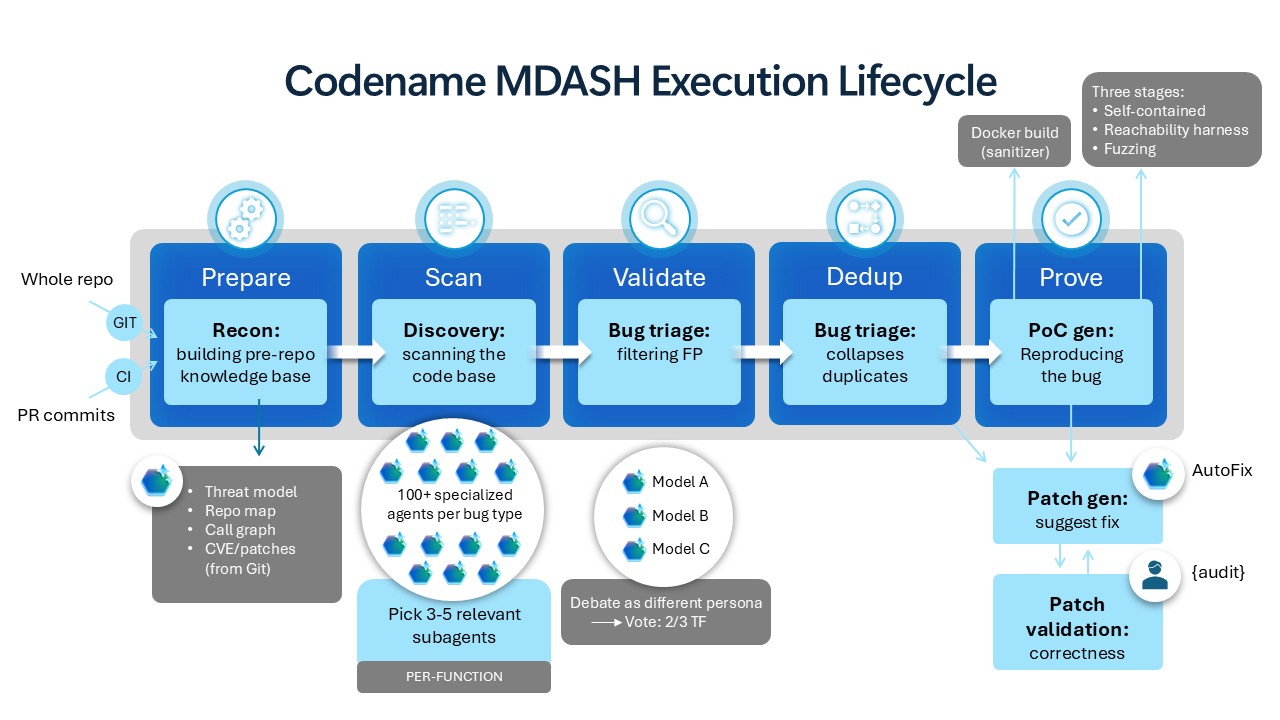
It compresses both clocks at once. On the defensive side, Microsoft is using MDASH, a multi-model agentic scanning system that combines Microsoft's own security models with partner technology including Anthropic Mythos, and runs purpose-designed AI agents to find and validate potential vulnerabilities. The same tooling assists engineers in determining which Windows versions are affected, what consequences a flaw can have, and which remediation applies. Microsoft stresses that AI has not replaced security engineers: the final verdict on a vulnerability and the decision on how to fix it remain human work.
On the offensive side the logic is symmetrical, and the target is not zero-days but your own update delay. Once a patch is public, an attacker can feed the before-and-after binaries to an AI tool; the diff points straight at what changed, from which the trigger conditions of the underlying flaw can be inferred. That same task used to demand days or weeks of manual reverse engineering. Microsoft's warning is that it can now be done in hours.
One nuance worth carrying into your risk register: AI is not inventing these vulnerabilities. It is shrinking the gap between a flaw existing and a flaw being known. Dustin Childs, threat awareness lead at the Zero Day Initiative, has said that record-sized patch months have become a "new normal" he is still not comfortable with, and that enterprises holding on to monthly, count-driven triage are pushing their network edge to a tipping point of exposure.
What is the patch gap, and how wide is yours?
Definition first: the patch gap is the interval between Microsoft publishing a fix and that fix being installed and rebooted on a specific device. A release does not secure one endpoint. Until the update lands, the device sits inside that window, vulnerable to a flaw whose recipe is now public.
Jeremy Chapman, the Microsoft 365 division director who works with Windows customers, has already told enterprises to stop delaying monthly security updates by three days or longer. His argument is arithmetic rather than opinion: if a critical update is deployed weeks after release, an attacker who uses AI to analyse the flaw has been handed enough time to work with.
Microsoft's own device diagnostics show how real the gap is. In the sample measured in August 2026, less than half of enterprise devices had installed a security update two weeks after release; four weeks later, about a quarter of them were still missing it.
Regulators are converging on the same expectation. In June 2026, CISA issued Binding Operational Directive 26-04, "Prioritizing Security Updates Based on Risk", which replaces BOD 19-02 and BOD 22-01, requires federal agencies to remediate the highest-risk known-exploited vulnerabilities within three calendar days, and adds forensic triage so agencies check whether a system was compromised before the patch landed. It binds only US civilian agencies, but CISA encourages every organisation to adopt the same risk-based model — and it is the clearest external signal that a monthly patch queue is no longer a defensible control.
Which October 2026 flaws should move first?
Two disclosure signals outrank the rest of the queue. One Windows Shell security feature bypass flaw, tracked as CVE-2026-96951, was already found under active exploitation; a .NET Framework security feature bypass flaw was publicly disclosed. Feature-bypass issues rarely deliver code execution by themselves, but exploited ones are usually chained with a second bug — which makes them the opening link in an intrusion, not the closing one.
Microsoft's own guidance points the same way: prioritise by risk, not by raw volume. Order the work as follows.
- Internet-facing devices first. Anything reachable from outside — VPN concentrators, jump hosts, public-facing management interfaces, remote desktop gateways.
- Identity infrastructure next. Domain controllers, certificate services, SSO and conditional-access components, privileged workstations. This is where one leaked token becomes everything.
- Then systems that hold regulated or business-critical data. File shares, databases, backup repositories, HR and finance endpoints.
- Cross-check against a known-exploited catalogue. If an advisory also appears on CISA's KEV list, it inherits the shortest clock you can enforce.
- Only then the long tail, sorted by severity, exploitability and whether the affected component is even running in your estate.
Step by step: how to shrink the patch gap from weeks to days
- Measure time-to-installed, not time-to-released. Your KPI is the percentage of managed devices patched within a target window, per ring. Vendor publication dates are not a metric; they are the starting gun.
- Pre-define risk tiers before the release lands. Decide now that exploited or internet-exposed flaws follow a 24-72 hour clock, and that the rest of the queue follows your standard ring cadence. Reaching that clock requires a pre-approved emergency change template — not a committee.
- Front-load compatibility testing. Keep a standing test ring with your line-of-business applications, printers, LOB add-ins and security agents, refreshed monthly so a new cumulative update can be validated in hours instead of being queued behind change freezes.
- Sequence the estate by exposure. Patch internet-facing and identity assets in the first wave, general endpoints in the second, and special-purpose machines last, with compensating controls holding the line in between.
- Plan the reboot before the patch lands. This cycle has a specific trap: the October 2026 Windows security update shipped as a standard update rather than a restart-free hotpatch update, so devices enrolled in hotpatching still require a restart to complete installation (Microsoft release notes; reported by Petri). Book maintenance windows and user comms in advance, or your coverage report will stall on un-rebooted devices.
- Verify, don't assume. Pull compliance data from your endpoint management platform, not from the deployment console alone. An "offered" update is not an installed one.
- Apply compensating controls where a patch cannot land. Network isolation, disabling the exposed service, virtual patching at the WAF or IPS, restrictive access to the vulnerable component. Log each one as a time-boxed exception with an owner and an expiry date.
- Close the loop weekly. Publish an ageing report of unpatched high-risk assets to the service owner. Unpatched estates survive because nobody sees them.
Deployment checklist for this patch cycle
- Confirm CVE-2026-96951 (Windows Shell security feature bypass, actively exploited) has been mapped to the affected components in your inventory.
- Identify .NET Framework-dependent servers and developer workstations covered by the publicly disclosed bypass advisory.
- List every device with an outstanding reboot requirement, including hotpatch-enrolled servers, and schedule it.
- Check coverage against a target: percentage of endpoints patched at day 3, day 7 and day 14.
- Pull the offline and long-absent estate — field devices, contractor laptops, shift workstations — and quarantine or gate them at network access.
- Review the three legacy endpoints that cannot be patched and confirm the compensating control is still enforced.
- Snapshot authentication logs for exploited-flaw indicators, so you can answer "were we exposed before we patched?".
- Update the exception register and expiry dates; anything past due goes to the service owner.
- Verify backups and rollback paths before the wide ring deploys.
- Rehearse the emergency lane once per quarter with a synthetic critical CVE and a stopwatch.
Common misconceptions that keep fleets exposed
- "More CVEs means the vendor got sloppy." It can equally mean the vendor is looking harder. Judge the trend in exploitation and time-to-fix, not just the count.
- "The patch is out, so we are covered." Coverage is a function of deployment. A fix nobody installed is a published, documented attack recipe.
- "High CVSS equals top priority." A 7.8 on a component you do not run is noise; a medium-severity bypass being exploited on your exposed hosts is the real emergency.
- "We have a 30-day SLA, that's industry standard." Older guidance assumed days-to-weeks of attacker research. Microsoft's telemetry — less than half of enterprise devices patched at two weeks — shows the bottleneck is the last mile, not the paperwork.
- "Hotpatching means no restart windows." Not this cycle: October 2026 shipped as a standard update, so even enrolled devices need a reboot.
- "Patch Tuesday is a Windows-only problem." Applications, browsers, drivers, firmware and third-party agents ride the same queue and often lag further behind than the OS does.
Count-based triage vs risk-based triage
| Dimension | Count-based queue | Risk-based queue |
|---|---|---|
| Trigger to act | Advisory published in the monthly batch | Exploitation signal, exposure and asset criticality |
| Clock | Change calendar, often weeks | 24-72 hours for the top tier |
| Failure mode | Queue overflow at 1413 advisories | Requires honest asset inventory and test rings |
| Primary metric | Number of CVEs closed | Percentage of exposed assets patched per tier |
| Best fit | Small, homogeneous estates | Regulated estates, distributed workforce, identity-critical environments |
FAQ: what security teams ask after a record patch month
Does 1413 CVEs mean Windows is less secure than it was?
No — it means more of what was always there is now visible. Microsoft's Windows Servicing and Delivery view, voiced by Nuno Costa, is that counts measure disclosure effort, while security posture is measured by how quickly protection reaches devices.
Is a three-day patch clock realistic for thousands of endpoints?
As a blanket target, no. As a targeted lane, yes: pre-approved emergency change, a standing test ring with your critical applications, and a definition of "highest-risk" tied to exploitation and internet exposure. That is the structure behind both Jeremy Chapman's three-days advice and CISA's BOD 26-04.
Can we wait for a compatibility cycle on an actively exploited flaw?
Not without accepting exposure. If testing genuinely cannot complete, mitigate first — isolate the affected service, restrict external access, block the exploitation path at the perimeter — and treat the mitigation as an exception with a hard expiry, not as a permanent fix.
What about individuals and small businesses on Windows 11?
The message is direct. A rising fix count does not prove the OS is more fragile, but promptness has never mattered more. Install each monthly cumulative security update as soon as it lands, allow the restart, and avoid indefinite deferrals — a delayed update is the window an AI-assisted attacker is counting on.
Does installing updates remove the need for monitoring?
No. Detection still has to cover the pre-patch period, since that is where compromise happens. Keep authentication and process telemetry for the hosts that were slow to update, and use it to prove you were not exposed before deployment completed.
Action recommendations: your next 72 hours
- Hour 0-6 — Endpoint lead. Pull current patch coverage for the October 2026 cumulative update, split by ring, and list every host with a pending reboot.
- Hour 6-24 — Vulnerability manager. Map CVE-2026-96951 and the disclosed .NET Framework bypass against your inventory; flag internet-facing and identity systems.
- Hour 24-48 — Infrastructure owner. Deploy to the exposed tier and identity infrastructure; schedule restarts inside a notified window.
- Hour 24-48 — SOC. Hunt for exploitation indicators on devices that were unpatched during the exposure period and record the result.
- Hour 48-72 — CISO or service owner. Publish the coverage figure, the exception list with owners and expiry dates, and one structural fix — test ring, emergency lane or reporting — to institutionalise.
- Next cycle — everyone. Move your standing target from "advisories reviewed" to "exposed assets patched within X hours", and report it monthly.
The wider lesson from this release is that the security race has moved off the vendor's side of the line. AI is accelerating both how fast flaws are found and how fast they can be weaponised, so the defensive metric that matters is the full chain: discovery, publication, deployment, verification. At IT Insights we treat that chain as an operations problem with a measurable clock, not as a monthly newsletter to get through.
Reference sources
- Microsoft October 2026 security update guidance and Patch Tuesday release notes (source of record for the 1413 CVE and 1102 Windows figures).
- Microsoft Security, "Beyond the benchmark: Advancing security at AI speed" — microsoft.com
- Microsoft Learn, "Codename MDASH Overview" — learn.microsoft.com
- CISA, Known Exploited Vulnerabilities catalogue updates and BOD 26-04 prioritisation expectations — cisa.gov
- Petri, "Microsoft Temporarily Pauses Reboot-Free Hotpatch Updates" — petri.com
- SecurityWeek, "Microsoft Patches Record 1413 Vulnerabilities, Including Exploited Windows Zero-Day" — securityweek.com
- Infosecurity Magazine, "Microsoft Breaks Patch Tuesday Record Again with 1400+ CVEs" — infosecurity-magazine.com
- Freebuf coverage of Zero Day Initiative commentary on record CVE volumes — freebuf.com