
ItInsightsWorld General Review: X Web App Rebuild — Faster Loads, Country-by-Country Rollout, and Who Should Switch First?
This ItInsightsWorld General review compares X's rebuilt web app with the older browser experience: X says profile pages now load several-fold faster on weak networks, with a first post appearing in about 2.7 seconds after more than 22 seconds before. The main trade-off is access, because signed-in rollout remains country by country.
What did X actually change in the web app?
The core change is not a cosmetic redesign. X rebuilt the browser application so that ordinary visitors, search-engine crawlers, and link-preview tools can be served from one consolidated architecture instead of the previous three separate server systems. X chief engineer Yagiz Nizipli presents the update as a performance-first overhaul, and the most visible benefit appears in slow-network conditions.
- Profile loading: X describes a first post appearing in about 2.7 seconds instead of more than 22 seconds in its slow-connection example.
- Rollout path: signed-in users are being moved country by country, while unlogged visitors and search-engine pages already use the new architecture.
- Operating model: merging the old paths is intended to reduce duplicated maintenance and make future updates easier to coordinate.
- Engineering explanation: X's engineering blog says the rebuild covers why the team rebuilt X.com, how the rollout is happening, and how old and new apps compare.
For general readers, the practical takeaway is that the rebuild is mainly an infrastructure story. It may feel smoother, but the user-visible surface remains recognizable. That distinction matters because many users will first notice speed when a link opens, not because they were asked to learn a new navigation pattern.
How does the new web app compare with the old version?
The comparison conclusion is straightforward: the new app is most compelling when the user's pain point is waiting for a profile or linked post to appear. The old app may still be adequate for people already on a strong connection and familiar interface.
| Decision factor | Old X web experience | Rebuilt X web experience | What it means for readers |
|---|---|---|---|
| First visible content on a profile over a weak network | More than 22 seconds for the first post in the example cited by X. | About 2.7 seconds, a several-fold improvement. | Better for travel, low-end devices, mobile web users, and readers who open profiles often. |
| Architecture | Three separate server systems handled users, crawlers, and preview bots. | A unified architecture serves those paths. | Less duplicated plumbing over time, though staged migration can delay universal access. |
| Availability | Default path for many logged-in accounts until migration reaches their region. | Phased: signed-in users country by country; visitors and search pages already switched. | Some users may not see the new app immediately, even when reports describe it widely. |
| Perceived experience | Long waits could interrupt reading, sharing, and verification flows. | Early observers report smoother interaction and visible polish. | The win is most useful when the page opens from a shared link or profile. |
| Risk profile | Stable but less optimized for slow-network first paint. | Faster first paint, but rollout gaps and page-level performance may vary. | Do not treat one metric as proof that all feeds, media, and notifications have improved equally. |
The table supports a nuanced judgment. A faster profile page does not automatically mean every home feed, video player, or notification flow has improved equally. Independent coverage of the launch also highlights the profile-loading metric as the clearest gain, while broader user experience still depends on account eligibility, device type, and network conditions.
Why is the country-by-country rollout important?
Conclusion: rollout, not raw speed, is the first practical barrier. X says the logged-in transition is happening country by country, so readers in different regions may have different experiences for weeks. Unlogged visitors and search-engine pages, however, already run on the new architecture. That means a person can encounter the rebuilt app through a public profile or a search result before seeing it inside a signed-in session.
- If you are signed out, you are more likely to already be in the new architecture.
- If you are signed in, your country and account eligibility determine the migration window.
- If your region has not been included yet, the old app can still be acceptable on a strong network.
- If you use public pages for research, previews, or verification, the architecture change may matter more than any visual redesign.
Because X expects more signed-in users to encounter the rebuilt app within the coming weeks, the most reasonable strategy is patience rather than workarounds. The rollout shape also tells readers how the company is managing risk: test in public pages first, then move logged-in traffic gradually.
What do external voices add beyond the official numbers?
Conclusion: external reporting and observer comments reinforce the same direction but add useful nuance.
One widely shared detail comes from X's own engineering communication, which coverage quoted as a waiting-time description rather than a broad benchmark: on the old web app, a user could "stare at the X logo for more than 22 seconds" before the first post appeared, while the new app shows it in about 2.7 seconds. The value of that quote is that it turns the number into a lived moment—the logo wait—so the improvement is easier to evaluate than an abstract architecture change.
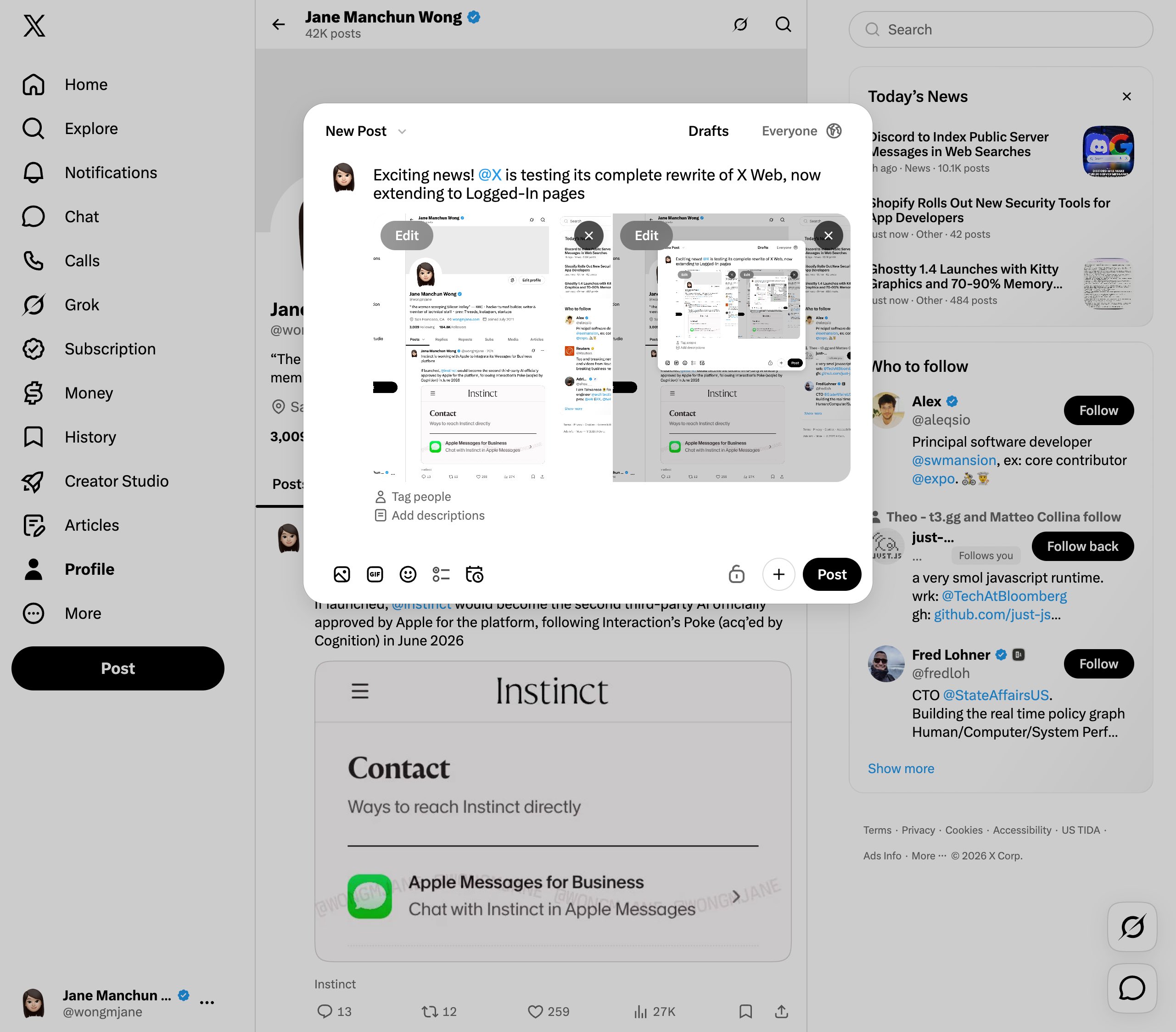
Security researcher Jane Manchun Wong said she obtained access to the new X Web and described the experience as smoother, with visible interface polish. That complements the official numbers: when waiting time falls, the app can feel cleaner even if the feature set has not changed dramatically. Her case also shows that staged rollouts can have imperfect boundaries, which is normal for large platform migrations.
For an ItInsightsWorld General reader, the cross-check matters. Official numbers describe engineering effort; independent observation describes perceived quality. Both point toward a real speed improvement, but neither proves that the entire platform has been rebuilt in one switch.
Who should treat the new app as useful now?
Strong fit: profile readers and link-first users
If you often open a person's profile, verify a shared post, or browse X from a search result, the rebuild is likely to help. The measured scenario—first post on a profile—is close to many real use cases where the user wants context quickly.
Wait and see: heavy home-feed users
If your main workflow is continuous scrolling, the first-load metric is useful but not the whole story. Feed rendering, media loading, and notification behavior may have different constraints. Until rollout reaches your account consistently, it is better to judge from daily use than from launch announcements.
Low priority: desktop-only fast-network users
If you already use X on a stable desktop network and rarely open public profiles, the improvement may be less noticeable. For that group, the bigger question is whether the unified architecture makes future features ship faster and more reliably.
Common misconceptions about the rebuild
- Misconception: A country-by-country rollout means every user can switch today. Reality: Signed-in migration remains phased; visitor and search paths are already using the new stack.
- Misconception: Faster profile loads prove all performance problems are solved. Reality: The headline metric is a slow-network profile example, not a comprehensive benchmark across every page type.
- Misconception: The rebuild is mainly a visual redesign. Reality: The most important change is architecture: merging three separate server systems into one model.
- Misconception: Early smoother feedback means the migration is complete. Reality: More users are expected within the coming weeks, and old behavior may still appear for accounts outside the rollout.
Action checklist: what to do as an X user, editor, or product observer
- Check whether your signed-in account has already switched. If not, do not force a workaround; the rollout is intentional.
- Compare your real pain point: profile and link opening may improve first; heavy scrolling may not change as dramatically.
- Test on a realistic network, not only fast desktop Wi-Fi. The official claim is strongest in weak-network conditions.
- If you publish links or summaries, treat this as a reminder that page load and preview quality affect how content is perceived.
- Review updates from X's engineering blog before drawing platform-wide conclusions.
FAQ: what readers ask about the X web app rebuild
What is the X web app rebuild?
It is X's re-architecture of the browser experience. The goal is faster rendering and a unified server model for users, search crawlers, and link-preview bots.
Why does the about 2.7 second figure matter?
Because it refers to the first visible post on a profile over a slow connection. X's comparison with more than 22 seconds makes the waiting-time difference concrete, and it supports a several-fold improvement claim.
Who already has the new app?
Unlogged visitors and search-engine pages already use the rebuilt architecture. Signed-in users are being moved country by country, with broader access expected within the coming weeks.
What should readers not assume?
Do not assume every page, feed, video, or notification path is now instantly faster. The clearest evidence so far is profile loading and smoother early-use reports.
What is the best decision framework?
Use the rebuilt app for profile-heavy and weak-network tasks; stay cautious about global judgments until rollout and independent long-term use align.