
Windows 11 27H2 vs. Windows 12: How Microsoft's 2027 Upgrade Compares With 24H2, 25H2 and 26H2
By James Hartley · IT Insights · General guide to a decision many households and offices now face
Short answer: the next heavyweight Windows change is not a rebranded operating system. Reporting points to Windows 11 27H2, being prepared for 2027, as a replacement-style release that swaps out or heavily rewrites core system components — the first update of that kind since 24H2 in 2024 — while Windows 11 25H2 and 26H2 stay lighter enablement-package upgrades.
That difference reaches well beyond version numbers. It determines how much compatibility testing a machine needs, how long a preview phase runs, and whether a laptop that already feels slow should be refreshed now or held back for two more years. Below, the four releases are laid side by side, confirmed Microsoft data is separated from speculation, and the whole picture ends with a decision framework for five typical reader profiles.
Is Windows 12 off the table for next year?
Conclusion first: Microsoft's visible route is continuity, not a rebrand. Windows 12 was widely anticipated after The Verge reported in 2022 that Microsoft was returning to a three-year major-release cadence; no such product has ever been announced, and the current plan instead treats 27H2 as the milestone that keeps extending the life of Windows 11.
On certainty, be exact: Microsoft has not formally denied that Windows 12 could appear at some future point. What the roadmap looks like today is 27H2 delivering a substantial, core-component-level upgrade in performance, reliability and everyday experience. So if the question is whether next year brings a brand-new Windows 12, the evidence leans strongly toward no — the company's effort is going into refining Windows 11.
What separates 27H2 from 25H2 and 26H2?
Conclusion first: 25H2 and 26H2 activate features already staged inside the installed system, whereas 27H2 is planned to replace or substantially update core components. On Windows 11 25H2 and 26H2, eligible devices typically download a small update package and reboot once; 27H2 is expected to follow the 24H2 pattern instead, which makes it closer to a complete operating-system upgrade than to a routine feature update.
| Dimension | 24H2 (2024) | 25H2 | 26H2 | 27H2 (planned) |
|---|---|---|---|---|
| Delivery method | Full OS replacement | Small enablement package | Small enablement package for devices on 25H2 or 24H2 | Replacement-style update expected |
| Servicing platform | New platform base | Shared base with 26H2 | Shared base with 25H2 | New platform base, reunifying architectures |
| Validation effort | Broad app and driver testing | Limited | Limited | Broader compatibility verification and longer test cycles |
| Preview window | Standard Insider cycle | Rolls forward from 24H2 | Rolls forward from 25H2 | Windows Insider work may begin earlier in 2027 |
| Character | Major | Feature unlock | Feature unlock plus memory efficiency work | Major — the heaviest in years |
Microsoft's own IT-pro guidance describes 26H2 as an enablement package rather than a full OS install, which is exactly the contrast the 27H2 reporting breaks. That single technical distinction explains why analysts describe the 2027 release as "important" rather than merely "big".
Why 27H2 would be the first update that reaches everyone
Conclusion first: Microsoft's 2026 releases split Windows 11 into two branches, and 27H2 is where they converge again.
Windows 11 26H1 was positioned by Microsoft as an ARM-only release for Qualcomm Snapdragon X2 machines, while Intel and AMD computers received 26H2 as the equivalent version. Microsoft has confirmed that 26H1 devices will not be pushed to 26H2; they wait for the next platform release. Windows Central summarised that moment plainly: "Microsoft is planning to bring everyone back onto the same platform release with version 27H2 in 2027."
Two reader-level consequences follow. If you bought an ARM laptop in 2026, 27H2 is effectively the first genuine feature milestone you will receive. And because a single code line must now serve both x86 and ARM, the 2027 release carries structural work — unification, efficiency and stability — that package-based updates simply cannot attempt.
How much speed is actually promised on an 8GB PC?
Conclusion first: the concrete performance numbers available today are already shipping; they are not being reserved for 2027.
Recently published Microsoft data shows the system optimisation programme targeting 8GB memory devices has produced visible results. According to Microsoft's internal test results, the latest optimisations raise Windows 11 response speed by up to 20% and multitasking performance by up to 40%. Those improvements have begun reaching devices supported under Windows 11 26H2, rather than being exclusive to the future 27H2 build.
Independent testing points the same direction. Windows Latest compared 26H2 with 25H2 on an 8GB laptop and described boot-time memory usage falling by roughly 1GB to 2GB, echoing user reports after the 26H2 rollout. Treat the following as our analysis rather than a vendor claim: efficiency work of this kind benefits machines that were already spilling data to storage, whereas very small memory configurations and hard-disk notebooks stay constrained regardless of the build number.
The strategic signal matters more than the percentages. Microsoft putting efficiency and resource utilisation back at the centre of its roadmap is the clearest available evidence that 27H2 will lean on further low-level performance gains rather than on new interface toys.
What Intel APX adds — and who will not benefit yet
Conclusion first: Advanced Performance Extensions is a genuine performance lever, but only for software rebuilt to exploit it and for processors that implement it.
Intel Advanced Performance Extensions (APX, the advanced performance extensions instruction-set add-on) is the other change drawing attention. Windows 11 experimental builds have started showing signs of APX support; if the capability lands officially, it could deliver extra gains for optimised 64-bit applications.
The mechanism is register capacity. APX increases the number of general-purpose CPU registers from 16 to 32, which reduces memory access counts and instruction overhead so a processor spends fewer cycles moving data in and out. Intel's developer documentation describes the doubling in exactly those terms, explaining that a compiler can hold more values in registers. Coverage of recent Insider test builds has reported an APX enable switch appearing in an experimental channel, tied to Intel silicon expected around 2027.
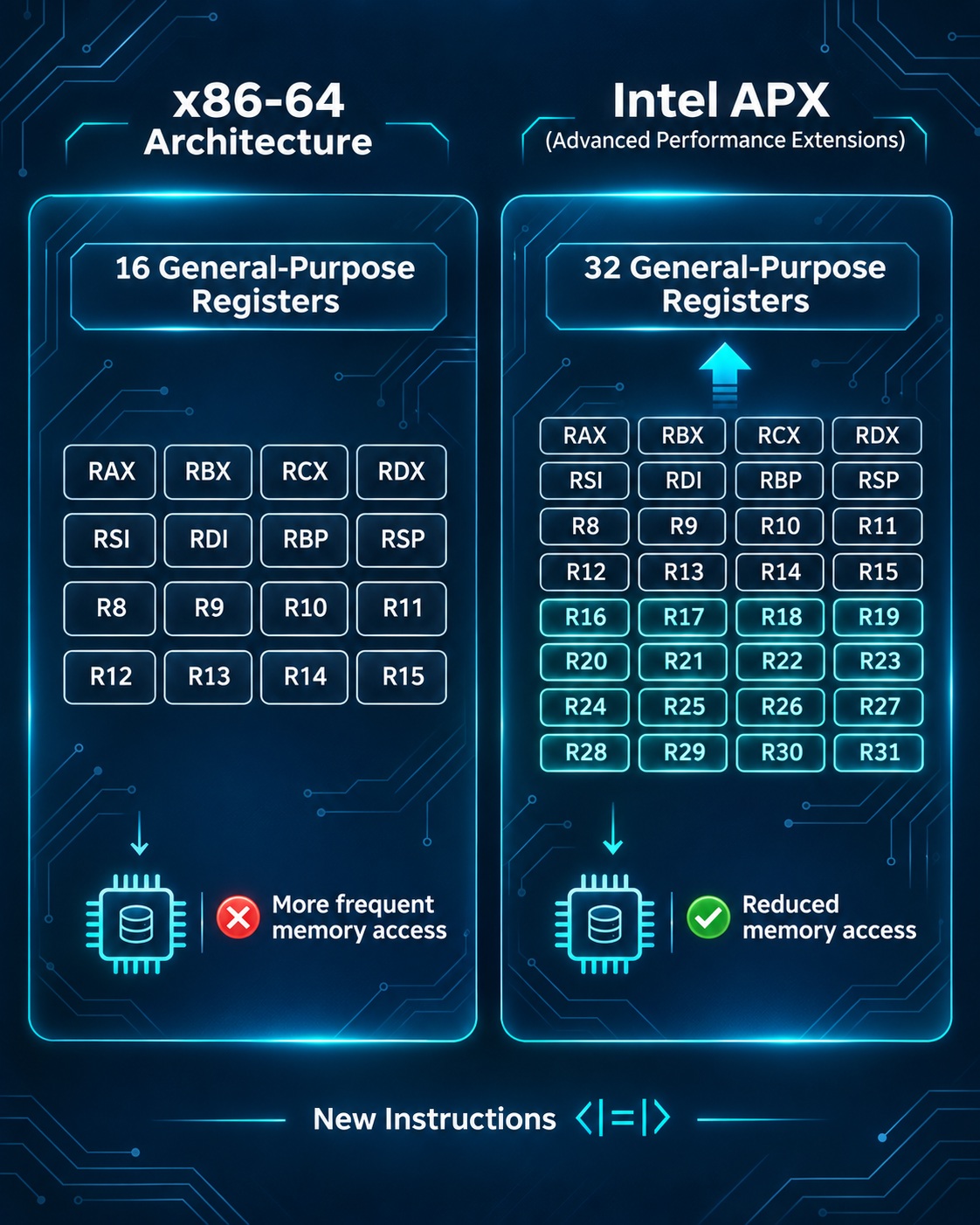
Two caveats before anyone budgets for free speed. Microsoft has not confirmed that this technology will form part of the Windows 11 27H2 release, and realised benefit depends on future processor support and on software vendors recompiling their applications. Anything not built for APX runs exactly as it does today.
Does the Bloom wallpaper change mean anything technical?
Conclusion first: a wallpaper is cosmetic, but its timing is a tell — Microsoft is preparing a fresh visual identity for a new platform generation.
Bloom has served as the signature visual element of Windows 11 since the system launched in 2021, and reports indicate it is about to be replaced. The incoming default wallpaper is expected to present a colourful folded geometric form encircled by clouds, with distinct treatments per edition: consumer builds may emphasise gaming, productivity, creativity and performance themes, while Windows 11 Pro keeps a palette closer to today's Bloom.
Those designs may be unveiled during the Ignite 2026 conference this month, with a wider rollout planned from January 2027 — a deliberate warm-up ahead of the year's major system update.
What a replacement-style upgrade costs an organisation
Conclusion first: plan 27H2 as an OS migration, not as a monthly patch.
- Validation scope. Enablement packages leave the servicing platform untouched, so application and driver regression can stay light. A replacement-style update, on the pattern used for 24H2, means re-testing disk images, drivers, endpoint security agents and line-of-business software.
- Timeline. Windows Insider preparation for 27H2 may start earlier in 2027, giving IT teams a pilot window — but the feature set will still be moving during that window.
- Support arithmetic. Annual feature updates arrive in the second half of the calendar year with 24 months of support; Microsoft's lifecycle page puts 25H2 on Home and Pro through October 13, 2027, almost exactly when 27H2 is expected. Skipping 26H2 is therefore not a neutral choice.
- Hardware baseline. Microsoft's optimisation effort is anchored on 8GB configurations, so fleets below that threshold are the ones most likely to need capital spend rather than a software wait.
Should you wait for Windows 11 27H2? Five reader profiles
| Your situation | Verdict | Why |
|---|---|---|
| Still running Windows 10 | Move now | Support for Windows 10 ended October 14, 2025. A two-year wait leaves the machine unpatched in the meantime. |
| Budget laptop with 8GB RAM that feels sluggish | Take 26H2 today | The published 20% and 40% gains are opening up on devices supported by 26H2; 27H2 would add more, later. |
| New Snapdragon X2 notebook on 26H1 | Nothing to do | Those devices are not routed to 26H2 — 27H2 is the reunification release you are already on. |
| Small business fleet on 24H2 or 25H2 | Upgrade now, pilot 27H2 later | Stay inside a supported branch this cycle, then test 27H2 on one machine once preview builds appear. |
| Gamer or enthusiast chasing maximum frame rates | Hold for hardware | Real APX gains need chips exposing 32 general-purpose registers plus rebuilt 64-bit apps; the OS alone changes little. |
Common misconceptions in the 27H2 story
- "27H2 is really Windows 12 under a different label." Nothing is confirmed: Microsoft has not formally denied a future Windows 12, but it has also not announced one.
- "Enablement packages are cosmetic rebranding." They unlock functionality already present in the system while keeping the same servicing platform — which is precisely why they install in minutes.
- "The performance figures arrive in 2027." Microsoft's 8GB optimisation results, up 20% in responsiveness and up 40% in multitasking, are already reaching 26H2-supported devices.
- "APX will accelerate every program." Only software recompiled for it, on supporting processors.
- "Requirements are settled." The final feature list, hardware requirements and exact release timing for 27H2 remain unconfirmed by Microsoft.
FAQ: what readers ask before deciding
Is Windows 11 27H2 officially confirmed?
Microsoft has not published the final feature list, hardware requirements or a specific release date. Multiple reports nonetheless describe it as a full-replacement platform release planned for 2027, and as the most substantial Windows upgrade since 24H2.
Will my current computer be able to run it?
Unanswered for now, because requirements are not public. The pragmatic reading: a machine that already struggles with Windows 11 26H2 at 8GB of memory is not a comfortable candidate for a two-year wait.
Should I join Windows Insider to preview it?
Reasonable for a spare device or an IT pilot ring. Insider testing for 27H2 may begin earlier in 2027, and preview builds carry driver and application risk that a primary work machine should not absorb.
How long do today's versions stay supported?
Feature updates ship in the second half of each year with 24 months of support. Home and Pro devices on 25H2 are covered to October 13, 2027, per Microsoft's lifecycle documentation.
Will the desktop look different?
The earliest visible signals are expected around Ignite 2026 this month, with the successor to Bloom rolling out more broadly from January 2027.
Action checklist before you commit
- Record your present version (Settings, then System, then About) and note whether you are on 24H2, 25H2 or 26H2.
- Match that version to its support end date on Microsoft's lifecycle page and set a reminder 90 days ahead.
- Verify a working backup or restore point before any feature update.
- Upgrade one device first and live on it for two weeks before touching the rest.
- Track two markers for 27H2: the Ignite 2026 announcements this month and the January 2027 wallpaper rollout.
- Before 2027, price a hardware refresh against the cost of patience, especially on 8GB machines.
- Ignore "Windows 12 is imminent" headlines until Microsoft actually announces one.
Verdict: the useful way to read this story is as a fork between patience and housekeeping. Everything Microsoft has committed to so far — the 8GB optimisation programme, the 26H2 delivery model, the lifecycle dates — is available now, while 27H2 remains a reported plan whose scope is genuinely large. For most readers the efficient move is to get onto the current supported release, then treat 27H2 as a validation project starting with the first Insider builds rather than as a reason to postpone maintenance for two years. IT Insights will keep tracking the unconfirmed details — feature list, hardware floor and launch date — as Microsoft fills them in; questions about this guide can go to contact@itinsights.com.
Sources referenced
- Microsoft Tech Community, "An IT pro's guide to Windows 11, version 26H2" — https://techcommunity.microsoft.com/blog/windows-itpro-blog/an-it-pro%E2%80%99s-guide-to-windows-11-version-26h2/4559760
- Microsoft Tech Community, "What to know about Windows 11 version 26H1" — https://techcommunity.microsoft.com/blog/windows-itpro-blog/what-to-know-about-windows-11-version-26h1/4491941
- Microsoft Learn, "Windows 11 Home and Pro" lifecycle — https://learn.microsoft.com/en-us/lifecycle/products/windows-11-home-and-pro
- Microsoft Learn, "Windows 11 - release information" — https://learn.microsoft.com/en-us/windows/release-health/windows11-release-information
- Microsoft Support, "Windows 10 support has ended on October 14, 2025" — https://support.microsoft.com/en-us/windows/deployment/updates-lifecycle/windows-10-support-has-ended-on-october-14-2025
- Intel Developer, "Introducing Intel Advanced Performance Extensions (Intel APX)" — https://www.intel.com/content/www/us/en/developer/articles/technical/advanced-performance-extensions-apx.html
- Windows Central, "Windows 11 version 27H2: Microsoft's next major platform release" — https://www.windowscentral.com/microsoft/windows-11/windows-11-version-27h2-faq
- Windows Latest, testing of Windows 11 memory optimisation on an 8GB laptop — https://www.windowslatest.com/2026-10-21/microsoft-says-its-optimizing-windows-11-for-8gb-pcs-so-i-tested-26h2-on-an-8gb-laptop/
- The Verge, 2022 report on Microsoft's return to a three-year release cadence — https://www.theverge.com/2022/7/15/23219885/microsoft-windows-12-2024-next-major-windows-version-rumors