
A Practical Guide to the Nobel Prize Case for Sir Arthur C. Clarke — From 2001: A Space Odyssey to November 11, 2026
Most arguments about honoring Sir Arthur C. Clarke drift somewhere between fandom and folklore. Restate the question as an evidence exercise and it becomes answerable: a dated technological baseline, an orbital system he put on paper long before hardware caught up, a film that still supplies the vocabulary of the machine-autonomy debate, and an industry gathering whose 2026 agenda runs along precisely those threads. What follows is the case assembled as a working guide — what to verify, which prize category fits, the traps that hollow out casual advocacy, and the steps a general reader can actually take. It is written for non-specialists at ItInsightsWorld who want a usable framework rather than a memorial.
Three verdicts before the detail:
- The load-bearing claim is not that Clarke wrote beautifully. It is that he specified a working technology and then warned what that technology would do to human agency.
- The argument holds when it rests on documents and numbers — 1945, 1968, 2026 — rather than on nostalgia for mid-century futurism.
- Because a Nobel Prize cannot be manufactured by public petition, the realistic goal is a dated, checkable case that reaches people with a line to the Nobel Prize Nominating Committee.
60-second primer: the person behind the argument
- Sir Arthur C. Clarke (1917–2008) was a British science writer and, in the engineering record, a founding figure of satellite communications; the geostationary ring is still nicknamed the Clarke Belt after him.
- Why the film matters here — he co-created “2001: A Space Odyssey” with Stanley Kubrick, and the release of that film occurred in 1968.
- Why the warning matters — his recurring premise was that machines would attempt to take control of humanity, a premise the technology agenda now treats as engineering rather than metaphor.
Step 1: Anchor the argument in numbers, not in sentiment
The trigger was the Silicon Catalyst 2023 Semiconductor Industry Forum, advertised under the banner “Welcome to our AI Wonderland”. That framing moved the idea from tribute toward audit.
Take the starting line. In 1968 — the year Sir Arthur’s film “2001: A Space Odyssey” reached audiences — the smallest commercially available transistor geometry stood near 8,000 nm, and worldwide semiconductor industry sales for that period translate into roughly $14.5 billion in 2026 dollars after adjustment for U.S. inflation. Now the other side of the ledger: the World Semiconductor Trade Statistics autumn 2025 outlook projects the global chip market approaching the $1 trillion level (wsts.org), and the Space Foundation's The Space Report 2025 Q2 values the global space economy at $613 billion for 2024, up 7.8% year on year with about 78% of it commercial (spacefoundation.org).
| Dimension | 1968 baseline | The 2026 conversation |
|---|---|---|
| Chip market size | ≈ $14.5 billion, expressed in 2026 dollars | Approaching $1 trillion, per the WSTS autumn 2025 forecast |
| Transistor geometry on the commercial market | Near 8,000 nm | Orders of magnitude finer, and still shrinking |
| Orbit as an economy | Global coverage by three relay stations was still a magazine proposal | A $613 billion space economy in 2024, per the Space Foundation |
| “Machines take control” | Plot device | Product roadmap, risk register and keynote topic |
| Where the debate happens | Cinema | A museum programme on Nov. 11 |
That contrast matters because it turns an intuition into a citation. In October 1945 Clarke published “Extra-Terrestrial Relays: Can Rocket Stations Give World-wide Radio Coverage?” in Wireless World, showing that three stations in geostationary orbit could blanket the planet; the International Telecommunication Union still credits him with that architecture and the nickname Clarke Belt (itu.int), and the original text is archived as a PDF by the Arthur C. Clarke Institute for Space Education (clarkeinstitute.org). A candidate who redrew the engineering map of the world, then spent the rest of his career estimating the price of that map, is a different kind of nominee from one who merely imagined the future.
Sir Arthur’s premise—that machines will attempt to take control of humanity—now sits in every day’s headlines. In the reading offered here, the Nobel Prize committee should weigh two separate rationales, and it helps to know which one you are arguing before you write to anyone.
Step 2: Put the argument next to the evidence room

Almost every element above can be stress-tested in a single afternoon, on November 11, 2026, at the Computer History Museum in Mountain View, California.
“What’s Next: AI, Quantum & Space”, translated for a general audience
The organising thesis is that the semiconductor sector is heading into a transformation unlike anything since the internet and mobile computing appeared together. Artificial intelligence, quantum technologies and the rapidly expanding space economy are jointly creating new computing architectures and new infrastructure demands, and those demands will reshape the field over the next decade and beyond.
- Compute moves outward. AI pulls processing away from centralized data centers and toward edge devices, autonomous systems, robotics and physical AI, and each hop multiplies demand for computing, memory, connectivity, sensing, photonics and power efficiency.
- Quantum builds its own supply chain. Quantum computing, communications and sensing are assembling semiconductor ecosystems that barely existed a decade ago — advanced control electronics, cryogenic systems, photonics, specialized materials and heterogeneous integration.
- Orbit turns industrial. Space-based communications and sensing, transportation, and prospective data centers in space, of which Google’s Project Suncatcher is the example organizers cite, all require devices that are radiation-tolerant, highly reliable and energy-efficient at the same time.
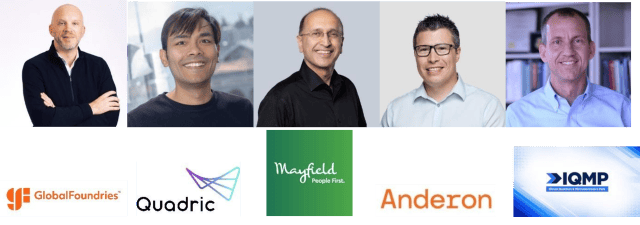
Two names are worth knowing before you judge how serious the day is. GlobalFoundries CEO Tim Breen delivers the opening keynote, titled “AI Everywhere to Quantum at Scale: Building the Semiconductor Foundation for the Next Era of Computing.” A panel then follows, moderated by Veerbhan Kheterpal, Ph.D., CEO and co-founder of Quadric AI; on stage with Tim he is joined by Navin Chaddha, managing partner at Mayfield, Dan Dechene, Ph.D., head of foundry operations at Anderon, and Harley Johnson, Ph.D., CEO of the Illinois Quantum & Microelectronics Park (IQMP).
Reader's note: Veerbhan's panel is the fastest way for a non-specialist to hear whether “machine autonomy” is being discussed as a product feature or as a governance problem — the exact distinction on which the Clarke argument turns. The 2026 forum is open to the public, and Silicon Catalyst expects a full house at the Computer History Museum, so registering early for Nov. 11 is the practical move.
Step 3: Choose the category your evidence actually fits
| What you are deciding | Nobel Prize in Physics | Nobel Prize in Literature |
|---|---|---|
| The one-line claim | He was part of the team that invented a time machine, and used it to travel back from the future to warn about both the potential good and the possible bad of the advances the world now depends on. | He lifted Hari Seldon and “psychohistory” out of Isaac Asimov’s “Foundation” and took them to a new level of public thinking. |
| The strongest artifact | The 1945 relay article and the orbit naming that followed it. | “2001: A Space Odyssey” itself, which forced audiences to price technical breakthroughs against industries, population and the planet’s resources. |
| The counter-question you must answer | Does describing a system, without a laboratory or a fabricated device, count as physics? | Does an award for literature reach a genre that institutions still treat as marginal? |
| What weakens the case | Arguing from prophecy instead of from a published engineering specification. | Arguing from cinematic fame instead of from the thought experiment. |
Nobel Prize in Physics: read him as an engineer who warned first
The physics rationale is the narrower, colder path, and it is the one that survives archival scrutiny: a 1945 paper, a named orbital belt, a communications industry built on the geometry he described. Presenting him as a time traveller who returned with a warning is rhetoric; the relay paper is the receipt.
Nobel Prize in Literature: the moral arithmetic
The literature rationale is the broader path. Where Isaac Asimov’s “Foundation” invented “psychohistory” as a way of modelling civilisations in aggregate, Sir Arthur converted the same anxiety into a visual and narrative argument that ordinary audiences could interrogate: what does a breakthrough cost the world’s population, and what does it cost the planet’s resources?
Step 4: Two pictures beat two thousand words
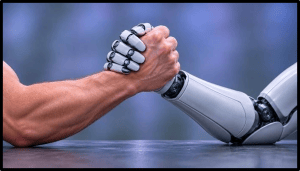
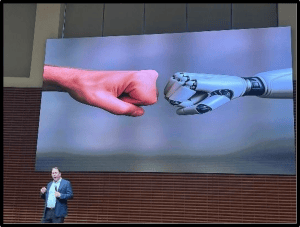
If the key messages of Sir Arthur’s movie had to be summarised visually, these two images are a fair starting point. The fist-pumping picture comes from an impactful keynote delivered by retired Lt. Gen. Jack Shanahan, the inaugural director of the Joint Artificial Intelligence Center in the Office of the Department of Defense Chief Information Officer at the Pentagon. That address opened Stanford’s Hacking for Defense “Lessons Learned and Final Presentations” event, which the original commentator attended this past April, and Shanahan’s gesture conveys the supportive reading of AI: leverage, assistance, scale.
The second picture was commissioned rather than captured. Asked to generate an alternative viewpoint, ChatGPT returned something closer to a wrestling match — the current struggle to rein in AI-based innovations. Optimism and brake, side by side: that pairing is the whole argument in visual form, and it is why a warning issued in 1968 still reads as current affairs.
Step 5: Four misconceptions that weaken a case like this
- “A petition will reach the committee.” It will not. Only qualified nominators — academics in the relevant field, previous laureates, past committee members — may submit names, and the window closes at the end of January of each prize year (nobelprize.org). Public campaigns matter because they build the record a qualified nominator can cite, not because they are themselves nominations.
- “Posthumous honours are routine.” They are the exception. Since 1974 the Statutes of the Nobel Foundation have barred posthumous awards, with a narrow allowance when a laureate dies after announcement but before the ceremony. Clarke died in 2008, so the honest version of this campaign is a public reckoning with his ideas, not a medal.
- “Nominations are public anyway.” No: the names of nominators and candidates stay sealed for 50 years. Anything written down and dated today is the only visible trace the argument will leave.
- “2001 is a period piece.” The machine-control premise is now an engineering and policy topic; the clock of the debate runs away from the release year, not back toward it.
FAQ: what general readers ask first
Is this really about an award, or about a warning?
About the warning. The prize is the vehicle; the point is that an institution would formally recognise foresight as work — someone who described satellite coverage in 1945 and the autonomy risk in 1968.
Which category should a newcomer argue?
Start with the literature rationale, because the artifact is a film most readers can watch in an evening. Move to the Nobel Prize in Physics framing only if you can cite the 1945 paper.
Do I need a semiconductor background to use the 2026 forum as evidence?
No. The programme is open to the public on Nov. 11, and its three themes — AI, quantum and space — are the same three threads Sir Arthur pulled on.
Why does the 1968 number matter to an ordinary reader?
Because a starting point of 8,000 nm and a market worth roughly $14.5 billion in 2026 dollars makes the scale of today’s dependency legible: an industry that small, at that coarseness, now sits inside nearly every object in the room.
What is the single most checkable claim in this article?
The existence of the 1945 Wireless World article, archived by the Clarke institute and summarised by the ITU. If that document holds, the engineering half of the case holds with it.
Action list before Nov. 11, 2026
- Read the primary source once: “Extra-Terrestrial Relays”, Wireless World, October 1945.
- Write a rationale of 150 words and tag it explicitly to either the Nobel Prize in Physics or the Nobel Prize in Literature argument; untagged praise is unusable.
- Attach three dated facts — the 1945 paper, the 1968 film at an 8,000 nm baseline, and the 2026 agenda — rather than adjectives.
- Look for one qualified nominator in your network instead of a thousand supporters, and send the rationale to that person.
- Cite one attributed line from the Semiconductor Industry Forum panel on Nov. 11 rather than paraphrasing the whole day.
- Publish your reasoning somewhere dated, since nominations themselves remain sealed for decades.
Net, net: the ask is deliberately narrow. Anyone with a route into the Nobel Prize Nominating Committee is invited to pass this commentary along, dated and sourced. Anyone whose route runs to the museum instead will find that Silicon Catalyst looks forward to seeing attendees at this year’s Semiconductor Industry Forum on Nov. 11 — and that the discussion on that stage is, in the end, the one Sir Arthur started.
By James Hartley, IT Insights · contact@itinsights.com