
Volkswagen's Two-Track Tech Bet in Numbers: S32K5, VEGA, and a Test Clock That Drops From 3 Days to Hours
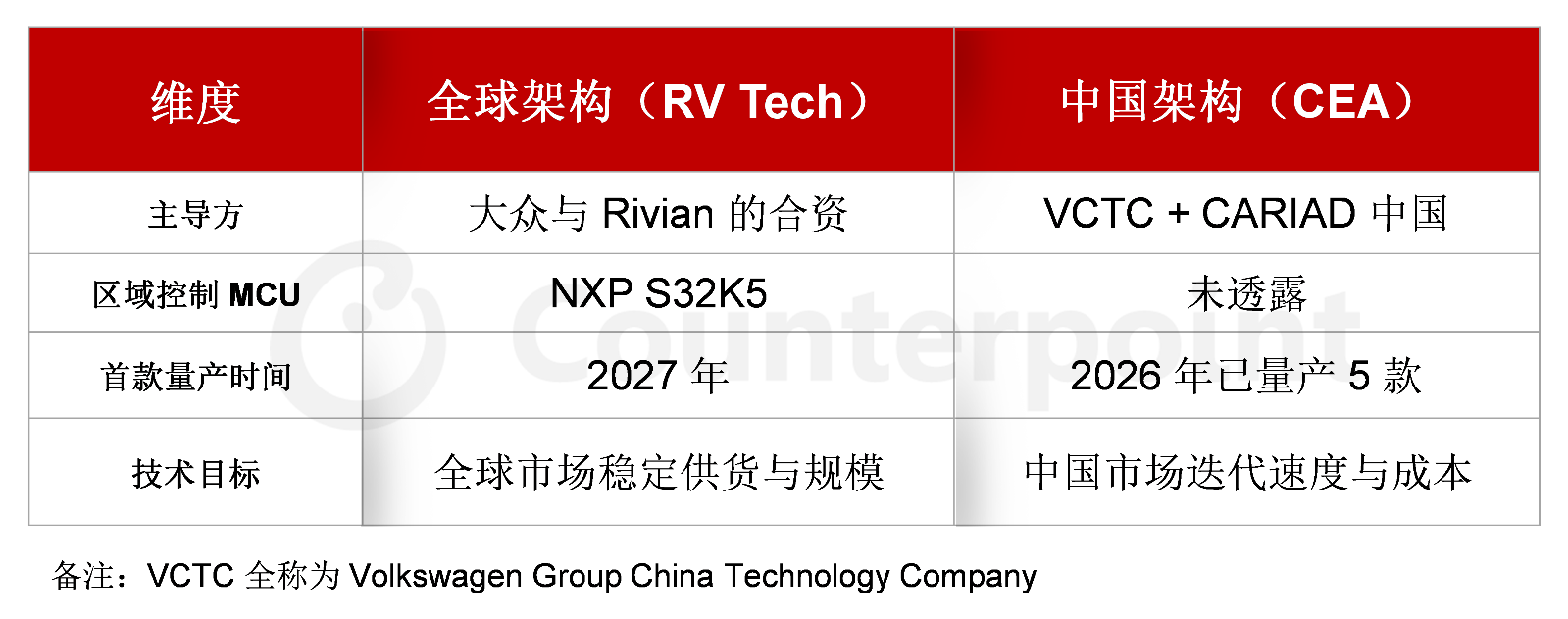
Conclusion first: Volkswagen is not settling on one technology stack. On October 26, NXP and Volkswagen Group announced a strategic partnership in which the S32K5 microcontroller family was selected as the building block for zone control modules, to be used across multiple brands and models, with the first vehicle carrying the technology planned for 2027. Two days later, Volkswagen staged its first Tech Day in China and presented VEGA, a locally built technology system covering three areas: vehicle platforms, the electronic/electrical (E/E) architecture and advanced driver assistance systems (ADAS). Read together, the announcements look less like a contradiction than like a budget decision — scale and stability on the global side, development speed and market fit on the China side.
Counterpoint Research frames the same tension from the analyst's chair: the two decisions appear inconsistent on the surface, but jointly they show Volkswagen reallocating global technology leadership. Operating two parallel systems raises the bill for validation testing, supply-chain management and software maintenance, and the company has not said publicly whether the two architectures will eventually merge, or which one would lead.
Six figures that make the strategy legible
- 3 days to 2 to 3 hours: the software functional-test cycle Volkswagen says it compressed with C-Brain, an AI tool chain built on the China E/E architecture CEA.
- 2 weeks to 20 minutes: the reported fall in software fault-diagnosis time, the second number used to argue that the China development loop has changed shape.
- About 30%: the reduction in electronic control unit count that Volkswagen Group attributes to CEA, the architectural reason simplification, faster integration and cost targets appear in the same sentence.
- 2027 / 2028 / 2029: three separate clocks — the first S32K5-based model in 2027, mass production of the CARIZON C7H system-on-chip in 2028, and Counterpoint Research's earliest realistic consumer L3 window in 2029.
- 14.3% and 26%: the year-on-year declines in Volkswagen Group global deliveries (to 1.89 million units) and quarterly operating profit (to €1.2 billion) reported for the third quarter of 2026 — the financial backdrop that makes duplicated engineering spend a hard sell.
Where so-called China speed actually shows up
The headline artefact at Tech Day was not a car but a tool chain. Volkswagen disclosed that C-Brain shortens software functional testing from 3 days to 2 to 3 hours and cuts software problem diagnosis from 2 weeks to 20 minutes. Counterpoint Research cautions that such figures cannot be read straight as an equivalent jump in overall R&D efficiency: a faster test loop does not shorten physical validation, and a zone-based architecture still has to survive cold chambers, hot summers and long road trials. What the numbers do demonstrate, in that reading, is that Volkswagen is stepping away from a model in which every software change waited on a globally unified process.
The cost logic is embedded in the hardware. Volkswagen Group has said CEA lowers electronic control unit counts by roughly 30 per cent versus earlier vehicle generations, and that this simplification is a main lever behind the cost-reduction ambition attached to the Compact Main Platform (CMP), which is expected to deliver more than 600 km of CLTC range on A-segment electric and plug-in hybrid models. Fewer controllers, one architecture shared across powertrain types, and a largely local supplier base: that is where speed and savings are meant to come from.
Who defines the architecture: VCTC, CARIAD China and XPeng
CEA is a pillar of the China technology system, but it was never a clean-room design. In April 2024, Volkswagen and XPeng signed a strategic framework agreement on electronic/electrical architecture, committing to joint development based on XPeng's then-current EEA 3.0. Volkswagen has emphasised that CEA is researched and developed jointly by Volkswagen (China) Technology Co., Ltd. (VCTC), CARIAD China and XPeng. Counterpoint Research describes the outcome as a hybrid: XPeng's E/E know-how merged with Volkswagen's functional-safety and validation discipline, then localised into engineering by the China team.
With XPeng's architecture evolving to EEA 4.0 in 2026, CEA 1.0 faces a continuing upgrade cycle and a generation gap to close. Counterpoint Research's judgement is that which chip generation gets adopted matters less than the transfer of authority: Chinese research teams now hold part of the architecture definition and technology-selection rights rather than merely adapting decisions made in Germany.
Two stacks, two supplier logics
| Dimension | Global stack (NXP S32K5 route) | China stack (VEGA route) |
|---|---|---|
| Stated priority | Scale, stability, cross-brand commonality | Development speed, local market adaptation |
| Zone silicon | S32K5 family, unveiled in March 2025 with a software-defined, hardware-enforced isolation design intended to let automakers build safe and secure partitions for applications up to ASIL-D, extending NXP's CoreRide platform | Supplier of the zone-control microcontroller used in CEA has not been disclosed |
| First product marker | First model planned for 2027, across multiple group brands | CMP-based compact models integrating CEA, later slated for export markets |
| Definition owner | Historically the Germany headquarters | VCTC, CARIAD China and XPeng, with delegated downstream choices |
| Chief unresolved risk | Duplicate validation and maintenance spend | Whether China-developed technology can reach global scale |
The S32K5 detail matters more than it appears. A zone controller is where a zonal architecture lives or dies: it aggregates sensors and actuators, routes time-sensitive network traffic and hosts mixed-criticality workloads. NXP's argument for the family is that isolation is enforced in hardware, so a safety-critical function and a comfort function can share a board without sharing a failure mode. Volkswagen's China operation reaches a comparable zonal topology by a different path — a co-developed architecture whose component sourcing has not yet been published.
Three ADAS silicon routes and one in-house chip
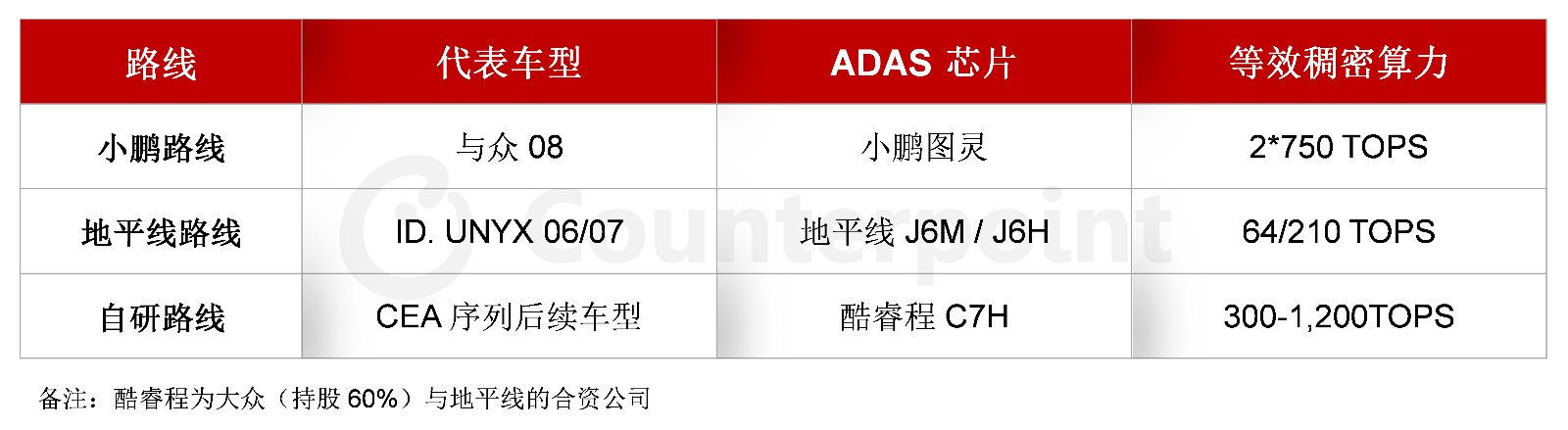
Counterpoint Research counts three ADAS chip technology routes that Volkswagen has laid out in China. One of them runs through CARIZON, the joint venture formed with Horizon Robotics, where a system-on-chip internally designated Nash Architecture and labelled C7H is under development for series production in 2028. The firm notes specifically that C7H is not a chip built on a direct Horizon IP licence; Horizon mainly acts as joint-venture shareholder, provider of AI foundation-model technology and a chip supply-chain partner. That framing lines up with Volkswagen Group China's own engineering communications, which pair CARIZON's proprietary C7H SoC with a GAIA World Model data platform and an AI foundation model rather than describing the chip as a licensed derivative.
For Volkswagen, in-house silicon is partly a dependency-reduction play and partly a margin play, since internal development targets the high-value part of the bill of materials. Counterpoint Research reads this as an industry-wide shift: carmakers are no longer satisfied with buying standardised chips from suppliers and now want greater definition power over the components that determine performance, cost and product differentiation.
L3 is a calendar problem before it is an engineering problem
Volkswagen said at Tech Day that it plans L3-level automated driving technology to be ready in 2027. Counterpoint Research narrowed the interpretation immediately: readiness does not mean the feature will be commercially available to Chinese consumers in 2027. Technical preparation, road-testing permission and market access for private users are different stages, and given the pace of China's autonomous-driving regulation and type approval, the firm expects consumer-facing L3 commercialisation in China to arrive no earlier than 2029.
The rule book reinforces that caution. China's Ministry of Industry and Information Technology granted road approval to two L3-equipped electric sedan models in December 2025, indicating that conditional automation is clearing approval model by model rather than industry-wide. In addition, GB 44721-2026 — the country's first mandatory national safety standard for L3 and L4 automated driving systems, published on 30 July 2026 and applicable from 1 July 2027 — resets testing and lifecycle-safety duties almost exactly when Volkswagen's own target year begins. A sensible read is that 2027 is when the compliance environment forms, which is why a later launch date is the conservative expectation.
Why the urgency looks new
Volume data explains the timing. Volkswagen Group's global deliveries fell 14.3 per cent year on year in the third quarter of 2026 to 1.89 million units, with China carrying the steepest weakness, and the group reported quarterly operating profit down 26 per cent to €1.2 billion, blaming falling volumes in China and North America. Against that backdrop, paying twice for validation, supply chains and software upkeep is a deliberate choice rather than an oversight: management appears willing to absorb duplicate engineering cost if the China loop converts into shorter product cycles before the sales slide flattens.
From China to South America, Africa and Southeast Asia
Volkswagen also plans to apply the China-developed system in more overseas markets, including extending the CMP platform with its integrated CEA architecture to regions such as South America, Africa and Southeast Asia. Coverage of the Tech Day adds sequencing: South America is expected to be the first region to localise CMP and CEA in locally built vehicles before 2030, while Volkswagen has set an ambition to export at least 300,000 China-built cars a year by 2030. Counterpoint Research sees the move as exploiting the China research system's advantages in cost control and development efficiency to serve emerging-market demand. The open variable is silicon: because the zone-control microcontroller supplier for CEA has not been made public, whether Chinese chipmakers eventually join Volkswagen's global product system remains an unanswered question.
Five ways this story gets misread
- One architecture will swallow the other. Counterpoint Research leaves both outcomes open: whether the two stacks converge, and which leads, is undecided.
- A test cycle cut from 3 days to 2 to 3 hours means the whole car is developed that much faster. Tool-chain speed and physical validation run on different clocks.
- Technology ready in 2027 means buying the feature in 2027. Preparation, permits and private-user market access are separate gates; 2029 is the earlier bound in the firm's estimate.
- C7H is a rebadged Horizon part. It is described as proprietary to CARIZON, with Horizon participating as shareholder, foundation-model provider and supply-chain partner.
- VEGA is just a component catalogue. Its significance is delegated definition rights over platforms, architecture and intelligent-driving development.
What to watch next: a practical checklist
- Follow the component list, not the press release. The first export model on CEA that discloses its zone-controller silicon will show whether Chinese semiconductor vendors enter Volkswagen's global supply chain.
- Watch the three cost lines. Validation testing, supply-chain management and software maintenance are where the two-stack premium surfaces first in group reporting.
- Read L3 claims against dates. With the new national standard applying from 1 July 2027, features marketed as ready that year still face an approval phase before private users can rely on them.
- Compare architectures when shopping. CEA-linked CMP products and globally defined platforms differ in software update cadence and driver-assistance supplier, not only in price.
- Track where authority sits. VCTC, CARIAD China and CARIZON now influence architecture and chip choices that were previously steered from Germany — a signal for hiring, sourcing and partnership decisions.
Frequently asked questions
Did Volkswagen pick NXP over its China partners?
No. The S32K5 selection concerns the group's software-defined vehicle zone architecture, while VEGA and CEA concern the China product cycle. Counterpoint Research reads the pair of moves as a reallocation of research leadership, not a substitution of one supplier camp for another.
What exactly does VEGA cover?
It is Volkswagen's first locally developed integrated technology system in China, spanning vehicle platforms, the electronic/electrical architecture and ADAS — the three areas the company listed at Tech Day.
Is CEA developed entirely by Volkswagen in China?
Not fully. Volkswagen states that CEA is jointly developed by VCTC, CARIAD China and XPeng, building on a framework agreement signed in April 2024 around XPeng's EEA 3.0, with further upgrades required as XPeng moves to EEA 4.0 in 2026.
Why does the 2029 estimate matter if Volkswagen says 2027?
Because the two statements measure different things: engineering readiness versus the ability to sell a function to private owners. Licensing, insurance and national safety rules sit between them, which is why Counterpoint Research cites 2029 as the earliest likely commercial date.
Does this affect buyers outside China?
Eventually, yes. The first model using the S32K5-based zone architecture is planned for 2027, and Volkswagen intends to carry CMP plus CEA into South America, Africa and Southeast Asia, with South America expected to localise the stack before 2030.
The most useful way to file this away is as a governance story told in numbers: a software test measured in hours, diagnosis cut to 20 minutes, an ECU count down by around 30 per cent, an in-house chip with a 2028 date, an L3 milestone that is really a 2029 market event, and a delivery decline that forced the experiment to start now. Volkswagen is keeping both stacks because each optimises a different variable, and because the group has decided it does not have to choose before the products ship. For anyone tracking how cars are engineered, the telling detail is not the NXP deal or VEGA on its own — it is that announcements made two days apart now imply two supply chains, two validation regimes and two definitions of finished.