
ItInsightsWorld Guide: Vibe vs Vibe Marketing in 2025, Compared by Risk, Cost, and Fit
The useful answer is simple: in 2025, Vibe is less a productivity promise than a risk-sharing choice. It is best for rapid prototypes, curiosity loops, and audience tests where a human can judge taste and failure. It is weakest when a non-engineer turns a fast draft into a production system without review. For ordinary readers, the question is not whether to join the trend, but which tasks are safe to automate first.
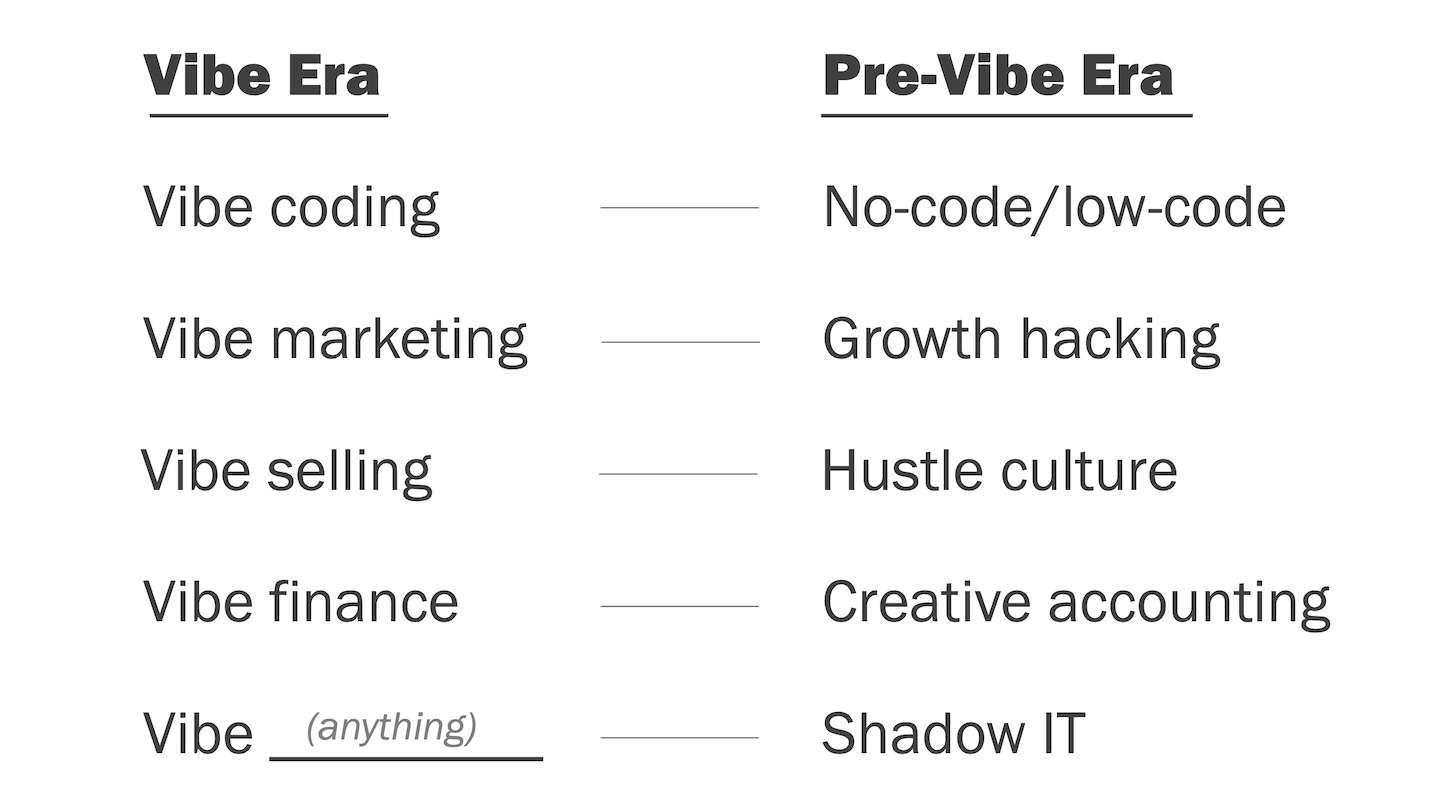
After 1967’s Summer of Love, cultural energy often moves in waves. The latest commercial echo is the word Vibe, which now travels faster than product roadmaps. It is easy to mock: the term “Vibe” has outpaced “agentic,” and both can be stretched until they mean almost anything. Yet the underlying behavior is real: people are using large language models to make things quickly, then decide what to keep.
Andrej Karpathy, one of OpenAI’s original co-founders, gave the phrase its first serious frame in a February 2, 2025 post. He used vibe coding to describe quickly making software by talking with an LLM-powered coding assistant. His own summary was refreshingly casual:
I just see stuff, say stuff, run stuff, and copy paste stuff, and it mostly works.
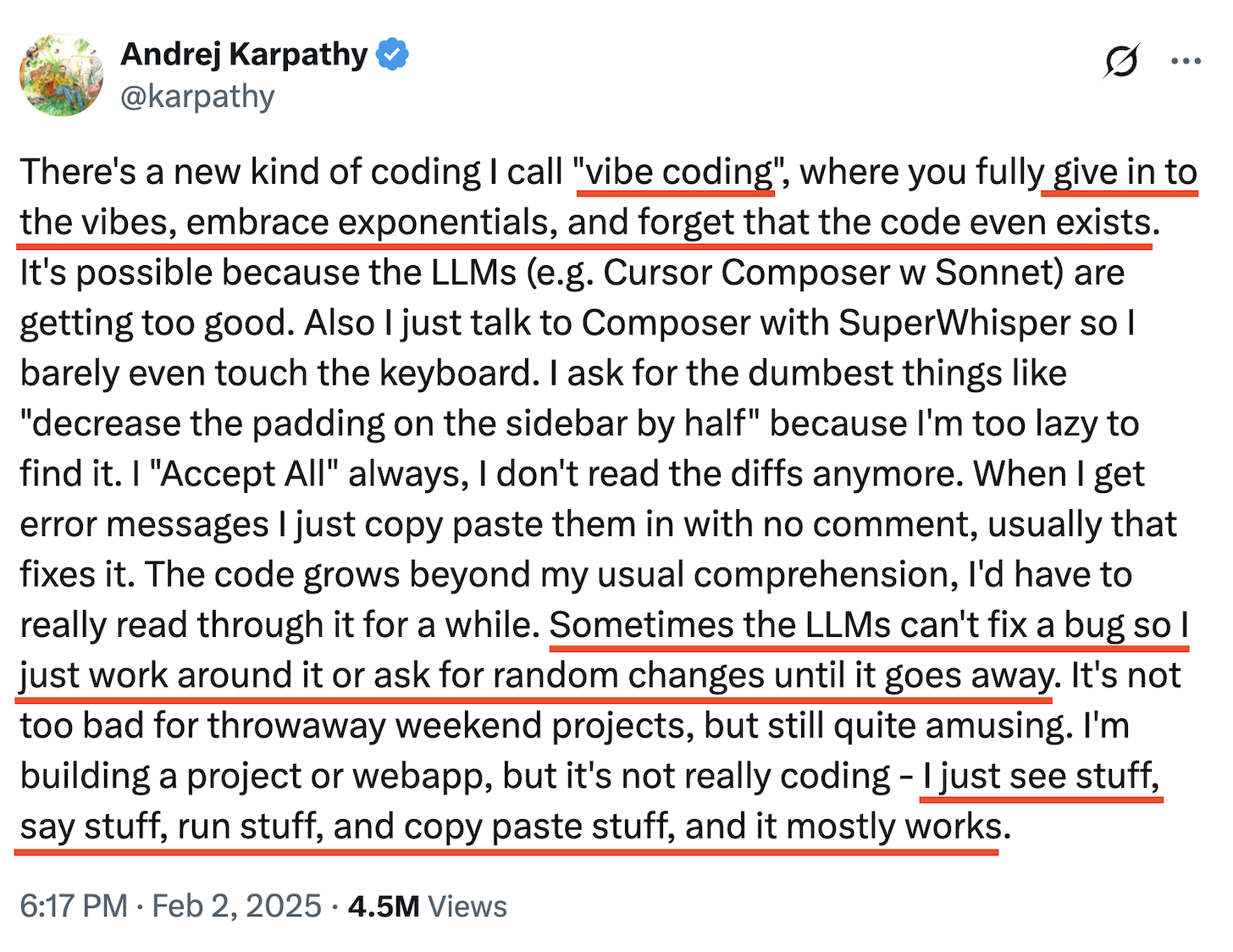
Andrej is not a hobbyist waving away engineering; he is a world-class computer scientist. That is why the method unsettles people: if someone who can write code chooses to let the model carry the syntax, the old objections about craft change shape. No-code critics have long warned that non-engineers should not ship apps. They would dislike a bug-fixing method that appears to just work around it or ask for random changes until it goes away. Still, the cultural memory of the 60’s slogan Power to the people helps explain why this feels exciting: access to creation tools is moving outward.
The word also sounds like a strange fusion of 1960’s counterculture and 2020’s techno-optimism. I am not implying that recreational drugs are involved, but non-Haribo gummies beside a keyboard would not surprise me.
Over recent months, vibe coding has spread rapidly. Jason Lemkin of SaaStr recently joined the trend, spending 100+ hours vibe coding an app with Replit as a non-engineer, though the results were mixed. He shared the highs and lows along the way in a series of LinkedIn posts.
Afterwards, he wrote about which apps make sense for non-engineers to vibe code, from safe “green light” apps such as internal dashboards or personal workflows to here-be-dragons “red light” apps, such as trying to rebuild Salesforce from the ground up.
I turned his examples into a visual continuum I call the Lemkin Scale of Vibe Coding, ranging from 1 viable vibing to 10 unviable vibing. Do not read too much precision into this scale. It is only a loose way to approximate the challenge a non-engineer would face when trying to vibe code a particular app. It is comparable to a doctor asking how much pain you are feeling on a 1-10 scale. “Depends, doc. Ask me again after I see how much my insurance actually covers.”
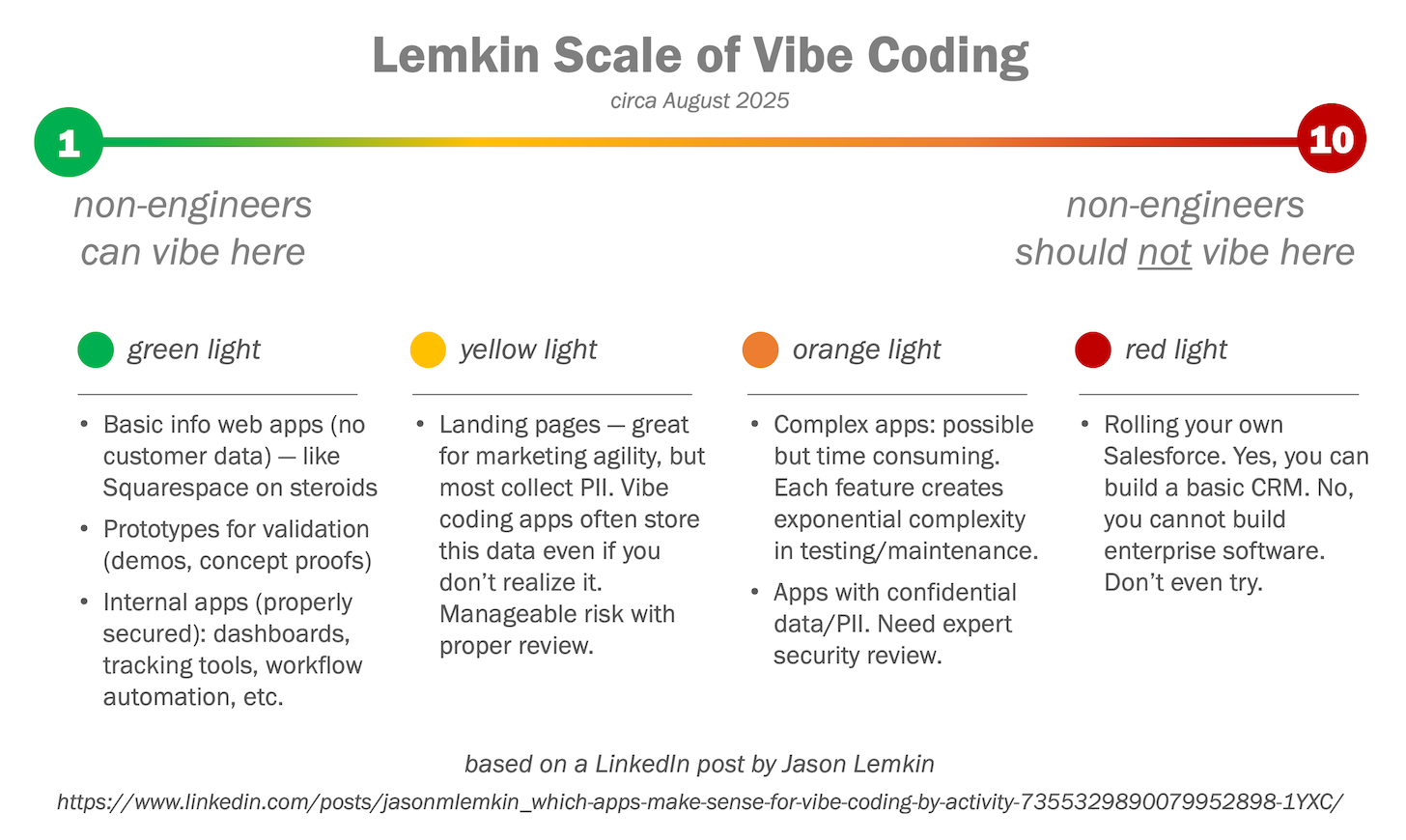
Of course, the examples along this spectrum are only a snapshot of what is easy or hard today. As these AI tools continue improving at an impressive clip, more advanced app building can be expected to shift left toward the green side over time. A “7” today might be a “3” in a year from now.
Why comparison matters: speed, security, and skill
For a general reader, this is where the comparison starts to matter. The same speed that creates a working demo can also expose a bad deployment path. Wiz Research reported in September 2025 that one in five vibe-coded applications it reviewed had serious security vulnerabilities or configuration errors, based on a scan of more than 5,600 deployed apps. That does not mean every prototype is dangerous; it means the risk rises when the prototype leaves the builder’s control.
The low-code baseline also matters. Gartner projected the low-code development technologies market at $58.2 billion by 2029 with a 14.1% compound annual growth rate, which suggests that AI-adjacent building is not a temporary mood but part of a longer software-access shift. For ItInsightsWorld readers, the practical question is therefore comparative: where does speed create enough value to pay for review, and where does it simply move work to a less visible place?
What is Vibe Marketing? A comparison, not a slogan
With vibe coding sweeping social media and attracting so much attention and affection — the startup that achieved the fastest growth to $100 million ARR, in just 8 months since November 2024, is a vibe coding platform literally called Lovable — marketers quickly jumped onto vibe marketing.
Greg Isenberg seems to have coined the phrase first. Greg framed Vibe Marketing as a combination of vibe coding with AI agents and workflows that lets individual marketers accomplish things that once required a whole team of specialists. They can move faster, ship more ideas at a fraction of the cost, and easily build or customize tools and systems tailored to their specific needs. Vibe marketers are übermarketers. Even if they do not work at Uber.
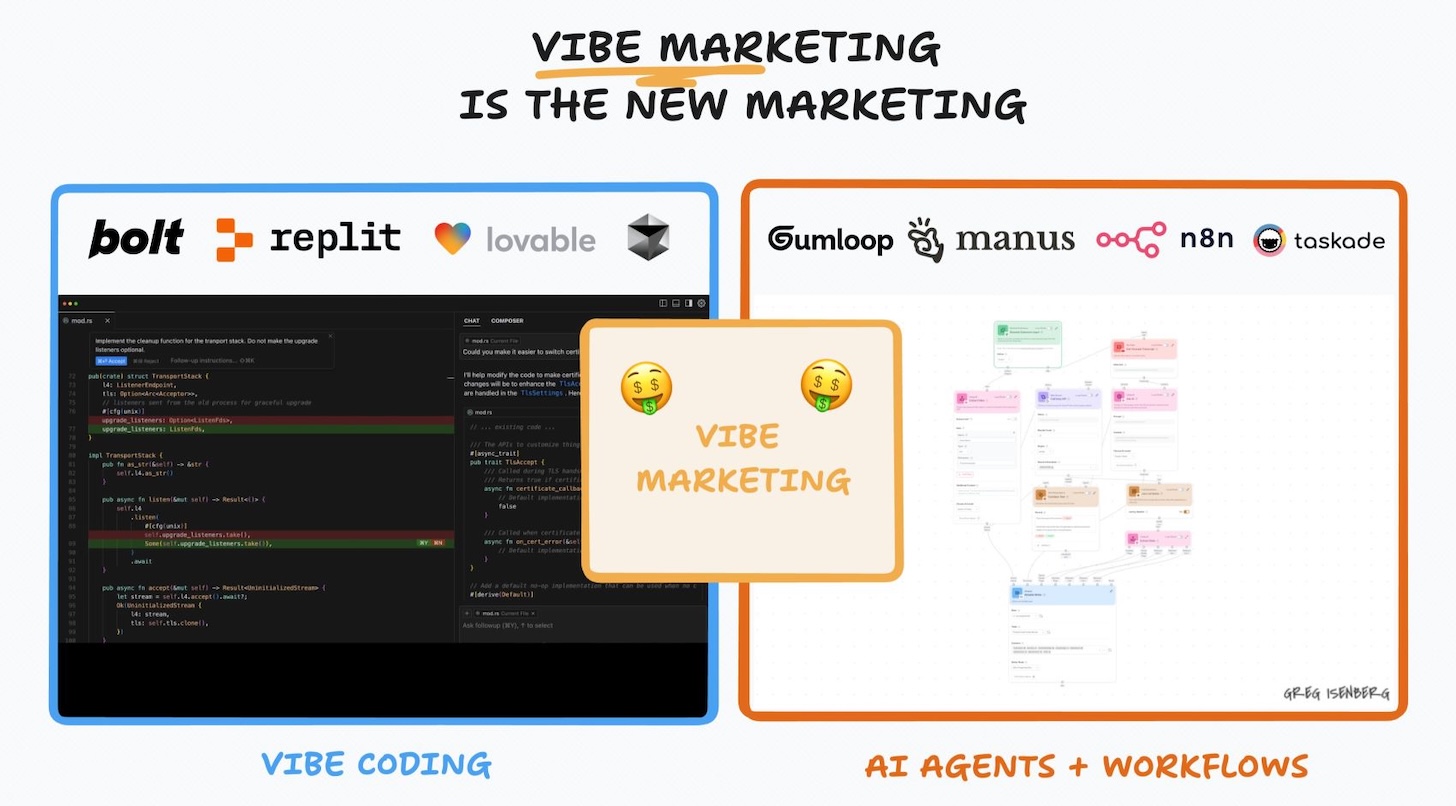
As an aside, this is a cliché marketing move: if Vibe is cool, and agentic, is cool, then something that is both vibe and agentic has to be even more cool, right?
If vibe coding is the next generation of no-code/low-code, this definition of Vibe Marketing seems like the next generation of growth hacking. Some people call this the work of GTM engineers. But the label matters less than the trade-off: production agents, apps, and automations are useful, but they feel more like a marketing operating system than a vibe. You want that system to be fluid, adaptable, structured, reliable, and governed.
Vibe vs Vibe Marketing: a side-by-side trade-off view
| Dimension | Vibe coding for builders | Vibe Marketing for campaigns | General decision |
|---|---|---|---|
| Primary value | Turn curiosity into a working interface fast | Turn a hypothesis into a testable message fast | Choose where speed saves hours, not where it hides risk |
| Good fit | internal dashboards, personal workflows, small tools | micro-campaigns, creative variants, audience segments | start with low-blast-radius tasks |
| Risk | security gaps, fragile architecture, technical debt | generic copy, fatigue, privacy missteps | require human review before anything becomes production |
| Scale signal | more than 50 users or any payment, login, customer data | outbound email, paid media, regulated claims | move to red light review |
| Measurement | does it work and stay fixed after changes | does the audience respond better than before | compare experiments, not tools alone |
The phrase agentic, alone does not solve these questions. It merely promises that software can act, while the reader still needs to decide who checks the action.
What should it actually mean for marketers?
My interpretation is that Andrej’s good vibrations with vibe coding came from the freedom to think less about code and more about indulging one’s imagination to bring new ideas to life, even as imperfect prototypes. The “vibe” is human creativity unleashed. That is the vibe marketers should embrace.
Better yet, marketers should become the market whisperers and customer whisperers who try to tune into the vibes of their audience. If vibe coding delights developers — they are the ones feeling the vibes — vibe marketing should focus on delighting customers.
Automated content generation. Automated outbound emails. Automated data scraping. These are useful AI-powered capabilities that marketers can and probably should implement in their operating system. But the mechanics are not the vibe. The real question is how prospects on the receiving end of that machinery feel about it. Are they humming The Beach Boys’ Good Vibrations or Monty Python’s Spam, Spam, Spam?
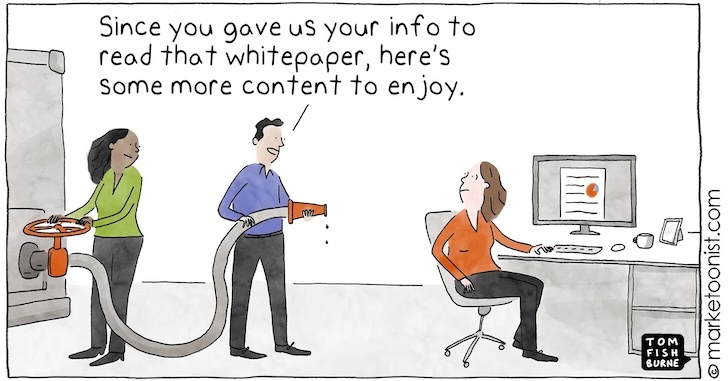
McKinsey’s personalization research provides a useful counterweight to that joke. It found that 71% of consumers expected companies to deliver personalized interactions, and 76% grew frustrated when they did not. In other words, audiences do not dislike automation by reflex; they dislike irrelevant, noisy, or unexplained automation. The difference is editorial: relevance, consent, and a human sense of timing.
Experimentation is the real vibe, not automation for its own sake
Curious about a customer pattern? Use AI to mine your data lakes and warehouses for answers that previously would have required an analyst or data scientist — a barrier high enough that most questions popping into your head were not worth pursuing. But now? Let those “I wonder…” curiosity vibes flow.
Do those answers lead to a hypothesis? Compose a micro-campaign, using AI to develop the creative — which can have more ambitious, app-like, multimodal, and dynamic concepts than were ever previously in reach for an individual marketer to whip up solo — segment a test population, deploy, monitor, and measure against your hypothesis. Most experiments should be quick, cheap, and low-risk. Iterate the promising ideas. Scale the proven ones. Jettison the duds.
Which experiments vibe with your audience? Those get promoted from vibe-land to a more polished production plateau.
If Big Data was about harnessing the volume, velocity, and variety of data, Vibe Marketing is about Big Experimentation — harnessing the volume, velocity, and variety of marketing experiments to out-innovate your competition.
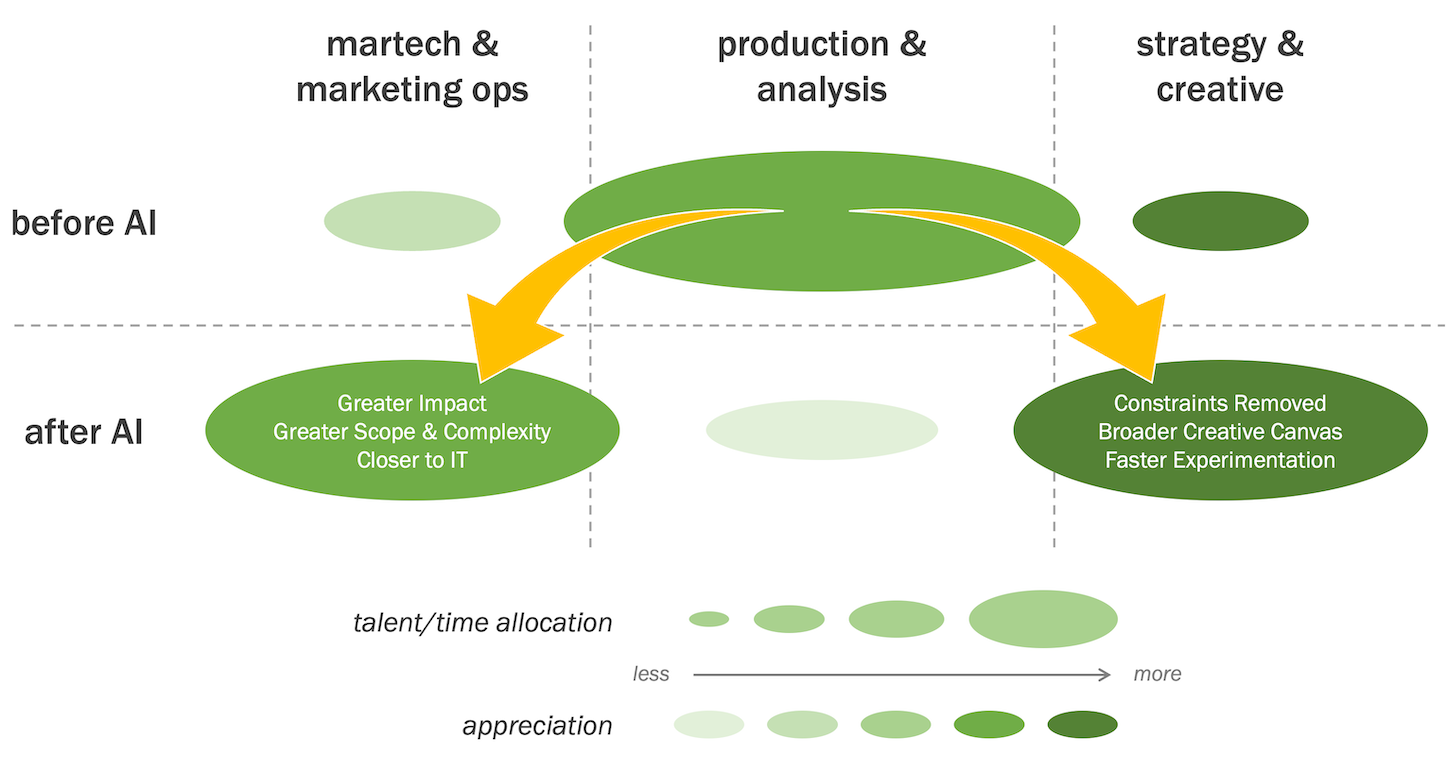
Yes, guardrails are needed: proper permission management for data, compliant respect for customer privacy and preferences, and adherence to brand standards. But this is increasingly manageable with professional AI martech tools. One of the greatest contributions marketing operations teams can make in this environment is setting up the scaffolding and safety nets for the rest of the marketing team to vibe more ideas to life.
Common misconceptions to retire before you ship
- Vibe means no skill is needed. It does not. It changes the skill: judgment, testing, review, and audience sense become more visible.
- If it mostly works, it can run forever. A short-term demo and a long-term system are different promises.
- Faster output equals better marketing. Speed only helps when the receiver feels the result is relevant.
- Non-engineers should never touch software. The better rule is: non-engineers should not own production risk without support.
- Vibe Marketing is just automated spam with a trendy name. That happens when teams optimize mechanics instead of customer response.
Action checklist: what to do this week
- Pick one internal workflow you can test as a green light project, such as a small tracker or reporting aid.
- Define the red light boundary now: payments, customer authentication, regulated claims, personal data, and anything facing external scale.
- Time-box the trial: one day for prototype, one day for peer review, one day for decision. Do not let a fun build become a quiet support burden.
- For campaigns, run one small test against an existing control group, then evaluate whether the customer response improved.
- Ask a human to read the copy and click through the interface, because the user’s feeling is the final benchmark.
FAQ: Vibe, Vibe Marketing, and practical judgment
Is vibe coding only for developers?
No. It is also for non-engineers building small tools. The question is whether the project stays personal or internal, or whether it starts handling customer data, money, login, or public traffic.
Why does Vibe Marketing sound weaker than vibe coding?
Because marketing has an external audience. Code can fail quietly in a browser; a campaign can annoy thousands of people at once. The feedback loop is social, not merely technical.
What is the safest first project?
An internal workflow or personal dashboard that does not touch private customer information. If it helps you make decisions and can be thrown away without damage, it is a strong candidate.
When should a non-engineer stop and ask for help?
Before anything goes public, asks for passwords, stores records, spends money, or becomes a system that others depend on. Those are review points, not optional polish.
Will the Vibe label last?
The label probably will not. The creative power of experimentation enabled by AI-empowered builders and marketers is likely to continue growing, whatever name sticks.
The verdict: treat vibe as a decision, not an identity
The verdict is not to reject the vibe or worship it. Treat Vibe as a decision style: use it where curiosity, iteration, and human judgment can absorb risk; move cautiously where data, trust, and public experience are involved. The language may fade after this 2025 Summer of Vibes, but the useful habit will remain: build cheaply, test honestly, listen closely, and ship only what deserves production.
For questions about this ItInsightsWorld guide, contact contact@itinsights.com.
By James Hartley