
UK Energy Bills 2026: A 5-Step Practical Checklist Before the January 2027 Jump
By James Hartley, ItInsightsWorld (IT Insights)
Conclusion first: what has actually changed in your bill
If your direct debit has quietly outgrown your patience, the arithmetic behind it is finally on the record. In October 2026 the UK price cap reached £1,723 a year for a typical dual-fuel home, up £60 in a single step and 47% higher in real terms than in October 2020 — levels not seen since 2022, the year the UK government committed more than £60bn to supporting consumers after Russia’s invasion of Ukraine. A further jump of roughly 25% now looks close to certain under the cap for January 2027, which would drive a typical annual bill towards £2,200.
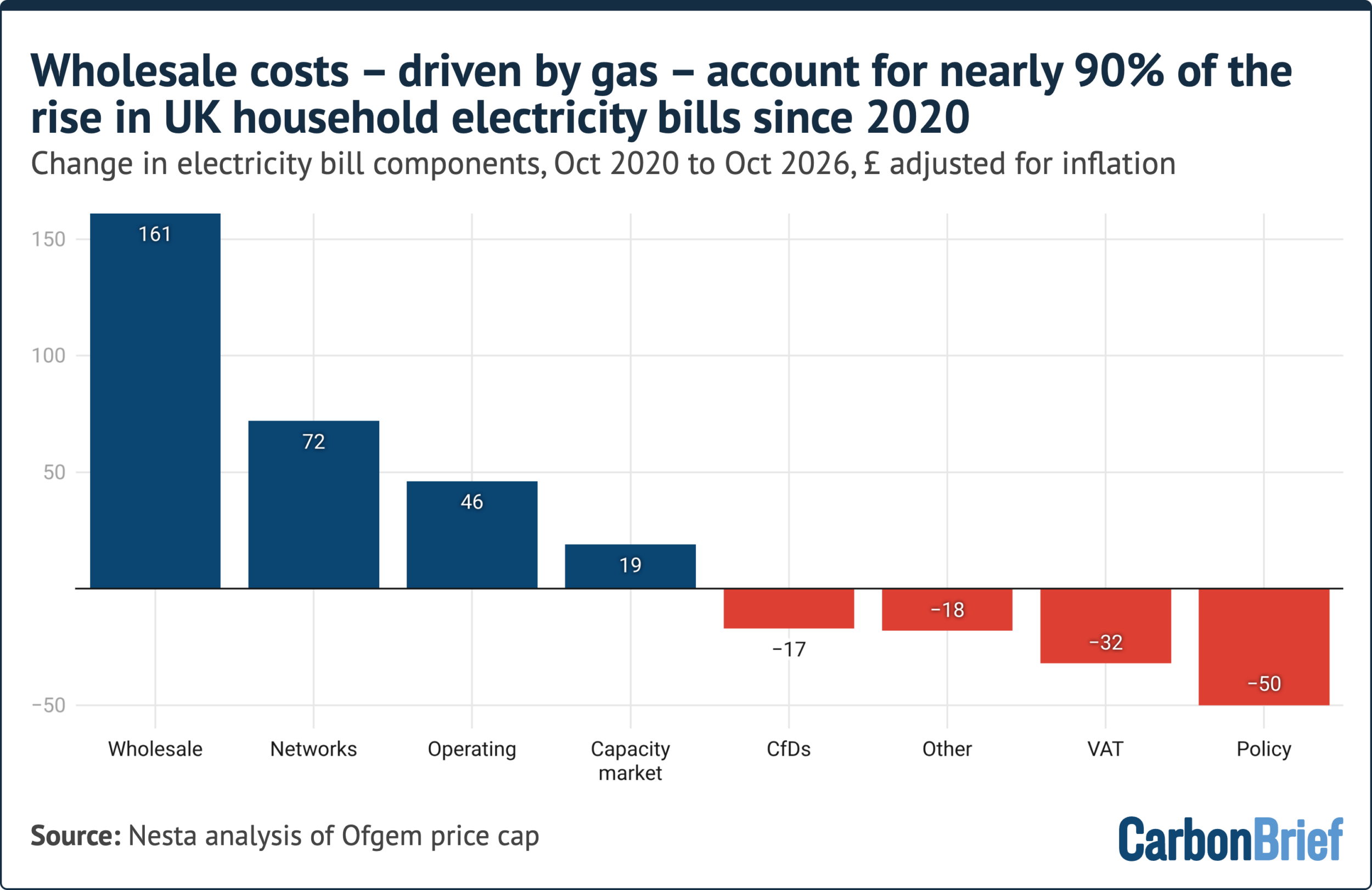
Three facts cut through most of the argument. First, expensive gas — not environmental levies — explains more than 80% of the rise in dual-fuel household bills since 2020, on Nesta analysis published by Carbon Brief. Second, the trigger was geopolitical: high gas prices driven by the Iran war, an exposure that the thinktank ECIU, with E3G, has costed at about £183bn of direct economic damage from the UK’s dependence on fossil fuels over the past four years. Third, the remedies conflict: continue the clean-energy transition to get off the “fossil-fuel rollercoaster”, slow down, or abandon climate goals in favour of more gas.
Treat what follows as a working checklist rather than an opinion column. It shows how to sort your money into four piles, which reliefs already apply to you, what is still movable at the budget on 28 October, and what to do in the next 90 days.
Step 1: split your bill into four piles before you argue about the total
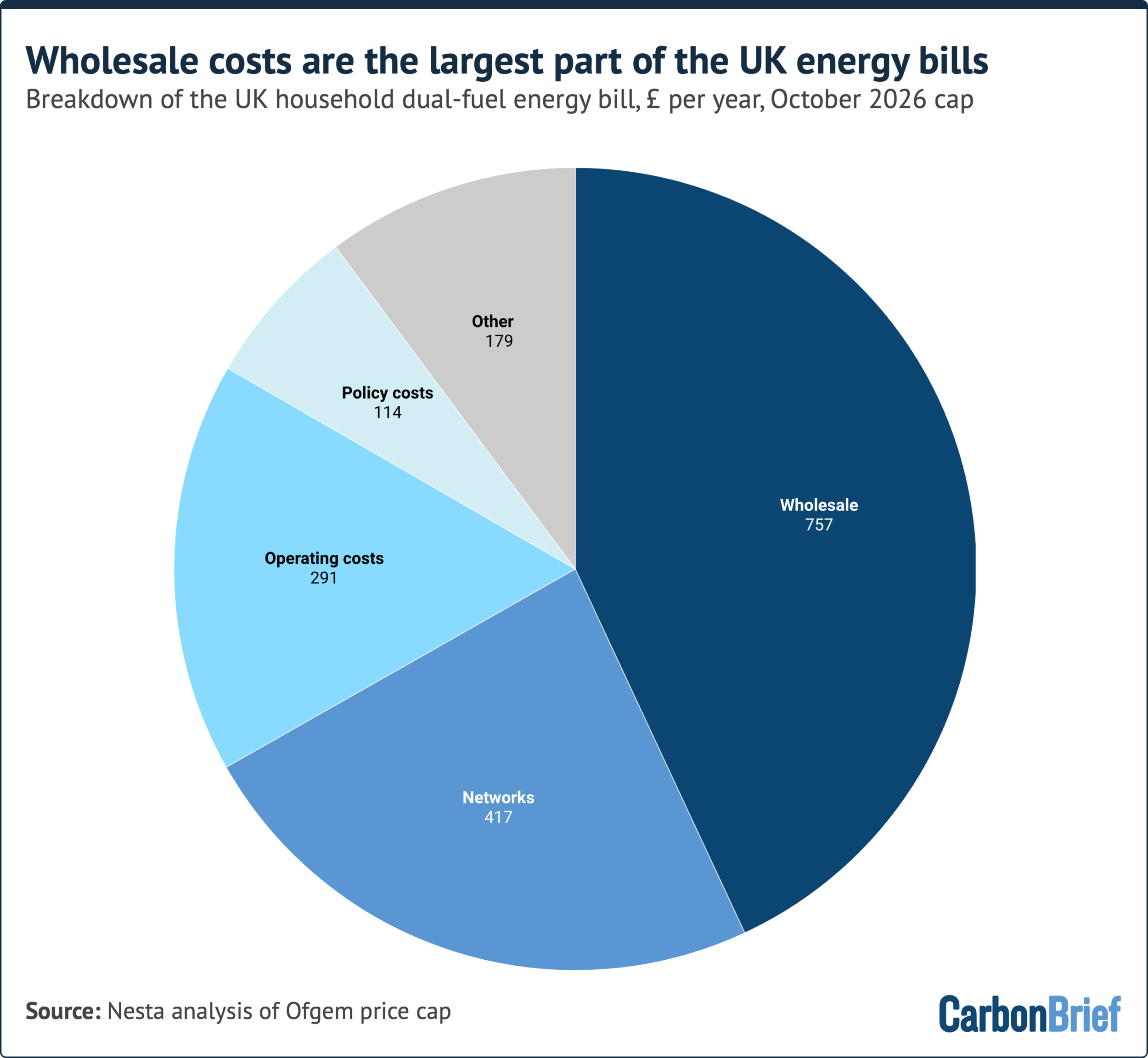
Carbon Brief’s reading of the £1,723 cap, built from figures released by the thinktank Nesta, breaks the typical household bill into four blocks.
| Cost block | Share of the £1,723 cap | Can a household act on it? |
|---|---|---|
| Wholesale gas and electricity | 44% | Only indirectly — through demand, timing and technology choice |
| Network charges | 24% | Little direct control; varies by region and meter type |
| Operating costs (including bad debt) | 17% | Partly — payment method, accurate readings, arrears help |
| Policy costs | 7% | Politically movable, but not the cause of this year’s rise |
Because the UK, like most other countries, runs power markets on marginal pricing, the wholesale cost of both electricity and gas is tied to gas prices. That single mechanism is why a conflict far away lands on your kitchen table.
Everything outside the wholesale block is often grouped as “non-commodity costs”, and it has grown, chiefly because of network investment. Yet none of it is what pushed bills up again in recent months. Two takeaways: don’t wait for levy changes to shrink the biggest block, and remember that the remaining 48% is the part government can rearrange.
Step 2: separate locked-in costs from contested ones
Industrial users face high costs too, especially for electricity, but the household picture is dominated by two streams: wholesale gas, and the money now being sunk into pipes and cables.
At the end of 2025 the energy regulator Ofgem approved £29bn of upfront investment in the national gas and electricity grids and the gas distribution network that reaches homes and businesses, part of a wider package of up to around £90bn out to 2031. As a result, network charges are expected to climb around 50% between 2025 and 2030, from £222 to £330 a year for a typical dual-fuel household. That figure covers gas and electricity transmission plus gas distribution, but not electricity distribution; a further investment package for 2028-2033 is due to be approved by Ofgem by the end of 2027.
Tim Jarvis, the head of Ofgem, described the package at a recent conference attended by Carbon Brief as a “once-in-a-generation renewal of our energy infrastructure”. The regulator attributes roughly three-fifths of the £108 per household per year rise in network charges to 2030 to “business-as-usual” items such as ongoing maintenance, and only £30 to expanding the electricity transmission grid. The Energy Networks Association makes a similar point: up to 80% of investment in electricity grids is needed just to maintain existing assets.
Household checklist for this step:
- Identify which of the four piles you can influence before comparing suppliers — switching cannot change wholesale gas prices, only your exposure to them.
- Expect standing charges, not unit rates, to carry part of the network increase; Ofgem publishes regional standing-charge tables because these differ sharply by postcode.
- Watch the electricity distribution decision due by the end of 2027 — it is the next tranche of network cost not yet counted in the £222 to £330 rise.
Two charges that are smaller than the commentary suggests
“Constraint costs” — windfarms switched off when the network cannot carry their output, with gas plants fired up instead — sit inside network balancing charges. They have risen steeply, partly because of high gas prices, but still amount to just £35, or 4% of a typical annual electricity bill. Much of today’s squeeze reflects the 2010s decision to defer grid spending under a policy known as “connect and manage”; Ofgem says the grid investment it has now approved would limit constraints in future.
Steven Agnew, head of policy at trade association RenewableUK, points to a National Audit Office review and calls investment in the grid “critical to avoid large rises in consumers’ bills as more of the country’s electricity is generated from clean sources”. He adds: “The current crunch is the result of inaction by successive previous governments to tackle this issue. Consumers are losing out on some of the benefits because low-cost wind has to be turned down and expensive gas turned up elsewhere.”
Projections from the National Energy System Operator (Neso) show how sensitive this is to sequencing: balancing costs could rise from £2bn to £8bn by 2030 if the grid faces delays, while its central projection is £3-4bn, with options available to contain it.
The second under-appreciated line is “bad debt” — unpaid bills recovered by suppliers through a charge on everyone. Carbon Brief’s analysis of Ofgem data puts it at around £60 on a typical bill, an increase of roughly £40 since 2020 and more than half of the rise in “operating costs”. Trade association Energy UK warns rising debt could add another £10-15 by next year. If you have been billed on estimates, this is the pile where accuracy saves money: Citizens Advice notes that the gap between estimated and actual readings compounds over time, so submit readings monthly.
Step 3: take stock of the relief already granted — and why you cannot feel it
The Labour government was elected in 2024 on a pledge to cut bills by £300 a year by 2030, relative to levels in late 2023. It has moved twice. At the 2025 budget it closed the “energy company obligation” (ECO) efficiency scheme and shifted 75% of the “renewables obligation” support for legacy renewables into general taxation. Together those changes were expected to save a typical household £134 a year, or £154 including homes on electric heating — savings that apply to households only.
Industry bodies and politicians had pressed for policy costs to come off electricity bills for years, a move previously resisted by the Treasury. On top of that, the new prime minister Andy Burnham announced in July that VAT would be removed from electricity bills for six months from 1 October, cutting around £45.
Yet bills kept rising. Dr Richard Carmichael, a researcher at the UK Energy Research Centre (UKERC) and research fellow at Imperial College London, tells Carbon Brief that the effect of cutting policy costs and VAT has been “masked” by wholesale prices.
Something else is being masked in the opposite direction: clean power is already holding bills down, a point rarely made in the headline debate. Nesta research suggests electricity bills are rising “much more slowly” than gas this year, even through the Hormuz crisis, because of clean-power expansion — an early sign that electricity prices are starting to “decouple” from gas. In April the government announced reforms it hopes will “break [the] link between gas and electricity prices”, although analysts told Carbon Brief the impact is likely to be “modest”. The link should keep weakening as more wind and solar is built, including projects won at a record “contracts for difference” (CfD) auction earlier this year.
Scale of that effect: since the start of the Iran war the UK has avoided importing around £5.9bn of gas because of record wind and solar output, on previous Carbon Brief analysis. As Agnew of RenewableUK puts it: “Put simply, every wind turbine we build is gas we don’t need to buy.” Windfarms also cut wholesale power prices by roughly a third in 2025, according to the Energy and Climate Intelligence Unit (ECIU), through the “merit-order effect”, in which zero-cost wind displaces the most expensive gas plants. Separate University College London research found UK wind energy saved consumers £104bn net of subsidy costs over 2010-2023.
Action point: relief you have already been given may not appear as a discount line. Check whether your household qualifies for the warm home discount scheme, which for winter 2026/27 is a £150 credit on an electricity bill applied between October and March; the core group is identified automatically by the Department for Work and Pensions, according to the government’s published eligibility statement for England and Wales.
Step 4: track the policy moves still in play
With household and industrial prices elevated for more than five years, the idea list is long, running from quick tweaks to structural redesign of markets and retail tariffs. Some politicians want climate goals dropped in the name of cheaper energy, which is why the debate matters to your bill rather than just to the news cycle.
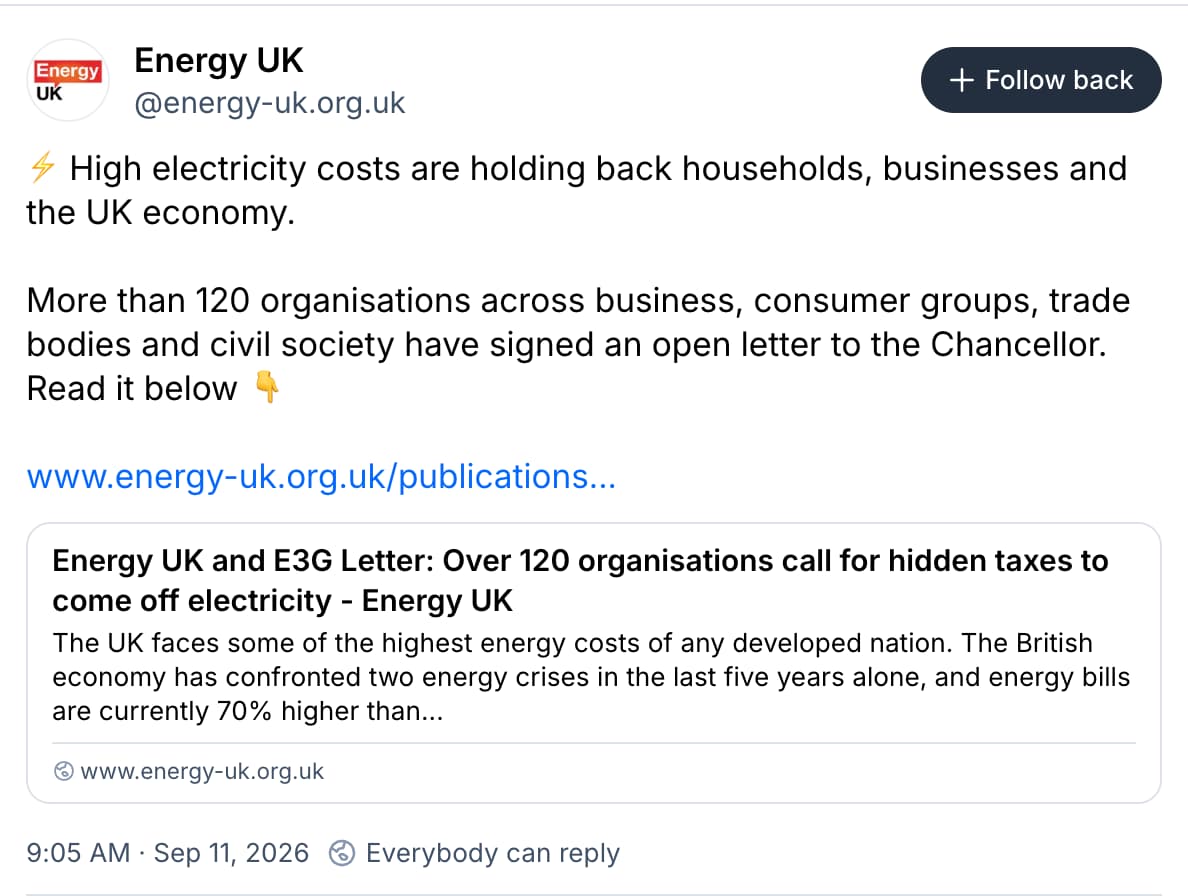
The most widely shared demand ahead of the budget on 28 October is to lift more policy costs off electricity bills, for households or for all users. In a September letter, more than 120 trade bodies, businesses and charities asked for “hidden taxes” to be removed from bills for businesses and households alike, arguing that levies supporting the Sizewell C nuclear plant, the warm home discount scheme for fuel-poor households and feed-in tariffs for small-scale legacy renewables should come out of general taxation, on top of the existing 75% renewables obligation decision.
That would “bring the total average domestic energy bill reduction achieved by this government to as much as £250 a year”, the group says, adding that it would lower inflation, boost manufacturing and incentivise electrification, helping to “fully realise [the UK’s] economic potential”. Energy consultant Kate Mulvany calls bringing policy costs and bad debt into general taxation “in all likelihood the fastest route” to lower bills. The obstacle is that the money has to come from somewhere — most likely the Treasury, which has resisted before, though Energy UK head Dhara Vyas argues it should now go a “step further”.
Option map: what each proposal would do to a typical bill
| Proposal | Who benefits most | Known catch |
|---|---|---|
| Move remaining policy costs to general taxation | Households and, if extended, businesses | Treasury must fund it |
| Shift policy costs from electricity onto gas bills, as recommended by a report from parliament’s Energy Security and Net Zero Committee | Electricity users and those electrifying heating or transport | Raises the cost of gas use, penalising homes that cannot switch yet |
| Remove standing charges from gas bills, requested by Burnham from ministers and modelled by Nesta as worth £27 a year | Low-usage households; supports heat pumps and EVs | Costs shift to unit rates |
| Boost “flexibility” and network efficiency, including dynamic line ratings | Everyone, via lower system costs | Only households able to shift usage capture the direct discount |
| Targeted relief: extend the warm homes discount, a “social tariff”, or a “rising block tariff” with cheap “essential” use | Fuel-poor households | Cliff-edge effects, and possible disincentives to electrify |
| Government pays off household energy debt rather than recovering it through bills; permanent VAT removal on electricity | All billpayers, especially arrears cases | Fiscal cost each year |
The rebalancing argument turns on the “spark gap”, the ratio between electricity and gas prices. That ratio stood at 4.3 in the UK as of April 2026, fell to 3.3 under the latest price cap and could drop again to 3.0 in January 2027, on Carbon Brief analysis. Further ideas have come from Nesta, the “electricity bills taskforce” and others, including paying off household energy debt and a permanent VAT cut on electricity.
Carmichael’s verdict is blunt: “Flexibility is a fairly obvious one that…would deliver bill reductions for people who can participate in flexibility, but it would also reduce system costs for everyone.” Ashutosh Padelkar, research lead at Aurora, agrees there is “more work to be done on improving network efficiency”, citing innovations such as “dynamic line ratings”, where cables can be “overloaded a bit for a small amount of time”. With bills set to leap by around a quarter at the start of 2027, pressure is building for immediate household relief too — although Mulvany warns that paying for an extended warm homes discount through bills could raise costs for other households, and Dr Carmichael notes a social tariff carries “potential for a sort of a cliff edge where people are just missing out on it”. The New Economics Foundation, where energy secretary Miatta Fahnbulleh previously worked, favours a “rising block tariff”. At the other end of the spectrum, Common Wealth, and Stonehaven with Greenpeace, propose putting gas-fired stations into a strategic reserve to break the gas-power link more completely.
Step 5: make the electrification decision on arithmetic, not slogans
Groups arguing for a fundamental shift in energy strategy usually claim the government is “rushing” towards clean power by 2030 and that slowing down would cut costs. A September 2026 report from the Institute for Fiscal Studies (IFS) states that “continuing to push for rapid decarbonisation does risk increasing costs”, resting on NESO modelling published in 2024 suggesting it could be slightly cheaper to rely on more gas in 2030 than under the clean-power 2030 target.
Peter Levell, IFS deputy research director, tells Carbon Brief that gas prices have “risen significantly” since that modelling, which “other things equal” makes more renewables relatively cheaper than more gas power. He also notes capital costs have risen, making renewables relatively dearer — while the cost of gas-fired plants has climbed even more steeply — and says it is unclear how long the current disruption will last.
The Tony Blair Institute (TBI) has pressed the same theme, arguing in a February 2026 report that the objective should be “cheaper power by 2030” rather than “clean power 2030”, achievable “while maintaining a clear decarbonisation trajectory”. Earlier versions favoured slower renewable expansion in favour of nuclear and carbon capture and storage; the latest places more weight on flexibility, optimised grid expansion and electrification. The strongest push to abandon current policy comes from the Conservative party, which now campaigns against clean power 2030 and wants the UK to scrap its climate targets, backing a report by thinktank Onward claiming the country could save “over £320bn” by prioritising “cheap power”. Carbon Brief factchecked it and found the savings built in from the start by assuming gas and nuclear would be cheap.
Tom Glover, head of energy firm RWE UK, summed up the problem: “There’s a difference between a useful scenario and a plan you’d build a system around. This report is the former presented as the latter. If you accept its assumptions, the results follow logically. The problem is the assumptions…built on a stack of optimistic inputs.” Johnny Gowdy, a director at thinktank Regen, calls the report’s gas-price assumptions “very optimistic – and potentially reckless”. Since the start of the Iran war, UK wholesale gas prices — already roughly three times higher than before the Ukraine crisis — have more than doubled again, leaving the UK more exposed to volatility in seaborne gas markets than systems built on domestic generation.
A rule of thumb you can use today
Current air-source heat pumps deliver roughly three units of heat per unit of electricity, so on running costs alone they need electricity to cost no more than about three times gas to beat a modern gas boiler. Compare that threshold with the spark gap figures above — 4.3 as of April 2026, 3.3 now, potentially 3.0 in January 2027 — and you can see why the levies debate is really a heating-decision debate. Industry analysis published by Energy UK in October 2026, its work on making clean heat cheaper, models annual heating costs of a gas boiler against a heat pump before and after exactly this kind of policy rebalancing.
| If the spark gap is… | Practical reading for a household |
|---|---|
| Above 4 (the UK position as of April 2026) | Keep a gas boiler unless you are replacing it anyway; insulate and improve controls first |
| About 3 (the current cap, or the January 2027 forecast) | Heat pump plus a time-of-use or EV-style tariff becomes competitive on running costs |
| Below 3 (the “rebalance” scenario favoured by the Net Zero committee) | Electrification decisions get easier, but existing gas users pay more per kWh |
Five mistakes that quietly cost households money
- Assuming the cap limits what you spend. Ofgem caps the maximum unit rate and the daily standing charge on default tariffs, not your total; usage and your region’s standing charges still set the bill.
- Staying on estimated readings. Under-estimates become arrears, and arrears are recovered across all customers as bad debt — around £60 of today’s bill.
- Switching to an off-peak tariff without changing behaviour. Economy 7 style deals trade a higher daytime rate for a cheaper night rate; comparison-site guidance suggests they only pay back if a large share of your electricity — commonly around 40% — is used off-peak.
- Reading levy cuts as proof nothing changed. The £134, £154 and £45 reductions are real but “masked” by wholesale costs, so compare component lines, not just totals.
- Choosing heating from a single headline number. Running cost depends on the spark gap, your tariff window and whether you will leave the gas network at all, not on one newspaper estimate.
Your next 90 days: a concrete action plan
- Pull your last 12 months of bills and mark each line against the four piles; note how much of the increase is standing charge rather than usage.
- Send actual meter readings on the same day each month, and photograph the display as evidence.
- Ask your supplier for a free smart meter — it is the precondition for time-of-use, tracker and EV tariffs, and for testing whether shifting your load helps.
- Check warm home discount eligibility, council tax reductions and local grants before winter demand peaks; the £150 rebate lands between October and March and many eligible homes never receive it because details are stale.
- Re-base your direct debit after the January 2027 cap change rather than letting it drift, which is how operating-cost and bad-debt charges snowball.
- Fix the cheap things first: draught-proofing is the number-one low-cost heating tip published by the Energy Saving Trust, ahead of gadgetry, with controls and loft insulation the next-best returns.
- Only then model a heat pump or EV, using the spark-gap table above and a tariff with an overnight window.
FAQ
Why did my bill rise in October 2026 if policy costs went down?
Because 44% of the cap is wholesale cost, tied to gas through marginal pricing. Policy costs are 7%, and the cuts — plus the temporary VAT removal — were more than offset by gas prices driven by the Iran war.
Is the clean-energy transition the cause of high bills?
Not of this rise: gas explains more than 80% of the increase since 2020. Grid renewal does add cost — a rise of around 50% in network charges between 2025 and 2030 — but Ofgem says most of that is maintenance of ageing infrastructure rather than connecting renewables.
Would slowing decarbonisation make bills cheaper?
Unproven. The IFS warns that rapid decarbonisation risks higher costs, but its own Peter Levell notes gas prices have “risen significantly” since the modelling behind that warning, and critics such as Regen’s Johnny Gowdy call the alternative assumptions “very optimistic – and potentially reckless”. Meanwhile Nesta finds clean power is already holding electricity bills back.
What is the single best household action?
Accurate readings, then a deliberate look at whether you can shift a third to a half of your electricity use into a cheap window. That is the consumer version of the “flexibility” argument made by Carmichael, Padelkar and Nesta.
The bottom line
The most reliable way to respond to a rising cap is to stop treating your bill as one number. Wholesale gas sets the direction of travel, grid renewal sets the floor, and policy choices — from shifting levies to general taxation to pruning standing charges — decide how much of the burden lands on you. Nothing on that list delivers the £300 promised for 2030 on its own, and the January 2027 forecast may arrive before any of it does. What you do control is exposure: readings, tariff shape, insulation and the timing of any switch away from gas. Those are the levers worth pulling this quarter, and starting costs almost nothing.