
How to Read UK Climate Finance Data: A 4-Step Field Guide to the £12.8bn Aid Picture
By James Hartley — IT Insights, ItInsightsWorld General
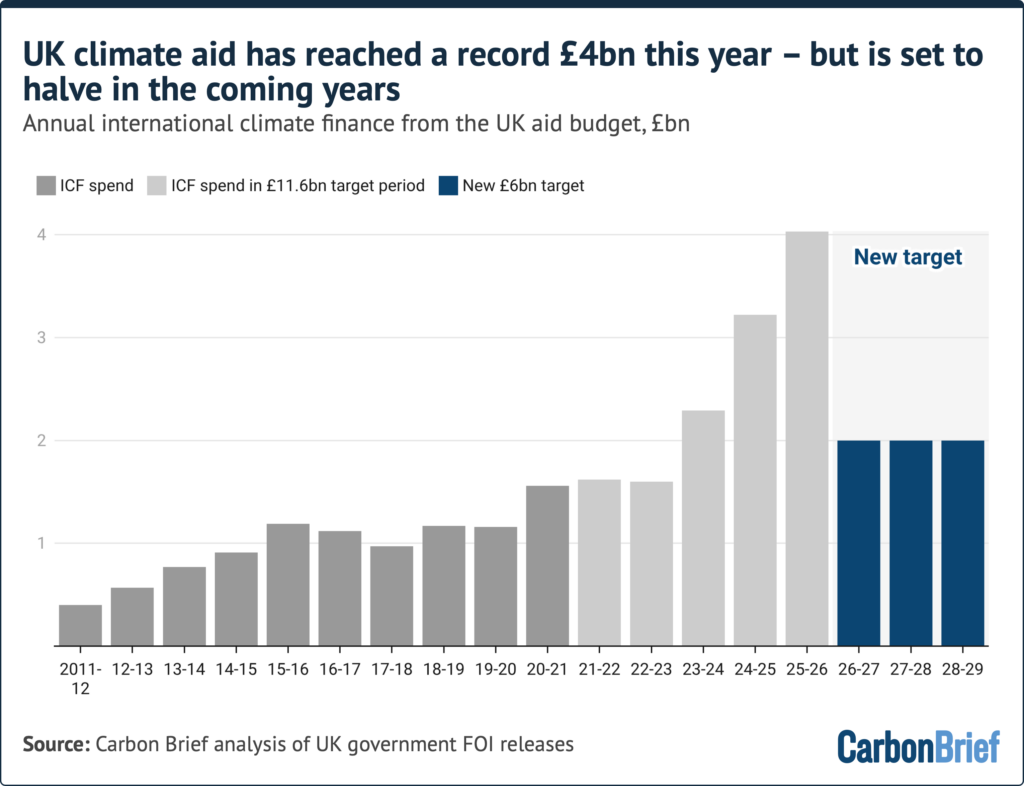
Start with the headline: £12.8bn of UK public money has been counted as climate finance for developing countries since 2021, clearing the £11.6bn pledge comfortably and reaching a record £4bn this year. Now read the sentence underneath it, because that is where the practical value sits. Behind those totals sit roughly 500 aid projects over the past five years, funded through a blend of genuinely new spending, relabelled existing aid and instruments that live outside the aid budget. And the next commitment, announced by the Labour government in March 2026, is around £6bn across three years — about £2bn in climate aid annually, roughly half the latest yearly figure. Whether you write policy notes, vet an ESG claim or simply want to know if a “record” headline means real progress, you need a method rather than a number. Here are four steps, with the pitfalls, a verification checklist and the questions readers ask most often.
Step 1: Know which dataset a figure came from
Three separate streams describe the same pot of money, and they disagree on timing and granularity, so the first job is to identify which one you are quoting.
The richest project-level view comes from freedom-of-information (FOI) requests compiled into a public dataset by Carbon Brief, which has periodically tracked this information since 2017. It shows that between 2021-22 and 2025-26, at least 493 projects, funds and institutions received UK climate finance — which is how we can say around 500 climate projects have received UK support since 2021.
Official reporting to the UN is mandatory under international obligations, but it arrives with a two-year delay and is not broken down by financial year, so progress toward the £11.6bn goal cannot be accurately gauged from routine publications alone. The UK government does not routinely publish progress data, which is precisely why the FOI release matters.
A third channel is easy to miss. FCDO maintains a standing International Climate Finance results series on GOV.UK; its 2026 results are scheduled for publication on 4 November 2026 (source: gov.uk/government/collections/international-climate-finance). That series reports what funded programmes achieved rather than how much was counted, so it answers impact questions well and budget questions poorly.
Readers can also go to the source themselves. UK rules let anyone — including non-UK residents — submit an FOI request in writing to a public body, and the authority should reply within 20 working days (guidance: gov.uk/make-a-freedom-of-information-request; ico.org.uk). Ask for spend by financial year and by department and you reproduce the exact request that made the £12.8bn picture possible.
Step 2: Split new money from re-tagged money
Ask one question of any headline total: would this pound have been spent anyway? Separate Carbon Brief analysis shows the target was met only because the government reclassified £2.2bn of existing foreign aid as climate finance, without spending any more — partial reliance on what that analysis described as “questionable accounting”. A second change automatically labelled 30% of aid for all humanitarian projects in Afghanistan as climate finance, with knock-on effects across other climate-vulnerable and war-torn nations.
Use this mapping table whenever a climate-aid claim lands in your inbox:
| Counting move | Effect on the headline | Check to run |
|---|---|---|
| Reclassifying existing aid as climate finance | Adds £2.2bn to the five-year period total without new cash | Compare year-on-year budgets, not the cumulative pledge |
| Auto-tagging humanitarian programmes (30% in Afghanistan) | Changes who ranks as the top bilateral recipient | Ask whether climate was the purpose or only the label |
| Counting “core” funding to development banks | Moves the largest shares from projects to institutions | Trace how much reaches a country programme |
| Counting private investments, export credit and guarantees | Bolsters the £6.7bn pledge to “drive climate and nature outcomes” | Convert to grant equivalents before comparing with grants |
These concerns are not only campaign criticism. The UK's own aid watchdog, the Independent Commission for Aid Impact, reviewed international climate finance commitments in February 2024 and concluded that accounting changes were inflating reported totals, with insufficient transparency about the new methods, including adjustments made within British International Investment (icai.independent.gov.uk). The Commons International Development Committee went further in a report published in September 2026, finding that changes to the accounting methodology had undermined the impact, additionality and credibility of the UK's commitments (publications.parliament.uk).
Step 3: Trace the chain — multilaterally or bilaterally?
Most UK climate finance was delivered “multilaterally”, meaning it supports large funds or institutions working across multiple countries. More than 80% of the funding since 2021 is therefore listed as helping “developing countries” in general, or whole regions such as “Africa”. That is an honest answer and a dead end at the same time: it tells you the money exists, but not where a project sits.
The bilateral slice is where country-level stories live. Of the £2.1bn, or 17%, delivered “bilaterally” — with the UK directly supporting climate projects in specific countries — the biggest beneficiaries are nations in east Africa and south Asia, and around two-thirds goes to nations classified as “least developed”. For many years Ethiopia was the top recipient, largely on long-running ecosystem restoration and drought resilience work. Over the £11.6bn period, however, Afghanistan overtook it, with £256m of its aid labelled climate-related against Ethiopia's £226m. The UK does not provide aid via the Taliban, channelling it instead through partners such as UN agencies.
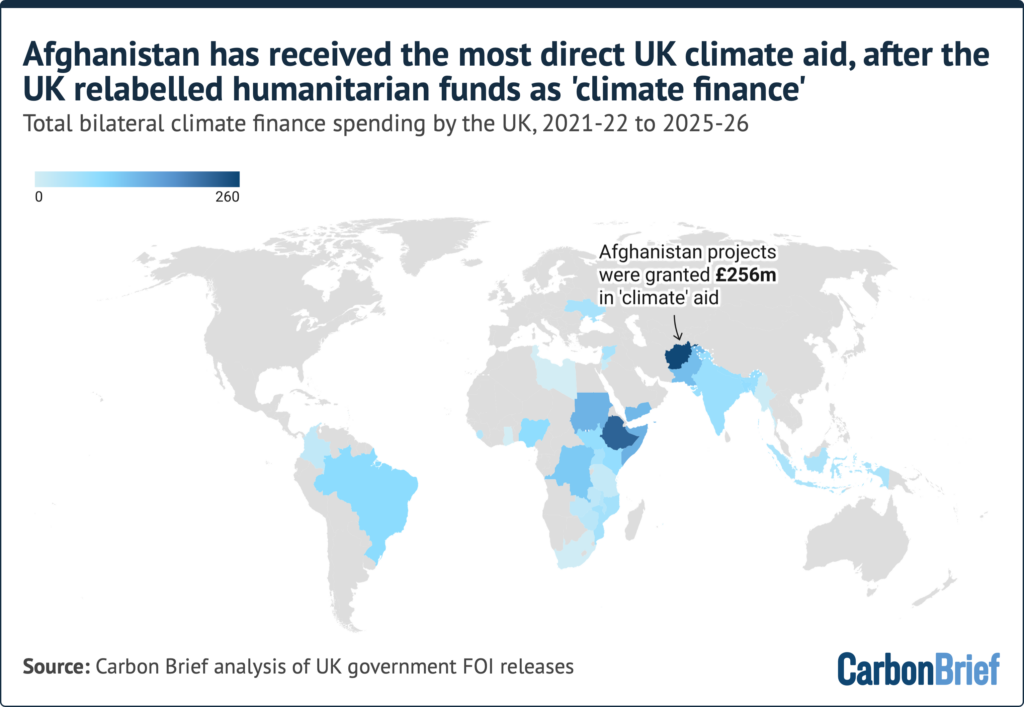
The same humanitarian-tagging logic explains why Somalia (£139m), Sudan (£136m) and Yemen (£130m) also appear among the top recipients of “climate aid”.
When middle-income countries show up with large sums, read leverage rather than relief. Examples include £83m to support Brazil's Amazon Fund, a carbon offsetting initiative, and £43m to boost UK investment in India's low-carbon infrastructure; £198m channelled by the UK into a World Bank-backed project helping Colombia, Cambodia and others create and sell “high-integrity” carbon offsets; and £229m to a group using foreign aid to attract private capital for projects in mainly low-income nations, including a solar farm in Uganda and a “sustainable aviation fuel” project in Pakistan.
Single-country grants are the easiest to evaluate because their purpose is explicit: £45m to help Ukraine curb its reliance on fossil fuels, £40m in cash transfers for drought-affected Kenyans, £30m to provide flood resilience in Nepal, plus solar projects in Mozambique and carbon offsets in the Amazon.
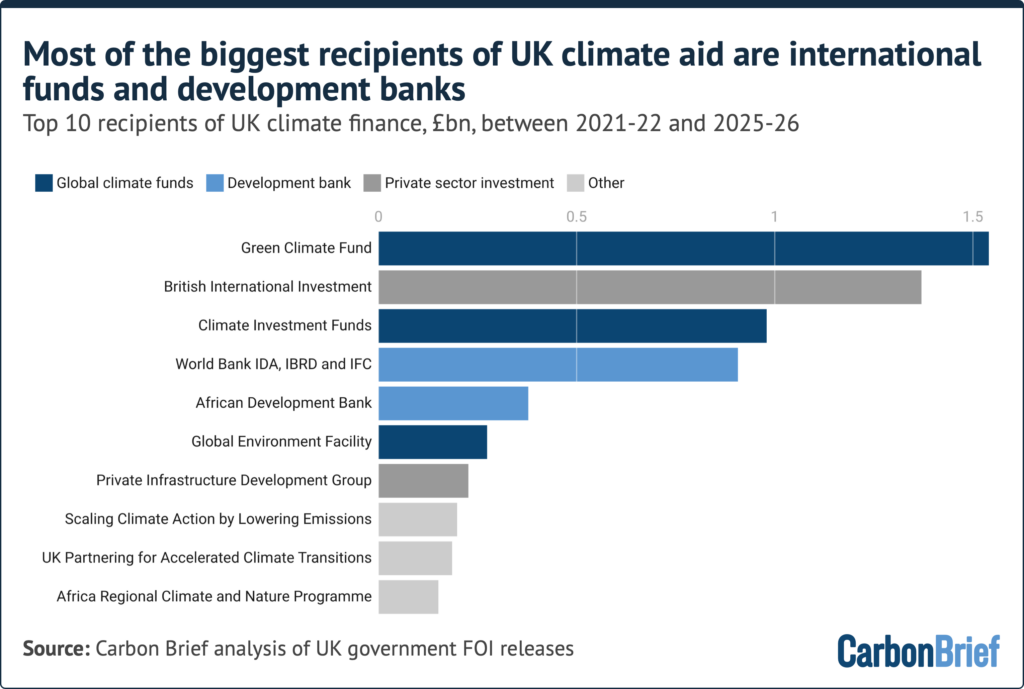
Institutional shares are highly concentrated. Despite recently trimming its 2024-27 support for the Green Climate Fund, the UK still provided £1.5bn to that flagship UN fund, more than any other initiative. British International Investment, or BII — a publicly owned, for-profit company investing in developing-country businesses and partially supported with UK aid money — received almost £1.4bn. Other major recipients are multilateral development banks (MDBs), particularly various arms of the World Bank and the African Development Bank, reflecting the decision to start counting “core” funding as climate finance. The UK has increasingly relied on BII to meet its climate-finance goals, partly because the body chose to prioritise clean-energy investments rather than fossil fuels, and the accounting changes that boosted the significance of BII and MDBs are exactly what experts, MPs and the aid watchdog dispute.
Step 4: Judge the instrument, not the headline number
A grant, a loan and a guarantee are three different promises wearing the same label. Alongside the £6bn in climate aid, the government has pledged to invest £6.7bn from outside the aid budget to “drive climate and nature outcomes”, and instead of grant funding this support will include private investments, export credit and guarantees to development banks. The UK already provides such finance, but it has not previously been counted towards climate-finance targets.
The same caution applies globally. OECD tracking of the earlier goal shows climate finance provided and mobilised by developed countries reached USD 132.8 billion in 2023 and USD 136.7 billion in 2024 — above the old $100bn benchmark, but with loans and mobilised private capital doing much of the work (oecd.org). Analysts at Development Initiatives also note that the Rio Markers used to tag climate-relevant aid were designed as qualitative tools rather than an accounting standard, so donors interpret terms such as “significant” and “principal” differently (devinit.org). That is the structural reason two credible organisations can report different totals for the same donor year.
And the yardstick is moving. At COP29 in Baku, governments agreed a successor goal of mobilising $300bn a year for developing countries by 2035, with efforts to reach $1.3tn (unfccc.int). Read the UK's around £6bn over three years against that much larger, much looser target and the political arithmetic becomes clearer.
What the trend line says next
In 2019, the UK government committed to spending £11.6bn of the nation's aid budget on climate finance between 2021-22 and 2025-26 — its contribution to an international goal to mobilise $100bn of climate finance a year between 2020 and 2025. Under UN climate treaties, developed countries are obliged to support developing countries and assist their efforts to cut emissions and adapt to climate change. Because £12.8bn was provided over the five-year period, the £11.6bn target was met comfortably, and the record annual figure is tenfold the 2011-12 level when the UK started providing climate finance, before inflation.
Direction of travel matters more than the peak. FOI data show UK climate finance reached a record £4bn in 2025-26 and the same total was recorded this year. Alongside other major donors such as the US, however, the UK has dramatically cut its aid budget, placing significant strain on the nation's climate finance — and that is the mechanical reason the numbers fall next, even if every programme performs well.
Common misconceptions
- “Target met” means “more money spent”. The £11.6bn goal was cleared partly by re-tagging £2.2bn of aid already budgeted.
- The top recipient must host the biggest climate programme. Afghanistan's £256m follows a 30% humanitarian tagging rule, not new climate initiatives.
- Multilateral flows are a rounding detail. They are the story: £1.5bn to the Green Climate Fund and almost £1.4bn to BII dominate the totals.
- Every pound counted is a grant. The £6.7bn outside the aid budget is built on investments, export credit and guarantees.
- Governments publish this routinely. The UK government does not routinely publish progress data, and UN reporting carries a two-year delay.
Verification checklist: six checks before you cite a figure
- Ask which source produced it: FOI dataset, UN submission, FCDO results release or a campaign estimate.
- Ask which financial year it covers and whether inflation is included.
- Ask what share is new money versus reclassified aid such as the £2.2bn exercise.
- Ask whether multilaterally routed money is credited to “developing countries” or to a named country.
- Ask whether the instrument is a grant, a loan or a guarantee, and convert to grant equivalents.
- Ask whether the same activity is counted twice — as climate finance and as, say, biodiversity or humanitarian aid.
Frequently asked questions
Did the UK really hit its £11.6bn promise?
Yes, on the official counting rules, with £12.8bn delivered over the five-year period. The contested part is how: Carbon Brief's analysis points to partial reliance on “questionable accounting”, including reclassification and automatic tagging.
Why does the record £4bn still point downwards?
Because the record was set in 2025-26 and this year, while the successor commitment averages £2bn a year over three years — roughly half that run rate — and sits inside a shrinking aid budget.
Where can I see project-level detail?
Carbon Brief has released the full FOI dataset as a spreadsheet, and BIST separately published a dataset covering hundreds of climate-science projects in or benefiting developing countries. Official results reporting sits on GOV.UK.
Does the money reach the poorest countries?
Partly. Around two-thirds of bilateral climate aid goes to least developed nations, but more than 80% of all funding is pooled multilaterally, and large middle-income lines are aimed at mobilising private investment rather than humanitarian need.
Action advice by reader type
- Journalists and researchers: request spend by financial year from all four departments via FOI, and lead with the accounting change rather than the total.
- NGOs and grant-seekers: track Green Climate Fund replenishment windows and MDB capital increases, since that is where the UK's “core” money now lands.
- Investors and corporates: the £6.7bn outside the aid budget signals guarantees and export credit as the growing instruments — useful for frontier-market solar, such as the Uganda example, and for sustainable aviation fuel pipelines like Pakistan's.
- General readers: treat annual records as timing artefacts; compare pledges with pledges, in constant prices.
How the figures were compiled
All international climate-finance data used here was obtained via FOI requests and compiled into a spreadsheet. UK climate finance comes from the aid budgets of four departments, with the Foreign, Commonwealth and Development Office, or FCDO, providing three-quarters of the total. The remainder comes predominantly from the Department for Energy Security and Net Zero, or DESNZ, with much smaller sums from the Department for Environment, Food and Rural Affairs, or Defra, and the Department for Business, Innovation, Science and Trade, or BIST. Figures have been subject to regular revisions; this guide is based on final figures provided via FOI requests in recent months, and departments may still change them in future releases.