
£11.6bn by 2026: Did the UK Deliver Its Climate Finance Pledge, or Just Redefine It?
A headline figure can be true in two very different ways. One version is true because new money arrived. The other is true because the definition of "arrived" was rewritten while the counting kept running. By 2026 the UK had reached its £11.6bn climate aid target for developing countries, but the result rested on questionable accounting — the second kind of true.
The framing is worth borrowing even if you never read an aid budget. Four mechanics sit behind this story — re-tagging existing programmes, absorbing other institutions' budgets, retroactive classification, and mid-cycle rule changes — and each one turns up again in corporate sustainability claims, charity appeals and public-sector scorecards. Below is a side-by-side audit: what was promised, what was booked, which components did the work, how the UK's money compares with other donors, and a checklist you can point at the next spending headline you meet.
Verdict at a glance
- The promise: under the Paris Agreement, the UK committed to delivering at least £11.6bn of overseas climate finance between 2021 and 2026.
- The booked total: data obtained by Carbon Brief via freedom-of-information requests, over the course of several months, shows £12.8bn over the past five years — including a record £4bn in the past year alone.
- The reclassified slice: roughly £2.1bn, nearly a fifth of the total, comes from the government's accounting changes rather than fresh spending.
- The counterfactual: strip those amounts out and cumulative UK climate finance would only have reached around £10.7bn by 2026, leaving a shortfall of £924m — a miss of nearly £1bn.
- What comes next: the government has pledged £6bn of foreign aid for climate projects over the next three years, but earlier Carbon Brief analysis indicates continued use of questionable accounting is likely to make up around a third of the new target.
The promise, and the pressure that built up behind it
Under UN climate treaties, the UK and other developed countries must supply new and additional climate finance to help developing countries tackle climate change. They also face targets to mobilise $100bn of climate finance per year through to 2025 and at least $300bn by 2035 — the second figure agreed at COP29 and folded into the broader "Baku to Belém" financing push. UN synthesis reporting, summarised by Carbon Brief in the run-up to COP30, warns that even that goal will be insufficient for adaptation needs, which is why the credibility of each donor's counting rules matters more than the size of the headline.
As the UK's contribution to international climate finance, the Conservative government pledged in 2019 to provide £11.6bn between the financial years 2021-22 and 2025-26, a move it described as doubling its previous five-year target. After that, successive governments cut the money flowing to foreign aid, pointing to economic strain and a need for more defence spending. That put great pressure on the £11.6bn target, which comes from the UK aid budget.
How much pressure is measurable, and that is a piece of context rarely attached to the pledge itself. ICAI's analysis of UK spending plans, published in 2026, expects aid to fall by roughly 42% — about £6.5bn — over four years. The House of Commons Library records the government's own arithmetic: the reductions are expected to release £500m for defence in 2025/26, £4.8bn in 2026/27 and £6.5bn in 2027/28. Hold a nominal target fixed inside a shrinking envelope and only three futures exist — more money, fewer projects, or a wider definition. The UK chose the third.
To keep the target while aid was being reduced, the Conservative government decided in 2023 to loosen the criteria for what it defined as climate spending. That allowed the UK to remain committed to the £11.6bn goal without spending more on new climate projects, simply by relabelling existing funds. The current Labour government has chosen to maintain this approach, while pledging to cut aid spending even further. Campaigners, MPs and even the UK's official aid watchdog have strongly criticised the move, calling it "creative accounting" and "Moving the goalposts".
Two rulebooks, side by side
The fastest way to see what happened is to compare the definitions rather than the totals. Nothing below changes the underlying spending; only the boundary of what counts changed.
| Test | Rules before the 2023 change | Rules after the 2023 change |
|---|---|---|
| What qualifies | Money newly provided for a climate purpose, generally interpreted as extra on top of existing aid | Also a calculated share of budgets approved for other purposes, if the channel carries a climate target or tag |
| Funding for development banks | Un-earmarked core contributions were not attributed to climate | A share of core funding counts as climate finance — adds £1.1bn |
| Humanitarian aid | Counted only where a climate link could be identified | 30% counted automatically in countries judged most vulnerable — adds nearly £600m |
| Private-sector investing | A default, fixed share of 30% applied to British International Investment (BII) | Climate share calculated from real-world BII investments |
| Costs from past events | Not normally swept into later climate reporting | £99m of spending on COP26 counted as climate aid |
| Disclosure | Not fully published | Still not published; reconstructed by Carbon Brief through FOI |
What the government could show — and what it could not
The UK government says it met the £11.6bn target, but has not published the full details of how it did so, or even the total amount provided by 2025-26. FOI data obtained by Carbon Brief over the course of several months shows that total climate finance over the past five years actually reached £12.8bn, including a record £4bn in the past year alone. Carbon Brief's analysis of government data also shows that around £2.1bn, nearly a fifth of the total, comes from the government's accounting changes.
The chart below shows that, without those changes, cumulative UK climate finance would only have reached around £10.7bn by 2026, leaving a shortfall of £924m.
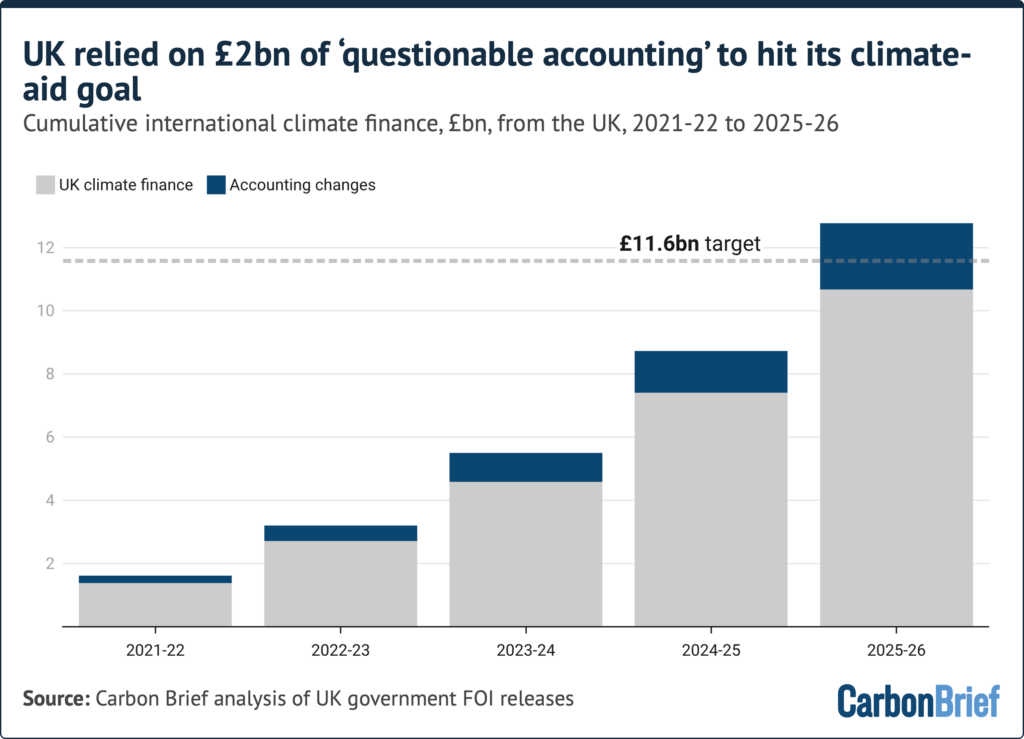
That final figure of £2.1bn is higher than the UK Independent Commission for Aid Impact (ICAI) forecast in 2024, when ICAI estimated that total reclassified climate finance would reach £1.7bn. In other words, the watchdog's own warning was under-calibrated relative to what the re-tagging eventually produced.
The government says its accounting changes are consistent with internationally agreed ways of calculating ICF, used by other major donors. Experts have noted, however, that the UK was traditionally viewed as taking a more rigorous approach to climate-finance accounting, a field that is notoriously unregulated and opaque.
A recent International Development Committee (IDC) report — the first parliamentary body to put the accounting question inside the wider story of a shrinking aid budget — noted that developed countries have committed to providing new and additional climate finance to developing countries, generally interpreted as extra funds on top of existing aid. The IDC concluded from its evidence that, alongside aid cuts, the UK's accounting changes have eroded the additionality and credibility of its climate finance.
Responding to Carbon Brief's findings, IDC chair Sarah Champion said the data shines a new light on the committee's findings:
"The picture is not getting any better. If questionable accounting has been used to get around a £1bn shortfall on ICF spend between 2021-22 and 2025-26, this only underlines my concerns that the government has been cutting corners to maintain headline climate-spending commitments, rather than working to deliver genuine climate and nature outcomes."
The three reclassifications, ranked by size and risk
Three major components explain most of the UK's upward revision in climate-finance spending. They are not equivalent. They differ in size, in how defensible the logic is, and in how exposed they are to decisions taken by institutions the UK does not control.
| Component | Value added | How it works | Why critics push back |
|---|---|---|---|
| Share of core funding to multilateral development banks (MDBs) | £1.1bn — by far the largest chunk | Un-earmarked contributions that governments provide to support these banks in their work, including loans and grants to developing countries; split mainly between the World Bank and the African Development Bank | MDBs face criticism for lack of transparency and reliance on loans rather than grants; the flows now depend on bank climate targets that are being dismantled |
| Automatic climate tagging of humanitarian aid | Nearly £600m | 30% of aid counted as climate finance when it goes to one of the countries judged most vulnerable to climate change, including Afghanistan, Sudan and the Democratic Republic of the Congo | Projects are counted even without a discernible link to climate change, such as helping conflict-affected people in Yemen or orphans in Zimbabwe; the Center for Global Development (CGD) has described this revision as arbitrary, since every aid project is already screened for any climate-relevant components |
| Private-sector investing through BII | £133m over the first four years, against an internal forecast of £266m over the five-year target period | The climate share is calculated from real-world BII investments rather than from a default, fixed share of 30% | Government records of BII climate finance have been inconsistent, making the true impact hard to estimate; BII has faced criticism over legacy fossil-fuel investments and over channelling aid money to billionaires |
| Costs of hosting the summit | £99m | Spending on COP26, from when the UK hosted the climate summit, booked retrospectively | Save the Children UK says retrospective classification of expenditure should stop |
The MDB line deserves the closest look, because it is both the largest and the least stable. This revision has been justified because the World Bank and other banks have clear targets for funding climate-relevant projects using their core funding. The flaw is that the justification depends on targets that are now disappearing. The US has been pressuring MDBs to drop their climate plans altogether, and the Trump administration has already forced the World Bank to abandon its overall target to put 45% of its funds towards climate finance. Reporting by Reuters in June 2026, followed by the Bretton Woods Project, indicates the bank retired that goal outright and extended its Climate Change Action Plan only while an independent evaluation review decides its future — which is precisely the predictability critics warn is being removed.
Jon Sward, environment project manager at the Bretton Woods Project NGO, tells Carbon Brief: "One thing removing the overall [World Bank] target definitely does is it adds…a lack of predictability of the flows going forward."
BII is a publicly owned, for-profit company investing in developing-country businesses and partly funded by injections of UK aid money. In recent years, BII has increasingly turned its attention to investing in clean power, reaching more than £1bn in climate investments in 2025. Because the records are patchy, Carbon Brief used the earlier internal government forecast estimating that the change would add a total of £266m over the five-year target period — a useful reminder that even the reconstruction of this target carries its own uncertainty band.
Grants versus loans: how the UK's money compares with peers
Comparison is the missing half of most coverage of this story. Nearly all of the UK's climate finance so far has been grant-based, while OECD reporting on developed-country climate finance shows that loans continue to represent most public climate finance, even if the share of grants is higher for the poorest countries. Independent analysis of the COP29 outcome, published by Sciences Po's chair on sustainable development, makes the same point about France and Japan: the majority of their financing takes the form of loans, which inflates headline figures relative to the budget effort behind them.
| Dimension | UK approach | Loan-heavy donor approach |
|---|---|---|
| Form of finance | Nearly all grants | Loans dominate reported totals |
| Budget pain per £/$ reported | High — every grant lands directly on the aid budget, which is why redefinition became attractive as aid fell | Lower — the same cash can be recycled through repayments |
| Effect on recipients | No new debt | Adds debt service in climate-vulnerable, debt-stressed economies |
| Main accounting risk | Reclassification and automatic tagging | Loan volume and leverage counting |
The trade-off is uncomfortable rather than simple. The UK is not "cheating" in the way a loan-heavy donor inflates a number, yet it has met its pledge partly by counting money that other donors would not claim. Both habits produce a headline larger than the new effort behind it.
What comes after 2025
The accounting changes still matter as the UK starts its next phase of international climate finance, while reducing the aid budget further. The government has pledged £6bn of foreign aid for climate projects over the next three years, making the UK one of the only major donor countries to set out a new climate-finance target for the period after 2025, despite a global pledge to scale up support — a fact confirmed in the Foreign Secretary's March statement to Parliament on international development. Even so, the new UK goal halves spending from £4bn in the financial year 2025-26 to £2bn a year, on average.
Responding to Carbon Brief's analysis, a UK government spokesperson says: "We are proud to have both hit, and exceeded, our third international climate-finance target – and will continue to work hard on protecting climate and nature." The spokesperson added: "Climate change and nature loss pose a real and significant threat to global security and prosperity. That is why the UK is leading action on climate and nature, and prioritising climate finance in its aid budget."
Shruti Agarwal, senior climate finance adviser at Save the Children UK, tells Carbon Brief that the reduction in overall financial effort by the UK is a concerning pattern that must cease. She adds: "[The UK should] strengthen transparency by publishing timely, detailed data on international climate spending and stop classifying expenditure as climate finance retrospectively, as seen with COP26 expenses."
Four misconceptions worth clearing up
- "£12.8bn proves the pledge was comfortably met." The surplus is thin once you remove roughly £2.1bn of reclassified spending; on the older definitions the UK would have been £924m short.
- "Reclassified money disappeared." It still funds development banks, humanitarian programmes and investing. The dispute is about whether it was new and additional — not about whether it exists.
- "Only the UK counts like this." The government argues its method is consistent with internationally agreed ways of calculating ICF used by other major donors. The criticism is that the UK abandoned a stricter house standard in a field that is already opaque.
- "A new £6bn target means renewed ambition." It averages £2bn a year against the record £4bn just delivered, and questionable accounting is likely to supply around a third of it.
Five questions to audit any climate-spending claim
- Was the total volunteered or extracted? Here, the full dataset only surfaced through FOI requests lodged over the course of several months — the absence of a published breakdown is itself a finding.
- Did the tagger change mid-period? A rule change in 2023, applied across a window that began between 2021-22 and 2025-26, is the single largest driver of the "target met" verdict.
- Is anything counted retrospectively? £99m of spending on COP26 illustrates how past events can be re-described as climate finance after the fact.
- Are the counted flows stable? £1.1bn rides on MDB climate targets that the World Bank has now retired under US pressure, so the number may not survive as a repeatable method.
- Is it additional to a shrinking envelope? Compare the claim against total aid, not against last year's climate line alone.
For transparency, the underlying method is worth knowing. Carbon Brief obtained full datasets of international climate-finance spending via FOI, covering the five-year period 2021-22 to 2025-26, with the full dataset set out in Carbon Brief's analysis of the £12.8bn in spending over this period. In addition, Carbon Brief requested from the Foreign, Commonwealth and Development Office (FCDO) details of what climate-finance spending would have been prior to the 2023 accounting changes, for the period 2021-22 to 2024-25, then used this information to calculate the impact of accounting changes in 2025-26, combining the figures to work out the full impact. UK climate-finance figures have been subject to regular revisions; although this analysis is based on final figures provided via FOI requests in recent months, departments may still change the figures in future releases.
FAQ
Did the UK hit its £11.6bn pledge or not?
On the government's published definition, yes: the analysis puts delivery at £12.8bn over the past five years. On the definition in force before the 2023 loosening, no — around £10.7bn, a £924m miss.
How much was relabelled?
About £2.1bn, nearly a fifth of the total — larger than the £1.7bn that ICAI forecast in 2024.
Where did the relabelled money come from?
Principally a £1.1bn share of core funding to the World Bank and the African Development Bank, nearly £600m from automatically counting 30% of humanitarian aid in climate-vulnerable countries, £133m from recalculating BII's climate share against a forecast of £266m over the five-year target period, plus £99m of spending on COP26.
Is this just an accounting dispute with no real-world consequence?
It has one. The IDC concluded that the changes, alongside aid cuts, have eroded the additionality and credibility of UK climate finance, and the same practice is expected to supply around a third of the next £6bn pledge.
Why should a general reader care?
Because the four mechanics are generic. Any institution can hit a target by redrawing it, and the tell is almost always the same: missing disclosure, a mid-cycle rule change, retrospective classification and reliance on third-party budgets.
What to watch before the next count
- Publication of the full FCDO climate-finance dataset — not a headline total — for the new three-year window.
- Whether reclassified items really reach around a third of the £6bn pledge, and whether ICAI updates its £1.7bn baseline forecast.
- The fate of the World Bank's climate plan after the retirement of the 45% target — the £1.1bn counting logic depends on it.
- Whether the 30% humanitarian auto-tag survives scrutiny from the CGD and parliamentary committees.
- How the UK's £2bn-a-year average compares with the $300bn global target agreed at COP29 — donors are being asked to scale up, not settle.
Bottom line
Judged as a bookkeeping exercise, the UK's £11.6bn story is a pass: the ledger balances, the government is "proud to have both hit, and exceeded" the target, and the method is defended as consistent with other donors. Judged as a test of whether richer countries are putting new money behind the climate commitments made to poorer ones, it is a fail with a £924m hole in it — and, on the committee's language, a case in which questionable accounting has been used to get around a £1bn shortfall while aid budgets are being cut. For readers, the practical takeaway is a habit rather than a verdict: when an institution reports a pledge met, ask which rulebook produced the number, and whether the money would still count if the definition had stayed where it started.