
ItInsightsWorld Teardown Watch: Why the Trump Mobile T1 Reads as a 2024 HTC U24 Pro With a $749 Price Tag
A smartphone that reaches retail more expensive than it was announced, yet carries an interior already on the market, raises a question about engineering before it raises one about specifications. Trump Mobile's T1 has now drawn that question in measurable form: a teardown published recently by the YouTube channel JerryRigEverything shows the handset sharing its internal architecture with the HTC U24 Pro, a phone launched in 2024, to the point that the two mainboards are interchangeable.
The chronology matters. Unveiled in June 2025, the T1 only reached shelves in June 2026, and across that gap its design and spec sheet were revised repeatedly without ever settling into a true flagship tier. Pricing moved the other way: the originally announced $499 became $749 at launch.
What the specification sheet offers
The current retail configuration covers the following ground:
- 6.78-inch AMOLED display with a 120Hz refresh rate
- Qualcomm Snapdragon 7 Gen 3 processor
- 512GB of internal storage
- 50MP main camera plus an 8MP ultra-wide unit
- 50MP telephoto camera with 2x optical zoom, and a 50MP front camera
- 5000mAh battery
On paper, that list is not behind its time. What has drawn criticism is not performance but provenance: the T1's exterior already echoed the HTC phone, and the latest disassembly extends the resemblance from shell to circuit board.
The board swap: evidence rather than inference
Rather than comparing photographs, the test was functional. A T1 mainboard placed inside an HTC U24 Pro chassis powered on and ran normally; the same procedure in reverse, with a U24 Pro board seated in the T1 body, also worked. Zack Nelson's conclusion is that the two devices sit on the same hardware platform.
Where the two handsets still diverge
| Attribute | Trump Mobile T1 | HTC U24 Pro |
|---|---|---|
| Market timeline | Revealed June 2025, on sale June 2026 | Released in 2024 |
| Body styling | Gold chassis, reshaped camera area, several modified outer parts | Original 2024 styling |
| Mainboard | Boots and runs inside a U24 Pro body | Boots and runs inside a T1 body |
| Internal layout | Board layout, component positions and screw configuration match the U24 Pro | Board layout, component positions and screw configuration match the T1 |
| Energy | 5000mAh, charging up to 30W | 4600mAh, charging up to 60W |
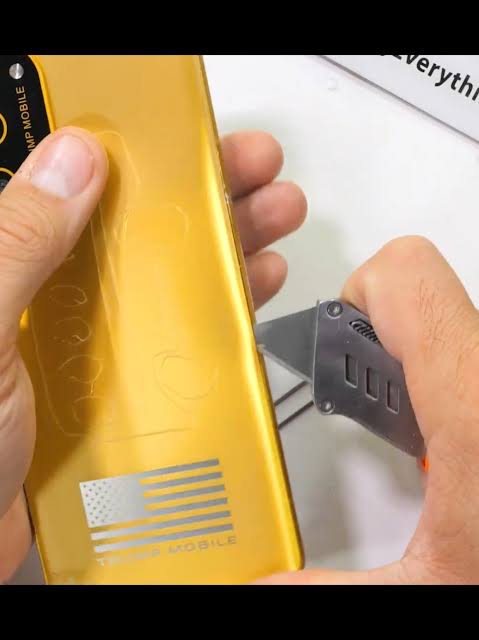
A portion of the memory components on the two devices comes from different suppliers, a divergence that leaves the overall hardware design similarity untouched. Equally, none of the visible changes — the gold finish, the reworked camera island, the adjusted external parts — alters the fundamental internal composition. Detail work has also attracted scrutiny: the flag graphic printed on the body does not carry the 13 stripes used on the flag of the United States.
Resistance of the chassis
In the routine abuse sequence the T1 behaved creditably. Normal scratching and the standard bend test left the handset intact, with no obvious structural failure during flexing. Reliability of that kind reflects a mature, already-proven shell; on its own it does not answer the originality question.
An earlier examination reached the same place
The latest video is not the first attempt to open this phone. Repair specialists iFixit had previously performed a detailed teardown, supplementing it with CT scans and component-by-component comparison, and reported matching mainboard layout, internal component positions and screw configuration across the two models. The differences recorded there — capacity, charging ceiling and partially divergent memory sourcing — reappear in the new disassembly.
Manufacturing origin: what the evidence can and cannot carry
Trump Mobile has leaned on the phone's American identity in its communications, and the close kinship with the HTC U24 Pro has invited questions about where design and production actually sit. Shared hardware, however, establishes neither a fabrication location nor the site of final assembly, so earlier claims that the device is assembled in the United States cannot be fully verified from teardown evidence alone.
A more ordinary industry reading is available. Smartphone brands routinely commission complete platforms from original design manufacturers, or ODMs, firms that supply the same or closely related hardware to several customers and then adjust exterior styling, configuration and branding to order. Whether such a supplier stands behind the T1 is not established by the available evidence, and no specific company can be identified on this basis.
What a $749 retail figure has to justify
For a device carrying that price, the findings sharpen the positioning debate. A purchase bundles brand promise, design intent and differentiation along with the components; when a new release barely departs from a model that has been on the market for two years, the case has to be made through price, service or some other measurable advantage rather than through the label on the box.
For readers tracking this segment, the takeaway is narrow but concrete: the JerryRigEverything teardown produced no sign of an internal originality breakthrough, and the board-swap test tightened rather than loosened the T1's link to the HTC U24 Pro. The body proved durable and the specification remains serviceable; what is still unproven is the phone's distinctiveness and the manufacturing narrative attached to it. At this price level, earning that proof matters more than the badge.