
iPhone Duo vs Galaxy Z Fold 8 and Mate X7: Reading TrendForce's 29.8% Foldable Forecast as a Buying Decision | IT Insights
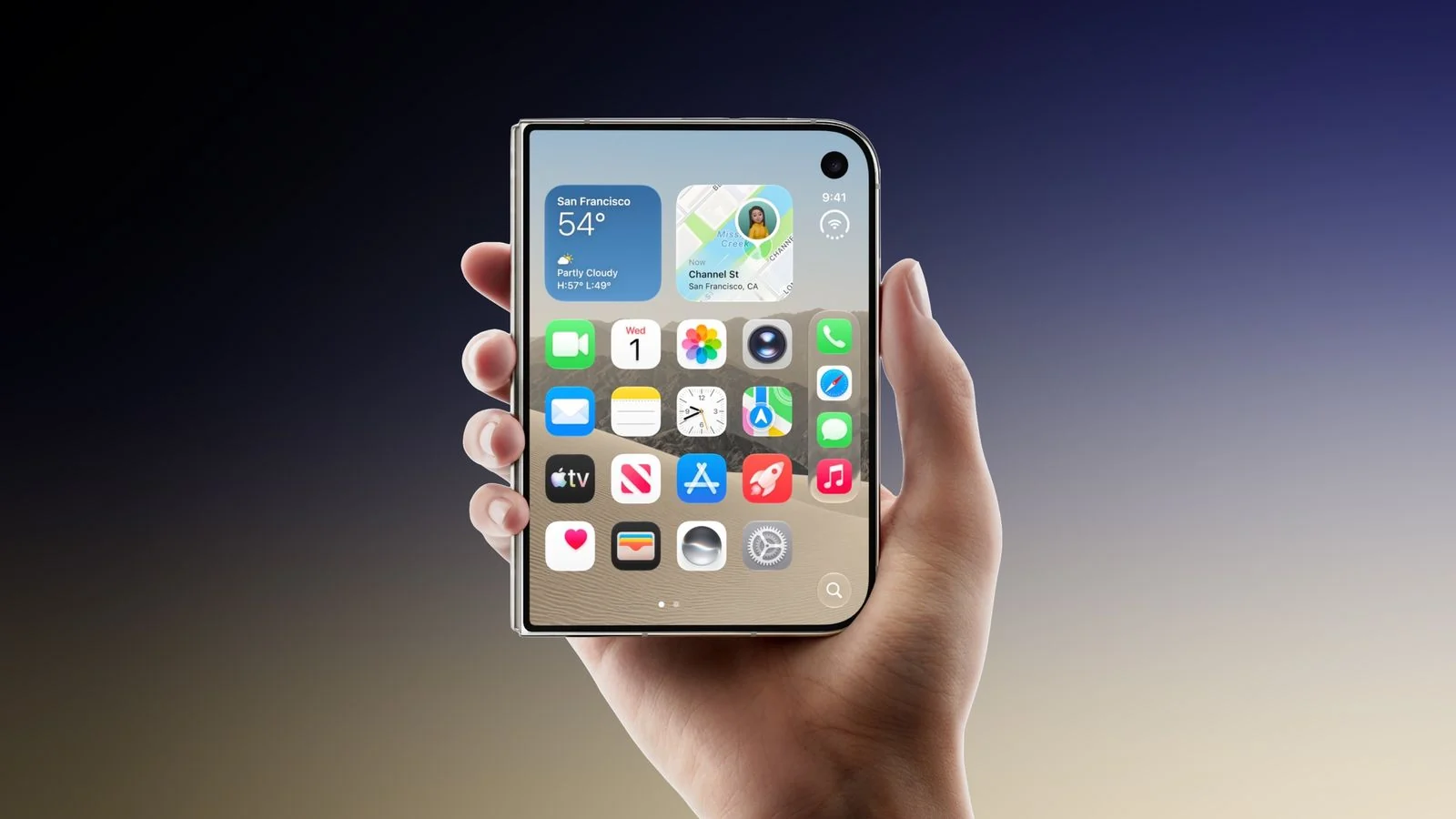
Market-share charts are easy to skim and hard to act on. The newest one from TrendForce says the iPhone Duo will climb to 29.8% of global foldable smartphone shipments in 2027, close to a third of a category that did not have an Apple device in it until this year. Useful headline, incomplete answer. Below we translate that forecast into the questions a shopper actually faces: how much of that number is hype versus logistics, what the same event looks like through the lens of IDC and Counterpoint, and which of the three credible flagship folds fits which kind of user.
Three conclusions up front
- For Apple households, the real variable is supply, not appetite. Apple has publicly described demand for the device as "unusually strong", and delivery dates slipped in several markets within days of preorders opening. TrendForce's own trajectory - around 5 million units shipped by the end of 2026, equal to 24.8% share, then 29.8% in 2027 - implies that shelves, not wishlists, are the constraint.
- For Android fold loyalists, nothing forces a switch yet. Samsung keeps first place at 31.9% and Huawei holds third at 21.3%. The hardware trade-offs on the desk today - weight, windowed multitasking, service access - still favour one camp or the other depending on how you work.
- For everyone, treat a single share number as the midpoint of a range. TrendForce models 23.5 million foldable units in 2027 on 16.3% growth, after a 2026 that grows just 0.5%. Rival houses publish far steeper curves, so the honest reading is "direction is clear, magnitude is not".
What the report actually says
TrendForce's earlier estimate had the iPhone Duo at roughly 5 million units shipped by the end of 2026, giving Apple a 24.8% slice of the foldable market in its opening season. That debut lands in a category that is barely moving: the firm puts full-year 2026 growth at only 0.5%, with shipments from some Android fold vendors falling by more than 20% year on year.
Apple's arrival is what the analysts expect to bend the curve. Global foldable smartphone shipments are forecast to reach 23.5 million units in 2027, up 16.3% - the strongest expansion the segment has seen since the first hinge designs went on sale. In the report's reading, the value of Apple's entry is not the logo but the plumbing: tight integration of silicon, operating system and developer ecosystem, plus app adaptation and hardware reliability that keeps improving. That combination, TrendForce argues, pushes the competitive agenda away from novelty shape and toward productivity, multi-task handling and software polish.
The scoreboard, ranked
| Position in 2027 (TrendForce scenario) | Vendor | 2026 share | 2027 share | What the move means |
|---|---|---|---|---|
| First | Samsung | 35.1% | 31.9% | Still the leader, but surrendering ground for the first time since it owned the format |
| Second | Apple (iPhone Duo) | 24.8% (launch season) | 29.8% | Near 30% share with a single model, on a first generation of hardware |
| Third | Huawei | 24.8% | 21.3% | Squeezed between the two ecosystems that own their app stores outright |
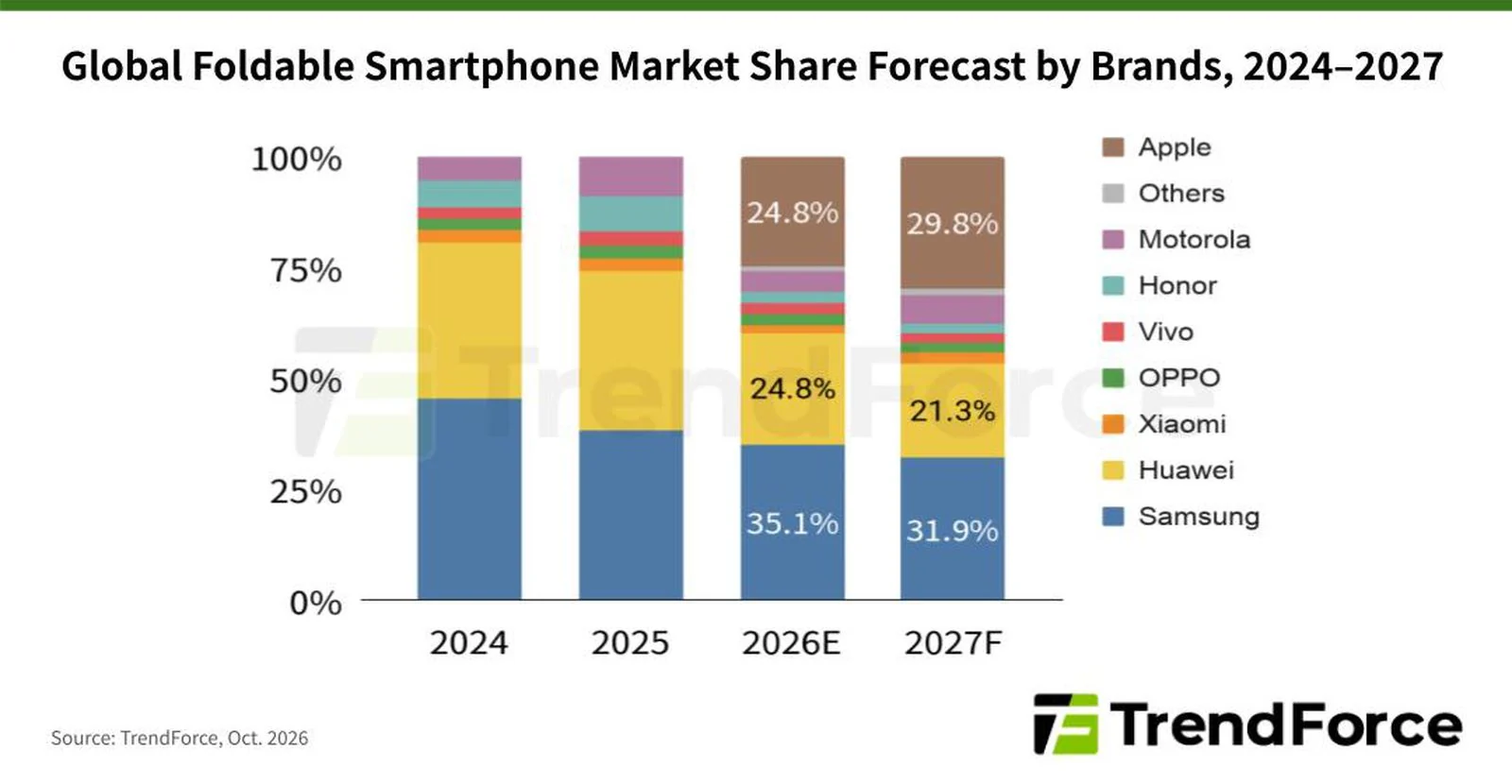
Read as a buying guide rather than an earnings note, the table says something quieter: foldables in 2027 will be a three-horse contest between ecosystems, not a technology race between hinges. If the projection holds, Apple will have captured close to 30% of the world's foldable shipments within two years of shipping its first one.
Same event, three very different numbers
One gap that headline summaries rarely cover is how wide the analyst spread is around the exact same product launch.
- TrendForce: about 5 million iPhone Duo units in 2026, 24.8% share, then 29.8% in 2027 on a 23.5 million-unit market.
- IDC: in a mid-2026 outlook the firm forecast Apple shipping more than 17 million foldable iPhones by 2027 and taking roughly 40% of the foldables market, and it separately estimated Apple exceeding 22% of first-year foldable units while holding about 34% of foldable market value - a reminder that premium pricing makes revenue share outrun unit share (source: idc.com blog, August 2026).
- Counterpoint Research: forecasts up to 6 million foldable iPhone shipments in 2026 for a roughly 25% share and the number-two slot, and expects the whole category to pass 100 million cumulative shipments by the end of 2026 (source: counterpointresearch.com).
The practical lesson: when a forecast says "29.8%", the useful question is not "is that number right?" but "which research firm's definition of the category, and which supply assumption, produced it?" Note also that the houses disagree about 2026 itself - TrendForce's cautious 0.5% market growth sits alongside IDC's projection of around 30% expansion for the same year.
Context the share numbers hide
Two framing facts make 29.8% look very different from 29.8% of, say, the whole phone market.
- Foldables are still a rounding error in global handset volume. Smart Analytics Global puts category penetration at roughly 1.5% of smartphone shipments in 2025, rising to about 2.2% in 2026. Twenty-odd percent of a two-percent niche is a strategy story, not a mass-market one.
- The winning format is the book-fold, and Apple pushed it there. Counterpoint has book-style (horizontal folding) models taking around 76% of foldable shipments in 2026, up sharply from 52% in 2025. Buyers who want a tablet-sized inner screen now have the deepest vendor support; shoppers who preferred lightweight clamshells should expect slower roadmap attention.
Three foldables, three trade-off philosophies
Specs below are drawn from Apple's own product pages, CNET's hands-on and review coverage, and independent spec databases; weights and prices vary by configuration and market.
| Dimension | Apple iPhone Duo | Samsung Galaxy Z Fold 8 | Huawei Mate X7 |
|---|---|---|---|
| Screens | 7.6-inch folding inner panel with nano-texture finish plus a 5.4-inch cover display that runs full apps | About 7.6-inch inner display in a wider, roughly 4:3 ratio that suits documents and split views | About 7.9-inch inner panel in a taller format, paired with a large outer screen |
| Mass and thickness | 254 g, 11.3 mm closed and about 5.2 mm open; thin when unfolded, noticeably substantial closed | Roughly 201 g and 9.7 mm closed, about 4.5 mm open - the lightest of the three folded | Roughly 235 g; the heaviest designs prioritise battery and camera modules over pocketability |
| Multitasking | Two apps side by side, fixed 50/50 split on the inner screen; saved app pairs, but no free-form windowing | Up to three apps plus desktop-style modes and stylus support - the productivity pick today | Multi-window on HarmonyOS with cross-device continuity; satellite messaging on some variants |
| Ecosystem lever | The exact strength TrendForce credits: chip, operating system and developer adaptation in one house | Broadest Android fold app base and the longest hinge-production history | Strongest retail and service network in its home market |
| Entry pricing | US$1,999 for 256 GB, with preorders starting 16 October and in-store availability from 23 October 2026 | About US$1,999 to US$2,099 depending on configuration and region | Launched in China around the 12,999 yuan mark, with official discounts appearing within months |
| Best fit | iPhone, iPad and Mac households that treat the inner screen as a reading and two-up workspace | Heavy multitaskers, note-takers and anyone who wants the lightest folded body | Readers inside Huawei's device family who value service access over app breadth |
Five common misconceptions
- "29.8% means Apple beat Samsung." It does not. In the same forecast Samsung stays first at 31.9%; Apple rises to second and Huawei holds third.
- "Big foldable share means foldables are mainstream." 23.5 million units in 2027 remains a fraction of a single percent band of all smartphones sold, on TrendForce's own maths.
- "Apple entering solved creases and repair bills." Vendor ratings measure mechanisms, not accidents. Samsung's lab figure of 500,000 open-close cycles for the Galaxy Z Fold 8 hinge is about the hinge; drops, dust ingress and inner-panel replacement are the cost drivers, and foldable inner screens still repair for a multiple of a conventional flagship's.
- "Demand and supply are the same story." Slipping delivery dates prove constrained allocation, not that list-price stock will be easy in 2027.
- "Unit share tells you who wins the money." IDC's split between roughly 22% of units and about 34% of value in Apple's first year shows how premium pricing distorts any single metric.
Before you order: a six-point checklist
- Decide which screen you will actually use daily. The inner panel is the product; if you never unfold it, you have bought weight and a repair bill.
- Compare folded mass, not unfolded thinness. Apple's own marketing leans on a 5.2 mm open profile while the closed device is 11.3 mm and 254 g.
- Count the windows you need. Two-app split is enough for reading plus messaging; three apps, desktop mode or a stylus is Samsung territory.
- Price the risk, not just the phone. Check what an out-of-warranty inner display costs in your country and whether an accidental-damage plan is bundled or sold separately.
- Locate the service network. Fold repairs are modular and slow; a nearby authorised depot matters more than a 5% cheaper online price.
- Ask what generation you are comfortable owning. First-generation folds across the industry have carried the rough edges; TrendForce's 2027 numbers assume those edges get smoothed out.
Decision guide by reader type
If you are already an Apple household on a two-year upgrade cycle: waiting into 2027 is the low-risk move. The forecast itself argues that availability improves as the product ages, while the ecosystem adaptations - app optimisation, reliability refinements - are exactly what TrendForce credits for the jump from 24.8% to 29.8%.
If you want a foldable now and you live in Android: the case for Samsung or Huawei is unchanged by this report. Both keep first and third place, and windowing breadth remains ahead of the iPhone Duo's two-app split.
If you are a value buyer: watch the clamshell and older-generation book folds. Apple's entry validates the format rather than cheapening it, and a maturing category usually pushes first-generation pricing down before it pushes second-generation features up.
FAQ
Is TrendForce's 29.8% forecast something to rely on?
Use it as a directional benchmark. TrendForce is the source behind the widely quoted launch-season estimate of about 5 million iPhone Duo units by the end of 2026, but IDC and Counterpoint model different Apple volumes for the same period, so treat the figure as one scenario inside a range.
Should I wait for a second-generation foldable?
If your priority is long-term reliability and total cost of ownership, yes - and the report's logic supports it, since it ties the 2027 leap to improving hardware dependability and app adaptation rather than a new shape.
Do foldables still have a visible crease?
Modern ultra-thin folding glass and precision hinges have reduced crease visibility to a side-light detail on flagship models, but the fold is a physical feature, not a defect you can design away entirely.
Can a foldable replace a tablet?
Partially. A 7.6-inch inner display handles reading, split-view reference work and light document editing. It does not replace a 11-inch tablet for annotation-heavy or multi-window work, and no forecast - near 30% or higher - changes that limit.
Does Apple's success hurt Huawei and Samsung owners?
It compresses the middle. Under TrendForce's scenario both slide, from 35.1% to 31.9% and from 24.8% to 21.3% respectively, while the two ecosystem leaders consolidate. Expect faster software support on the top-selling lines and slower attention to niche form factors.
The takeaway
TrendForce has handed the industry a clean proposition: one new device can move a stagnant category from 0.5% growth to 16.3% and put a first-time maker within sight of the lead. For readers the translation is simpler. The foldable market of 2027 will be decided by ecosystems and service economics, not by who folds a screen best. Match the device to how many windows you open, how heavy a pocket you accept and how close the repair depot is - then let the share charts be whatever they want to be.
Prepared by James Hartley, IT Insights. For corrections, data questions or reader tips about this comparison, write to contact@itinsights.com.