
Toyota Eyes the Robotics Crown as Its Next Growth Engine Beyond Cars
The world's largest carmaker is selling investors on growth that sits outside the automobile. According to the Financial Times, Toyota is aiming to become a leading force in the global robotics industry, modernising its production lines both to withstand competition from China and to open up a new source of expansion.
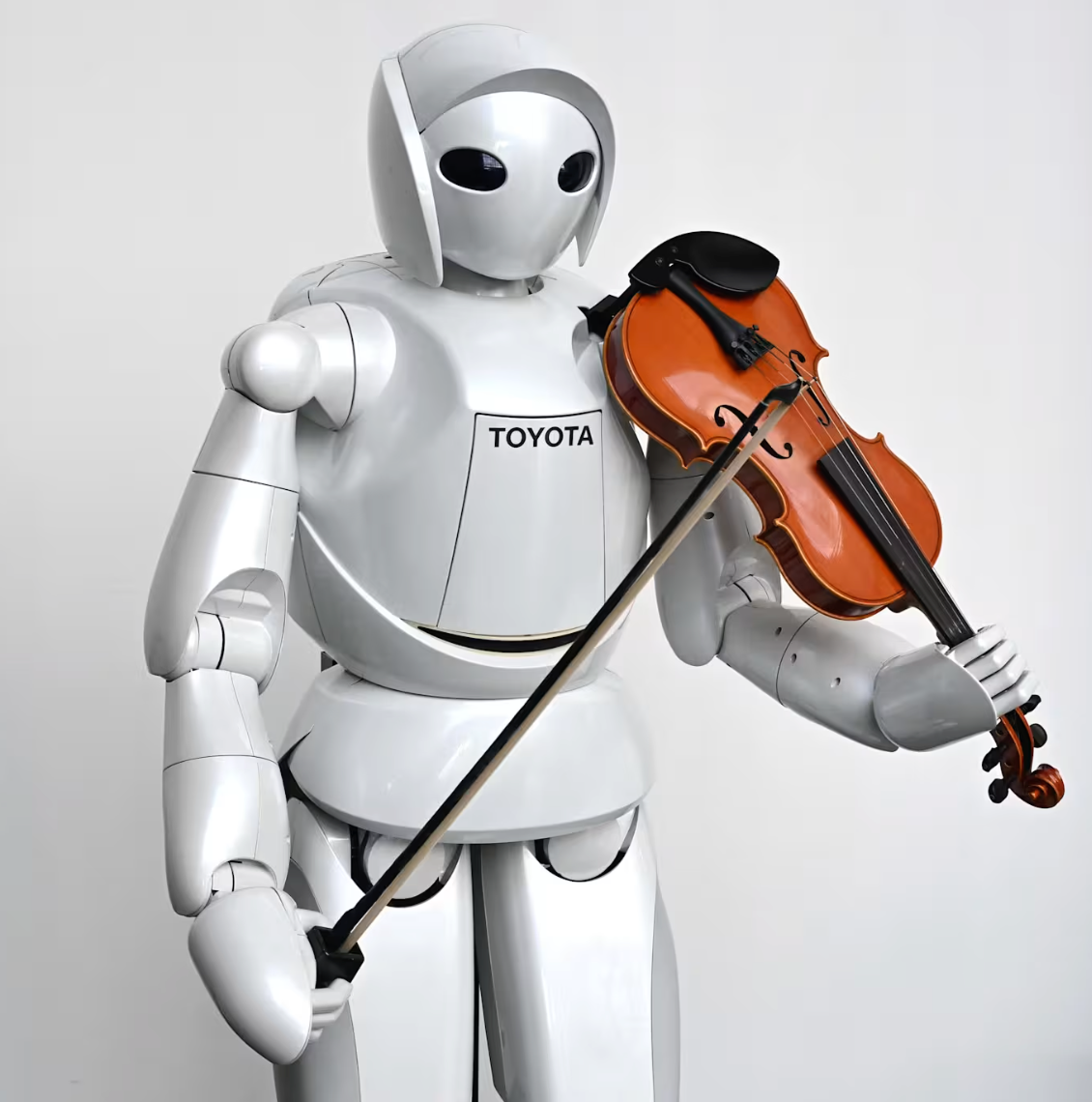
Pictured: a humanoid robot developed by Toyota.
The pitch is being delivered directly to global investors by Toyota's senior executives. Under an investment plan of $6.4 billion a year, the company intends to deploy 400,000 robots to advance factory automation, while a dedicated robotics team is being assembled under the chief production officer.
Multiple signals suggest Toyota is now trying to turn 20 years of robotics research into the commercialisation of intelligent robots, a field where it competes with Tesla, XPeng Motors and Hyundai Motor. The shift is drawing growing attention from investors.
"I think Toyota could become the world's biggest humanoid robot company — it just needs to let itself go and do it," said Carl Vine of asset manager M&G, an investor in Toyota. "Whoever controls the software layer controls global manufacturing. Toyota is developing its own large behaviour model... and because its business is so enormous, it holds huge amounts of data in-house. Those are the critical ingredients."
Goldman Sachs analysts share that read on the outlook. Working from Toyota's technology base and its experience of mass production, they estimate the group could capture 3% to 8% of the global humanoid robot market by 2035, equivalent to sales of 190,000 to 540,000 humanoids.
Tesla CEO Elon Musk has also been outspoken, describing Tesla's Optimus humanoid as the "most important product of all time" for the company and setting a long-term goal of lifting annual output to 1 million units. Production of the robot has begun, though it has not yet entered large-scale manufacturing.
A Late Entry Into a Race Japan Was Once Synonymous With
Through the first decade and the second decade of this century, Honda introduced its Asimo humanoid and SoftBank unveiled Pepper, and Japan came to be viewed almost as the face of robotics. As artificial intelligence has risen, however — and as clips of Chinese humanoid robots dancing and practising kung fu have spread online — a growing view holds that Japan has slipped behind the United States and China.
Pictured: Toyota CEO Kenta Kon driving the robotics agenda.
In robotics ambition, Toyota is the latecomer; its rivals have likewise moved into the technology, hoping to bring down car manufacturing costs and to find fresh revenue.
People close to Toyota said the company's promotion of its robotics ambitions stepped up sharply after new CEO Kenta Kon took over. The reason, they added, is that Toyota has realised it must work considerably harder if it is to compete with China on factory production lines and in technology.
Toyota has an opportunity to introduce robotics when a new car assembly plant near Nagoya comes online in the early 2030s — the group's first new assembly plant in Japan since 2012.
"The people responsible for production had almost stopped thinking about using new technology to build cars," a former Toyota executive said. "The production system is now one of the keys to competing with China. Robotics is an important means for Toyota to respond to competition from Chinese manufacturing."
The Assets Behind the Bet
The case Toyota puts to investors rests on what it already owns: two decades of accumulated robotics research, the mass-production capability Goldman Sachs points to, and the internal data that M&G's Carl Vine calls decisive. Whether the group will now let itself go after that prize is the open question — and the Nagoya-area plant of the early 2030s will be the first place the ambition becomes visible.