
ItInsightsWorld Explainer: Tesla's Emergency Drive Away — When a $539 Escape Hatch Beats a 170,000-Yuan Bill
Start with the verdict, because this is one of the rare car features where the price tag is printed on the receipt. Tesla's Emergency Drive Away, shipped free in software update 2026.38.3, lets a driver pull away from a Supercharger with the connector still locked into the car. It saves seconds when seconds matter — and then bills you like a tow truck you called for fun.
At ItInsightsWorld we test new tech against three questions: what problem does it solve, what does the escape hatch cost, and who is most likely to hit it by mistake. Tesla has been unusually honest on the first two. The answer to the third arrived a few days ago, when a fatigued driver at a station in Austin became the first recorded accidental activation of the mode.
1. What the update actually changes at the stall
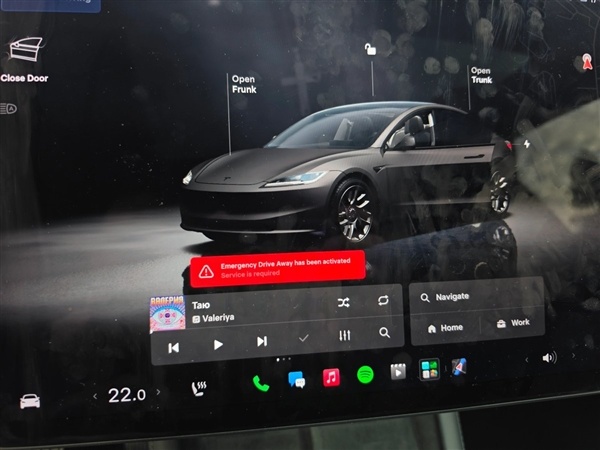
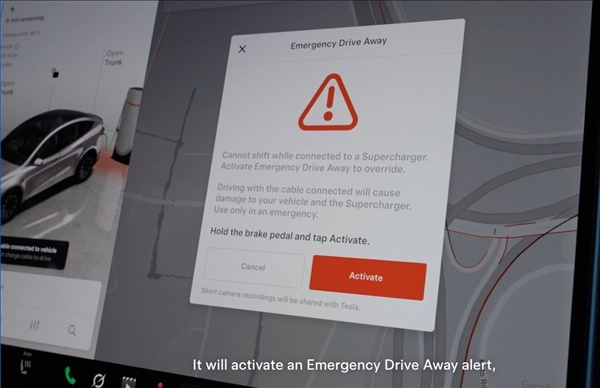
Before the update, a plugged-in Tesla simply refused to select a gear. Now the centre screen interrupts with a red warning that says, in effect, you cannot select a gear while connected to a Supercharger, and that activating Emergency Drive Away will force a release. Confirming is deliberately awkward: hold the brake pedal and tap Activate at the same time. Once engaged, the car can drive off and the connector is torn from the port. At the same moment the vehicle sends Tesla a short camera clip — the first half of the evidence file used to decide whether the escape was genuine.
2. Why the feature exists: the Twin Falls trigger
The origin is not marketing copy but an incident report. Coverage of the 1 August shooting at the Supercharger beside an In-N-Out in Twin Falls, Idaho, described people sitting in plugged-in cars that could not be driven away because the connector stayed locked (see auto.ifeng.com and the Wikipedia entry compiled on the case). Tesla's response reorders the priorities at a charging stall: occupants first, hardware second. The joint between handle and cable is built to give way so that a person can leave immediately, and the update exists for that one scenario.
3. Who can use it — and who cannot
Scope is the single most misunderstood part of the rollout, so it is worth pinning down before any cost discussion.
- Where: U.S. Tesla Superchargers only. Coverage of the launch notes the mode is not available at third-party stalls.
- Which hardware: V2, V3 and V4 Supercharger posts. It is not a solution for Wall Connectors, Mobile Connectors or destination chargers.
- Which cars: the update must be installed; reporting from Car and Driver and HotCars notes pre-2021 Model S and Model X are excluded.
- What it costs upfront: nothing. The fee appears only after the mode is engaged.
4. Cost comparison: four ways to leave the same stall
Read the table as a trade-off sheet, not a spec sheet. The same car, the same cable and the same five minutes can end in a zero invoice or in a six-figure problem.
| Path | What the driver does | Car side | Station side | Likely bill |
|---|---|---|---|---|
| Normal finish | Stop charging, unlock the car, walk the handle back | No stress on the port | None | Nothing |
| Cable stuck, nobody in danger | Official troubleshooting: press Stop Charging on the touchscreen, unlock the vehicle, pull the manual release cable on the left side of the rear trunk, defrost or run the inlet heater if the latch is frozen | No forced release | None | Nothing — this is the free path almost nobody reads |
| Activate tapped by mistake, car never moves | Red alert persists; a service inspection is demanded | Charge port checked, alert cleared | Untouched | $539, about 3,595 yuan |
| Real drive-away with the gun still in | Car leaves, connector rips out | Damage depends on pull force and angle; severe cases need a whole charge port module | Pedestal, cable and internal equipment can suffer, with glycol coolant leaking along the line | Up to $25,000 in stall repairs, plus possible fines |
Tesla's own figure for station damage is $25,000, converted in the coverage as roughly 16.7 wan yuan — about 167,000 yuan — and once port replacement and fines stack up, the worst-case tally circulating around the story sits near 170,000 yuan.
5. Do the arithmetic before you judge the penalty
$25,000 sounds punitive until you compare it with what a stall actually costs. Tesla's public Supercharger-for-business configurator, broken down by Electrek in April 2026, priced an eight-post V4 site at $500,000 in hardware, with installation running about $55,000 per post — roughly $940,000 all-in before land and grid work. Dragging a live cable through a pedestal can therefore consume something close to 40 percent of one post's hardware value in a single evening. The fine is not a punishment invented by a legal department; it is close to the repair invoice.
6. Four misconceptions worth deleting from your mental model
- "It works wherever the cable is stuck." It does not. Outside U.S. Superchargers, and outside a genuine threat, the free manual-release routine in the owner's manual is the correct tool.
- "A quick test costs nothing." The alert is persistent and the inspection is demanded even when the car has not moved an inch.
- "Only the connector tip breaks." Electrical components and the civil works around the post can be involved, and coolant loss along the cable raises the repair scope.
- "Every activation invoice looks the same." The $539 figure came from an owner posting on X; another owner's account on the TeslaSupport subreddit described the inspection itself being absorbed under warranty, with only a small unrelated line charged. Outcomes are negotiable.
7. Verification: the two data streams are your leverage
When the mode engages, Tesla receives both a short camera clip and vehicle telemetry — the two signals that decide whether a car actually rolled while plugged in. If both say it did not, the sensible remedy is a remote clearing of the service alert instead of a paid workshop visit. That is precisely the situation reported on X by user @Tutrifour, whose car did not move an inch and who was still quoted $539, a conversion of roughly 3,595 yuan noted by Chinese tech outlet Kuai Keji, for inspecting the port and clearing the alert. Notably, in that state the car still charges normally afterwards.
Two practical points follow. First, in the days before the fix ships, evidence is worth money: photograph the stall number and the centre-screen warning, and ask for the telematics record in writing. Second, if nothing moved and nothing is damaged, request remote alert clearing and warranty handling before paying anything.
8. A 60-second decision checklist
- Is a person in danger right now? Yes — use Emergency Drive Away without hesitation. No — go to step 2.
- Cable refuses to release? Stop charging on the screen, unlock the car, pull the manual release cable in the rear trunk.
- Winter and a frozen latch? Run the defrost or inlet heater and wait; do not yank.
- If you must activate, do it once, deliberately, brake held and one tap on Activate — the Austin case happened because the driver tapped through every confirmation while fatigued.
- After any activation, inspect the port visually, log the time and stall, and book the required check.
- Car did not move? Ask for remote alert clearing instead of paying the inspection fee.
- Never treat the mode as an exit shortcut. Misuse can trigger fines on top of the repair bill.
FAQ: the four questions the desk keeps receiving
Is it an option I have to buy?
No. It arrived in the 2026.38.3 over-the-air update and is enabled at supported stations; the money appears only after you engage it.
Will it save me at a non-Tesla fast charger?
Current availability is limited to Tesla Superchargers in the United States, so at third-party hardware the older problem remains — and there the network's own release procedure applies.
My car never moved, so why the workshop?
Because activation forces the connector out and sets a service flag. Tesla's stated requirement is an inspection of the charge port; the fee discussion is about whether that inspection should be charged or handled remotely.
Can I still charge normally after a false alarm?
Yes. Owners describing the paid inspection also confirm the vehicle continues to plug in and charge as usual.
Our verdict
Judged as a product, Emergency Drive Away is an honest safety feature with an unfinished interface: the intent is correct, the warning flow is not forgiving enough, and the follow-up cost is applied too bluntly. Tesla's charging director Max de Zegher has said the company will move quickly on owner feedback, with accidental activation as the first thing to be optimised. Until that lands, treat the red screen as what it is — an airbag, not a doorbell. Keep the manual release in the trunk in mind, and you will never have to compare $539 against a 170,000-yuan repair estimate.
By James Hartley, IT Insights. Have a stall story that checks our arithmetic? Write to the desk at contact@itinsights.com.