
From Cybertruck to Cybercab: Why Tesla Is Swapping Its Texas Line in About Eight Months | ItInsightsWorld
On November 9, Elon Musk said on X that Cybertruck orders are growing faster than the factory can fulfil them, yet the line at the Texas Gigafactory will be shut down in about eight months and a lot of customer deposits will have to be returned. The story is not a money-losing pickup. Musk rejected the claim that "Cybertruck is not profitable" and recast the decision as an opportunity-cost trade: scarce tooling, shifts and floor space move away from an unusually difficult build and toward Cybercab, Tesla's steering-wheel-free Robotaxi vehicle.
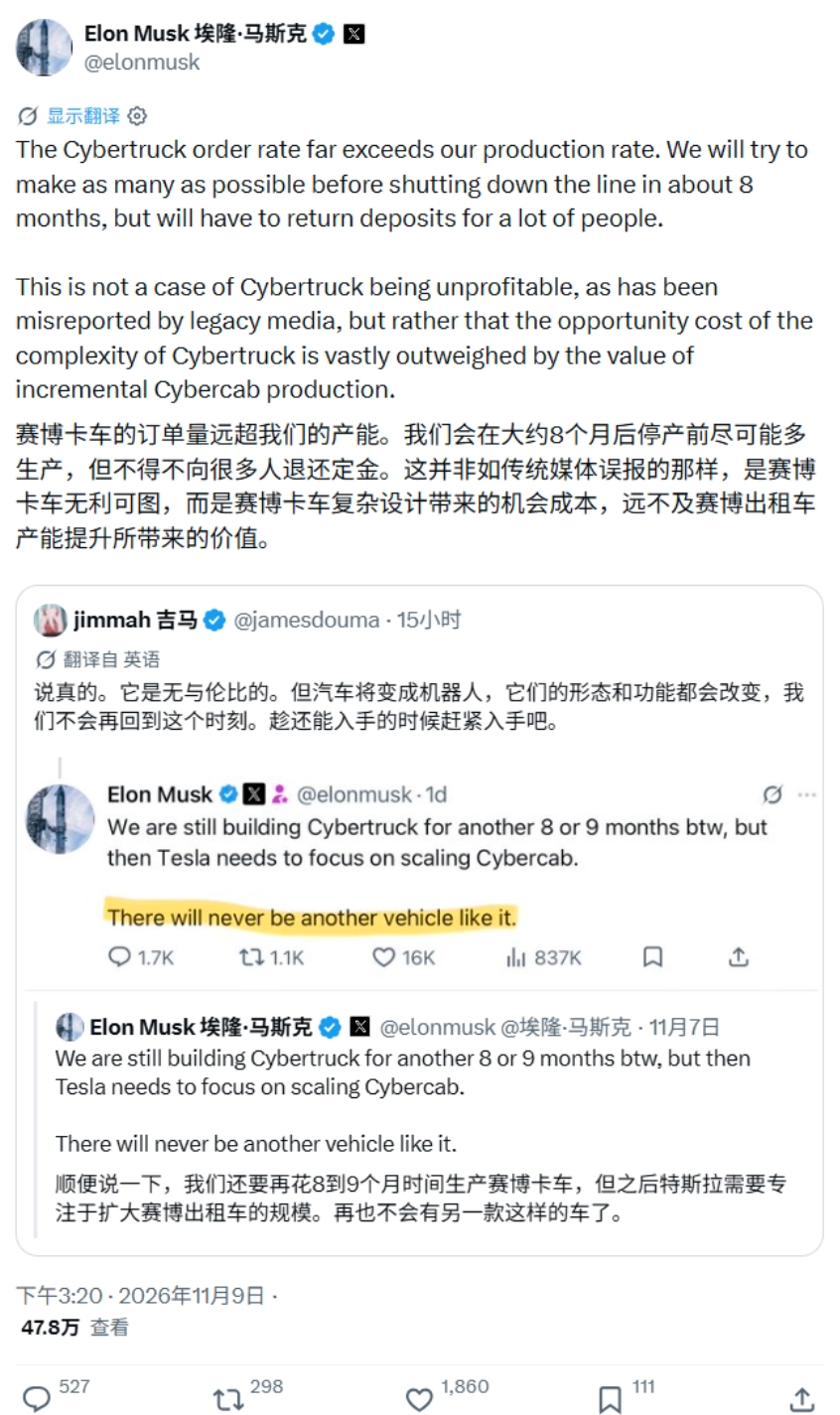
What did Musk actually say, and what does the record show?
The primary record is short. On November 9 Musk posted on X that Tesla would "try to make as many as possible before shutting down the line in about 8 months, but will have to return deposits for a lot of people", as Reuters reported the same day. In the days before that post he had said an extra production shift would be added so that as much of the backlog as possible is finished before the line is dismantled, and earlier reporting dated November 6 had already placed the end of Cybertruck production at the Texas Gigafactory around mid-2027, with the freed space going to Cybercab expansion. Tesla has published neither the number of outstanding reservations nor the deposit money involved, so treat any precise figure circulating online as an estimate, not a fact.
For households holding a reservation, the refund question looks worse than it is. Tesla's own Cybertruck support page states that a reservation can be cancelled at any time before delivery and the pre-order payment refunded in full. What the wind-down really costs an order holder is queue position and waiting time, not the deposit itself.
How wide was the gap between the 2019 hype and the 2026 output?
The numbers explain why a "sold out" product can still be the wrong use of a factory.
| Milestone | What is on the record | What it signals |
|---|---|---|
| November 2019 | Design reveal and reservations opened; reservations were claimed at over 1 million | Demand was captured years before a buildable, deliverable product existed |
| November 2023 | First deliveries reached the first owners | An almost four-year delay between order and road |
| Q2 2026 | The "other models" group - Cybertruck, Semi and the last batch of Model S/X - delivered 12,364 units combined | Tesla still does not disclose Cybertruck sales separately, so the model hides inside a small aggregate |
| First three quarters of this year | Cybertruck sales fell 28% year on year, with about 11,600 units sold | Registered demand is contracting even while the order book is described as long |
| Around mid-2027 | Planned wind-down of Cybertruck production at the Texas Gigafactory | Shifts and floor space are reassigned to Cybercab ramp-up |

Two further dates sharpen the comparison. Tesla confirmed during its first-quarter 2026 earnings call that Cybercab production had already begun at the same Texas Gigafactory, as Electrek reported on April 23, 2026. And the volume ambition behind that car has been public since the We, Robot reveal on October 10, 2024: Tesla has discussed a long-term run-rate of roughly two million Cybercabs a year, with engineering leadership noting on earnings calls that more than 90% of vehicle trips carry no more than two passengers. Measured against about 11,600 Cybertruck sales in nine months, that is the arithmetic Musk is pointing at.
If the truck is not unprofitable, what is Tesla really optimising?
Musk was explicit that the "Cybertruck is not profitable" framing he had seen in media coverage was wrong. His stated reason is an opportunity-cost calculation: the engineering attention and production complexity that Cybertruck consumes are more valuable to Tesla when redirected, and Cybercab ramp-up is the competing use of exactly those hours and that roof. In other words, the truck is not being cancelled for losing money; it is being cancelled because the next unit of it costs the company something better.
Tesla's own chief engineer, Wes Morrill, put the softer version of the same point: Cybertruck is a technology development platform. Its 48V low-voltage architecture, steer-by-wire control and Etherloop wiring system are not stranded by the shutdown - they are inherited by Cybercab. The 3 mm cold-rolled stainless exoskeleton that made the truck expensive to build and awkward to repair is the part that stays behind.
That repair burden is the least discussed cost. Reporting by InsideEVs has pointed out that stainless panels are difficult to reshape, so collision work tends toward whole-panel replacement rather than the localised repair an insurer expects from a steel or aluminium body. A vehicle whose accident recovery is slow, specialised and expensive also drags on service capacity - a hidden tax on low-volume, high-complexity models.
Why Cybercab deserves the floor space it is taking
Cybercab is a two-seat, L4-level design with no steering wheel and no pedals, built as the core vehicle of Tesla's Robotaxi fleet, already in production at the Texas Gigafactory in 2026 and under road testing in Austin. The strategic clock is what makes room for it urgent.
- Competitive pressure is measurable. TechCrunch reported in September 2026 that Waymo was delivering around 500,000 paid robotaxi rides a week across 15 US cities, with its executives targeting more than one million weekly rides by the end of 2026. A fleet-native car is Tesla's answer to that head start.
- Regulation is moving in the same direction. In late October 2026 the National Highway Traffic Safety Administration outlined performance-based federal safety standards that would cover autonomous vehicles without steering wheels or pedals - the class Cybercab belongs to.
- Compliance remains the open risk. The same regulator was reported in September 2026 to be scrutinising how a car with no manual controls was self-certified. Ramp-up economics depend on that question being resolved.
This is Tesla's second production-line swap in under a year
Read the Cybertruck decision next to an earlier one and the pattern becomes the lesson. In January 2026 Tesla announced the end of Model S and Model X production; those lines were subsequently removed and repurposed for Optimus, the company's humanoid robot. Tesla-published time-lapse footage of the dismantling work, summarised by ThomasNet, put the teardown at 46 days. Two legacy products have now been cleared out to release factory space for autonomous vehicles and robots, which suggests Tesla now treats a vehicle line as a reconfigurable asset rather than a permanent home for a nameplate.
Four misconceptions worth clearing up
- "A long backlog means strong demand." Most of that backlog was assembled in 2019 and held through four-year delays; deposits are refundable, so queue length overstates present purchase intent.
- "Tesla is killing a product that loses money." Musk denied exactly this, citing process complexity and opportunity cost instead.
- "Refunds mean reservation holders lose money." Tesla's published policy is a full refund of the pre-order payment when an order is cancelled before delivery.
- "The truck's engineering dies with the truck." 48V, steer-by-wire and Etherloop carry forward into Cybercab, per Wes Morrill.
Decision checklist: what to do depending on where you stand
- If you hold an undelivered Cybertruck order: decide against a deadline, not a hope. Tesla says it will build as many as possible in about eight months and then return deposits for a lot of people. Ask for your queue position, set a personal cut-off date, and cancel on your own terms rather than waiting to be cancelled on Tesla's.
- If you already own one: shift attention from resale hype to ownership mechanics - panel availability, authorised body-shop capacity and insurance treatment - because a discontinued, complex body tends to raise repair time before it raises resale value. Our breakdown of the model's price moves and recall history is here.
- If you are comparing EV purchases this year: weigh lifecycle evidence - service burden, price movement, support duration - above headline popularity. A practical framework is in our lifecycle comparison for everyday buyers.
- If you track the company rather than the car: watch three verifiable checkpoints - whether an added shift is staffed, whether Cybertruck volume in the "other models" line improves from the 12,364-unit Q2 2026 base, and whether Cybercab clears its federal certification questions.
FAQ: the questions readers actually ask
Is Tesla definitely ending Cybertruck production?
Yes, on the record as Tesla has stated it. Musk described winding down Cybertruck production at the Texas Gigafactory around mid-2027, with the line dismantled to expand Cybercab output. The variable is how many of the remaining orders get built before that happens.
When does the eight-month clock end?
Measured from the November 9 post, about eight months points to roughly the second quarter of 2027 for the end of the line's working life, consistent with Tesla's own "around mid-2027" language for the wind-down.
Will my deposit be refunded?
Musk said Tesla will have to return deposits for a lot of people, and Tesla's published Cybertruck FAQ allows cancellation before delivery with a full refund of the pre-order payment. Tesla has not published a refund schedule, so timing - not eligibility - is the practical uncertainty.
Why not run both lines instead?
Because Tesla's constraint is floor space and installed tooling, not order books. It had already demonstrated the same logic in January 2026, when Model S and Model X production ended and the space was converted to Optimus.
Does this mean Cybercab will now scale immediately?
Not automatically. Production has begun in Texas and testing has taken place in Austin, but ramp speed depends on the federal standards work now underway at the National Highway Traffic Safety Administration. Treat the switch as a bet that reallocates capacity, not as a guarantee of output.
ItInsightsWorld judgment
The useful takeaway is not that a polarising pickup is going away. It is that Tesla is now pricing its factory in units of strategic optionality: a low-volume, high-complexity model is worth less than the capacity, engineering attention and regulatory momentum it gives up. For general readers, that reframes how to judge a discontinued product - ask what the freed resources are being spent on, how transferable the technology is, and what the service tail looks like after the last unit leaves the line. Those three questions apply well beyond this one truck.
Reference sources
- Reuters (via The Fresno Bee), November 9, 2026: Musk on Cybertruck deposits and the roughly eight-month line shutdown - https://www.fresnobee.com/news/business/article317990863.html
- Tesla Cybertruck support and FAQ page on reservation cancellation and pre-order refunds - https://www.tesla.com/support/cybertruck-faq
- Electrek, April 23, 2026: Tesla confirms Cybercab production has started at Giga Texas - https://electrek.co/2026-04-23/tesla-cybercab-production-starts-no-nhtsa-2500-vehicle-cap/
- TechCrunch, September 24, 2026: Waymo fleet data and weekly paid ride volume - https://techcrunch.com/2026-09-24/waymo-is-scaling-fast-heres-what-the-fleet-data-shows/
- ThomasNet Insights, July 16, 2026: summary of Tesla's 46-day assembly-line teardown at Fremont - https://www.thomasnet.com/insights/tesla-assembly-line-teardown-fremont-factory/
- InsideEVs, December 2023: analysis of Cybertruck stainless-steel repair and insurance burden - https://insideevs.com/news/699189/tesla-cybertruck-repair-insurance/