
Case Review: The Terafab–TSMC Renegotiation and the Real Limits of Owning a Chip Factory
Strip the chip jargon out of the latest reporting and a very ordinary management story appears: a company that concluded it had to own the factory making its most critical component is now negotiating over who actually switches the machines on. Owning versus running is the pivot of the whole Terafab case, and it is the part most coverage treats as a footnote. For readers who simply want to know what this means for the price of robots, cars and AI services, the answer starts here rather than in a process-node chart.
Bottom line before the detail:
- The ambition has not been dropped; the deal shape has. As DigiTimes reported, citing supply chain sources, Musk is re-evaluating how to advance the Terafab chip plant and the two sides are preparing to reopen talks.
- TSMC's condition has not moved. Chairman and CEO C.C. Wei said it plainly on October 15: in any wafer fab the company joins, operations must belong to TSMC.
- The transferable lesson is generic: capacity is bought with tools, trained people and yield learning, not with land, concrete and a press release.
Case file: how one position moved in six weeks
- In early October, Musk confirmed that discussions with TSMC about Terafab were under way.
- Shortly after, he narrowed the offer in public: Tesla and SpaceX would build and operate Terafab themselves, and TSMC could at most lease part of the facilities.
- On October 15, on TSMC's earnings call, C.C. Wei said the company had sent a team to Texas to assess the project and had discussed capacity cooperation with the Terafab side, while insisting that whoever operates an advanced fab of that kind has to be TSMC.
- Now, the reported direction is the mirror image of step two. Factory operating control, co-investment and technology cooperation are all said to be in play, with advanced packaging also on the agenda because AI chip demand keeps packaging capacity tight. TSMC may end up carrying the primary responsibility for building and running the plant, while the equity split, the investment ratio and the division of work remain unsettled.
Notice what changed and what did not. Nothing in the reporting suggests TSMC relaxed its requirement; what moved, according to supply chain sources relayed by DigiTimes, was Musk's willingness to accept it. That is the single most reusable observation in this case: in a negotiation over an operationally unforgiving asset, the party whose constraint is physical rather than financial usually wins that constraint.
Why TSMC will not sign up as a tenant
Read the demand as economics, not pride. McKinsey's semiconductor cost analysis estimates that a standard mature-logic fab built in the United States costs roughly 10 percent more to build and up to 35 percent more to operate than the same facility in Taiwan, even with subsidies counted. Advanced nodes are harder still, because the cost gap is dominated by labour productivity, construction pace and the density of nearby suppliers, not by the price of the shell.
The second constraint is people, and TSMC's own American record is the evidence. Its first Arizona fab only reached volume production in the fourth quarter of 2024, a second fab has now been completed and a third has moved into construction, with the company and local reporting describing a long ramp of hiring and training programmes (Focus Taiwan; Taipei Times). If a customer-owned shell with a foundry tenant inside it produces at 80 percent of expected yield, the customer still blames the foundry brand. Operator control is how TSMC prices that risk.
Packaging is the third reason, and the most concrete for ordinary readers. Industry trackers have described CoWoS-class advanced packaging as effectively booked out through 2026, with reported lead times of 52 to 78 weeks; TSMC has not confirmed those figures, but the tightness is why packaging cooperation keeps resurfacing as a discussion item rather than a footnote.
The project numbers, and what that money does not buy
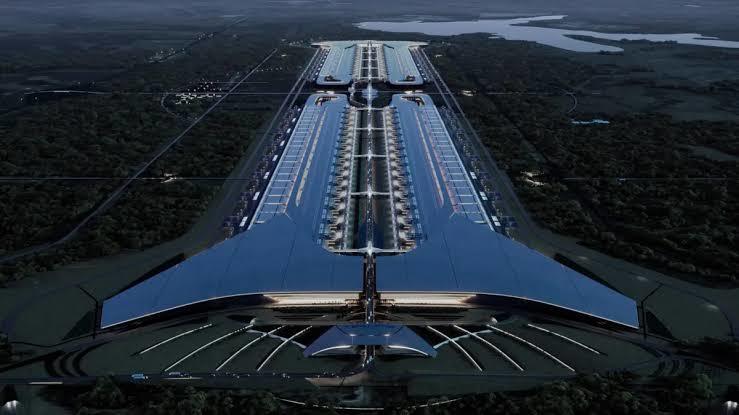
Terafab is being advanced by SpaceX and Tesla, with the site in Grimes County, Texas, in the United States. SpaceX's published plan concentrates advanced logic and memory chip manufacturing, packaging and test inside one campus, with more than 100 million square feet of planned manufacturing space, and the first phase is expected to draw about $16.8 billion of investment from SpaceX and Tesla. On the demand side, SpaceX says future chip requirements at Tesla and SpaceX are expected to exceed 1 terawatt of compute, and Terafab output is aimed at Optimus robots, Cybercab and SpaceX's planned space data centres. The declared goal is to reduce Musk's companies' dependence on external chip capacity while widening the supply of computing power for AI and robotics.
Here is the context check most headlines skip. Consultancy Simon-Kucher puts a single leading-edge fab today at roughly $15 billion to $20 billion. Set against that yardstick, $16.8 billion is about one fab's money chasing a campus of more than 100 million square feet of planned manufacturing space. The gap is not an error in the plan; it is a signal that the campus is meant to be filled over many funding rounds, which is precisely why opening the door to a co-investing operator is a rational retreat rather than a defeat.
The gap in most coverage: Musk's chips are still being made by other companies
Two public facts make the renegotiation far easier to understand. First, Tesla's next-generation AI5 processor was announced by Musk as complete in design on April 15, 2026, and is reported to be heading into manufacturing at Samsung's Taylor, Texas plant on a 2-nanometer-class process, with trial production reported in September 2026 and volume production expected in 2027 (Design-Reuse; Not a Tesla App). Second, Intel has publicly confirmed joining Terafab alongside SpaceX and Tesla, and Musk has said the intention is to use Intel's 14A process, which he described as state of the art but not yet fully finished (EE Times; Electronics360).
In other words, the same group that wants its own megafab is currently running a classic design-here-fabricate-there model across at least three outside suppliers. Terafab is therefore best read as a capacity hedge against a shortage, not as an ideological break with the foundry industry. That distinction is worth keeping in mind whenever a headline uses the word "independent".
Deal shapes on the table: a side-by-side read
The rows below are an analytical framing of the options described in the reporting, not separate announced plans.
| Model | Who builds | Who operates | Who carries capital risk | Speed to volume | Main vulnerability |
|---|---|---|---|---|---|
| Landlord model (Musk's original position) | Tesla and SpaceX | Tesla and SpaceX; TSMC at most rents space | Musk's companies | Slowest: own yield learning from zero | Rejected by the only operator with advanced-node depth |
| Operator-led model (current reported direction) | TSMC takes primary responsibility | TSMC | Shared, but equity split and investment ratio unresolved | Fastest credible path | Musk's core aim of controlling supply weakens |
| Packaging-and-licence hybrid | Split: campus by SpaceX and Tesla, tooling know-how by partner | Divided by process step | Both | Medium; packaging is the bottleneck that hurts most | Interface risk between logic, memory, packaging and test |
| Third-party process route (Intel 14A) | Existing US fabs | Intel | Intel, with customer commitments | Already live, tied to a node still maturing | Node readiness and allocation in a tight market |
If TSMC wins the construction and operating side of the argument, the architecture of the whole project shifts, including the role each named participant plays. Intel had announced its participation but the specific terms of that cooperation have not been disclosed, and any new TSMC mandate would likely redraw those lines.
Why the schedule, not the equity split, is the real risk
Tesla began construction of a research wafer fab in April this year at the north campus of its Texas Gigafactory, a facility treated as Terafab's lead-in project. Musk has said the team plans to finish a first test chip in May or June 2027 and is aiming for scaled production in the third or fourth quarter of 2028, while conceding the timetable is 'very aggressive' and that the project faces procurement challenges for advanced lithography and other semiconductor manufacturing equipment.
Two extra pressures sit behind that admission, and they are the ones that touch ordinary readers' wallets. One is equipment concentration: extreme ultraviolet lithography tooling comes from a tiny supplier base, so a new entrant queues behind incumbents who order years ahead. The other is policy. A 25 percent Section 232 tariff on certain advanced computing chips and specified derivative products took effect in the United States on January 15, 2026, according to legal and tax analyses of the presidential proclamation (EY; White & Case). That raises the landed cost of the very parts Tesla and SpaceX consume, and it is a fair explanation of why a domestic plant still has strategic value even when the arithmetic looks unattractive.
Four misconceptions worth correcting
- "This is Musk trying to cut TSMC loose." The reported outcome is the opposite: an enlarged TSMC role. The stated target has always been to reduce dependence on external capacity, not to end relationships with suppliers who are currently fabricating Tesla silicon.
- "A campus of more than 100 million square feet is the hard part." Square footage is the cheapest variable. Tool delivery, yield learning and trained staff decide whether silicon ever leaves the line.
- "Renting space makes TSMC a landlord." TSMC's condition, stated by C.C. Wei on October 15, exists precisely to prevent that arrangement from ever being offered.
- "A first test chip means products soon." Test silicon and volume supply are separated by yield ramp, packaging and qualification cycles measured in quarters, which is why the 2027 and 2028 milestones are stated as plans.
A reusable checklist for judging any 'we will build it ourselves' plan
- Ask who operates, not who owns. Ownership transfers balance sheets; operation transfers accountability for output.
- Divide the headline investment by the realistic cost of one unit of capacity. If the answer is well under one, the plan is a phased campus and later rounds are inevitable.
- Count the named suppliers for the two or three most critical tools. If the list is one or two deep, schedule risk belongs to you, not to them.
- Check whether the sponsor already buys the same input from outsiders. If yes, the project is a hedge, and hedge language is more honest than independence language.
- Test the timetable against the operator's own ramp record in the same country.
- Look for a policy or tariff line that changes the arithmetic; it often explains the timing better than technology does.
- Watch what has not been settled, not what has been announced: in this case the equity structure, investment ratio and specific division of work.
FAQ
What is Terafab, in one sentence?
A planned chip campus from SpaceX and Tesla in Grimes County, Texas, designed to combine logic and memory fabrication, packaging and test in one place for Musk's AI, robot and space businesses.
What exactly changed in the latest report?
Supply chain sources relayed by DigiTimes indicate Musk has softened his position on how to work with TSMC and that talks may be renegotiated, with TSMC possibly taking primary responsibility for building and operating the wafer fab.
Why does this matter if I do not buy chips?
Advanced packaging and leading-edge logic capacity set the ceiling on how fast robot fleets, driverless vehicles and AI services can scale. A new US campus plus an operator dispute is a story about future supply of consumer products, not only about two companies.
Is TSMC giving up anything here?
Nothing reported suggests so. It gains potential scope - construction, operations and co-investment - while keeping the one condition it has publicly insisted on: it runs fabs bearing its process.
What is the most likely next milestone to watch?
Whether the renegotiation produces an equity and responsibility structure before the test-chip target of May or June 2027, and whether equipment orders follow. Structure first, tools second, silicon third.
What to watch next
Four signals will tell you more than any statement: the announced equity and investment split, whether advanced packaging is written into the deal, the pace of lithography and fab-equipment orders, and whether the 2028 volume-production target survives its first quiet update. If you are reading this as a manager rather than a spectator, run your own build-versus-partner decision through the checklist above before you commit capital to a building. Control is real only where someone is willing to be accountable for output; everything else is construction.