
From 70% Weekly Use to 13% Frontier Firms: A Southeast Asia AI Case Review | ItInsightsWorld General
By Nathan Hale, technology analyst at IT Insights — General desk
Enthusiasm is not the bottleneck. Four published deployments — Grain in Singapore, Long Chau Pharmacy in Vietnam, Malaysia's grant-and-cloud build-out, Indonesia's capability pipeline — lead to one conclusion: durable gains show up only where leadership, training, data governance and daily operating habits are rebuilt as a single stack. Everything else in the regional numbers is demand waiting for that stack to arrive.
The material below is organized as case evidence rather than as a popularity contest. Sources are Google, Microsoft, IMDA, MDEC and Tech Wire Asia publications released between July 2025 and June 2026, and the sequence they imply transfers to any enterprise team deciding where the next year of AI budget should go.

Demand is visible on the surface of this market. The harder work sits underneath it, inside institutions.
Is the demand side still the problem?
No — on every published measure of individual behavior, the demand question is closed. Google's October 2025 note “Turning AI momentum in Southeast Asia into tremendous economic growth.” reports that 70% of people in the region already use generative AI tools weekly, a habit the company links to a potential US$270 billion contribution to regional output. The enterprise layer is not idle either: Microsoft's APAC Work Trend Index reporting of April 2025 (“APAC emerges as global AI frontrunner: Region's businesses lead worldwide intelligent agent adoption.”, published April 30, 2025) found 53% of APAC leaders using AI agents to fully automate workstreams or processes, the highest share of any region, and 52% of employees treating AI as a thought partner instead of a command line.
Four Microsoft Source Asia updates show the same shape across very different labor markets:
- Indonesia — 33% of workers qualify as Frontier Professionals in the June 30 update, more than double the 16% global average.
- Thailand — 32% of the workforce in that advanced-user band, per the August 4 release.
- Philippines — 25% already clear the threshold, according to the August 10 release.
- Malaysia — 24%, reported with the June 23 workforce update.
Attitudes track behavior. Tech Wire Asia's April 16 reading of Stanford's 2026 AI Index (“Southeast Asia leads the world in AI optimism. Its governance frameworks are nowhere near ready.”) recorded more than 80% of respondents in Malaysia, Thailand, Indonesia and Singapore expecting AI to profoundly change their lives within three to five years, with Singapore's generative AI adoption at 61% against 28.3% in the US. The July 11 brief on AI adoption in ASEAN trade finance explains the stickiness: usage concentrates where a concrete job already exists and the surrounding system is dense enough to absorb it. Southeast Asia is not waiting for someone to define mature adoption; it is waiting for organizations that can keep pace.
What did Grain actually change in Singapore?
Conclusion first: the food-technology company's numbers are an outcome of sequencing, not of tool selection. IMDA's AI for Enterprise Impact Playbook, released in May under the headline “New Playbook Charts a Clear AI Transformation Path for Local Enterprises.” (May 21, 2026), cites Grain as cutting product- and tool-development time by 80% and administrative workload by 20%. IMDA built the playbook jointly with SkillsFuture Singapore and Workforce Singapore, and presents it as a staged guide that matches support schemes to a firm's readiness level instead of pushing a single product shortlist.
The surrounding statistics explain why that case was selected. IMDA's National AI Impact Programme factsheet (“National AI Impact Programme: Empowering Enterprises and Workers to Transform with AI.”, March 2, 2026) shows Singapore SME adoption climbing from 4.2% in 2023 to 14.5% in 2024, while non-SME adoption moved from 44% to 62.5%. Strong curves — and a policy response that refused to treat them as finished work: NAIIP targets support for 10,000 enterprises over three years and AI Bilingual capability for 100,000 workers. That is an official acknowledgment that usage counts and institutional readiness measure different things.
Microsoft Singapore made the shortfall explicit in its April 29 essay “Fast AI adoption is not enough; Singapore must care about redesigning work.”: just 13% of organizations in Singapore and across Asia-Pacific meet the frontier-firm definition, compared with 31% in North America, even though enterprise uptake of agentic AI in Singapore reached 37% and remained concentrated in a few functions rather than the operational core.
Reusable lesson: price the transformation stack — role redesign, data access, training, approval paths — before pricing the next model contract.
Why does the data layer decide the ceiling?
Long Chau Pharmacy is the region's cleanest answer to tool-first thinking. FPT Digital's summit write-up of April 7, “Reshaping Vietnam’s Retai”, argues that AI applied on top of a deep enough data foundation can raise customer lifetime value by 20-30%, double conversion rates, halve the sales cycle and cut decision time by 40-60%. The pharmacy case it reported was narrower and more believable: a Data Lakehouse built in 2023, AI layered into logistics and warehousing, and a 50% reduction in manual workload.
Vietnam Investment Review reporting from October 2024 adds the customer-facing leg of the same platform: the chain, operated by FPT Digital Retail, runs medication reminders, electronic vaccination records, prescription tracking and home delivery through its app. Capacity built for inventory reappears as patient service. The transferable part of this case is the order of operations — data foundation, then internal operations, then customer experience — not the vendor stack.
Can funding, in-country cloud and skilling close one gap together?
Malaysia's 2025 and 2026 programme reads as a stack rather than four unrelated schemes:
- Money. MDEC's July 2025 release “RM2.9 Million in Strategic Grants to Advance AI and Industrial Digitalisation.” (July 8, 2025) channels MDAG-AI support of up to 70% of total project costs, capped at RM2 million, toward commercialising local AI products instead of importing them. Public reporting on the scheme adds two conditions that decide who actually benefits: funded projects run for up to one year, and applicants must hold or be pursuing Malaysia Digital status; the same package paired MDAG-AI with a SmartMFG+ incentive for local providers of manufacturing digitalisation.
- Infrastructure. Microsoft's May 21 feature “From pilots to impact: Malaysia enters next phase of AI-driven transformation.” said the Malaysia West cloud region had made more than 190 services generally available in-country, and that national AI adoption rose to 21.8% in Q1 2026 from 19.7% in H2 2025.
- Skills. The April 24 Elevate Malaysia expansion (“Malaysia deepens national AI partnership with Microsoft, expanding whole-of-nation skilling across educators, enterprises, and communities.”) counted 80,000 learners reached in the pilot phase on top of 800,000 Malaysians previously trained through AIForMYFuture.
The workforce still runs ahead of the management system. Microsoft's June 23 update “Microsoft's 2026 Work Trend Index: Malaysian workforce is ready for AI and organizations must keep pace.” reports 24% of Malaysian workers as Frontier Professionals and 69% saying they produce work they could not have created a year ago, while only 32% describe leadership as clearly and consistently aligned on AI.
What happens when national enablers line up — and where is the physical limit?
Indonesia shows the upside of alignment. Microsoft's March 12 note “Creating the Enablers for Indonesia's AI Future.” (March 12, 2025) reported 92% of the country's knowledge workers already using generative AI at work, above both global and APAC averages, and tied that to hard enablers: a US$1.7 billion cloud and AI investment commitment, an estimated US$2.5 billion of new economic value linked to the Indonesia Central region, 106,295 projected jobs, 704,342 people already skilled, and elevAIte Indonesia aiming at one million AI-skilled people by 2025. The June 30, 2026 headline — “Microsoft's Work Trend Index 2026: 33% of Indonesian Workers are at the Forefront of AI Adoption.” — is the workforce output of that pipeline, not a separate story.
Capacity is now a constraint worth modeling. Tech Wire Asia's February 25 report “Singtel building Southeast Asia's AI power grid through Johor.” (February 25, 2026) described a physical race to place sovereign AI capacity around Singapore, Johor and Batam: Nxera's DC Tuas added 58MW of AI-ready capacity, more than 90% precommitted, with regional operational and pipeline capacity expected to exceed 400MW in the mid-term. Singtel's own DC Tuas announcement, published in February 2026, supplies two details that matter to cost planning: a Power Usage Effectiveness of 1.23 at full load, and additional AI-ready capacity to come online in Batam and Johor in the second half of 2026. When an operator states plainly that enterprises are stuck between pilots and production, the data centre becomes part of the adoption argument rather than background noise.
Why does generative AI feel native rather than imported here?
Because the interface matches habits people already have. Google's July 14 report “How Gemini is speaking the language of Southeast Asia.” (July 14, 2026) says active Gemini users in the region more than doubled in a year; Nearly 70% of prompts arrive in native languages, led by Vietnam at 89%, Thailand at 87% and Indonesia at 84%; Almost three in four requests come from mobile devices; more than 40% use voice, photos or video; and roughly 40% ask the model to create something new rather than retrieve information.
Google's own framing in that report — adoption follows when technology feels native rather than translated — is a commercial statement. A model that cannot hold Thai nuance, Bahasa prompts or Vietnamese context consistently stays a novelty; one that can deepens usage quickly, because the cognitive cost of working in someone else's interface disappears. The softer layer is being funded too: in its October 2025 Southeast Asia note, Google said AI Ready ASEAN had equipped more than 800,000 young people, educators and parents with AI literacy and that Gemini Academy had trained more than 290,000 teachers across Indonesia, Malaysia, Thailand, Vietnam and the Philippines. The May 20 national partnership (“Accelerating AI impact in Singapore.”, May 20, 2026) adds another layer by tying health, education, enterprise engineering and safety benchmarks together instead of treating AI as a consumer app.
Which assumptions mislead decision-makers?
- Buying a tool equals transforming work. Microsoft's August 4 Thailand release (“Microsoft Unveils Work Trend Index 2026, Guiding Thai Organizations Toward ‘Owned Intelligence’ For AI-Era Growth.”) puts 32% of Thai workers in the advanced-user group and 89% using AI output as a starting point for their own ideas, yet only one-third of leaders actively reward experimentation and 60% of employees feel safer supporting old routines than redesigning them. Microsoft calls this the Transformation Paradox; the operational version is familiar everywhere: purchase the new system, protect the old process.
- Adoption is a procurement question. Microsoft's August 10 Philippines release (“Filipino Workers Outpace Global Peers in AI-Driven Reinvention, New Microsoft Work Trend Index Reveals.”) reports 25% of Filipino workers as Frontier Professionals, 77% producing work they could not have produced a year ago and 65% ranking critical thinking as the most important human skill in the AI era — and then the uncomfortable line: organizational factors such as culture, manager support and talent practices account for more than twice the impact of individual mindset and behavior alone.
- High user counts prove capability. More reachable models, cheaper tokens and faster networks are all available; distribution signals are not capability proofs, which is why headline usage ranks read as reach stories in this region too.
- A regional framework is a compliance ceiling. The ASEAN Guide on AI Governance and Ethics (2024) and its generative-AI expansion are voluntary guides, so firms still have to write their own controls, escalation paths and logging standards.
- Large enterprises carry the market. A separate diagnostic, the AIR APAC Mid-Market Readiness Index, scores 510 mid-market companies of 200 to 3,000 employees across Singapore, Australia, Malaysia, Indonesia and Thailand — the segment with the least in-house architecture and the most exposure to stalled pilots.
What should a team do in the next 90 days?
- Pick two workflows where a concrete job already exists, the way the July 11 ASEAN trade-finance analysis says adoption clusters.
- Fix data access and ownership before adding agents; the Long Chau sequence starts with a lakehouse, not a chatbot.
- Name one accountable executive per workflow and measure cycle time, manual hours and error rate — the Grain metrics, not prompt volume.
- Map available public support (NAIIP, MDAG-AI, sector fluency programmes) against readiness stage rather than company size.
- Write the governance artifacts — approval path, escalation, model logging — in the local languages your staff actually use, since Nearly 70% of regional prompts already arrive in native languages.
- Re-check frontier-firm status quarterly; a 13% frontier-firm share against 37% agentic uptake means the gap is organizational, not technical.
FAQ: what readers keep asking
Is Southeast Asia behind on AI?
Not on usage. Weekly generative AI use sits at 70%, worker-level frontier shares run from 24% to 33%, and Singapore adoption is reported at 61% against 28.3% in the US. The gap is institutional depth, where 13% of Asia-Pacific organizations qualify as frontier firms.
Why do workers move faster than companies?
Because individual tools require no committee. Employees fold AI into drafting, analysis and multi-step tasks while leadership still debates operating models; in Malaysia, 69% report new-quality output but only 32% see consistent leadership alignment.
Do grants actually build capability?
They shorten the cost curve, not the learning curve. MDAG-AI covers up to 70% of project costs capped at RM2 million, but funded projects run up to one year and require Malaysia Digital status, so the durable gains come from pairing grants with skilling and in-country services.
What should investors and operators watch in 2026?
Conversion, not curiosity: national adoption curves such as Malaysia's move from 19.7% to 21.8%, capacity bookings such as the 58MW DC Tuas site at more than 90% precommitted, and whether governance artifacts appear inside production workflows.
In this region, adoption is no longer sorted by enthusiasm. It is sorted by the institutions that can hold a workflow open after the first demo ends — and by the data, power and accountability layers those institutions depend on.
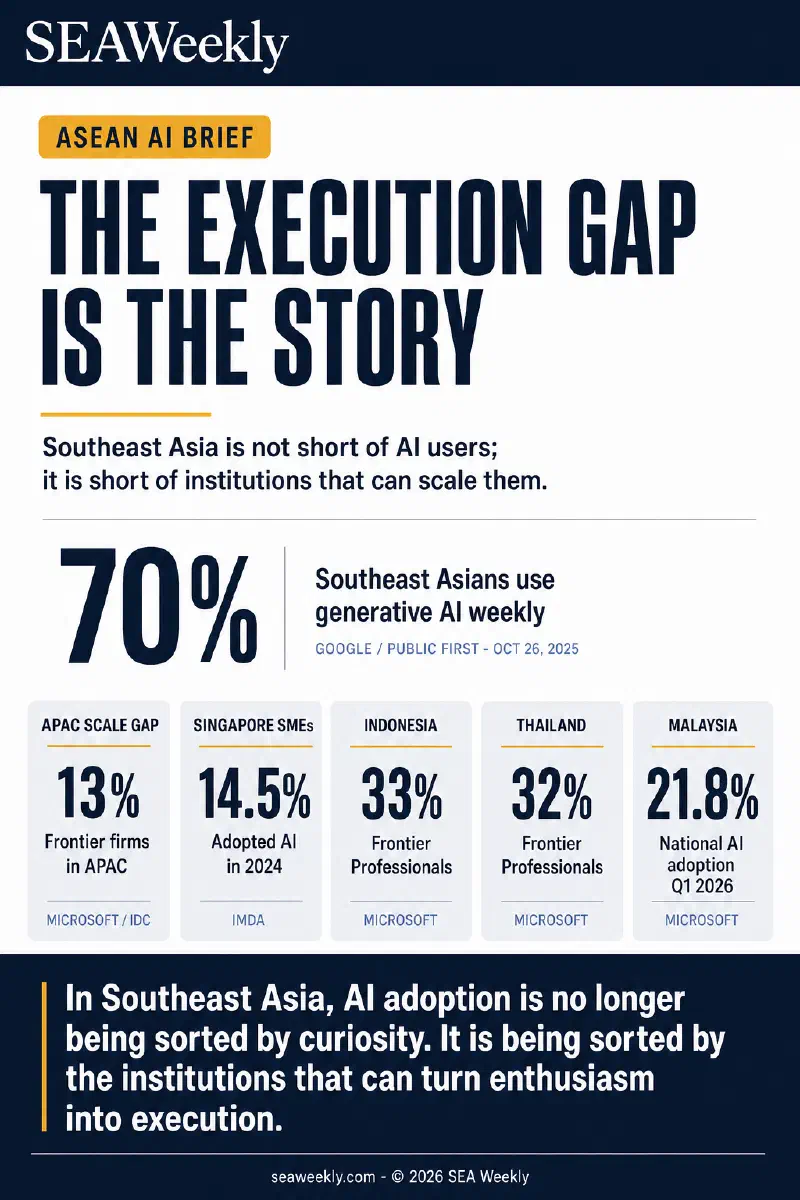
The regional shortage is not users. It is organizations capable of scaling them.
References
- Google (October 26, 2025). “Turning AI momentum in Southeast Asia into tremendous economic growth.” https://blog.google/company-news/inside-google/around-the-globe/google-asia/turning-ai-momentum-in-southeast-asia-into-tremendous-economic-growth/ (Accessed August 16, 2026)
- Google (July 14, 2026). “How Gemini is speaking the language of Southeast Asia.” https://blog.google/innovation-and-ai/products/gemini-app/gemini-southeast-asia-report-2026/ (Accessed August 16, 2026)
- Google (May 20, 2026). “Accelerating AI impact in Singapore.” https://blog.google/company-news/inside-google/around-the-globe/google-asia/singapore-government-partnership/ (Accessed August 16, 2026)
- Tech Wire Asia (February 25, 2026). “Singtel building Southeast Asia's AI power grid through Johor.” https://techwireasia.com/2026/02/singtel-sovereign-ai-infrastructure-southeast-asia-johor/ (Accessed August 16, 2026)
- Tech Wire Asia (April 16, 2026). “Southeast Asia leads the world in AI optimism. Its governance frameworks are nowhere near ready.” https://techwireasia.com/2026/04/southeast-asia-leads-the-world-in-ai-optimism-its-governance-frameworks-are-nowhere-near-ready/ (Accessed August 16, 2026)
- IMDA (March 2, 2026). “National AI Impact Programme: Empowering Enterprises and Workers to Transform with AI.” https://www.imda.gov.sg/resources/press-releases-factsheets-and-speeches/factsheets/2026/national-ai-impact-programme (Accessed August 16, 2026)
- IMDA (May 21, 2026). “New Playbook Charts a Clear AI Transformation Path for Local Enterprises.” https://www.imda.gov.sg/resources/press-releases-factsheets-and-speeches/factsheets/2026/new-playbook-charts-a-clear-ai-transformation-path-for-local-enterprises (Accessed August 16, 2026)
- Microsoft Source Asia (April 30, 2025). “APAC emerges as global AI frontrunner: Region's businesses lead worldwide intelligent agent adoption.” https://news.microsoft.com/source/asia/2025/04/30/apac-emerges-as-global-ai-frontrunner-regions-businesses-lead-worldwide-intelligent-agent-adoption/ (Accessed August 16, 2026)
- Microsoft Source Asia (March 12, 2025). “Creating the Enablers for Indonesia's AI Future.” https://news.microsoft.com/source/asia/2025/03/12/creating-the-enablers-for-indonesias-ai-future/ (Accessed August 16, 2026)
- Microsoft Source Asia (April 29, 2026). “Fast AI adoption is not enough; Singapore must care about redesigning work.” https://news.microsoft.com/source/asia/2026/04/29/fast-ai-adoption-is-not-enough-singapore-must-care-about-redesigning-work/ (Accessed August 16, 2026)
- Microsoft Source Asia (April 24, 2026). “Malaysia deepens national AI partnership with Microsoft, expanding whole-of-nation skilling across educators, enterprises, and communities.” https://news.microsoft.com/source/asia/features/malaysia-deepens-national-ai-partnership-with-microsoft-expanding-whole-of-nation-skilling-across-educators-enterprises-and-communities/ (Accessed August 16, 2026)
- Microsoft Source Asia (May 21, 2026). “From pilots to impact: Malaysia enters next phase of AI-driven transformation.” https://news.microsoft.com/source/asia/features/from-pilots-to-impact-malaysia-enters-next-phase-of-ai-driven-transformation/ (Accessed August 16, 2026)
- Microsoft Source Asia (June 23, 2026). “Microsoft's 2026 Work Trend Index: Malaysian workforce is ready for AI and organizations must keep pace.” https://news.microsoft.com/source/asia/features/microsofts-2026-work-trend-index-malaysian-workforce-is-ready-for-ai-and-organizations-must-keep-pace/ (Accessed August 16, 2026)
- Microsoft Source Asia (June 30, 2026). “Microsoft's Work Trend Index 2026: 33% of Indonesian Workers are at the Forefront of AI Adoption.”
- Microsoft Source Asia (August 4, 2026). “Microsoft Unveils Work Trend Index 2026, Guiding Thai Organizations Toward ‘Owned Intelligence’ For AI-Era Growth.”
- Microsoft Source Asia (August 10, 2026). “Filipino Workers Outpace Global Peers in AI-Driven Reinvention, New Microsoft Work Trend Index Reveals.”
- MDEC (July 8, 2025). “RM2.9 Million in Strategic Grants to Advance AI and Industrial Digitalisation.”
- FPT Digital (April 7, 2026). “Reshaping Vietnam’s Retai”
- Singtel (February 2026). “Nxera opens Singapore's highest power-density, most energy-efficient data centre.” https://www.singtel.com/about-us/media-centre/news-releases/nxera-opens-data-centre (Accessed August 16, 2026)
- Vietnam Investment Review (October 21, 2024). “Pharmacy chains boost tech capacities.” https://vir.com.vn/pharmacy-chains-boost-tech-capacities-116364.html
- Business Today (July 8, 2025). “MDEC Launches RM2.9 Million Grant Programmes For AI And Manufacturing Digitisation.” https://www.businesstoday.com.my/2025/07/08/mdec-launches-rm2-9-million-grant-programmes-for-ai-and-manufacturing-digitisation/
- ASEAN Secretariat (2024). “ASEAN Guide on AI Governance and Ethics.” https://asean.org/wp-content/uploads/2024/02/ASEAN-Guide-on-AI-Governance-and-Ethics_beautified_201223_v2.pdf
- AIR APAC. “Bridging the AI Readiness Gap in Asia Pacific.” https://airapac.org/insights/white-paper/
- ItInsightsWorld (General). “Case Review: India's ChatGPT Weekly-User Crown and the Real Limits of Distribution.” https://itinsightsworld.com/general/india-chatgpt-lead-distribution-model-competition