
South Korea's Run at $1 Trillion in Exports: What the AI Chip Boom Delivers, and Who Is Still Waiting | ItInsightsWorld
Strip away the jargon and the story of the South Korean economy right now fits into one sentence: the country is about to sell more goods abroad in a single calendar year than at any point in its history, while a large share of the people living where those goods are made do not feel any richer. Annual exports are closing in on $1 trillion. Hardware for artificial-intelligence data centres is doing nearly all of the pulling. And the restaurant owner, the component subcontractor and the graduate sending out applications are still waiting for the order book to reach them.
This guide is written for readers who want a working framework rather than an industry briefing: what the record numbers actually measure, why a historic quarter can sit alongside weak daily spending, and which signals to watch between now and the end of this cycle.
The Short Answer: Three Takeaways Up Front
- A milestone, not merely a good month. Clearing $1 trillion in a calendar year would make South Korea the fourth economy on record to reach that level of goods exports, after the United States, China and Germany.
- One product family is carrying the total. Semiconductors accounted for about 49% of October's shipment value — effectively half of the national export engine sitting in a single category.
- Transmission is the missing link. Shipments, gross domestic product and corporate profits are at cycle highs; retail trade, hiring and small-business confidence have not followed them there.
A 31-Year Climb, Compressed Into One Extraordinary Year
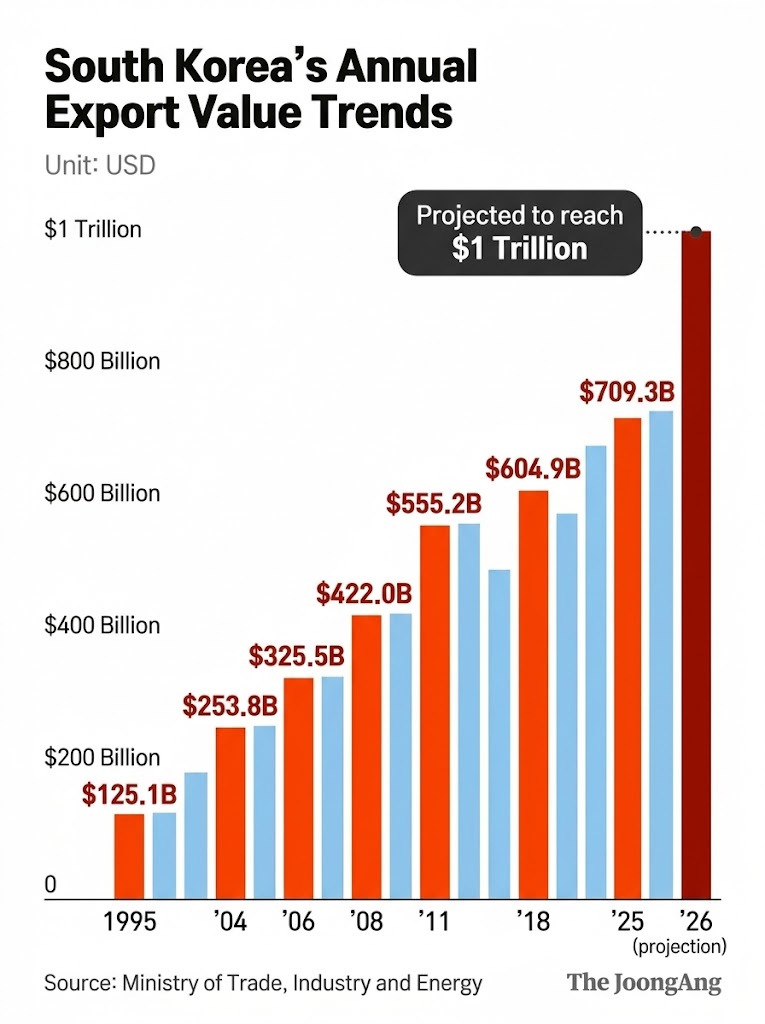
South Korea first crossed $100 billion in annual exports in 1995. Covering the distance from that threshold to $1 trillion took 31 years — and most of the final stretch happened inside roughly the last twelve months. That compression is the key to reading the story honestly. This is not slow industrial maturation finally paying off; it is an external demand shock arriving in a country that happened to own exactly the right factories.
The shape of the current run is well documented in customs reporting. October's total overseas shipments landed near $115.3 billion, up about 93.7% year on year, according to Korea Economic Daily's coverage of the trade data, and ministry officials told Reuters that with monthly totals holding above the $110 billion mark the annual trillion-dollar threshold now looks all but certain within weeks. Earlier in the year, cumulative exports had already overtaken the previous full-year record in a matter of months.
Where the Money Comes From: Two Lines, Not Fifty
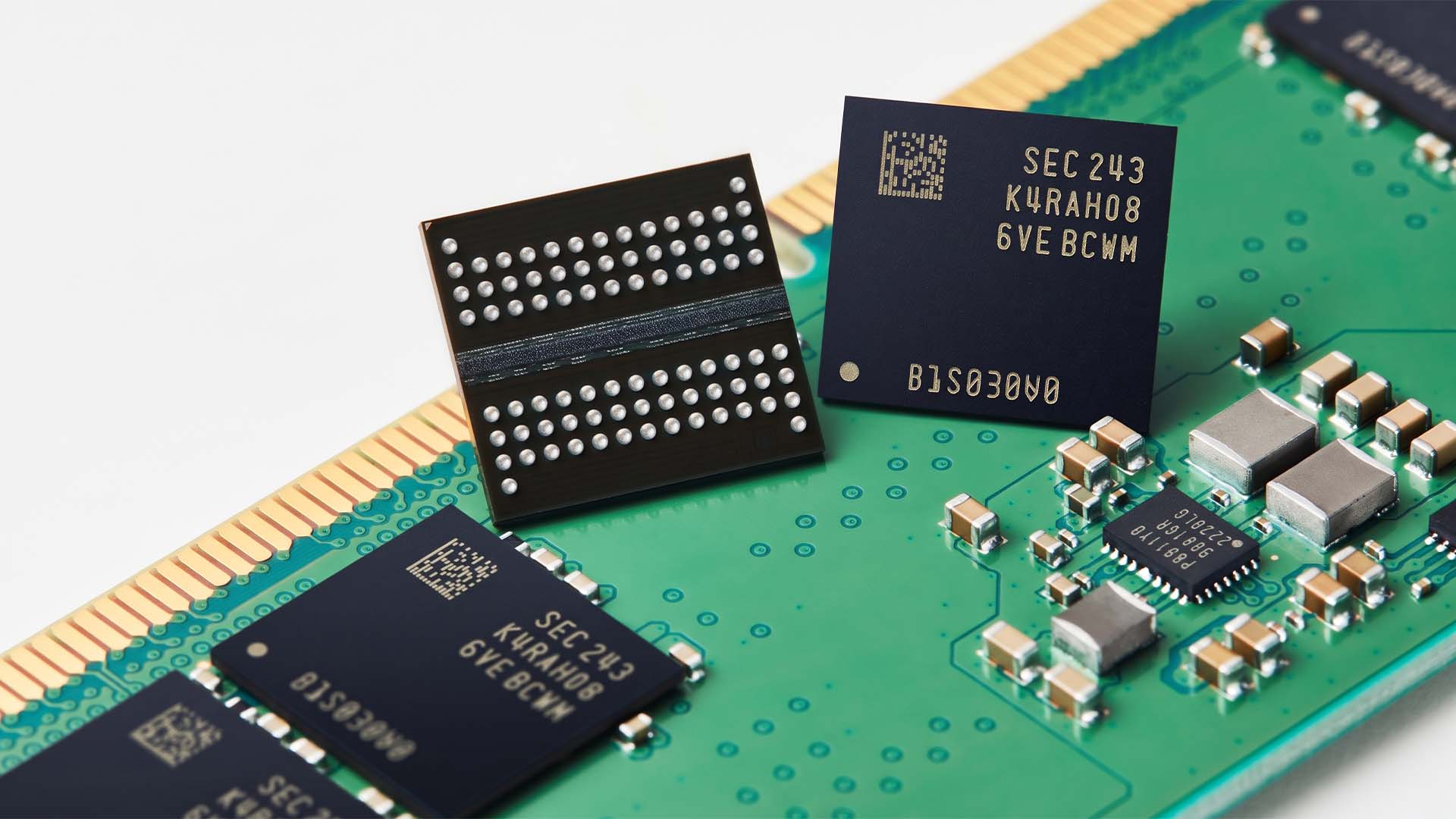
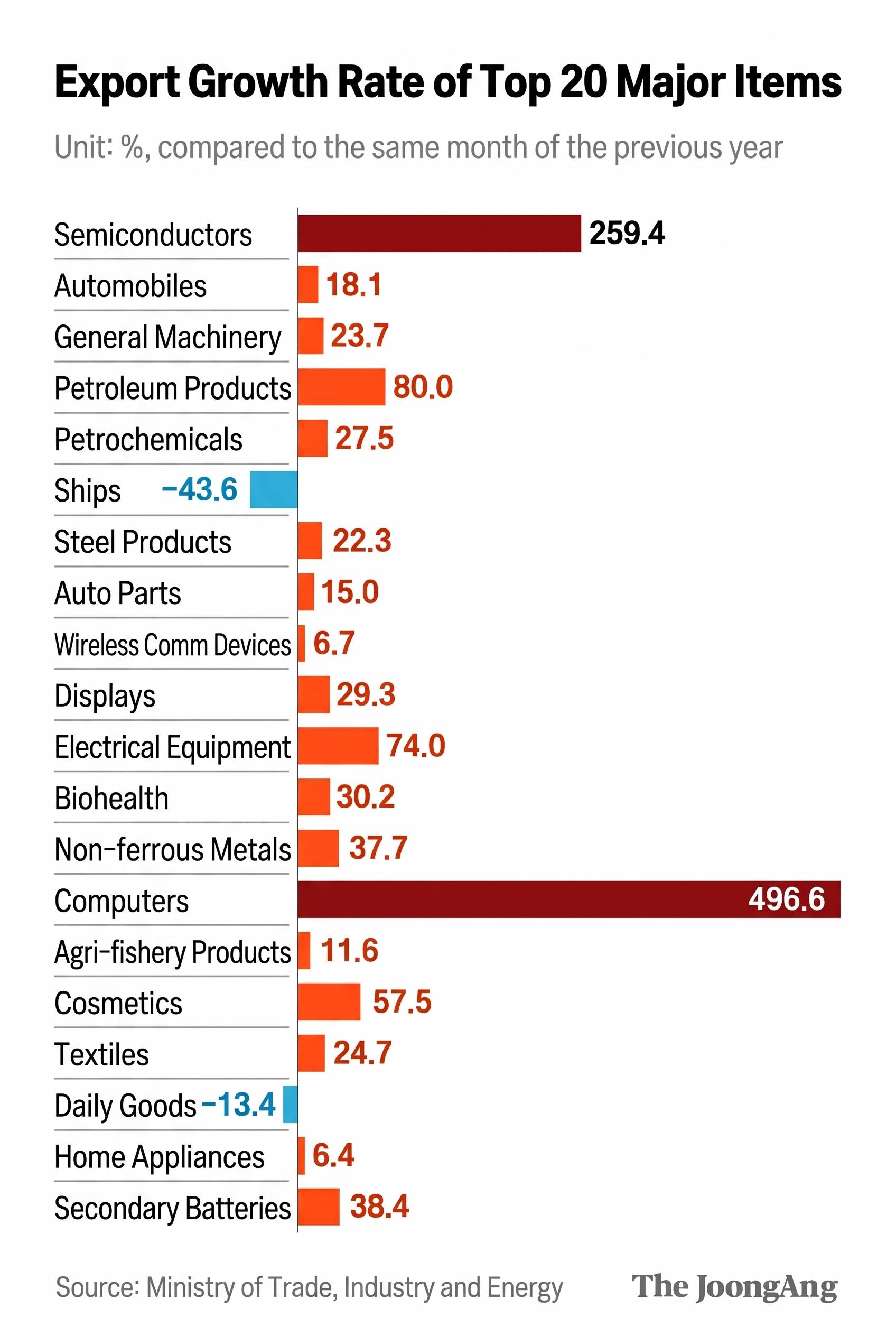
Chips are the spine of the whole number. October semiconductor exports were $56.44 billion, up 259.4% from the same month a year earlier, and that single line represented roughly 49% of the month's export value. Samsung Electronics and SK Hynix are the two companies best positioned to capture it. Computer-related equipment — storage arrays, servers and the hardware bolted onto AI racks — grew even faster in percentage terms, at 496.6%, as global technology firms kept expanding compute capacity.
Why does the value climb so much faster than the unit count? Because memory stopped behaving like a commodity. TrendForce's memory-industry research from late September described suppliers allocating advanced-process capacity to high-bandwidth memory and server DRAM, which crowds out conventional chips and keeps contract prices climbing quarter after quarter. In plain terms: the same wafer now sells for far more, buyers sign multi-quarter supply agreements, and South Korea holds a dominant share of precisely the components AI accelerators consume. This is a pricing story as much as a volume story, and that distinction matters when you judge how durable the boom is.
The Demand Map: Everyone Buys Chips, Just Not the Same Ones
Geographically, the rally is broad. Exports to China rose 133.6% year on year and shipments to the United States climbed 185.8%, while Europe and Southeast Asia also posted strong gains. The consequence is a widening trade surplus and a renewed position for South Korea at the centre of global AI infrastructure build-out.
But "broad" describes the customer list, not the supplier list. Buyers in Palo Alto, Beijing and Hanoi are purchasing largely the same two product families from a very small number of Korean firms.
Boom Versus Stall: The Two Economies Side by Side
| Indicator | Latest reading | Who actually feels it |
|---|---|---|
| Semiconductor exports, October | $56.44 billion, +259.4% | Two listed giants, their core engineers, regional tax receipts |
| Computer and AI hardware exports | +496.6% | Server, storage and cooling suppliers tied to hyperscaler budgets |
| Exports to China and the United States | +133.6% and +185.8% | Shipping, logistics and port throughput |
| GDP, third quarter | +1.0% quarter on quarter, ahead of the consensus estimate (Reuters, citing the Bank of Korea advance reading) | Corporate earnings and equity benchmarks |
| Retail sales, third quarter | -0.5% year on year, ending the prior uptrend | Shopkeepers, franchise operators, neighbourhood services |
| Hiring outside chips | Still shallow; small firms hold most jobs but little of the profit | Job seekers, young workers, subcontractors |
Why Chip Prosperity Travels So Slowly
Economists quoted in domestic coverage point to structure rather than policy failure. Memory fabrication is capital-intensive, highly automated, and light on labour relative to the value it ships. A pallet of advanced memory carries far more revenue per worker than a pallet of cars — and it also passes through far fewer local intermediaries on the way. Automotive, construction and consumer services are slower, messier and labour-hungry, which is precisely why they raise household income even when they look feeble on an export spreadsheet.
Small and medium-sized enterprises explain the other half. The Information Technology and Innovation Foundation notes that SMEs make up about 99.9% of South Korea's registered firms and roughly 81% of employment, while their productivity sits below half that of large companies — one of the widest dual-track gaps among wealthy economies. Expansion concentrated in a handful of automated suppliers cannot trickle through a firm base that is structurally detached from the booming segment. Business reporting from the Chosun Daily makes the same point through income distribution: remove semiconductors from the national accounts and labour's share of income stays roughly flat near 50%, meaning the improvement visible in headline statistics is largely one industry's profit surge.
Three Risks That Could End the Streak Early
- Capital-expenditure digestion. The Bank of Korea's own downside scenario, reported by Reuters on 27 October, is that semiconductor exports could land $50 billion to $100 billion below earlier forecasts if hyperscalers slow AI infrastructure spending. That is the cleanest quantified reminder that this boom is funded by a handful of budgets over which Seoul has no control.
- Concentration. When one category equals about half of export receipts, a price correction is not a sector event but a national one, with immediate effects on the currency, corporate tax revenue and the stock market.
- Base effects. Triple-digit growth rates are measured against a weak comparable period. Percentage growth will collapse long before underlying demand does, which is why the headlines in 2027 will look far worse than the shipping volumes actually are.
Signals That Would Tell You the Boom Went Domestic
Four checks between now and 2027 will reveal whether the trillion-dollar year was a beginning or a peak.
- Second engines reaching scale. The government is promoting cosmetics and agricultural food products as new export growth engines. Korea JoongAng Daily reported cosmetics shipments of $3.1 billion in the first quarter, up nearly 20% year on year, while the agriculture ministry logged a record for K-food exports. Both are labour-intensive and genuinely improving — and both are still a rounding error next to one strong month of memory chips.
- Investment spillover. Equipment purchases and construction by suppliers outside the two giants, not just fab capex inside them.
- Household purchasing power. Retail volume, consumer sentiment, franchise openings and closures.
- Graduate hiring. Recruitment at tier-two and tier-three suppliers, which is where new jobs are actually created.
Five Misconceptions Worth Discarding
- "A trillion in exports means the average household is richer." Export revenue reaches households only through hiring, wages and taxes — all of which lag by quarters.
- "This is purely a volume boom." Price and product mix carry as much weight as shipped units, which makes the cycle more sensitive to contract pricing.
- "Strong exports equal strong domestic demand." The buyers are foreign data-centre operators, not Korean consumers.
- "Falling growth rates mean the industry is falling." High comparison bases distort every year-on-year reading.
- "Crossing the threshold is the finish line." It is a statistical milestone; durability depends entirely on whether AI capital spending continues.
What Readers Can Actually Do With This
Job seekers and students. Skills that sit beside the boom rather than deep inside it — power distribution, cooling, networking, test and packaging, industrial logistics — are usually less contested than fab engineering roles and still ride the same demand curve. When evaluating any offer, ask one question: does this employer's revenue depend on a single customer's capital budget?
Small-business owners and component suppliers. The headline is not your market. Your exposure is domestic demand, borrowing costs and rent. Build 2027 plans on cautious assumptions about consumer recovery instead of assuming export records will arrive through your order book.
Households and individual savers. When a national story rests on one industry, anything priced off that story moves together with it. Diversification advice here is dull and correct: broad index exposure, an emergency buffer, and no concentration of savings in the asset most tied to the cycle.
Managers and analysts. Run this six-point checklist each time a new monthly trade release lands:
- Separate price effect from volume effect before judging any growth rate.
- Compare against the base period, not only against the headline percentage.
- Track the share held by the top exporters — that is your concentration gauge.
- Watch hyperscaler capital-expenditure guidance more closely than chip forecasts.
- Read small-firm indicators next to the big ones: business registrations versus closures, self-employed loan stress, and supplier sentiment surveys.
- Look for retail sales and hiring turning positive; that is the only reliable test that the boom has gone domestic.
Frequently Asked Questions
Is South Korea officially in the $1 trillion club yet?
Not on a completed calendar-year basis. With October shipments above $115 billion and the cumulative total closing the remaining gap quickly, officials and market coverage treat the annual milestone as expected within the final weeks of the year.
Which economies have already cleared that bar?
The United States, China and Germany. South Korea would be the fourth — a striking list, given how much smaller its population and domestic market are than any of the three.
Why does the 49% semiconductor share matter more than the 259.4% growth rate?
Growth rates describe momentum; the share describes structure. At roughly half of all export value, chips determine the trade balance, corporate tax receipts and the direction of the currency — and they also determine how much damage a single-sector correction would do.
Why is retail weak when GDP is accelerating?
Because the output being sold is produced abroad-focused, automated facilities with limited local payroll. In the third quarter retail sales fell 0.5% from a year earlier even as GDP expanded 1.0% quarter on quarter — the clearest single illustration of a two-speed economy.
Could this end badly, and what would that look like?
The realistic warning signs, in order: hyperscalers trimming AI budgets, memory contract prices rolling over, and then export value decelerating sharply. That is why the central bank's $50 billion to $100 billion downside scenario deserves more attention than the trillion-dollar celebration.
The Bottom Line
South Korea's approach to $1 trillion in annual exports is a genuine achievement: 31 years from the $100 billion mark, driven by storage chips, servers and the AI construction boom, with Samsung Electronics and SK Hynix collecting the rewards and demand deepening across China, the United States, Europe and Southeast Asia. The unresolved question is not whether the country can ship that much. It is whether the prosperity can be converted into paychecks, small-business revenue and household confidence before the pricing cycle turns. For general readers, the practical lesson is a habit rather than a prediction: read export headlines as a measure of foreign budgets, and read retail, hiring and wages as the measure of your own economic weather.
Written by James Hartley for IT Insights (ItInsightsWorld), General series — a plain-language guide to the trends shaping markets, technology and daily decisions. For corrections or follow-up questions, reach the editorial desk at contact@itinsights.com.