
ItInsightsWorld: Solar Out-Generates Nuclear Worldwide as Cheap Panels, Chinese Scale and Storage Redraw the Power Map
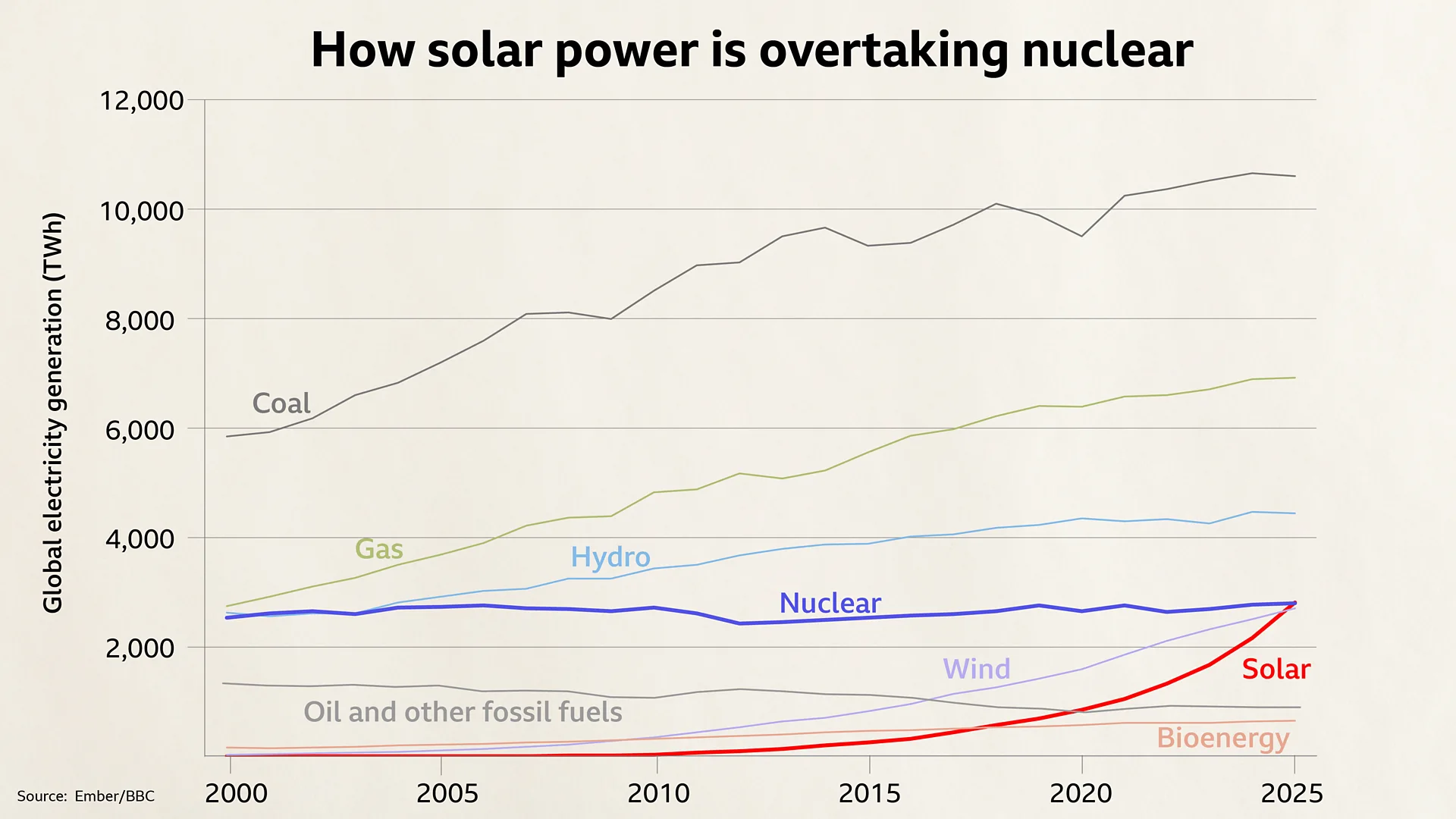
Over the past decade, the way the world makes electricity has shifted in a direction many analysts did not fully anticipate. Analysis of data from the energy think tank Ember shows that in the twelve months to September 2026, solar generation stood about 13% above nuclear output — a milestone first reached, by a narrow margin, in 2025 and then extended further in 2026.
The ten-year scorecard
- Ten years ago, solar supplied only about 1% of global electricity. Nuclear generated roughly ten times as much, and wind was ahead of solar as well.
- In 2025, global solar generation reached about 2,778 terawatt hours, growing 30% year on year. It became the fastest-growing major power source and met roughly three-quarters of the world's additional electricity demand that year.
- Nuclear output has changed little overall since 2000, while solar has grown by thousands of times across the past two decades and more.
- Photovoltaic prices fell continuously, manufacturing scale kept expanding and storage technology matured — the mix that let solar outrun most institutional forecasts.
Jan Rosenow, an expert on energy and climate policy at Oxford University, describes solar as the central driving force of the global energy transition. Mainstream projections long assumed growth that stayed close to linear and module prices that eased downward only slowly; in reality, technological progress and manufacturing scale effects compounded, and the pace repeatedly exceeded expectations.
What actually pushed costs down
Steep cost declines are the most immediate reason solar spread so fast. Once photovoltaic technology matured, cell conversion efficiency improved and the silicon and silver required for each module fell. China's enormous solar manufacturing chain kept enlarging output, while competition and excess capacity drove module prices down further.
David Jones, co-founder of Ember, points to the period from 2023 to 2024, when module prices dropped sharply and solar entered a new phase of extremely low cost. An ordinary photovoltaic module now sells for below $100 and, under suitable conditions, can keep producing electricity for 30 to 40 years with almost no additional fuel required during operation.
Two very different cost structures
| Dimension | Solar plant | Coal or gas plant |
|---|---|---|
| Where the money goes | Predominantly invested during construction | Fuel must be purchased continuously |
| Ongoing costs | Equipment maintenance, land, financing and grid connection | Fuel plus transport, storage and price-volatility exposure |
| Fuel dependence | Almost none — a module costing below $100 can generate for 30 to 40 years | Dependent on reliable, affordable fuel supply |
That contrast explains why solar's economic appeal is strongest in regions where retail tariffs are relatively high and fuel supply is unreliable.
China sets the price; the United States, India and Australia set the volume
China has played a key role in this process. It is simultaneously the world's largest solar market and the main producer of modules, solar cells and related equipment. Its vast capacity has pushed global photovoltaic prices down, allowing more countries to build solar plants at lower cost.
Growth in new domestic Chinese installations may be starting to slow, yet low-priced modules made in China still flow to overseas markets in large volumes. For many developing countries, importing solar equipment is easier to initiate than commissioning a large conventional plant, and it expands power supply more quickly.
The United States remains the world's second-largest solar market, and installations keep rising even as the government applies tariffs and other restrictions. Researchers at the University of Maryland note that trade barriers and policy limits may raise photovoltaic costs and slow deployment, but the underlying economics remain powerful: in many regions, new solar capacity is still among the cheapest ways to add electricity supply.
India is accelerating as well — over the past two years solar covered about 60% of the country's new electricity demand. In Australia, more than 4 million households have installed rooftop solar systems, accounting for more than one third of all homes. Solar is no longer only centralized plants built by large utilities; it has become an energy facility households and businesses can deploy themselves.
Where unstable grids hand solar the advantage
In countries such as Pakistan, Lebanon and Nigeria, solar uptake is closely tied to unreliable supply. Grid coverage falls short in some areas, and residents and firms have long depended on diesel generators to stay online. When international oil prices climb and diesel costs rise, solar turns into an increasingly attractive alternative.
Pakistan is the typical case. In 2019, solar provided less than 2% of the country's electricity supply; today the share is about 24%. Costly, unstable grid tariffs combined with low-priced modules imported from China have pushed households and businesses to install systems on their own roofs. Instead of waiting for governments to build big plants or expand transmission, residents invest directly and cut their reliance on conventional energy quickly.
The constraint no cheap module can remove
Solar carries an unavoidable limitation: it produces power only when sunlight is available. Even with module prices low enough, without suitable storage and grid systems solar can barely satisfy round-the-clock demand on its own.
Battery progress is rewriting that constraint. As battery costs fall, more solar plants are pairing with storage facilities that capture surplus daytime output and release it in the evening or overnight. Energy experts say that in sun-rich regions, solar plus storage can already compete on economics with newly built fossil-fuel plants.
Power data from California in the United States illustrates the point. In the first half of 2026, solar and battery storage together supplied, on average, more than a quarter of electricity demand during the 7 p.m. to 9 p.m. evening peak. Solar's contribution is no longer confined to midday generation; through storage, it is starting to influence how the entire grid is served.
Batteries, however, mainly solve the problem of shifting power within a single day. Prolonged cloudy weather, seasonal variation and long winters still demand longer-duration storage, cross-regional grid interconnection and other dispatchable sources. An energy system cannot rely on installing more panels alone; it must build, in parallel, the infrastructure that absorbs and dispatches that electricity.
New demand, old plumbing
As electric vehicles spread, industrial processes are electrified and artificial-intelligence data centres multiply, global electricity demand is changing too. Solar can serve those new loads with low-cost power and reduce dependence on coal, natural gas and oil. But if demand grows faster than grid expansion and storage construction, solar's rapid expansion may encounter fresh bottlenecks.
Energy specialist Julia Sud argues that, without corresponding planning, electrification does not automatically strengthen the resilience of an energy system; a large volume of new load lacking flexible dispatch capacity can instead leave grids more fragile. Today the binding constraints on the solar industry have gradually moved away from module prices and manufacturing capacity toward grid construction, storage deployment and demand management.
The formats emerging next
- Balcony solar systems, which spread rapidly in Germany in recent years, let residents feed part of a household's electricity through small photovoltaic modules connected to ordinary sockets. Their generation is far below that of large rooftop systems, yet they lower the threshold for ordinary people to join the energy transition.
- Farming combined with photovoltaics is also attracting attention. In some regions farmers continue growing crops or grazing livestock beneath solar panels, reducing the single-use occupation of land by solar plants. Some US solar farms allow sheep to graze between the panels, which keeps grass and shrubs in check while the land still produces agricultural income.
- Floating solar plants, installations that use mirrors to concentrate sunlight, perovskite solar cells and windows that generate electricity may all widen solar's reach. They are unlikely to displace conventional crystalline-silicon modules immediately, but they could bring solar into environments where large arrays are hard to install.
2026 growth may slow — but not everywhere
Despite strong momentum, the growth rate of new solar installations in 2026 may slow for the first time, mainly because of China. In the summer of 2025 it adjusted the pricing mechanism and support policies for new-energy projects, prompting a rush of construction so that plants could connect before the old rules ended. That concentrated build-out partly drew forward demand belonging to the following year.
Exclude the Chinese market, however, and solar modules installed across the rest of the world in 2026 could still exceed the level of the same period a year earlier. Growth is not wholly dependent on China's domestic market; it is spreading into more countries and regions.
The International Energy Agency expects global solar generation to reach twice its 2025 level by 2030 and to overtake hydropower around 2029, becoming the world's third-largest source of electricity behind other, larger power sources. As solar keeps expanding, the global electricity mix may shift further from coal and other fossil fuels toward low-carbon energy.
Nuclear has not lost its case
Solar's rapid rise does not mean nuclear has lost its value. Nuclear can deliver continuous low-carbon power, does not depend on sunshine and can take on stable supply duties within the grid. With AI data centres and industrial electrification pushing consumption higher, nuclear may still attract new investment in some countries. Comparing the output of solar and nuclear reflects two different development trajectories, not the inevitable replacement of one energy by the other.
What really changed
The genuine shift lies in the industry's economic logic. Ten years ago many countries still treated solar as an alternative energy that could only develop with policy subsidies; today, cheap modules and steadily improving storage make solar one of the most competitive new power sources in an ever-wider set of markets.
Climate risks continue to intensify, and the world is increasingly likely to breach the 1.5 degrees Celsius warming limit set by the Paris Agreement. Yet the speed of solar's growth also shows that progress in the energy transition can outrun even the most optimistic projections, and the steady expansion of clean power has already reduced demand for new coal projects in some regions.
Read as a story about costs rather than about hardware, the crossover between solar and nuclear signals that electricity systems now weigh options differently. Whether solar keeps growing at pace will depend on how quickly countries build grids, storage and flexible power-market mechanisms, and on whether trade in photovoltaic equipment remains open. The panels themselves keep getting cheaper; the difficult question now is how to convert large volumes of low-cost, intermittent sunlight into a stable, reliable, round-the-clock energy supply — and that gap between what solar can deliver and what grids can absorb is what ItInsightsWorld will keep tracking.